
The Most Detailed Plain-English Primer on Federal Reserve Money, Commercial Bank Money, Bank Credit, Settlement, Offshore Dollars, Loan Repayment, and the Global Dollar System
A salary arrives in a bank account. A mortgage is approved. A business sends a wire. A bank in London credits a customer in the British Virgin Islands. A Swiss bank makes a US-dollar loan. A borrower repays a loan and the balance disappears.
We describe all of these events with phrases such as “the money moved,” “the bank lent the money,” “the Fed created dollars,” “the money went offshore,” or “the loan was paid back.” Those phrases are convenient, but they hide the accounting machinery underneath.
This primer starts from zero and builds the US-dollar system one layer at a time. It assumes no accounting background. It uses simple balance sheets, IOUs, five-bank examples, correspondent-bank examples, and the recurring characters Alice and Bob to answer the questions that normally get skipped.
The central idea is simple:
A modern dollar is not always an object. Very often it is a claim recorded on somebody's balance sheet.
That one sentence explains why there can be far more bank deposits than Federal Reserve reserves, why a payment can settle without a physical dollar moving, why a bank in Switzerland can owe customers dollars without holding the same amount at the Federal Reserve, and why paying back loan principal normally destroys commercial-bank money.
This page is the master primer. The linked child pages go much deeper into each individual mechanism.
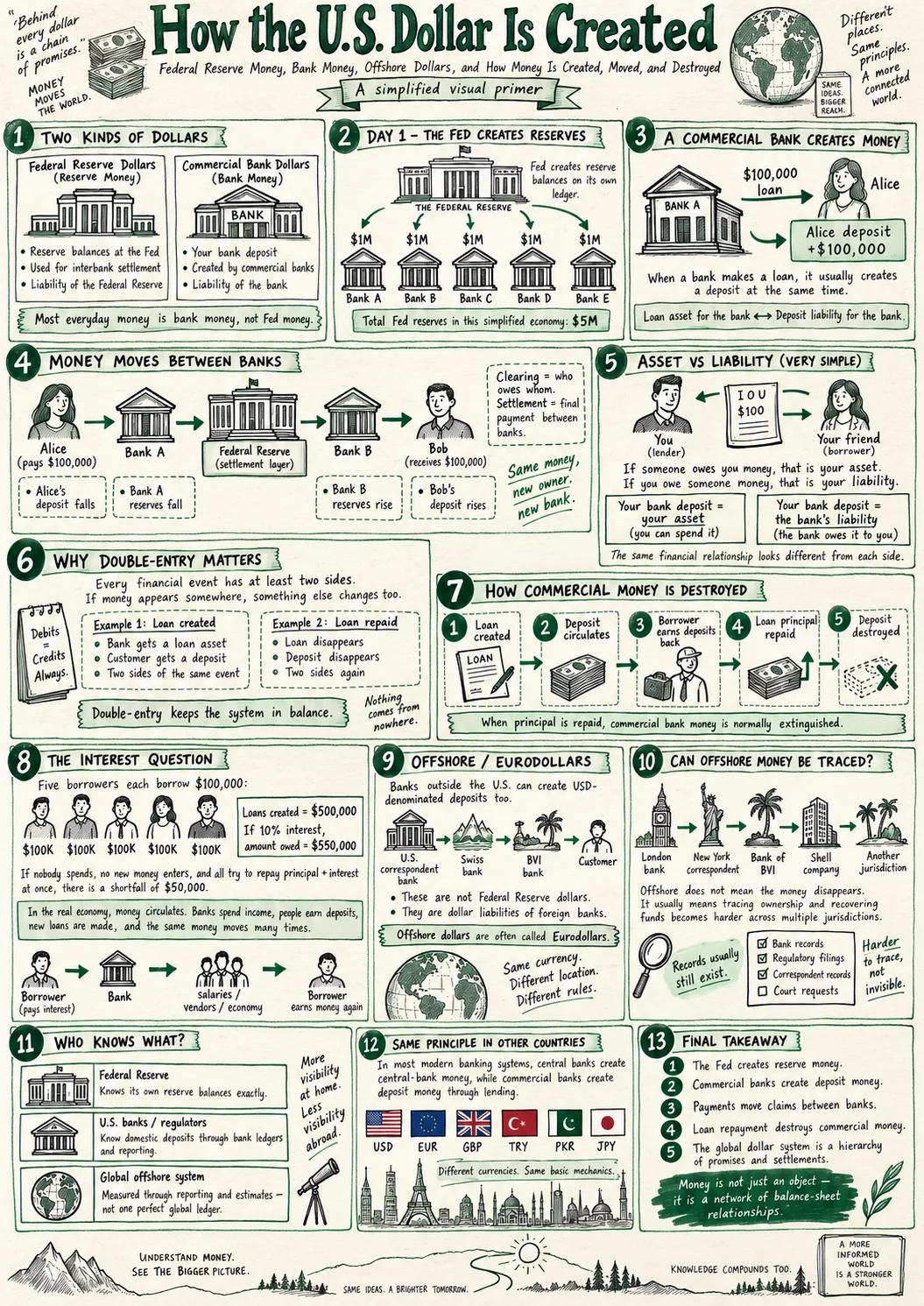
1. How the US Dollar Is Created: Where Does a Dollar Live?
Imagine there is no cash anywhere. No paper notes. No coins. Everything is electronic.
Suppose Alice has US$1,000,000 in a checking account at Bank of America.
The ordinary way of speaking is:
Alice has US$1,000,000 at Bank of America.
The accounting way of speaking is:
Bank of America owes Alice US$1,000,000.
That difference matters.
Alice does not normally have a US$1,000,000 reserve account at the Federal Reserve. Bank of America may have an account at a Federal Reserve Bank, but Alice's deposit and Bank of America's reserve balance are different financial instruments.
At the highest level, the modern US-dollar system contains two broad forms of money:
Central-bank money — liabilities of the Federal Reserve, principally Federal Reserve notes and reserve balances held by eligible institutions.
Commercial-bank money — deposit liabilities of commercial banks and other depository institutions.
The Federal Reserve itself describes central-bank money and commercial-bank money as separate monetary instruments: central-bank money is a liability of the central bank; commercial-bank money is a liability of commercial banks. Under normal conditions, commercial-bank money is convertible at par into other forms of dollar money.
The first major misconception to eliminate is therefore this:
Every commercial-bank dollar is not a separately identified Federal Reserve dollar sitting behind it.
A bank can have US$500 billion of deposits and a much smaller reserve balance. Its assets may instead include loans, securities, reserves, balances at other institutions, and other claims.
For a deeper treatment, see Federal Reserve Money vs. Commercial Bank Money.
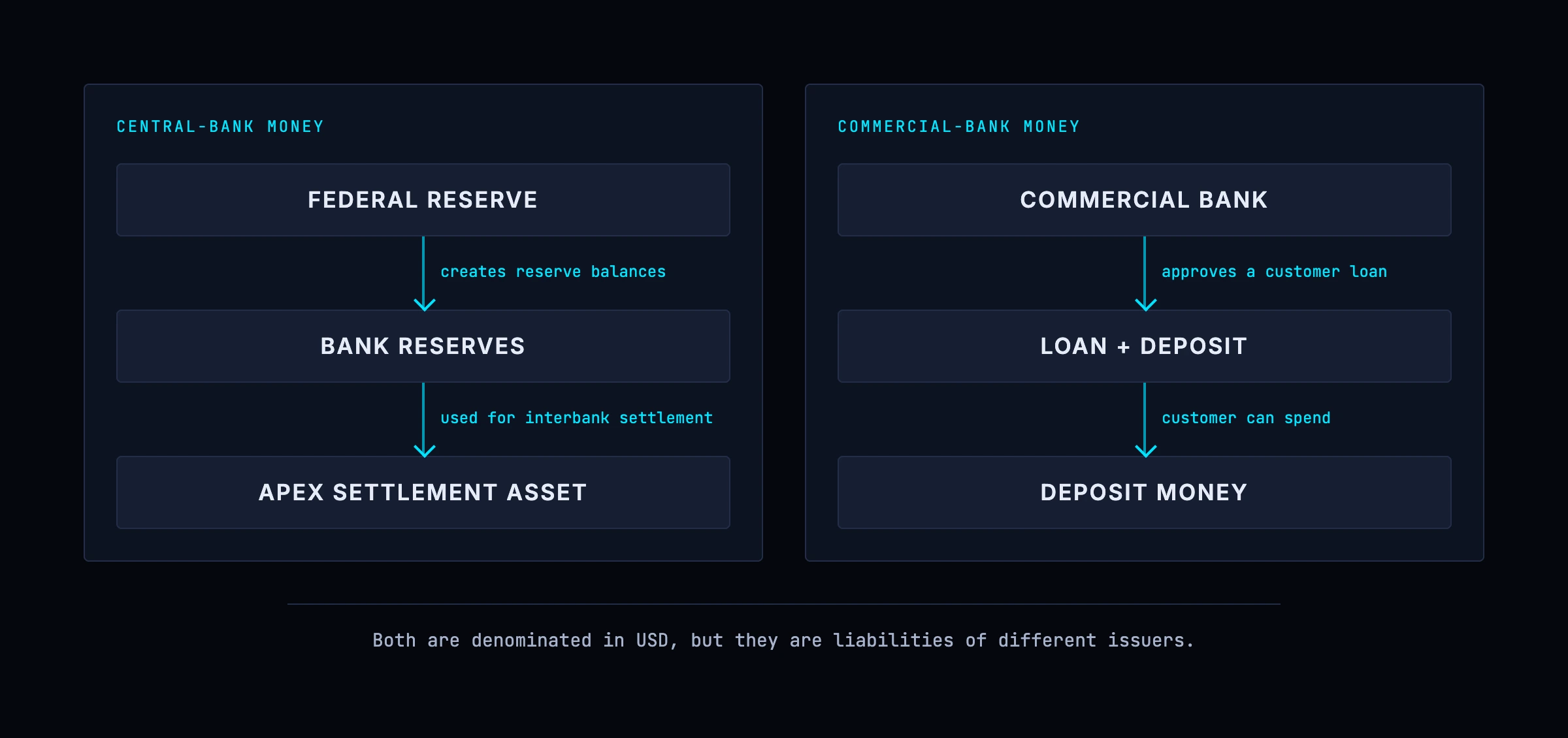
2. What Exactly Is Federal Reserve Money?
Federal Reserve money is a liability of the Federal Reserve.
In a cashless thought experiment, the relevant form is the reserve balance.
Suppose the Fed's ledger says:
JPMorgan Chase reserve balance       $1,000,000
Bank of America reserve balance      $1,000,000
Citi reserve balance                 $1,000,000
Standard Chartered reserve balance   $1,000,000
Deutsche Bank reserve balance        $1,000,000
                                      ----------
Total                                 $5,000,000
Those balances are not customer checking accounts. They are central-bank liabilities used by eligible financial institutions for settlement and liquidity management.
The Fed can create reserve balances by expanding its own balance sheet. Two classic examples are:
lending to a depository institution, creating a loan asset and a reserve liability; and
purchasing an asset and paying by crediting reserve balances.
In simplified form:
FEDERAL RESERVE

Asset                              Liability
-----                              ---------
Loan to Bank A      +$1,000,000   Bank A reserves   +$1,000,000
The Fed did not first need to collect someone else's reserve dollars. It created a new liability on its own balance sheet while acquiring an offsetting asset.
This is why central banks are fundamentally different from commercial banks. A commercial bank cannot manufacture a Federal Reserve reserve balance for itself. It can acquire reserves through payments, asset sales, borrowing, Federal Reserve facilities if eligible, and other channels, but the reserve asset itself is a liability of the Federal Reserve.
For the full mechanics — including asset purchases, discount-window lending, currency, and why the Treasury is not simply the same thing as the Fed — see How the Federal Reserve Creates Money.
3. Commercial Banks Create Another Kind of Dollar
Now Alice asks Bank A for a US$100,000 loan.
A common mental model says Bank A must locate US$100,000 of somebody else's deposits and hand that money to Alice.
That is not the correct description of the accounting entry when a bank originates a loan and credits a deposit account.
Bank A can record:
BANK A

Asset                              Liability
-----                              ---------
Loan to Alice       +$100,000     Alice deposit      +$100,000
Alice now has a spendable US$100,000 deposit.
Bank A now has a US$100,000 loan asset — Alice's promise to repay.
The balance sheet grew on both sides.
The Federal Reserve did not necessarily create another US$100,000 of reserves at the same moment.
This is commercial-bank money creation.
The Federal Reserve has itself described commercial-bank deposits as a form of money separate from Federal Reserve notes and reserve balances, and Federal Reserve research notes explicitly discuss deposit creation through commercial bank lending.
The Bank of England's widely cited explanation states the same mechanism more directly: when a bank makes a loan, it normally creates a matching deposit; when principal is repaid, the deposit money created by bank lending can be extinguished.
The key distinction is:
Federal Reserve creates:   Federal Reserve money
Commercial bank creates:   Commercial-bank deposit money
For the detailed balance-sheet mechanics and the constraints that prevent unlimited lending, see How Commercial Banks Create Money.
4. Why a Deposit Is an Asset to You but a Liability to the Bank
The words asset and liability become much easier when translated into ordinary language.
Asset
An asset is something valuable you own or a claim you have against someone else.
Liability
A liability is something you owe someone else.
Suppose Faisal lends John US$100.
John writes:
I owe Faisal US$100.
That one relationship produces two descriptions:
FAISAL                                JOHN

"John owes me $100"                  "I owe Faisal $100"
Asset                                Liability
There are not two separate US$100 amounts. There is one financial relationship seen from opposite ends.
A bank deposit works the same way.
If Bob has US$600,000 at Bank of America:
BOB                                  BANK OF AMERICA

Claim on BofA: $600,000              Owes Bob: $600,000
Asset                                Liability
This explains a sentence that initially sounds strange:
Your bank account is your asset, but your bank's liability.
The corresponding deep dive is Assets, Liabilities, and Double-Entry Banking Explained.
5. What Is Double-Entry Bookkeeping?
The correct term is double-entry bookkeeping, not “double accounting.”
Double-entry means that a financial event is recorded completely rather than from only one convenient angle.
Suppose a company receives US$1 million.
If accounting records only:
Cash +$1,000,000you still do not know what happened.
Was it revenue? A loan? Investor capital? A refund? A transfer from another account?
If it was borrowed, the complete story is:
Asset:
Cash                         +$1,000,000

Liability:
Loan payable                 +$1,000,000
The company received cash, but it also acquired an obligation.
A useful analogy is a two-camera security system:
Camera One shows US$1 million entering the room.
Camera Two shows that the money entered because the company borrowed it.
Double-entry insists that both views be recorded.
The foundational accounting equation is:
Assets = Liabilities + EquityA bank balance sheet follows the same rule.
For a non-accountant explanation with IOUs, mortgages, hotel vouchers, and bank-transfer examples, see Assets, Liabilities, and Double-Entry Banking Explained.
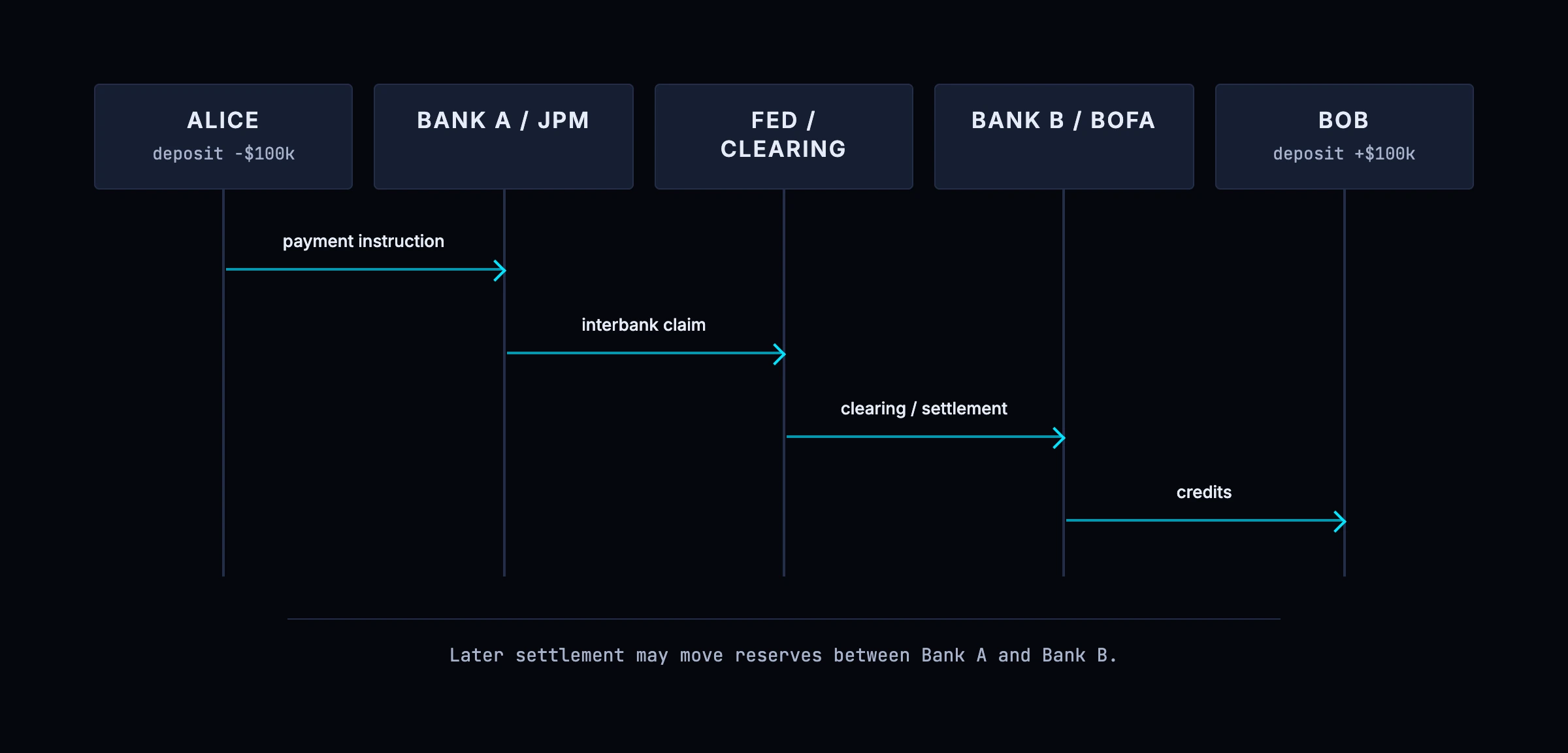
6. Alice Pays Bob: What Actually Happens?
Alice has US$100,000 at Bank A.
Bob banks at Bank B.
Alice buys equipment from Bob and pays US$100,000.
Bank A can reduce its liability to Alice:
Alice deposit at Bank A
$100,000 -> $0
Bank B creates or increases its liability to Bob:
Bob deposit at Bank B
$0 -> $100,000
But why should Bank B agree to owe Bob US$100,000 merely because Bank A's customer asked it to?
Bank B needs an offsetting economic claim.
One possibility is:
BANK B

Asset:
Receivable from Bank A          +$100,000

Liability:
Deposit owed to Bob             +$100,000
The customer-facing payment can therefore be recognized before the two banks have necessarily completed final settlement between themselves.
This is the beginning of the distinction between payment, clearing, and settlement.
For the full same-bank and different-bank examples, see How Bank Transfers Actually Work.
7. Why Does the Federal Reserve Need to Be Involved at All?
It does not need to intermediate every individual customer payment at the exact instant the customer sees the credit.
Banks can owe each other money.
Suppose during the day:
Bank A customers pay Bank B customers       $100 million
Bank B customers pay Bank A customers        $85 million
Rather than moving US$185 million of settlement assets in two directions, the banks or payment system can determine the net position:
Bank A owes Bank B       $100m
Bank B owes Bank A        $85m
                         -----
Net Bank A owes Bank B    $15m
Only the US$15 million net obligation may need final settlement, depending on the system.
This is why payment systems distinguish between:
Clearing
Determining who owes whom and how much.
Settlement
Finally discharging that obligation using an accepted settlement asset.
Fedwire provides finality through transfers credited to Federal Reserve master accounts. CHIPS uses a private-sector high-value USD system with liquidity-saving mechanisms, matching and offsetting obligations so enormous payment values can settle using much less funding than gross payment value.
That is why it is wrong to imagine every US$1 million customer transfer as requiring a fresh US$1 million reserve movement in exactly the same sequence as the customer instruction.
Read Clearing vs. Settlement: Fedwire, CHIPS, and Finality for the complete distinction.
For the commercial implementation of correspondent and interbank structures, the existing Faisal Khan pages on correspondent banking and settlement accounts provide the operational layer.
8. A Complete Five-Bank Toy Economy
Now combine the concepts.
Assume:
no cash;
five commercial banks;
each bank begins with US$1 million of Federal Reserve reserves;
total reserves = US$5 million;
no customer deposits initially.
The Fed's simplified ledger is:
Bank A reserves     $1,000,000
Bank B reserves     $1,000,000
Bank C reserves     $1,000,000
Bank D reserves     $1,000,000
Bank E reserves     $1,000,000
                    ----------
Total               $5,000,000
Bank A makes Alice a US$100,000 loan:
BANK A

Loan to Alice       +$100,000
Alice deposit       +$100,000
Commercial deposit money has increased by US$100,000.
Total reserve balances have not increased.
Alice pays Bob at Bank B.
Bank A's reserve balance may fall by US$100,000 and Bank B's reserve balance may rise by US$100,000 if the payment settles gross through reserve accounts:
Bank A reserves     $900,000
Bank B reserves   $1,100,000
Total reserves remain:
$5,000,000Bob now has the US$100,000 deposit.
Alice still owes the US$100,000 loan.
The debt and the deposit are now in different places:
Alice owes Bank A          $100,000
Bob is owed by Bank B      $100,000
This is normal.
For the full day-by-day example, including repayment, see The Five-Bank Economy: A Worked Example.
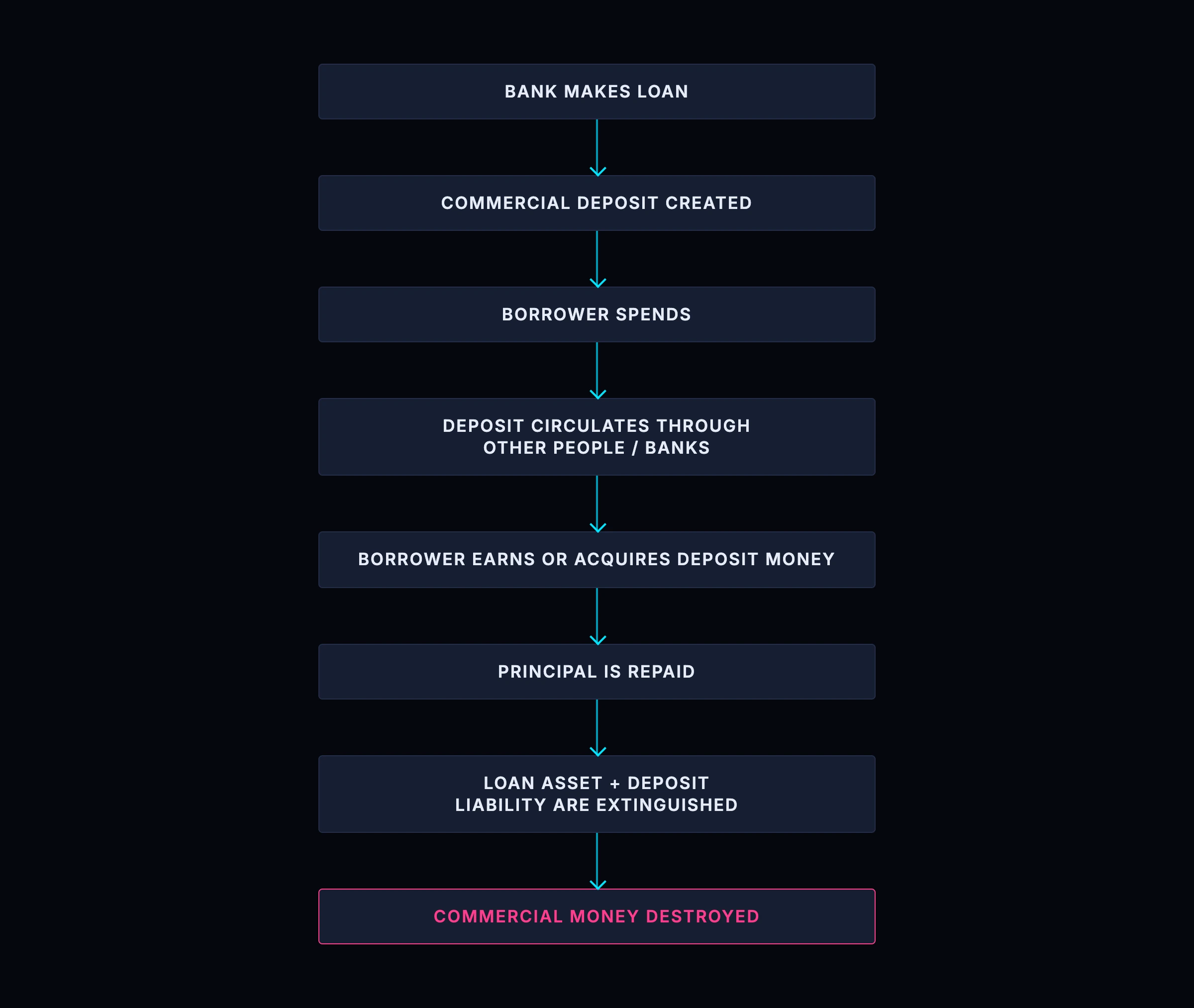
9. What Happens When the Loan Is Repaid?
This is one of the most important parts of the entire primer.
Suppose Alice later earns US$100,000 and the money returns to her account at Bank A.
Immediately before repayment:
BANK A

Asset:
Loan to Alice             $100,000

Liability:
Alice deposit             $100,000
Alice tells Bank A:
Use my deposit to pay off the loan.
Bank A removes the deposit liability:
Alice deposit -$100,000and removes the loan asset:
Loan to Alice -$100,000After repayment:
Loan to Alice                  $0
Alice deposit                   $0
The commercial-bank deposit money has been extinguished.
This is why it is accurate, in the normal bank-loan case, to say:
Bank lending can create deposit money; repayment of loan principal destroys deposit money.
The Federal Reserve reserve stock does not necessarily shrink merely because Alice repaid the loan. Reserves may have moved among banks during the life of the loan, but the deposit created by the commercial bank and the loan asset can cancel against one another on repayment.
The dedicated page How Loan Repayment Destroys Bank Money also covers defaults, write-offs, early repayment, principal versus interest, and why a default is not the same as repayment.
10. If Principal Is Created, Where Does the Interest Come From?
Suppose five people each borrow US$100,000.
Banks create:
5 x $100,000 = $500,000 of depositsSuppose the loans charge 10% interest after one year.
Total amount owed becomes:
Principal          $500,000
Interest            $50,000
                   --------
Total               $550,000
Now impose an artificial rule:
nobody spends anything;
banks spend nothing;
no new lending occurs;
no government spending exists;
no old deposits exist;
no money enters from anywhere else.
Then only US$500,000 of deposits exist, while US$550,000 is owed.
Under those deliberately frozen assumptions, the five borrowers cannot collectively pay US$550,000. The arithmetic does not permit it.
But this does not mean a real banking system requires the bank to create the entire interest amount at loan origination.
The crucial distinction is between a stock of money and a flow of payments.
A single US$100 deposit can be used repeatedly over time:
Alice -> Bank interest payment        $100
Bank -> Employee salary               $100
Employee -> Alice business purchase   $100
Alice -> Bank payment                 $100
The same monetary unit can support multiple payments as it circulates.
When interest is paid, it becomes bank income rather than principal reduction. When the bank pays salaries, vendors, taxes, deposit interest, dividends, or other expenses, deposits can return to the non-bank economy.
The closed-system “interest paradox” is useful because it shows that a completely frozen economy cannot pay more nominal obligations than the money available without some recycling or additional source of deposits. But the real economy is not frozen.
The full treatment is in Where Does the Interest on Bank-Created Money Come From?.
11. Does the Government Know How Much Money Exists?
The answer depends on which kind of money you mean.
Federal Reserve reserve balances
The Fed knows reserve balances extremely precisely because they are liabilities on the Federal Reserve's own ledger.
U.S. commercial-bank deposits
Each commercial bank knows its own customer-level ledger. Regulators receive detailed reporting and the Federal Reserve publishes monetary aggregates such as the monetary base, M1, and M2.
The Fed defines the monetary base as currency in circulation plus reserve balances. M1 includes currency held by the public and highly liquid transaction deposits. M2 adds additional liquid savings instruments.
However, the government does not maintain one public second-by-second master ledger showing the balance of every customer account in America.
Offshore dollar liabilities
Measurement becomes less complete.
The Treasury International Capital system collects U.S. financial institutions' reportable claims on and liabilities to foreign residents. But Treasury itself notes that those data do not always reveal ultimate beneficial ownership and do not capture every possible offshore dollar position.
The BIS separately gathers international banking statistics. These show that dollar banking outside the United States is enormous.
For the measurement problem in detail, read How Much US-Dollar Money Exists, and Does the Government Know?.
12. What Is an Offshore Dollar?
Suppose a Swiss bank has a US$300 million correspondent balance at a U.S. bank.
That does not mean the Swiss bank can only have US$300 million of customer dollar deposits.
Its simplified USD balance sheet might be:
SWISS BANK — USD POSITION

Assets
------
US correspondent balance       $300m
USD loans                       $900m
US Treasury securities         $200m
Other USD assets                $100m
                                -----
Total USD assets              $1.5bn

Liabilities
-----------
Customer USD deposits         $1.2bn
Wholesale USD funding          $200m
Other USD liabilities          $100m
                                -----
Total USD liabilities         $1.5bn
The Swiss customers' deposits are claims against the Swiss bank.
They are not individual Federal Reserve reserve balances.
Dollar deposits booked outside the United States are commonly associated with the Eurodollar system — a historical term that does not mean euros and is not limited to Europe.
BIS data demonstrate the scale. At end-2023, non-U.S. banks had roughly US$21 trillion of dollar liabilities, with about three quarters booked outside the United States. BIS also estimates very large off-balance-sheet dollar obligations through FX swaps, which should not be confused with ordinary deposits but are part of the broader global dollar funding system.
See Offshore Dollars and the Eurodollar System for the detailed explanation.
13. Can a Foreign Bank Actually Create a US-Dollar Deposit?
Conceptually, yes — but the wording needs precision.
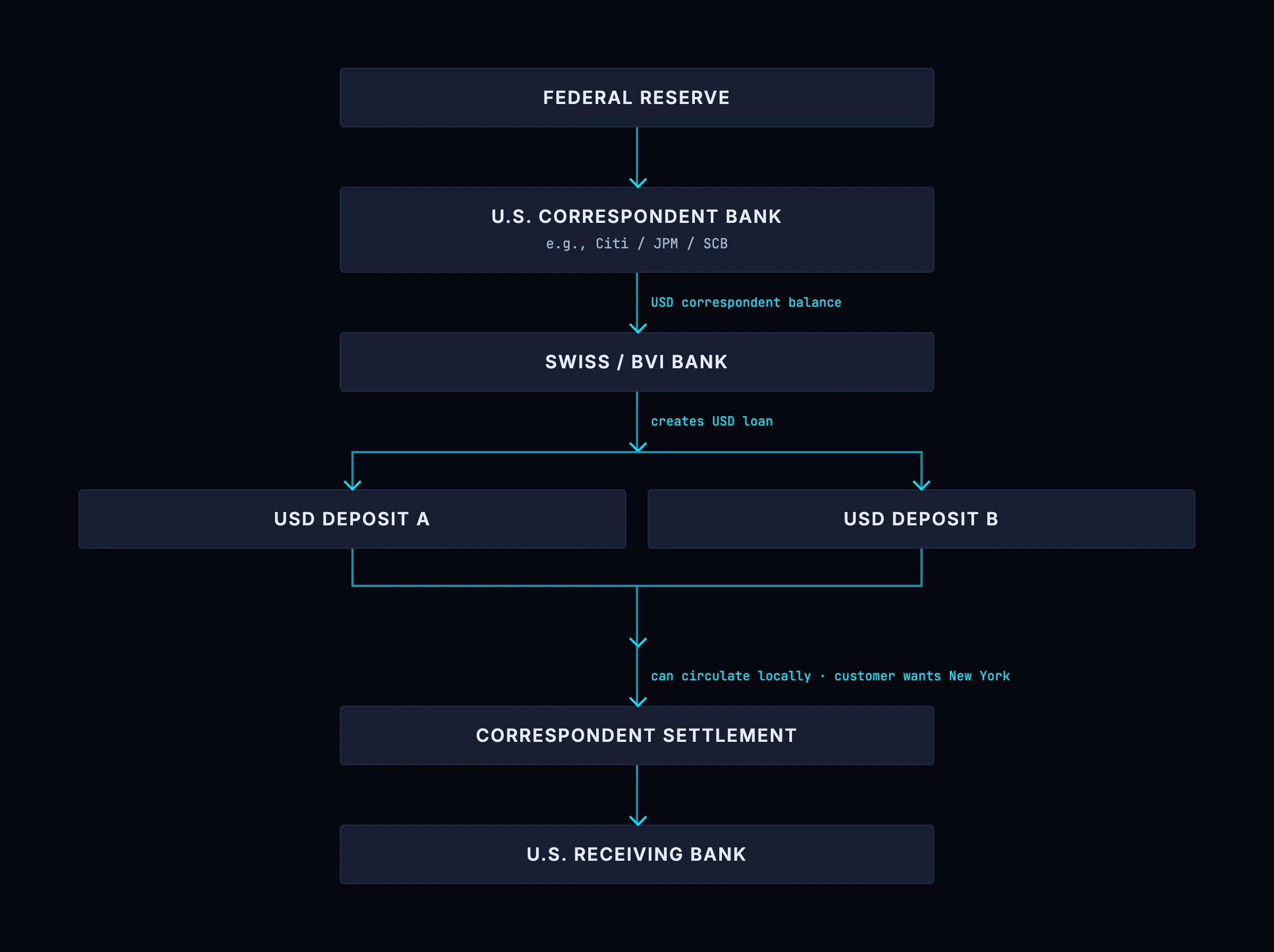
A foreign commercial bank can create a USD-denominated deposit liability when it books a USD-denominated loan, subject to local law, regulation, capital, liquidity, funding, and risk constraints.
Suppose a Swiss bank lends Alice US$100 million:
SWISS BANK

Asset:
USD loan to Alice             +$100m

Liability:
Alice USD deposit             +$100m
That does not mean the Swiss bank created US$100 million of Federal Reserve reserves.
It created a promise payable in dollars.
If Alice keeps the money inside the Swiss bank and pays another customer of the same institution, the bank can simply change its internal ledger.
If Alice says:
Send all US$100 million to my JPMorgan account in New York,
then the Swiss bank must perform externally. It may use:
a U.S. correspondent balance;
incoming dollar deposits;
wholesale dollar borrowing;
securities it can sell or finance;
FX swaps;
interbank funding;
other liquidity resources.
It cannot simply create a Federal Reserve reserve balance.
That distinction — creating a dollar-denominated bank liability versus creating central-bank dollars — resolves much of the confusion around offshore money.
Read Can Foreign Banks Create US Dollars? for the Swiss-bank and Pakistani-bank examples.
14. If the Swiss Bank Created It, Is the US$100 Million “Real”?
The word real is not very helpful in banking.
A better question is:
What exactly is the claim, who issued it, and can the issuer honor it at par?
A US$100 million deposit at a Swiss bank is a US$100 million claim against that Swiss bank.
A US$100 million deposit at JPMorgan is a US$100 million claim against JPMorgan.
US$100 million of Federal Reserve reserves is a claim against the Federal Reserve held by an eligible institution.
Those are different issuers.
Under normal circumstances, they are expected to exchange at par:
$1 Swiss-bank USD deposit
=
$1 JPMorgan deposit
=
$1 of settlement value
If the Swiss bank cannot raise sufficient dollar liquidity when its customers demand external transfer, the bank may face a liquidity crisis. The customer's claim does not retroactively become imaginary; rather, the bank may become unable to honor the claim promptly or in full.
This is why the global monetary system is better described as a hierarchy of claims than a collection of identical electronic tokens.
15. What Does “The Money Went Offshore and Disappeared” Mean?
Movies often portray a stolen bank balance moving from London to the BVI, after which someone says:
The money is gone.
In a regulated banking chain, that is usually misleading.
Suppose a hypothetical transfer is:
Trading company
      |
      v
London bank
      |
      v
USD correspondent
      |
      v
Bank of BVI
      |
      v
XYZ Holdings Ltd
Each institution normally records the part of the transaction it processed.
The payment has not entered an accounting black hole.
What may become difficult is:
obtaining records across jurisdictions;
identifying the beneficial owner behind the receiving entity;
freezing funds quickly enough;
following additional transfers through other banks, brokers, securities, trusts, nominees, or companies;
obtaining court orders and cross-border legal cooperation.
So offshore structures may create opacity, legal distance, and recovery difficulty. That is very different from saying that no ledger exists.
A foreign bank's U.S. correspondent may know that it owes the foreign bank US$50 million without knowing which underlying foreign customer economically owns US$3 million of that balance. The foreign bank's own sub-ledger contains that allocation.
The deeper explanation is in Are Offshore Dollars Traceable?.
For the operational mechanics of cross-border payment chains, see the existing Faisal Khan pages on cross-border payments and international bank transfers.
16. Does Every Country Create Commercial-Bank Money?
Broadly, modern banking systems around the world have the same distinction:
Central bank
    |
    v
Central-bank money

Commercial banks
    |
    v
Deposit money
Examples include:
Federal Reserve money and USD bank deposits in the United States;
Bank of England reserves and GBP deposits in the United Kingdom;
Eurosystem central-bank money and EUR commercial-bank deposits in the euro area;
CBRT central-bank money and TRY bank deposits in Türkiye;
State Bank of Pakistan central-bank money and PKR commercial-bank deposits in Pakistan;
Bank of Japan central-bank money and JPY bank deposits in Japan;
Bank of Canada settlement balances and CAD commercial-bank deposits in Canada.
The architecture varies by jurisdiction, and foreign-currency lending may be restricted. Dollarized economies, currency-board systems, Islamic banking structures, narrow-bank proposals, and special monetary arrangements introduce additional differences.
But the basic balance-sheet idea — banks creating deposit liabilities while making loans or purchasing assets — is not uniquely American.
See Commercial-Bank Money Creation Around the World.
17. Banks Cannot Create Unlimited Money
The statement “banks create money” is sometimes misunderstood as “banks can type any number they want into an account.”
They cannot.
Banks face multiple constraints:
Capital
Loans expose the bank to loss. Regulatory capital requirements constrain balance-sheet expansion.
Liquidity
Borrowers spend deposits. When deposits leave the originating bank, the bank may need reserves or other settlement/funding resources.
Funding
A bank may originate a loan and then lose the newly created deposit to another bank. The loan stays on its balance sheet and still has to be funded over time.
Credit quality
Bad loans destroy bank capital. Lending to borrowers who cannot repay is not sustainable money creation.
Interest rates and monetary policy
The Federal Reserve influences the cost and availability of funding, financial conditions, and credit demand.
Regulation and supervision
Leverage, liquidity, capital, concentration, underwriting, stress testing, and other prudential requirements matter.
Profitability
A loan that cannot be priced profitably after credit risk, funding cost, capital cost, operations, and expected losses is not attractive merely because the bank can create a deposit entry.
One common outdated simplification is that U.S. banks mechanically lend a fixed multiple of required reserves. As of 2026, the Federal Reserve's reserve requirement ratios remain at zero. Reserves still matter for settlement and liquidity, but the simple textbook “10% reserve requirement therefore 10x money multiplier” is not a faithful description of modern U.S. bank lending.
18. Bank Money Is Not the Same as Wealth
When Bank A lends Alice US$100,000, two things appear:
Alice gains deposit asset       +$100,000
Alice gains loan obligation     +$100,000
The economy has more deposit money, but Alice did not become US$100,000 richer on a net basis merely because she borrowed.
She gained an asset and a liability.
Likewise the bank acquired a loan asset and a deposit liability.
Money creation is not the same thing as wealth creation.
If Alice uses the loan to build a productive factory, the investment may eventually create real economic value.
If the loan finances an asset bubble that later collapses, money creation did not guarantee wealth creation.
This distinction is fundamental.
19. Loan Default Is Not the Same as Loan Repayment
Suppose Bank A created a US$100,000 loan and Alice spent the deposit to Bob.
Bob still holds the US$100,000 deposit somewhere in the banking system.
Now Alice defaults.
Bank A may have to write down its US$100,000 loan asset.
The loss reduces the bank's equity or provisions.
But Bob's deposit does not automatically disappear merely because Alice defaulted.
Compare:
Repayment
Loan asset                    -$100,000
Borrower's deposit            -$100,000
Principal repayment can extinguish both.
Default
Loan asset loses value
Bank capital absorbs loss
Previously created deposit may still exist elsewhere
This is why credit losses matter so much to banks. The liability side of the banking system does not magically shrink merely because an asset becomes bad.
20. The Most Useful Mental Model: A Hierarchy of IOUs
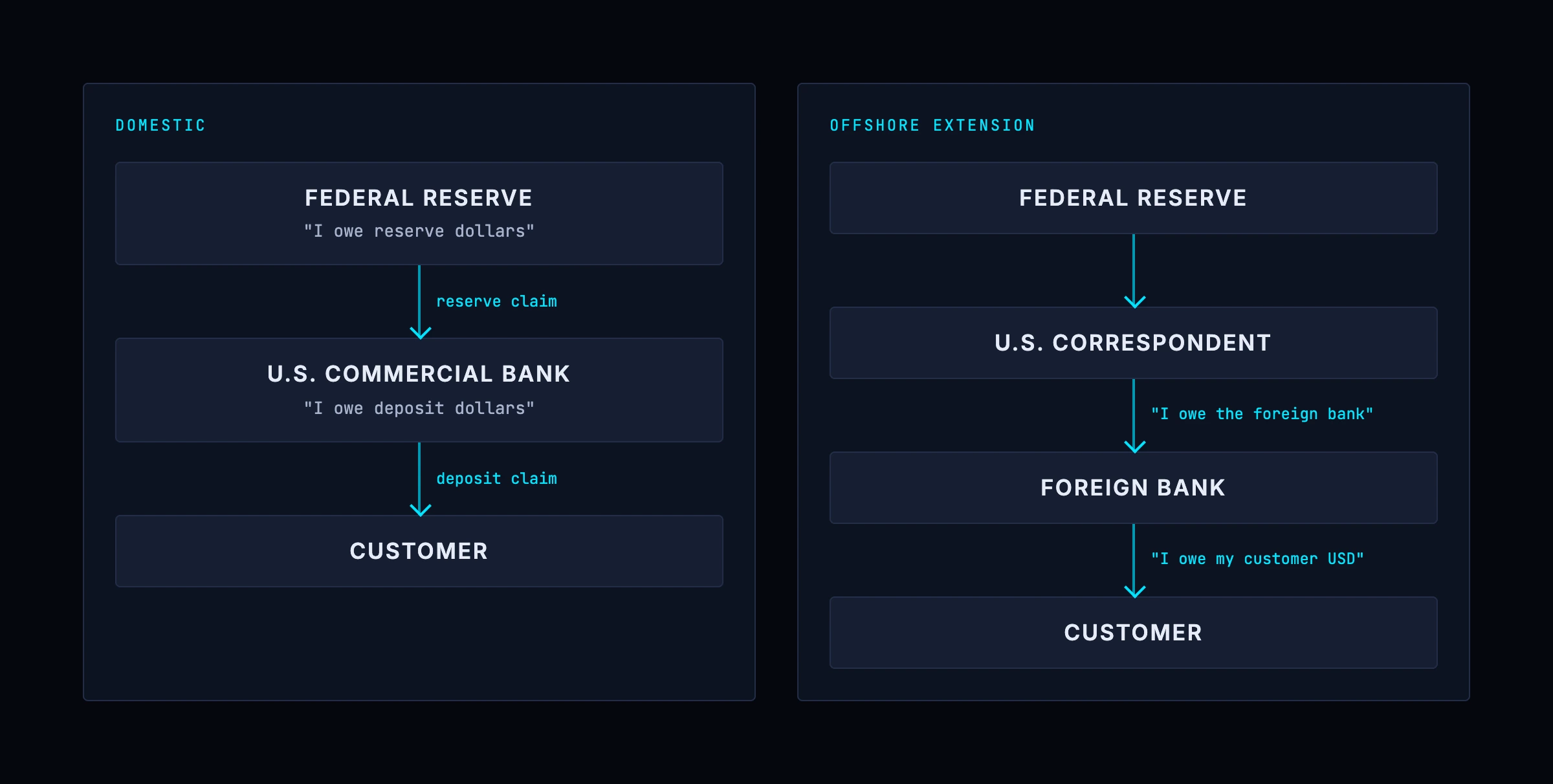
Put the entire system into one diagram:
                     FEDERAL RESERVE
                           |
                           | reserve liabilities
                           v
                  U.S. COMMERCIAL BANK
                           |
                           | deposit liabilities
                           v
                        CUSTOMER


                     FEDERAL RESERVE
                           |
                           v
                 U.S. CORRESPONDENT BANK
                           |
                           | correspondent liability
                           v
                     FOREIGN BANK
                           |
                           | USD deposit liability
                           v
                     FOREIGN CUSTOMER
At each level, somebody is owed something by somebody else.
The same unit of account — the US dollar — is used throughout the chain.
That is why the word dollar can refer to different claims:
a Federal Reserve note;
a reserve balance;
a JPMorgan deposit;
a Swiss-bank USD deposit;
a correspondent account balance;
another USD-denominated financial claim.
They are not all identical legal instruments.
What makes the system work is the expectation of convertibility, payment performance, settlement finality, regulation, liquidity support, and confidence.
21. The Five Questions to Ask About Any Dollar
When confronted with any banking or payment arrangement, ask these five questions.
Question 1: Who issued the claim?
Is it the Federal Reserve, JPMorgan, a Swiss bank, an EMI, a payment institution, a stablecoin issuer, or somebody else?
Question 2: Who owes whom?
Whose liability is the balance?
Question 3: What asset sits on the other side?
Does the issuer hold reserves, correspondent balances, loans, securities, receivables, collateral, or something else?
Question 4: What happens if the holder sends the money elsewhere?
Does the issuer need central-bank reserves, correspondent liquidity, prefunding, net settlement, or another funding source?
Question 5: What happens when the underlying debt is repaid or defaults?
Does the deposit disappear through repayment, or does the bank take a capital loss because the asset defaulted?
Those five questions solve an enormous number of apparent mysteries in banking.
22. The Complete Lifecycle of One Bank-Created Dollar
We can now describe the entire lifecycle of a US$100,000 commercial-bank deposit.
Creation
Bank asset:       Loan to Alice        +$100,000
Bank liability:   Alice deposit        +$100,000
Spending
Alice pays Bob.
Alice deposit                         -$100,000
Bob deposit                           +$100,000
Interbank settlement
If different banks are involved, reserves or other accepted settlement claims are rearranged.
Circulation
Bob can pay Charlie. Charlie can pay David. David can pay Alice.
The same deposit money can support many payments over time.
Repayment
Alice eventually acquires deposits and pays Bank A.
Alice deposit                         -$100,000
Bank loan asset                       -$100,000
Destruction
The principal-related deposit money is extinguished.
Meanwhile, the reserve layer may still exist. It has been redistributed among banks during the payment cycle rather than necessarily created and destroyed alongside each customer deposit.
23. What This Means for Cross-Border Payments
The monetary mechanics explain why international payments are primarily about ledgers rather than physical currency.
A BVI bank may have a USD nostro relationship with a correspondent bank. Its customers hold claims against the BVI bank. The BVI bank holds a claim against the correspondent. The correspondent interacts with the U.S. settlement system.
When a BVI customer receives US$1 million, it is not necessary that the customer itself have an account at the Federal Reserve.
The chain might be:
Federal Reserve settlement layer
            |
            v
Correspondent bank
            |
            v
Bank of BVI nostro / correspondent balance
            |
            v
Bank of BVI customer ledger
            |
            v
Customer USD balance
That structure is why correspondent banking relationships, settlement accounts, and correctly designed cross-border payment flows matter operationally.
24. What This Means for the Phrase “The Dollar Is American”
The Federal Reserve controls issuance of Federal Reserve liabilities.
The United States therefore occupies the apex of the official dollar settlement system.
But that does not mean every institution that creates a dollar-denominated obligation must be located in America.
A contract in Singapore can be denominated in dollars.
A bond issued in London can be denominated in dollars.
A deposit at a Swiss bank can be denominated in dollars.
A loan booked by a Japanese bank can be denominated in dollars.
What those institutions cannot independently create is the Federal Reserve's own liability.
So the precise statement is:
The Federal Reserve has the unique ability to create Federal Reserve money. The broader global financial system can create enormous quantities of credit and deposit liabilities denominated in the US dollar.
That distinction is the foundation of the international dollar system.
25. What This Primer Is Not Saying
Several common overstatements should be avoided.
“Banks can create infinite money.”
False. Capital, liquidity, risk, funding, regulation, demand, profitability, and monetary policy constrain bank balance sheets.
“Every dollar is backed one-for-one by reserves.”
False for commercial-bank deposits.
“Reserves are lent directly to ordinary borrowers.”
Generally the wrong mental model. Reserves are central-bank money used by eligible institutions; ordinary borrowers receive bank deposits.
“Money created by lending can never disappear.”
False. Repayment of loan principal can extinguish deposit money.
“If the bank creates principal but not interest, the system must collapse.”
False as a description of a dynamic economy. The closed-system arithmetic problem is real under frozen assumptions, but money circulates and bank income is spent, while lending, repayment, government activity, investment, and other flows occur continuously.
“Offshore dollars are untraceable.”
False as a general rule. Offshore banking can complicate beneficial-ownership identification and legal recovery, but regulated banks maintain ledgers and payment records.
“All USD liabilities are Federal Reserve dollars.”
False. The issuer matters.
26. Child Pages in This Primer
This master guide is supported by the following deep dives:
Frequently Asked Questions
Does the Federal Reserve create every US dollar?
No. The Federal Reserve creates central-bank money, including reserve balances and Federal Reserve notes. Commercial banks create deposit money through lending and certain asset transactions.
Is my checking-account balance Federal Reserve money?
Usually no. It is a liability of your commercial bank to you.
Does my bank keep one dollar of Fed reserves for every dollar in my account?
No. Commercial-bank deposits are not matched one-for-one to segregated reserve balances.
When a bank makes a loan, where does the deposit come from?
The bank normally credits the borrower's deposit account while recording the borrower's loan as an asset. That accounting operation creates new deposit money.
Can banks create unlimited deposit money?
No. Lending is constrained by capital, liquidity, credit risk, funding, regulation, profitability, monetary policy, and borrower demand.
When I transfer money to another bank, does the Fed move the exact same dollars?
Not necessarily. Customer liabilities change, interbank claims arise, payments may be netted, and final settlement may occur using reserves or another accepted settlement arrangement.
What is the difference between clearing and settlement?
Clearing determines payment obligations. Settlement finally discharges them.
Does paying back a bank loan destroy money?
Repayment of principal normally reduces both the borrower's deposit and the bank's loan asset, reducing commercial-bank deposit money.
What happens to interest?
Interest is bank income rather than principal repayment. Deposits used to pay interest can later re-enter the economy when the bank pays salaries, vendors, taxes, deposit interest, dividends, or other expenses.
If nobody spends anything, can borrowers collectively pay interest that was never created?
In a deliberately frozen closed system with only principal-created deposits and no recycling, no. The nominal amount owed can exceed the deposits available. Real economies contain continuous circulation, bank spending, new lending, repayment, government flows, investment, and other transactions.
Can a Swiss bank create a USD deposit?
It can create a USD-denominated commercial-bank liability through lending, subject to legal, regulatory, capital, liquidity, and funding constraints. It cannot create Federal Reserve reserves.
Is an offshore USD deposit a fake dollar?
No. It is a dollar-denominated claim against the issuing bank. Its quality depends on the bank's ability to honor that claim.
Does the U.S. government know every dollar held offshore?
No. U.S. authorities collect extensive cross-border banking and securities data, but there is no exact real-time global ledger of every USD-denominated claim.
Is offshore money untraceable?
Not inherently. Regulated institutions keep records. The difficulty can be beneficial ownership, jurisdiction, legal process, layering, and speed of recovery.
Does every country have commercial-bank money creation?
Most modern banking systems have some form of commercial-bank deposit creation, although the exact rules, currencies, central-bank arrangements, and foreign-currency restrictions differ.
Final Perspective
The US dollar is not one giant pile of identical electronic objects.
It is better understood as a hierarchy.
At the top sits central-bank money issued by the Federal Reserve.
Below it sits commercial-bank money issued as deposit liabilities by banks.
Around it sits a global network of correspondent balances, foreign-bank USD deposits, wholesale funding, securities, and other dollar-denominated claims.
A bank loan can create deposit money.
A payment can move that deposit claim from one bank to another while reserves settle the interbank difference.
Principal repayment can extinguish the deposit and the corresponding loan asset.
Interest is a flow of income, not a separate pile that must necessarily be created at origination.
Offshore banks can create dollar-denominated claims but cannot manufacture Federal Reserve reserve balances.
And when someone says “the money moved,” the most useful response is to ask:
Which liability disappeared, which liability appeared, what asset changed, and how was the obligation finally settled?
Once those questions become automatic, the architecture of modern money stops looking mysterious.
Authoritative Sources and Further Reading
Federal Reserve Board — What is the money supply? Is it important?
https://www.federalreserve.gov/faqs/money_12845.htm
Federal Reserve Board — A Lawyer's Perspective on U.S. Payment System Evolution and Money in the Digital Age
Federal Reserve Board — Understanding Bank Deposit Growth during the COVID-19 Pandemic
Federal Reserve Financial Services — Fedwire Funds Service
https://www.frbservices.org/financial-services/wires
Federal Reserve Board — Reserve Requirements
https://www.federalreserve.gov/monetarypolicy/reservereq.htm
The Clearing House — CHIPS
https://www.theclearinghouse.org/payment-systems/chips
U.S. Treasury — Treasury International Capital System
https://home.treasury.gov/data/treasury-international-capital-tic-system
Bank for International Settlements — International finance through the lens of BIS statistics: the global reach of currencies
Bank of England — Money creation in the modern economy
https://www.bankofengland.co.uk/quarterly-bulletin/2014/q1/money-creation-in-the-modern-economy
Deutsche Bundesbank — The Origin of Money – Part II: Book Money