
The Principal Is Created as a Deposit. The Interest Is Not. So How Can Everyone Repay?
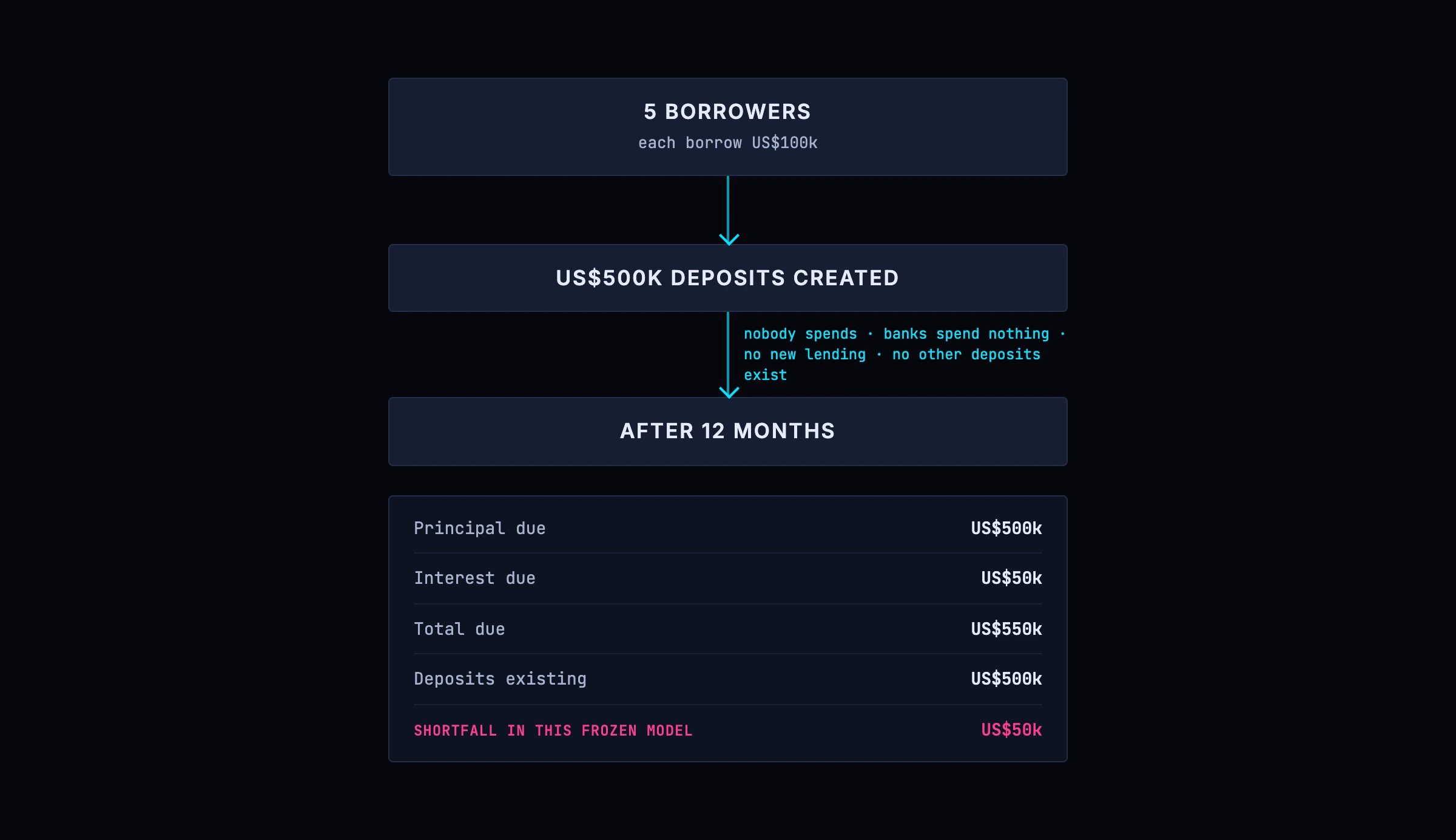
The question becomes even sharper in a deliberately frozen economy. If five people each borrow US$100,000, the banking system creates US$500,000 of deposits. If each borrower owes 10% interest one year later, the borrowers collectively owe US$550,000. If absolutely nothing else happens, only US$500,000 of deposit money exists.
Under those exact assumptions, the borrowers cannot collectively pay US$550,000. The arithmetic does not work.
That conclusion is correct. The mistake comes only if we then assume a real economy behaves like that frozen thought experiment.
1. Bank Loan Interest in a Closed System
Assume five borrowers:
Borrower A          borrows US$100,000
Borrower B          borrows US$100,000
Borrower C          borrows US$100,000
Borrower D          borrows US$100,000
Borrower E          borrows US$100,000
                    -----------------
Total principal          US$500,000
Assume each loan charges 10% interest for one year.
At maturity:
Principal owed           US$500,000
Interest owed             US$50,000
                         -----------
Total owed               US$550,000
Now impose extreme restrictions:
there was no money before these loans;
borrowers do not trade with one another;
nobody else borrows;
the banks pay no salaries;
banks buy nothing;
banks pay no rent, dividends, taxes, vendor invoices, or deposit interest;
government does not spend;
no foreign money enters;
no new deposits are created;
all five borrowers simply hold their US$100,000 for 12 months.
At the end of the year:
Deposits in borrowers' accounts       US$500,000
Amount borrowers collectively owe     US$550,000
Shortfall                               US$50,000
There is no accounting trick that produces the missing US$50,000. Under these assumptions, all five loans cannot be paid in full.
2. Why This Does Not Mean Interest Is Impossible
The frozen example has deliberately removed the defining characteristic of an economy: money circulates.
Money is a stock measured at a point in time. Payments, wages, interest, purchases, and revenues are flows measured through time.
Suppose there are only US$100 of deposits in a tiny village.
That same US$100 can be used repeatedly:
Monday:     Alice pays Bob         US$100
Tuesday:    Bob pays Charlie       US$100
Wednesday:  Charlie pays David     US$100
Thursday:   David pays Alice       US$100
There were US$400 of payments even though the village never needed more than US$100 of money at any one instant.
This repeated use of a stock of money is related to the concept of velocity.
Therefore the economy does not need a separate permanent dollar to exist for every dollar of interest that will ever be paid.
3. What Happens When a Borrower Pays Interest?
Assume Alice owes Bank A:
Principal                   US$100,000
Interest                      US$5,000
Alice has US$5,000 in her Bank A deposit account and pays the interest.
In simplified accounting, Bank A reduces the deposit liability it owes Alice and recognizes interest income:
BANK A

Deposit liability to Alice             -US$5,000
Interest income / retained earnings     +US$5,000
That is different from principal repayment.
When principal is repaid, the loan asset itself is reduced. When interest is paid, the principal loan asset does not disappear merely because interest was received.
For the full principal mechanics, see How Loan Repayment Destroys Commercial Bank Money.
4. Has the US$5,000 Permanently Disappeared?
Not necessarily.
Bank A is a business. It has expenses and distributions.
It may use its income to pay:
employee salaries;
software vendors;
landlords;
auditors;
lawyers;
utilities;
taxes;
interest on deposits or borrowings;
dividends;
contractors;
technology providers.
Suppose Bank A pays an employee US$5,000.
If the employee has an account at Bank A, the bank can credit the employee's deposit:
Bank expense / equity effect            -US$5,000
Employee deposit liability              +US$5,000
The deposit is back in the nonbank economy.
If the employee banks elsewhere, Bank A may need to send reserves to the receiving bank as part of settlement, and the receiving bank creates the employee's deposit.
The economic point is the same: bank income can be spent back into circulation.
5. Follow the Same US$5,000 Around a Circle
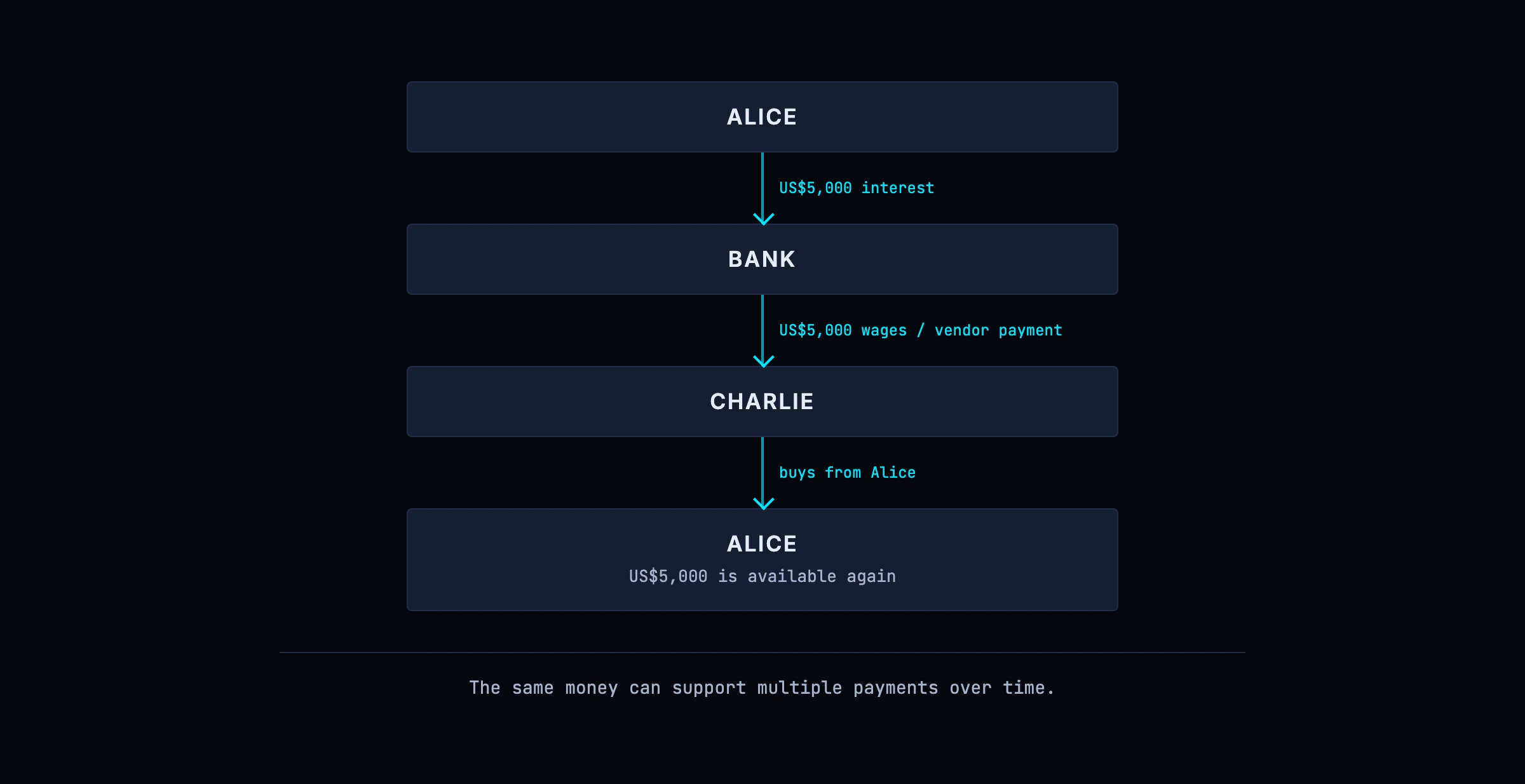
Suppose Alice pays US$5,000 of interest to Bank A.
Bank A later pays US$5,000 to Charlie, its software developer.
Charlie purchases US$5,000 of services from Alice's company.
The sequence is:
Alice
  │
  │ US$5,000 interest
  ▼
Bank A
  │
  │ US$5,000 software expense
  ▼
Charlie
  │
  │ US$5,000 purchase
  ▼
Alice
The same US$5,000 of deposit money has supported three different economic payments.
This is why cumulative payment obligations can substantially exceed the quantity of money measured at a particular instant.
6. Return to the Five Borrowers
The original frozen example had:
US$500,000 principal created
US$50,000 interest due
US$550,000 total obligations
Now allow the banks to operate normally.
During the year the banks pay employees, purchase services, pay deposit interest, distribute dividends, and incur other expenses.
Those payments place deposits into the hands of households and businesses.
The five borrowers can earn some of those deposits by selling goods or services.
Thus an individual borrower can accumulate more deposit inflows over the year than the amount initially created in that borrower's own loan.
The question is no longer:
Where is the unique additional US$10,000 assigned to each US$100,000 loan?
There is no such earmarked pool.
The question becomes:
Can the borrower earn or otherwise obtain enough existing deposits over time to meet the scheduled payments?
That is an income, cash-flow, and solvency question.
7. Does New Lending Also Supply Deposits?
Yes.
At the same time old borrowers are repaying loans, banks usually make new loans.
Suppose during a month:
New loans create deposits                +US$2.0bn
Principal repayments destroy deposits    -US$1.5bn
                                         ---------
Net loan-related deposit creation        +US$0.5bn
The actual monetary system contains millions of overlapping transactions, not one cohort of loans that is created on January 1 and all repaid simultaneously on December 31.
New credit creation can therefore add deposits while previous loans are being serviced.
This does not mean new borrowing is mathematically required to pay every dollar of interest. Circulation and bank spending matter too. But in a growing credit economy, new lending is one of the major flows affecting the stock of deposits.
8. What If Everyone Tries to Repay at Once?
This is where the thought experiment becomes useful.
Suppose all borrowers attempt simultaneously to eliminate all debt while banks make no new loans and greatly reduce spending.
Principal repayments contract deposits.
If repayment exceeds new credit creation and other sources of deposit growth, the commercial money stock can shrink.
That can contribute to a deleveraging cycle:
Loan repayment
     ↓
Deposit destruction
     ↓
Less spending power / weaker nominal demand, all else equal
     ↓
Lower income for some borrowers
     ↓
Harder debt service
The real macroeconomic outcome depends on monetary policy, fiscal policy, bank behavior, asset prices, income, international flows, and many other factors. But the accounting mechanism is important: widespread balance-sheet contraction can reduce commercial bank deposits.
9. Principal and Interest Are Economically Different
This distinction is essential.
Principal repayment
In the simplest same-bank example:
Loan asset                    -US$100
Customer deposit              -US$100
The loan and deposit contract together.
Interest payment
In a simplified same-bank example:
Customer deposit              -US$5
Bank interest income           +US$5
The interest is revenue to the bank. It affects the bank's income and ultimately its equity after expenses, taxes, and distributions.
The bank may then spend or distribute that income, causing deposits to appear in the accounts of employees, vendors, shareholders, governments, or other recipients.
10. What If the Bank Retains All Its Profits?
Suppose Bank A receives interest but refuses to spend or distribute any of it.
Then some purchasing power that had been represented by customer deposits has effectively moved into the bank's retained earnings rather than immediately returning as a nonbank deposit.
If every bank permanently retained all interest income while borrowers simultaneously attempted to extinguish all debts and no other deposit creation occurred, the closed-system constraint would reappear.
Real banks do not operate that way indefinitely. They have enormous operating costs, compensation expenses, taxes, funding costs, dividends, asset purchases, and other cash flows.
Nevertheless, the thought experiment illustrates why the timing and distribution of financial flows matter.
11. What About Deposit Interest?
Banks themselves frequently pay interest.
If a bank credits US$1,000 of interest to a customer's deposit account, in simplified terms the bank increases its deposit liability and records an interest expense.
That action increases the customer's spendable deposit balance.
So banks are not only receiving interest. They are also paying interest to depositors and creditors.
12. What About Bank Shareholders?
Suppose Bank A earns US$10 million after expenses and distributes US$5 million as dividends.
The shareholders receive deposits at their banks.
Those shareholders can then spend, invest, lend, or save the money.
Again, money flows back from the banking business to the nonbank sector.
13. Does the Borrower Need the Same Dollars That Were Originally Lent?
No.
This is one of the most important misconceptions to remove.
Alice borrowed US$100,000 and spent it on Bob.
Those exact deposit balances may then pass through dozens of people.
Alice can repay her debt using deposits she later earns from completely different customers.
The bank does not ask:
Are these the original dollars we created for you?
Deposits are fungible. Alice only needs a valid US$ balance sufficient to make the payment.
14. Could One Person Repay Only Because Someone Else Cannot?
In the frozen five-borrower example, yes: if only US$500,000 exists and US$550,000 is simultaneously demanded, not everyone can pay in full.
But once money circulates through bank expenditures, wages, business revenue, new lending, government payments, investment flows, and other transactions, the zero-sum framing no longer applies in the same way.
Individual defaults can still occur, of course. The point is merely that interest does not require a unique new dollar to be created and permanently assigned to each dollar of interest due.
15. The Stock-vs.-Flow Error
The most common conceptual error is comparing:
Money stock at one instantwith:
Total payments due over a period of timeand assuming they must be equal.
They do not.
A company with US$1 million in average cash can make US$20 million of annual payments if money continuously enters and leaves its accounts.
Likewise, an economy with a given money stock can support a much larger annual transaction volume.

16. The Correct Conclusion From the Thought Experiment
The frozen five-borrower example proves a limited but important proposition:
If banks create only US$500,000 of deposits, no other deposits exist, nobody spends or recirculates bank income, no additional credit is created, and all borrowers must simultaneously pay US$550,000, then full payment is impossible.
It does not prove:
Interest can never be paid because banks create principal but not interest.
That stronger claim ignores circulation, bank expenditure, income, timing, new credit, existing money balances, fiscal flows, and the fact that the same unit of money can service multiple payments.
17. A Compact Diagram
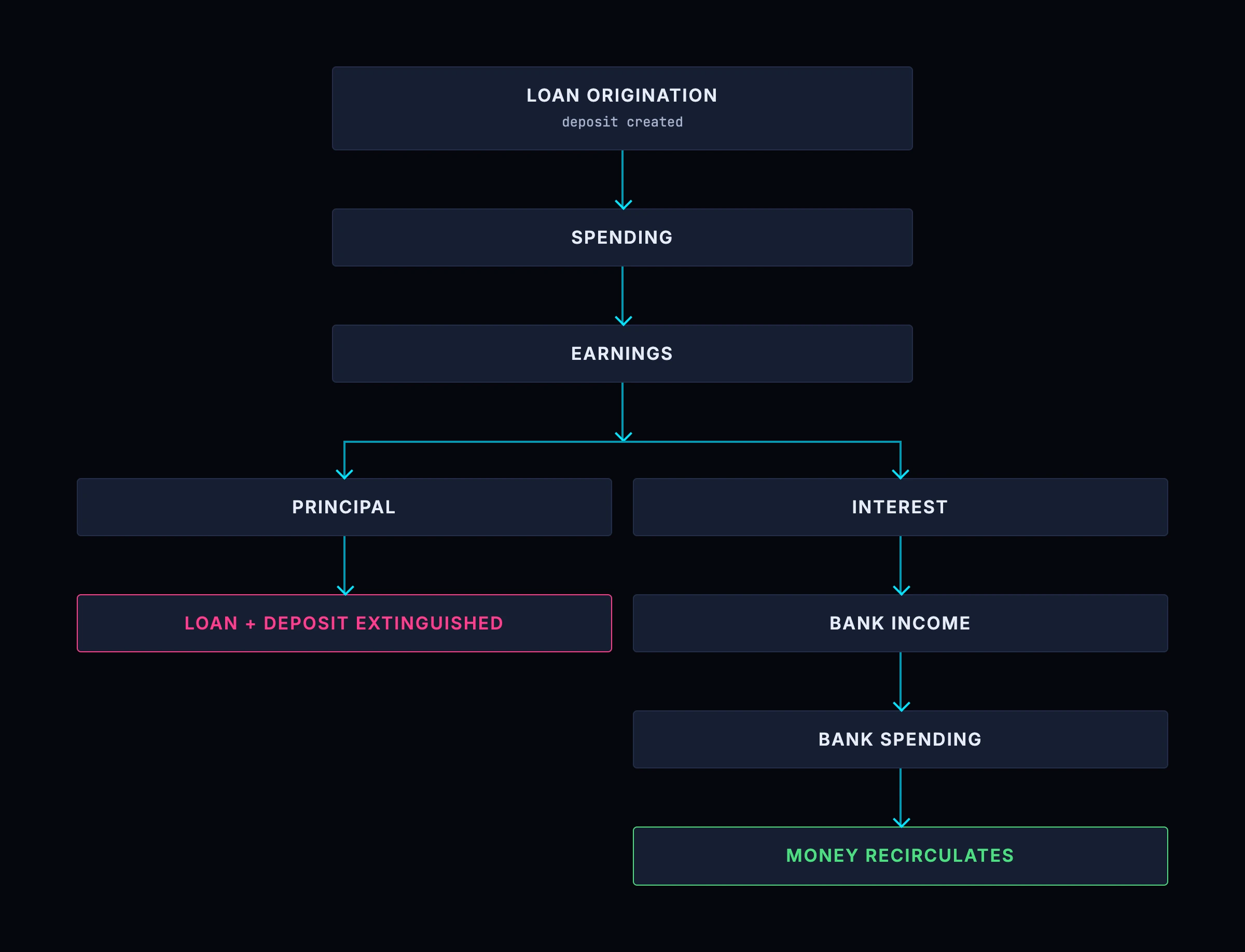
BANK MAKES LOAN

Loan asset +US$100,000
Deposit    +US$100,000
        │
        ▼
Commercial money exists
        │
        ▼
Borrower spends / earns / trades
        │
        ▼
Borrower pays interest
        │
        ▼
Bank earns income
        │
        ▼
Bank pays employees / vendors / taxes / dividends
        │
        ▼
Deposits circulate back into economy
        │
        ▼
Borrower can earn deposits again
The system is a circulating network, not a sealed envelope attached to each loan.
This page is part of How the US Dollar Is Created, the full primer on where dollars come from and how they move.
Frequently Asked Questions
Does a bank create the interest when it creates a loan?
Normally, no. The loan origination creates the principal deposit. The borrower's interest payments are made from deposits obtained through economic activity, existing balances, new credit flows, or other sources.
Is there a mathematical interest shortage?
Only under restrictive assumptions such as a closed system with no existing money, no circulation of bank income, no additional lending, no government flows, and simultaneous repayment. Those assumptions do not describe an operating economy.
Does paying interest destroy money?
A same-bank interest payment reduces the customer's deposit while increasing the bank's income/equity position. The bank can subsequently recreate deposits through spending or distributions. Principal repayment is the cleaner case of loan/deposit cancellation.
Does principal repayment destroy money?
In the standard bank-loan example, yes. The deposit used for repayment and the corresponding loan principal are reduced together.
Can the same dollar pay interest more than once?
Yes. A deposit can move from one person to another and support multiple payments over time.
If all borrowers tried to repay all debt at once, would deposits shrink?
Yes, all else equal. Widespread principal repayment without offsetting new deposit creation contracts commercial-bank money.
Related Pages in This Primer
Authoritative Sources
Bank of England, Money creation in the modern economy: https://www.bankofengland.co.uk/quarterly-bulletin/2014/q1/money-creation-in-the-modern-economy
Bank of England, How is money created?: https://www.bankofengland.co.uk/explainers/how-is-money-created
Deutsche Bundesbank, The Origin of Money, Part II: Book Money: https://www.bundesbank.de/en/service/school-service/animation-videos/the-origin-of-money-part-ii-book-money-860052
Federal Reserve, Understanding Bank Deposit Growth during the COVID-19 Pandemic: https://www.federalreserve.gov/econres/notes/feds-notes/understanding-bank-deposit-growth-during-the-covid-19-pandemic-20220603.html
Conclusion
A bank typically creates the principal deposit when it makes a loan, not a separate deposit representing all future interest. In a deliberately frozen economy, that creates a genuine shortfall if borrowers are required to repay principal plus interest simultaneously. In a functioning economy, however, money continuously circulates. Banks receive interest and also pay wages, suppliers, taxes, depositors, creditors, and shareholders. New loans are made while old loans are repaid. The same deposit money can be used repeatedly.
The correct question is therefore not, “Where was the interest money hidden when the loan was created?” It is, “What flows allow the borrower to obtain deposits over time, and how do those deposits circulate through the banking system?”