
One US$100,000 Loan From Creation to Circulation to Repayment
This chapter creates a deliberately simplified economy with five banks, no cash, and one new commercial loan. We then follow the loan-created deposit until the debt is repaid and the commercial money disappears.
The example is a teaching model, not a literal reconstruction of the real Federal Reserve System.
1. The Five-Bank Economy
There are six financial institutions:
Federal Reserve;
Bank A;
Bank B;
Bank C;
Bank D;
Bank E.
There is no physical currency.
Assume each commercial bank begins with US$1 million of Federal Reserve reserves.
FEDERAL RESERVE LIABILITY LEDGER

Bank A reserves       $1,000,000
Bank B reserves       $1,000,000
Bank C reserves       $1,000,000
Bank D reserves       $1,000,000
Bank E reserves       $1,000,000
                      ----------
Total reserves        $5,000,000
To make the starting balance sheets complete, assume the Fed originally supplied these reserves through loans to the banks.
Each bank therefore begins, very simplistically, with:
Asset:
Federal Reserve reserves     $1,000,000

Liability:
Borrowing from Fed           $1,000,000
The point is not that this is how real banks normally start. The point is to distinguish US$5 million of central-bank reserves from deposits that will be created later.
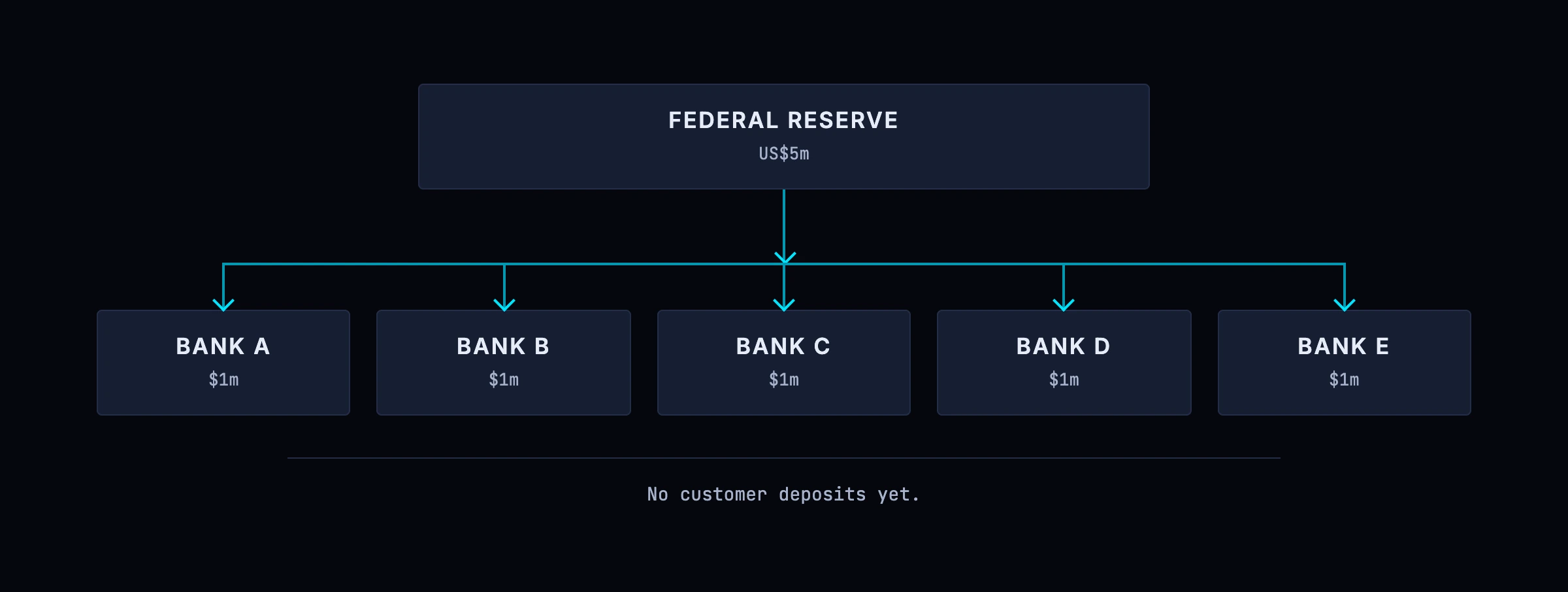
2. There Are Initially No Customer Deposits
At the beginning of the exercise:
Central-bank reserve money       $5,000,000
Customer deposits                         $0
This artificial starting point makes the next accounting entry visible.
3. Alice Borrows US$100,000 From Bank A
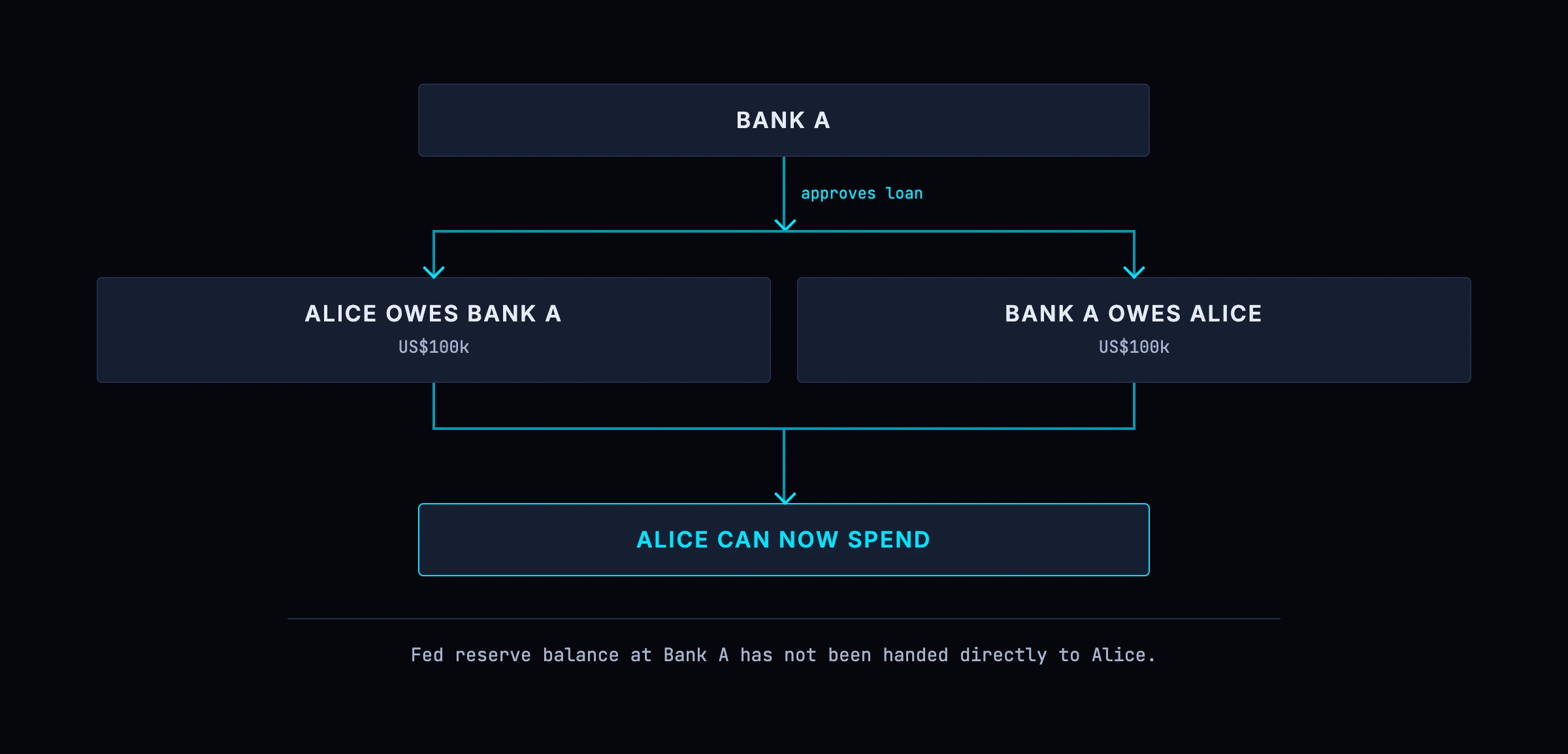
Bank A approves the loan.
It records:
BANK A

Asset:
Loan to Alice              +$100,000

Liability:
Alice deposit              +$100,000
Alice sees:
Checking balance: $100,000The banking system now contains:
Federal Reserve reserves       $5,000,000
Commercial-bank deposits         $100,000
The US$100,000 deposit is not a subdivision of the US$5 million reserve stock.
It is a new commercial-bank liability paired with Bank A's new loan asset.
4. Alice Does Nothing for One Day
Suppose Alice simply holds the deposit.
Bank A has:
Assets
Fed reserves              $1,000,000
Loan to Alice               $100,000

Liabilities
Fed borrowing             $1,000,000
Alice deposit               $100,000
Nothing has to happen to reserve balances merely because Alice has a deposit.
The new commercial money exists on Bank A's ledger.
5. Alice Buys Machinery From Bob
Price:
$100,000Bob banks at Bank B.
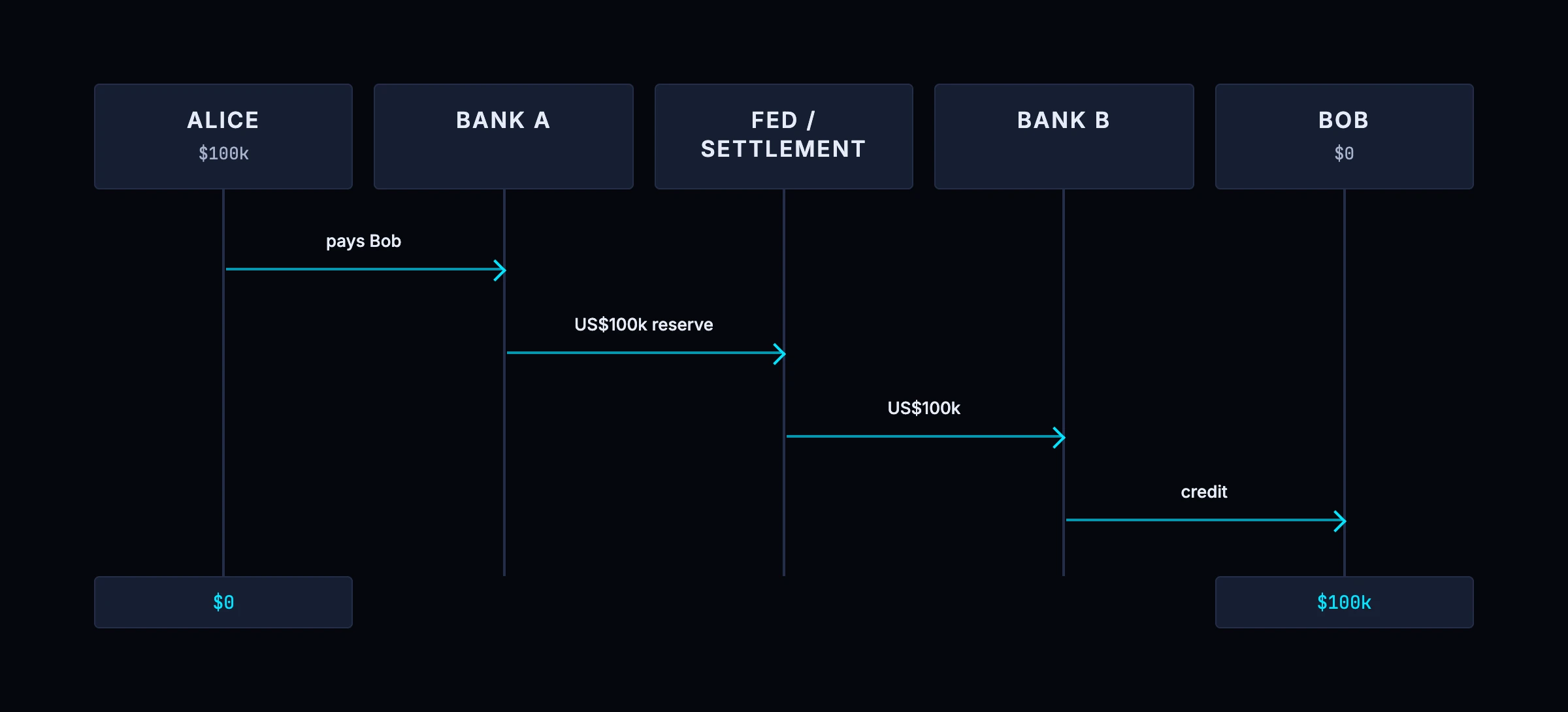
Alice instructs Bank A to pay Bob.
Bank A reduces:
Alice deposit -$100,000Bank B credits:
Bob deposit +$100,000If the payment settles gross through reserves, the Fed's ledger changes:
Bank A reserves
$1,000,000 -> $900,000

Bank B reserves
$1,000,000 -> $1,100,000
Total reserves are still:
$5,000,000The reserve money did not multiply or disappear. It changed distribution.
6. Where Is the US$100,000 Commercial Money Now?
Before the purchase:
Alice at Bank A $100,000After the purchase:
Bob at Bank B $100,000The deposit money still exists.
The issuer changed from Bank A's liability to Alice to Bank B's liability to Bob, with interbank settlement underneath.
Alice still owes Bank A:
Loan balance $100,000This is the crucial moment:
Alice's debt exists at Bank A
Bob's deposit exists at Bank B
The debt and the money created by the original loan no longer have to be held by the same person or the same bank.
7. Bob Pays Charlie at Bank C
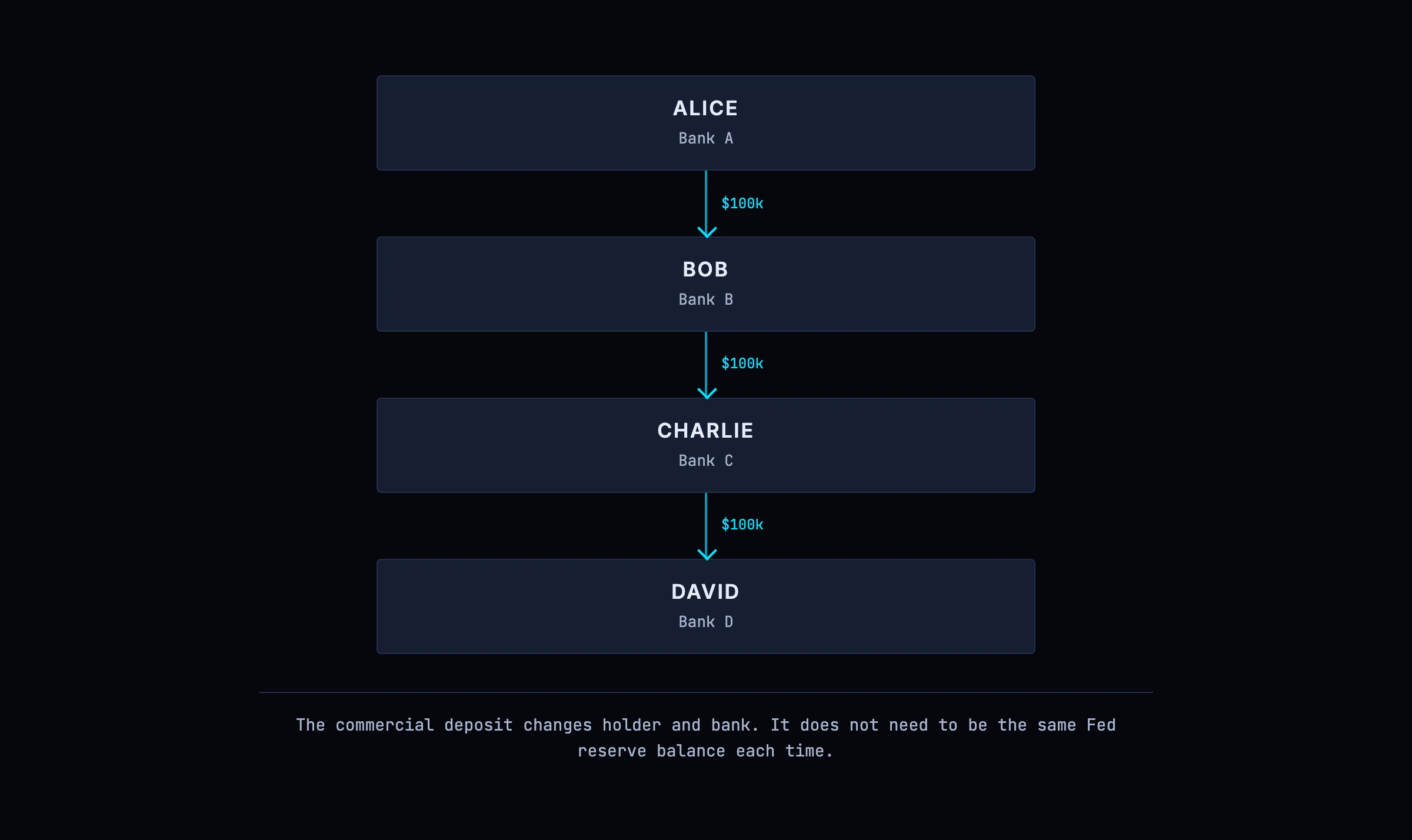
Suppose Bob buys inventory from Charlie for US$40,000.
Now:
Bob at Bank B            $60,000
Charlie at Bank C        $40,000
Reserve settlement may redistribute US$40,000 from Bank B to Bank C.
The commercial deposit money is now split between two holders.
The original loan to Alice remains US$100,000.
This illustrates why it is meaningless to ask where “Alice's original US$100,000” physically went. The deposit claim has circulated and fragmented through the banking system.
8. Charlie Pays David at Bank D
Charlie pays David US$25,000.
Now the US$100,000 of deposits may be distributed:
Bob at Bank B           $60,000
Charlie at Bank C       $15,000
David at Bank D         $25,000
                        -------
Total deposits          $100,000
The loan asset is still:
Bank A loan to Alice $100,000The loan and the deposit stock have become geographically and institutionally separated.
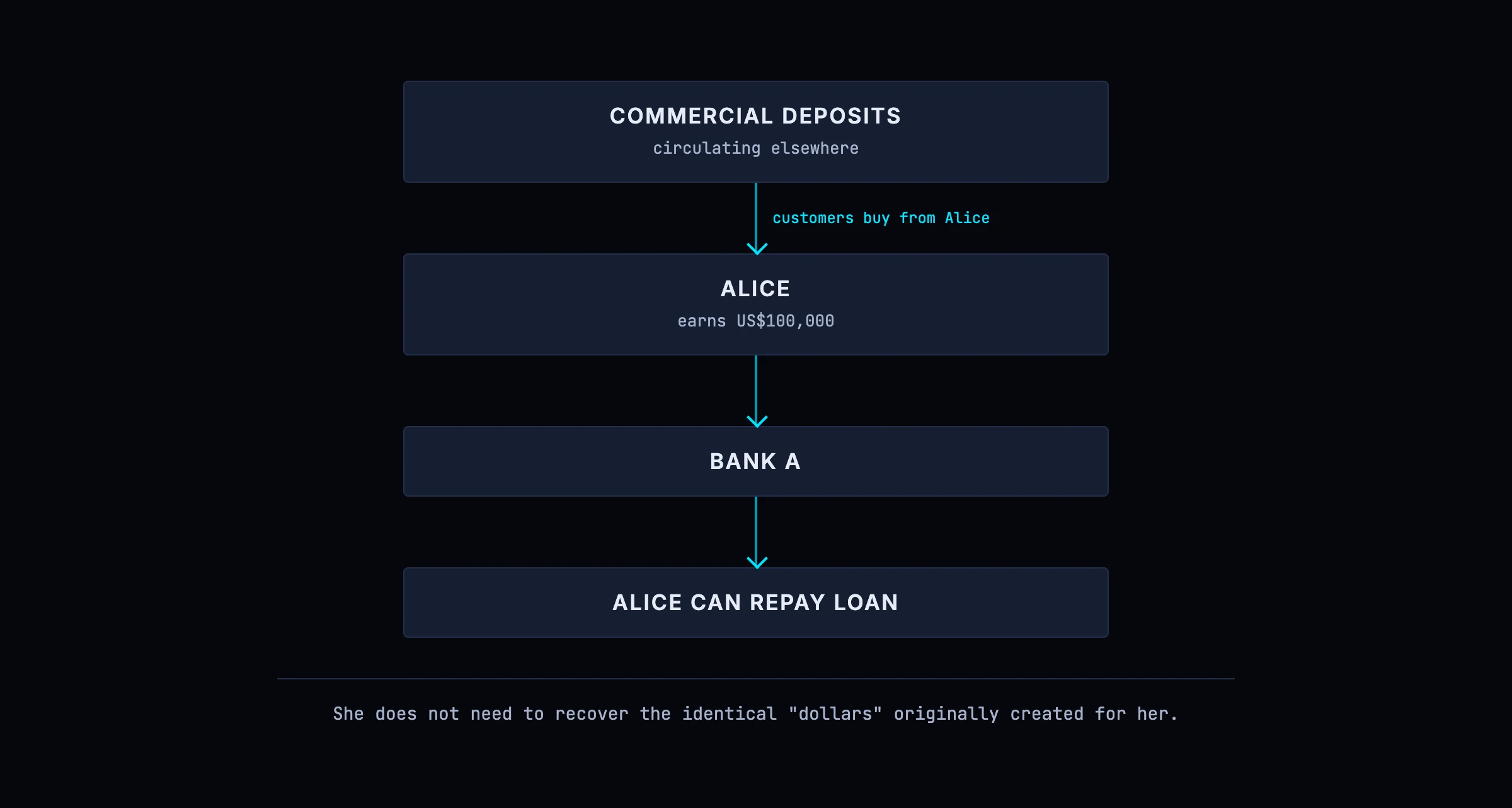
9. How Can Alice Ever Repay?
Alice no longer has the deposit she borrowed.
She spent it.
To repay the loan, she must earn or otherwise acquire deposits from someone else.
Suppose Alice provides consulting services to Bob, Charlie, and David.
They collectively pay her US$100,000 over several months.
Their deposits fall.
Alice's deposit rises.
Eventually:
Alice at Bank A         $100,000
Bob/Charlie/David             $0
Reserve movements over the months return settlement value toward Bank A as the payments arrive.
This is ordinary monetary circulation.
Alice did not need to find the exact digital objects she originally borrowed. She only needed to acquire an equivalent amount of bank deposits.
10. Alice Repays Principal
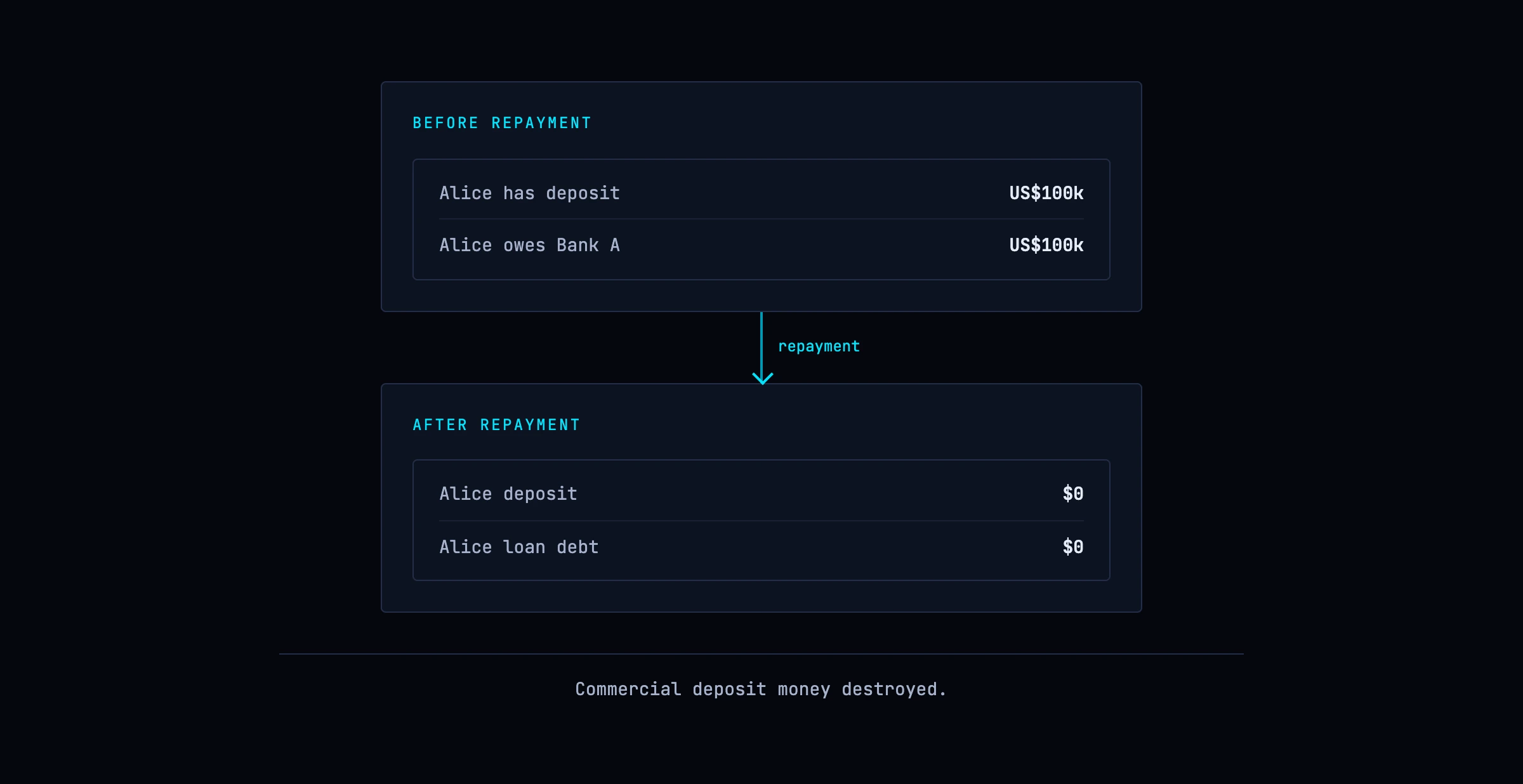
Immediately before repayment:
BANK A

Asset:
Loan to Alice            $100,000

Liability:
Alice deposit            $100,000
Alice instructs Bank A to repay the loan.
Bank A records:
Loan to Alice            -$100,000
Alice deposit            -$100,000
After repayment:
Loan to Alice                  $0
Alice deposit                   $0
The US$100,000 of commercial deposit money has been extinguished.
11. What Happened to the US$5 Million of Fed Reserves?
They never needed to change in aggregate.
At the beginning:
Total reserves $5,000,000After Alice borrowed:
Total reserves $5,000,000After Alice paid Bob:
Total reserves $5,000,000After Bob paid Charlie:
Total reserves $5,000,000After the money circulated back to Alice:
Total reserves $5,000,000After Alice repaid principal:
Total reserves $5,000,000The distribution among banks changed during payments.
The total reserve stock did not have to rise and fall with the commercial loan.
This is the cleanest illustration of why central-bank money and commercial-bank money are separate layers.
12. What If Bank A and Bank B Netted Payments Instead?
The previous example used simple gross reserve settlement for clarity.
Real systems can net obligations.
Suppose at the same time Alice paid Bob US$100,000, another Bank B customer paid a Bank A customer US$90,000.
Gross flows:
Bank A -> Bank B       $100,000
Bank B -> Bank A        $90,000
Net:
Bank A -> Bank B $10,000Only US$10,000 of additional settlement funding may be needed under the relevant clearing arrangement.
The customer deposit changes can still total US$190,000 of gross payment activity.
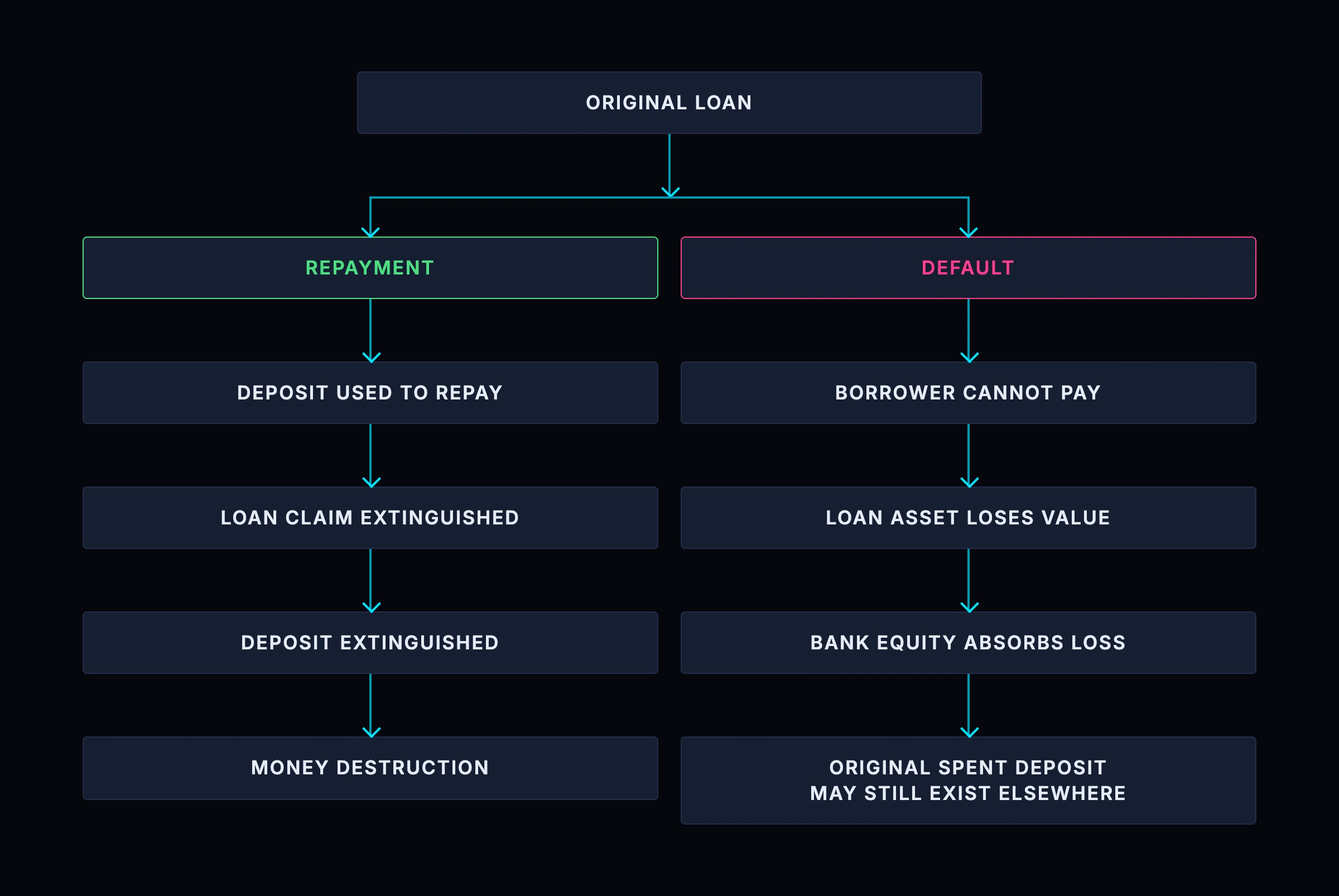
13. What If Alice Defaults Instead of Repaying?
Suppose Alice spent US$100,000 and then her business failed.
The deposits she created by borrowing may still be held by Bob, Charlie, and David.
Bank A's asset becomes impaired:
Loan to Alice $100,000 -> bad loanIf written off:
Loan asset                 -$100,000
Bank equity                -$100,000
The deposits held elsewhere do not automatically disappear.
Default destroys bank capital, not necessarily the deposit money that was created and spent earlier.
This is fundamentally different from successful principal repayment.
14. Now Add Interest
Suppose Alice owes 10% interest.
After one year:
Principal       $100,000
Interest         $10,000
                --------
Total           $110,000
The loan originally created only US$100,000 of deposits.
Alice must acquire the additional US$10,000 from deposits already circulating or created through other economic activity.
The bank does not need to create the interest at origination as a separate deposit.
The interest question is treated in detail in Where Does Bank-Loan Interest Come From?.
15. What This Example Proves
The five-bank model demonstrates several separate facts:
Federal Reserve reserves and commercial-bank deposits are different.
A bank loan can create a new deposit without reducing reserves at origination.
When the borrower spends, the originating bank may lose reserves to another bank.
The loan remains even after the deposit leaves the originating bank.
Deposit money can circulate among many customers and banks.
The borrower can repay using deposits earned from others.
Principal repayment can extinguish the loan asset and deposit liability.
Aggregate reserve balances do not need to change with each commercial loan lifecycle.
Default and repayment have different monetary consequences.
Interest introduces a flow problem, not a requirement that the bank pre-create an identical interest pile.
This page is part of How the US Dollar Is Created, the full primer on where dollars come from and how they move.
Frequently Asked Questions
Did Bank A lend out US$100,000 of its reserves to Alice?
No. Alice received a deposit. Reserves became relevant when payments crossed between banks.
Where did Alice's original US$100,000 go after she spent it?
The deposit claim moved through the banking system to other customers and banks.
Can Alice repay with different dollars from the ones she borrowed?
Yes. Deposits are fungible.
Does principal repayment destroy Federal Reserve reserves?
Not necessarily. It directly reduces the commercial-bank loan asset and deposit liability.
Why did total reserves remain US$5 million?
Because the example assumed no new Fed transactions. Payments only redistributed the existing reserves among banks.
What happens if Alice defaults?
The bank takes a loss on the loan asset; deposits previously created may remain elsewhere.
Conclusion
The five-bank example turns the monetary system into a visible sequence: central-bank reserves exist, a commercial bank creates a deposit by lending, the deposit circulates, reserves settle interbank differences, and principal repayment destroys the commercial deposit and loan together.
That lifecycle is the core mechanism behind much of modern bank money.
Authoritative Sources
Federal Reserve — Understanding Bank Deposit Growth during the COVID-19 Pandemic
Bank of England — How is money created?
https://www.bankofengland.co.uk/explainers/how-is-money-created
Deutsche Bundesbank — The Origin of Money, Part II: Book Money