
What Happens to the Deposit, the Loan Asset, the Bank's Reserves, and the Money Supply When Principal Is Repaid
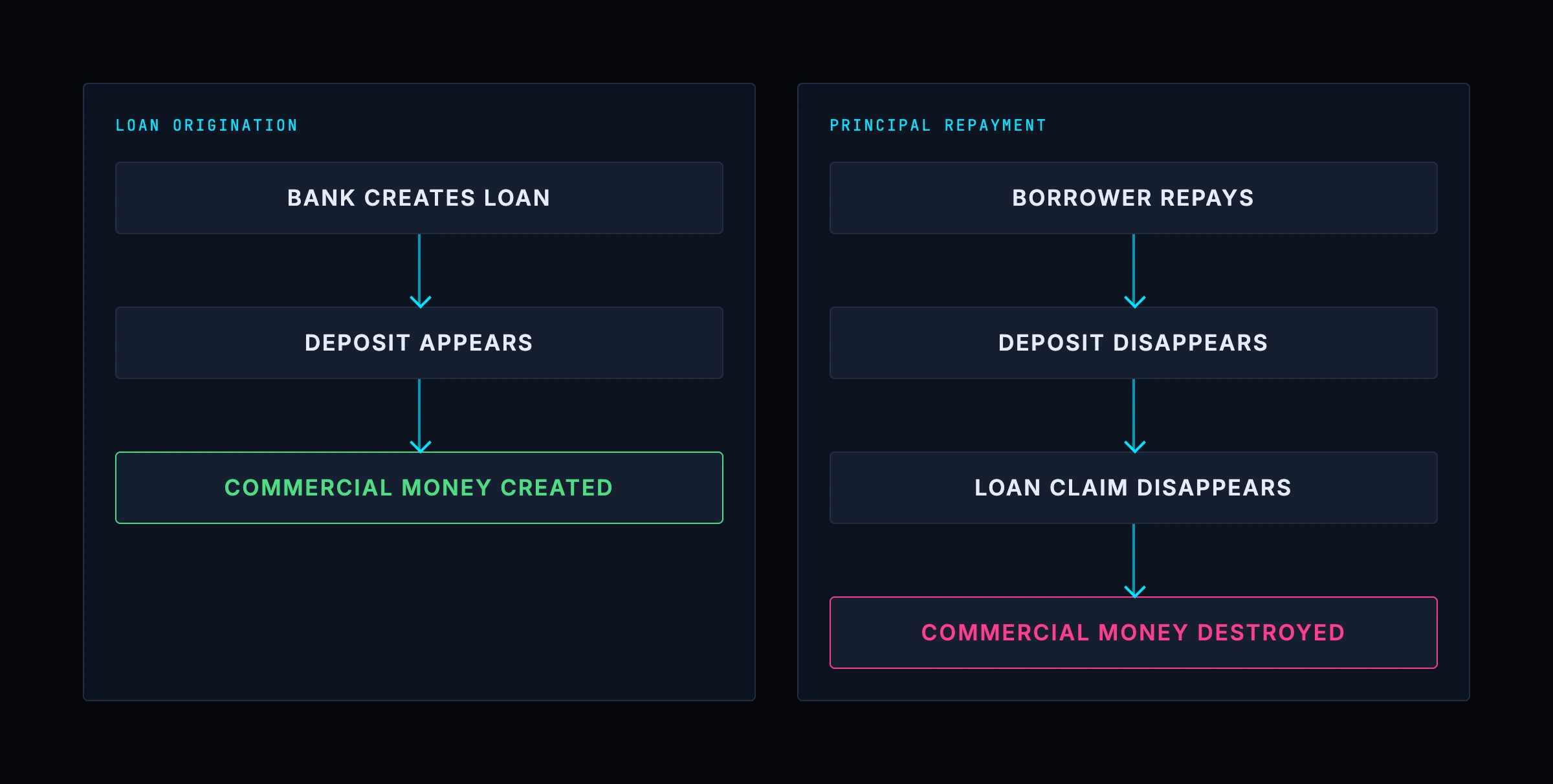
In the simplest case, repayment of loan principal reverses the original money-creation entry.
The bank's loan asset falls.
The customer's deposit falls.
The commercial-bank money represented by that deposit is extinguished.
1. Loan Repayment Begins With the Original Loan
Bank A lends Alice US$100,000.
At origination:
BANK A

Asset:
Loan to Alice              +$100,000

Liability:
Alice deposit              +$100,000
Bank A has created a new loan asset and a new deposit liability.
2. Alice Spends the Deposit
Alice buys machinery from Bob at Bank B.
Alice's Bank A deposit falls to zero.
Bob receives US$100,000 at Bank B.
The loan remains on Bank A's balance sheet:
Loan to Alice $100,000The deposit money has migrated into the wider banking system.
3. Alice Later Earns US$100,000
Over time Alice sells goods or services.
Customers pay her.
Eventually Alice has:
Bank A deposit $100,000Her debt remains:
Loan balance $100,000Now she can repay principal.
4. Principal Repayment Reverses the Creation Entry
Alice tells Bank A:
Pay off my loan from my deposit.
Bank A removes its liability to Alice:
Alice deposit -$100,000and removes its asset:
Loan to Alice -$100,000The resulting balances are:
Alice deposit                    $0
Loan to Alice                    $0
The commercial-bank deposit has been destroyed.
5. Why Call It “Destroyed”?
Because there is no longer a deposit liability held by a nonbank customer corresponding to that US$100,000.
The bank did not move the repayment into a vault marked “repaid loan money.”
The bank reduced its liability to the customer and reduced its loan receivable.
The two entries cancel.
This is why central-bank educational materials commonly describe bank money as being created by lending and destroyed by repayment.
6. Does the Bank Become US$100,000 Richer When Principal Is Repaid?
No.
Immediately before repayment, Bank A has:
Asset: loan to Alice       $100,000
Liability: Alice deposit   $100,000
After repayment:
Asset removed              -$100,000
Liability removed          -$100,000
The bank has exchanged the value of the loan claim for cancellation of an equivalent liability.
Principal repayment is not US$100,000 of profit.
Interest is different.
7. Principal vs. Interest
Suppose Alice owes:
Principal          $100,000
Interest             $5,000
                   --------
Total              $105,000
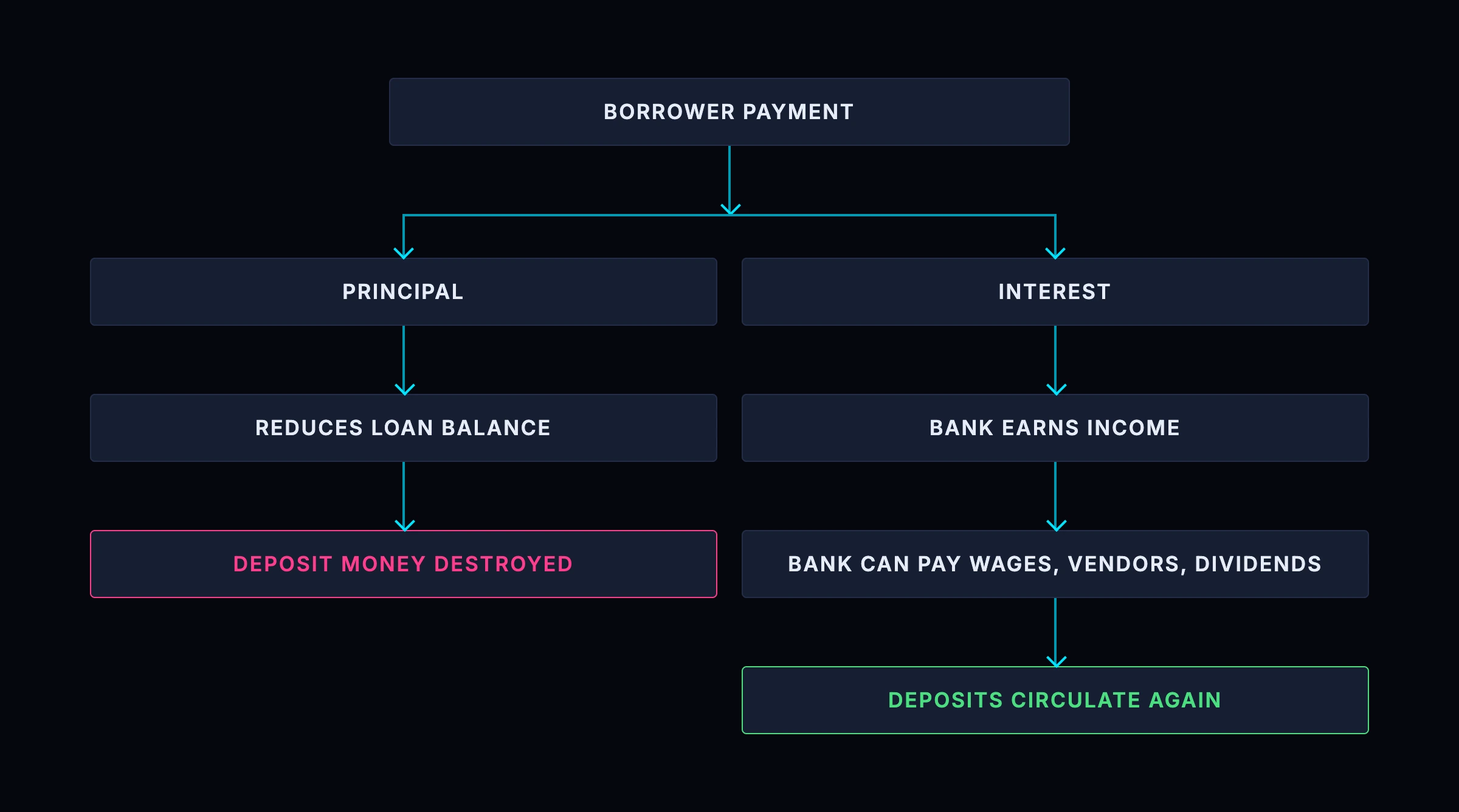
If she pays US$100,000 principal:
Loan asset          -$100,000
Deposit             -$100,000
If she pays US$5,000 interest, the bank recognizes income rather than eliminating US$5,000 of principal.
In simplified terms:
Customer deposit      -$5,000
Bank income/equity     +$5,000 before expenses/taxes/distributions
That US$5,000 can re-enter customer deposits when the bank later pays employees, vendors, taxes, deposit interest, dividends, or other obligations.
The interest problem is explored separately in Where Does Bank-Loan Interest Come From?.
8. Does Repayment Destroy Federal Reserve Reserves?
Not necessarily.
Suppose Alice's repayment deposit is already at Bank A.
Bank A can reduce its own deposit liability and loan asset internally.
No US$100,000 reserve transfer to another bank is required merely because the loan is canceled.
If Alice's funds are arriving from another bank immediately before repayment, reserves may move as part of the incoming payment. But that is an interbank settlement event, not the same thing as the destruction of the commercial deposit through principal repayment.
This distinction is important:
Commercial money destruction
= loan/deposit balance-sheet contraction

Reserve movement
= interbank settlement/liquidity event
9. What If the Borrower Repays Early?
The same principal mechanism applies.
If a US$300,000 mortgage is repaid early using a US$300,000 deposit:
Mortgage loan asset       -$300,000
Customer deposit          -$300,000
The outstanding stock of bank credit and deposits contracts relative to what it would otherwise have been.
Prepayment therefore matters for monetary dynamics, especially when large volumes of credit are refinanced or repaid.
10. What If a Different Customer's Deposit Is Used?
Suppose Alice has no deposits but sells her house to Charlie for US$100,000.
Charlie pays Alice.
Alice now has a bank deposit and uses it to repay the loan.
The deposit that is extinguished need not be the “same dollars” originally created by Alice's loan.
Deposits are fungible.
What matters is that an existing commercial-bank deposit is surrendered to extinguish a commercial-bank loan asset.
11. What If Alice Refinances?
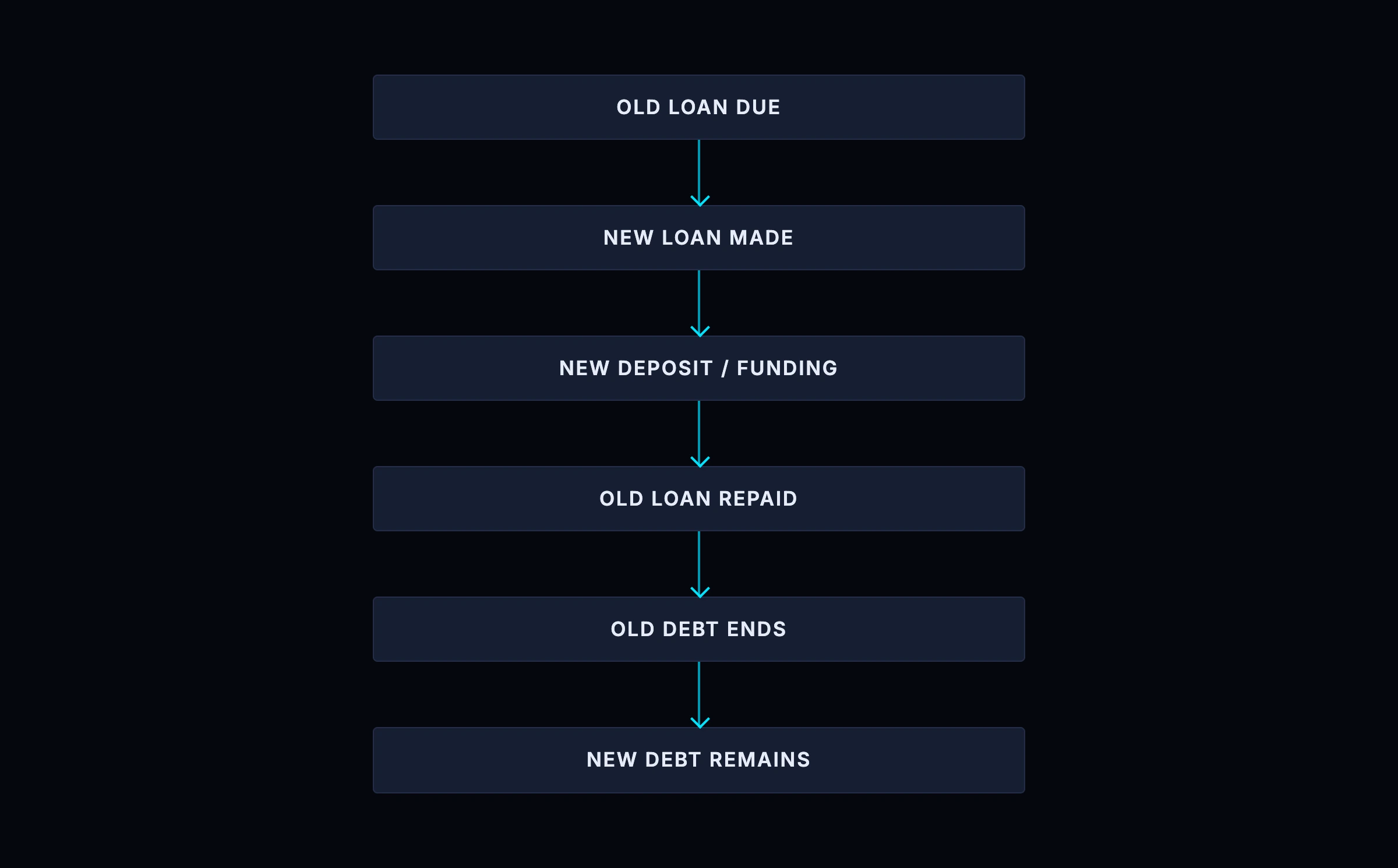
Suppose Alice owes Bank A US$100,000.
Bank B gives Alice a new US$100,000 loan.
Bank B creates a deposit, which Alice uses to pay Bank A.
One loan and deposit may be extinguished while another loan and deposit are created.
System-wide money may therefore remain similar even though individual bank balance sheets change dramatically.
This is why gross loan originations and gross repayments can be huge while net money growth is modest.
12. Default Is Not Repayment
This distinction cannot be overstated.
Alice borrows US$100,000 and spends it on Bob.
Bob still has the deposit.
Alice later defaults.
Bank A cannot simply cancel Bob's money. Bob is Bank B's depositor.
Bank A instead has a bad asset.
If Bank A writes off the loan:
Loan asset            -$100,000
Bank equity           -$100,000
The deposit created earlier may remain in the economy.
So:
Successful repayment
can destroy deposit money.

Default
can destroy bank capital.
Those are not the same outcome.
13. What If the Bank Sells the Loan?
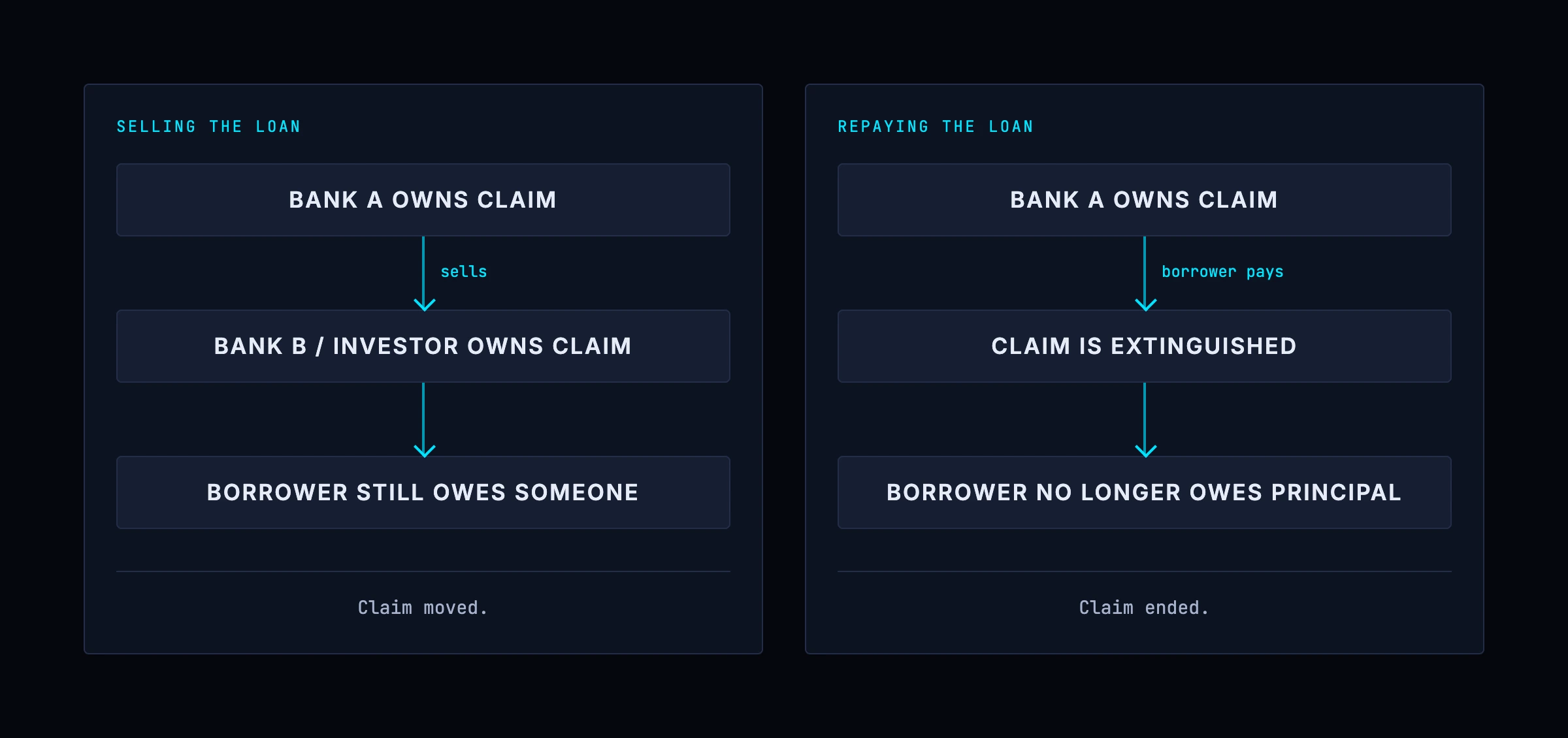
Suppose Bank A sells Alice's loan to a nonbank investor.
The money effect depends on how the investor pays.
If the nonbank investor uses a bank deposit to purchase the loan from Bank A, deposits can contract because a nonbank deposit is surrendered to the banking system while the loan moves to the nonbank sector.
If another bank buys the loan, the effect on aggregate customer deposits can differ.
This demonstrates why money creation and destruction depend not just on the asset but also on the sector of the buyer and seller.
14. Banks Are Constantly Creating and Destroying Deposit Money
A real economy contains overlapping flows:
New mortgage loans              +$10bn
Corporate loans                  +$5bn
Consumer loans                   +$3bn
Mortgage repayments              -$8bn
Corporate repayments             -$4bn
Consumer repayments              -$2bn
The money stock reflects the net effect along with many other bank balance-sheet transactions.
There is no moment when “all loans are created” and later “all loans are repaid.”
Creation and destruction occur continuously.
15. Why This Matters for Monetary Policy
When credit creation accelerates, deposit money can expand.
When households and businesses deleverage and repay loans faster than new loans are originated, deposit growth can slow or contract.
Central-bank policy influences these decisions through interest rates and financial conditions, even though the central bank is not manually approving every deposit created or destroyed.
This is one reason credit cycles and monetary conditions are closely related.
This page is part of How the US Dollar Is Created, the full primer on where dollars come from and how they move.
Frequently Asked Questions
Does paying principal destroy bank money?
In the normal bank-loan case, yes: the bank reduces the borrower's deposit and the loan asset.
Does the bank keep the repaid principal as profit?
No. Principal repayment cancels an asset and a liability; it is not ordinary income.
Does interest get destroyed the same way?
No. Interest is recognized as bank income, with different accounting consequences.
Does loan default destroy the deposit originally created?
Not automatically. The deposit may remain elsewhere while the bank writes down the loan and loses capital.
Does repayment reduce Fed reserves?
Not necessarily. Reserve movements and commercial deposit destruction are distinct processes.
Can refinancing replace destroyed money with newly created money?
Yes. A new loan can create a new deposit used to extinguish an old loan.
Conclusion
Commercial-bank money is not permanent. Bank lending can create deposits, and principal repayment can remove those deposits from the nonbank economy while simultaneously removing the bank's loan asset.
Understanding this reversal is essential to understanding credit cycles, money growth, and why the commercial money supply can expand and contract even when the stock of central-bank reserves follows a different path.
Authoritative Sources
Bank of England — How is money created?
https://www.bankofengland.co.uk/explainers/how-is-money-created
Deutsche Bundesbank — The Origin of Money, Part II: Book Money
BIS — What should the future form of our money be?
https://www.bis.org/speeches/20170426-what-should-future-form-our-money-be