
How a Loan Becomes a Deposit, Why Reserves Are Different, and What Stops Banks From Creating Unlimited Money
A commercial bank does not print Federal Reserve notes and it cannot manufacture Federal Reserve reserves. What it can do is create a deposit liability when it acquires an asset such as a loan.
That deposit is spendable money to the customer.
1. How Commercial Banks Create Money: Start With a US$100,000 Loan
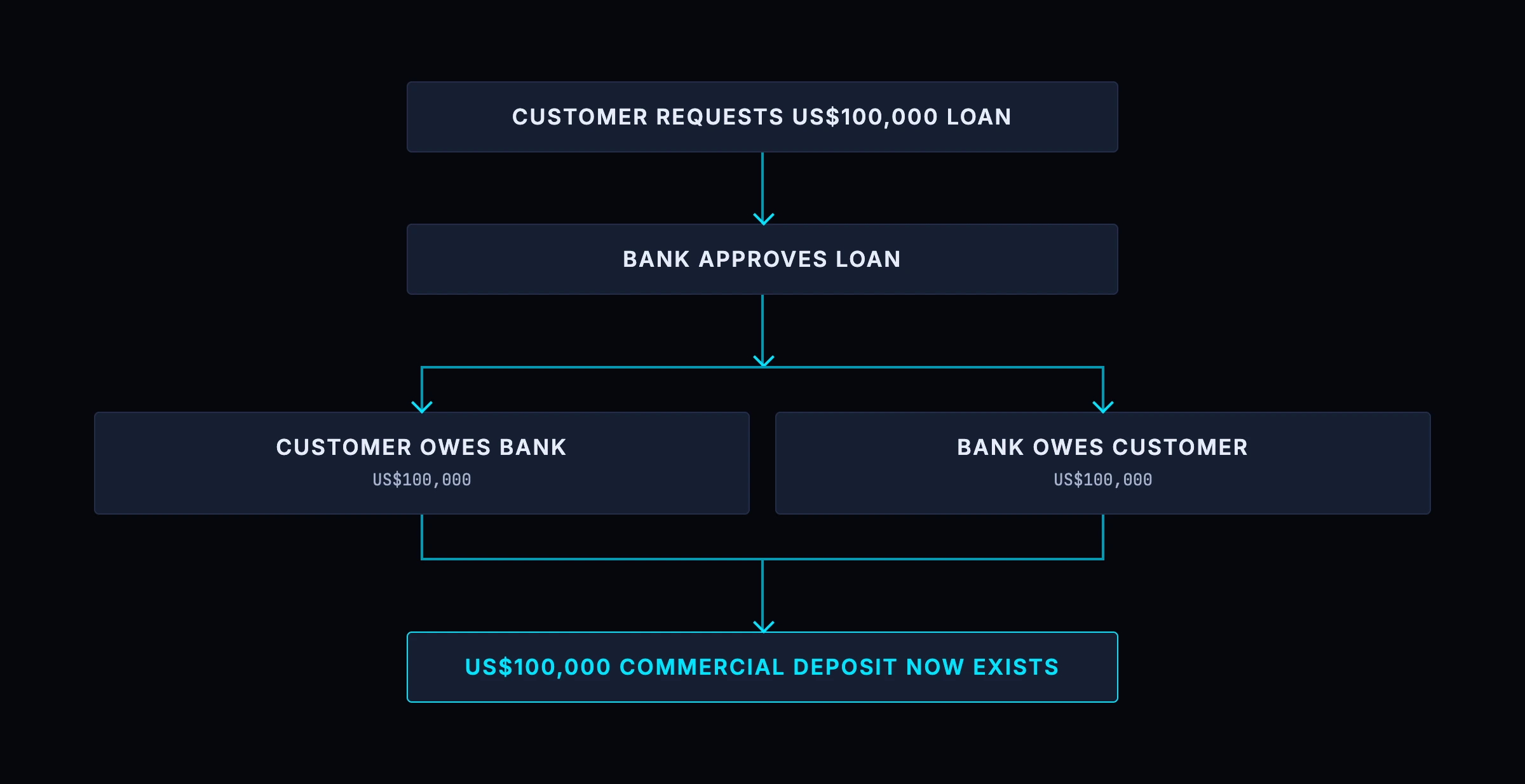
Alice asks Bank A for a US$100,000 business loan.
Bank A approves the loan.
The bank records:
BANK A

Assets                             Liabilities
------                             -----------
Loan to Alice      +$100,000      Alice deposit      +$100,000
The loan is an asset because Alice owes Bank A money.
The deposit is a liability because Bank A owes Alice money.
Alice opens her banking app and sees:
Available balance: $100,000That spendable deposit did not need to be transferred from a specific saver at the moment of origination.
The bank created the deposit while creating the loan asset.
2. This Does Not Mean the Bank Created Wealth
Alice gained:
Bank deposit asset +$100,000but also:
Loan debt +$100,000Her net worth did not rise by US$100,000 merely because she borrowed.
Similarly, Bank A gained a loan asset and a matching deposit liability.
Money creation and wealth creation are not the same thing.
3. Why the “Banks Lend Out Deposits” Story Is Incomplete
Banks absolutely do care about deposits as a source of funding.
But the accounting event at loan origination is not normally:
Saver's deposit             -$100,000
Alice's deposit             +$100,000
Instead, the new loan itself can be accompanied by a new deposit.
After Alice spends the deposit, however, the originating bank may lose the deposit to another bank and must manage the resulting liquidity and funding position.
That is the important nuance:
Loan origination can create the deposit, but the bank still has to fund and manage the resulting balance sheet after the borrower spends it.
This is why “banks create deposits” does not mean “banks do not need funding.”
4. What Happens When Alice Spends the Loan?
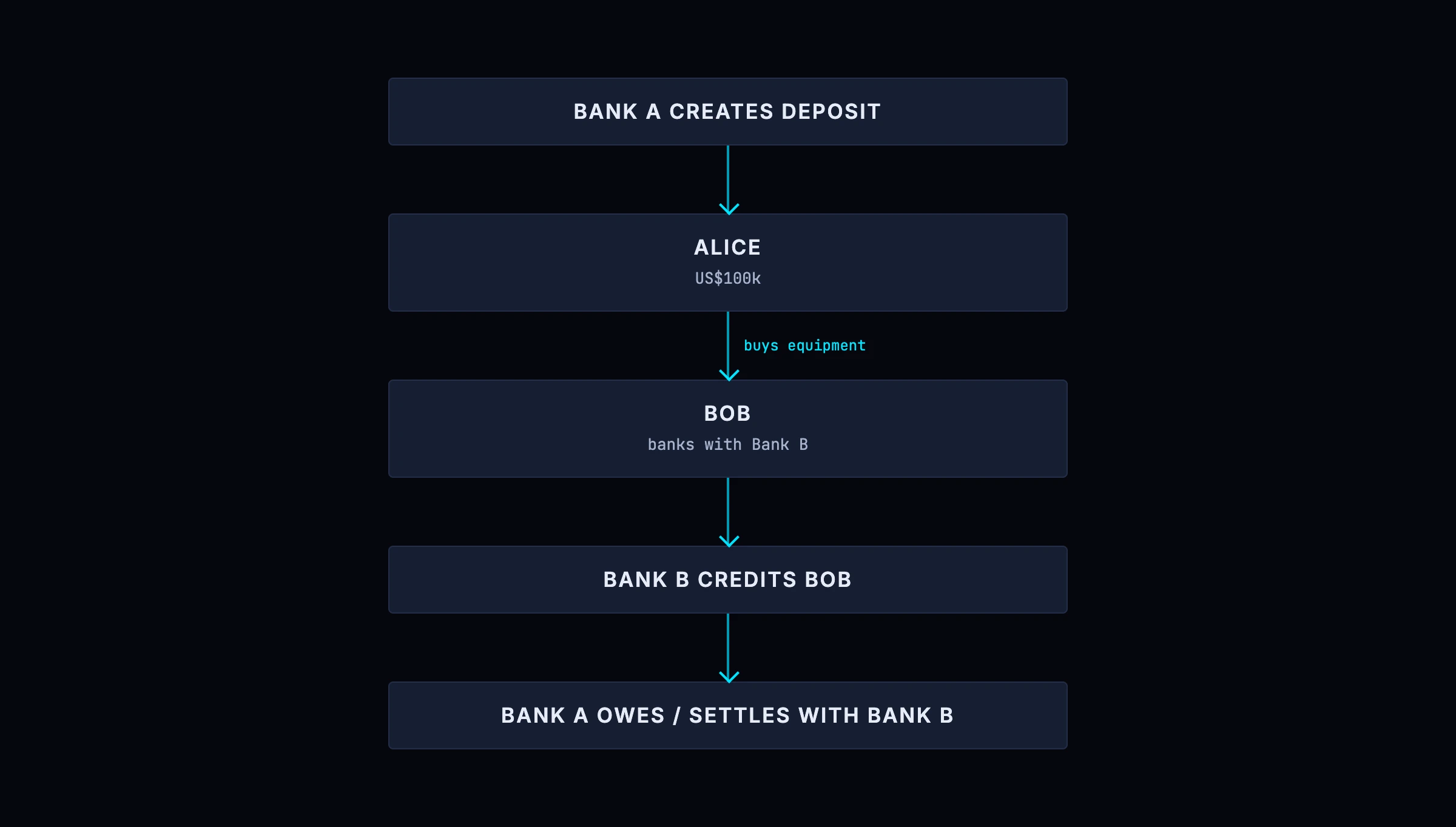
Suppose Alice pays Bob US$100,000 and Bob banks at Bank B.
Bank A reduces Alice's deposit:
Alice deposit -$100,000Bank B credits Bob:
Bob deposit +$100,000Bank A may then need to transfer reserves or otherwise settle its obligation to Bank B.
The loan remains on Bank A's balance sheet:
Loan to Alice $100,000The deposit Bank A created has migrated to another institution.
Bank A therefore has an ongoing funding and liquidity problem to manage even though it created the original deposit itself.
The payment mechanics are covered in How Bank Transfers Actually Work.
5. Can a Bank Create Money by Buying an Asset?
Yes, deposit creation is not limited strictly to loans.
Suppose Bank A purchases a US$1 million security from a nonbank customer and credits the seller's deposit account.
Simplified:
BANK A

Asset:
Security                    +$1,000,000

Liability:
Seller deposit              +$1,000,000
A new bank deposit can be created because the bank acquired an asset and paid by issuing its own deposit liability.
The reverse can also contract deposit money. If a nonbank buys an asset from the bank and pays using a deposit, the deposit can fall.
This is why money creation is fundamentally a balance-sheet phenomenon, not merely a physical lending process.
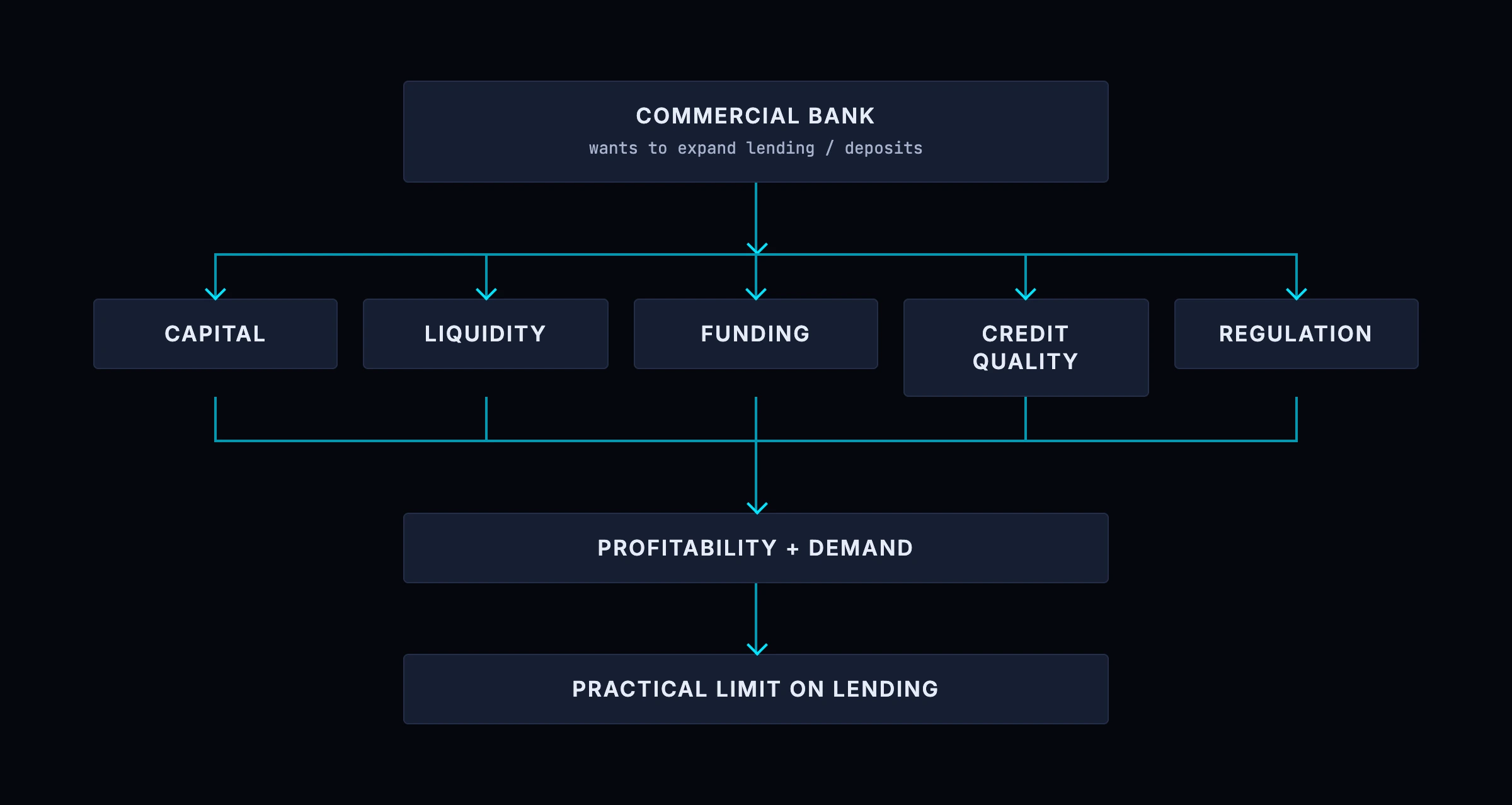
6. Why Banks Cannot Create Unlimited Deposits
The phrase “the bank types US$100,000 into an account” makes lending sound costless.
It is not.
Capital constraints
A loan is risky. If Alice defaults, Bank A can lose money. Capital requirements limit the amount and riskiness of assets a bank can support relative to its equity.
Liquidity constraints
Alice may transfer her new deposit immediately to another bank. Bank A may need reserves or other liquid funding to settle the outflow.
Funding constraints
The deposit created at origination may leave. The loan stays. Bank A must maintain a sustainable funding structure for the asset.
Credit underwriting
A bank that creates loans to people who cannot repay eventually destroys its own capital.
Interest-rate environment
The cost of wholesale funding, deposit pricing, and reserve balances affects loan profitability.
Regulatory constraints
Leverage requirements, risk-based capital rules, liquidity requirements, large-exposure limits, underwriting standards, stress tests, and supervision all matter.
Market demand
Banks need borrowers willing and able to borrow at acceptable rates.
Profitability
A loan that earns 6% may be unattractive if expected credit losses, operating cost, funding cost, and capital cost exceed the revenue.
7. The Reserve Requirement Myth
A common textbook example says:
A bank receives US$1,000 of deposits, keeps US$100 as required reserves, and lends US$900.
That example can teach a historical reserve-multiplier model, but it should not be treated as a literal description of U.S. banking in 2026.
The Federal Reserve reduced reserve requirement ratios to zero in March 2020 and official 2026 materials state they remain zero.
That does not make reserves irrelevant.
Reserves are still required for settlement and liquidity, and the cost and distribution of reserves matter. But the question “does the bank have 10% required reserves before making the next loan?” is not the correct modern U.S. lending test.
8. Bank A Can Create a Deposit but Cannot Create Reserves
This is the dividing line.
Bank A can record:
Loan to Alice              +$100,000
Deposit to Alice           +$100,000
Bank A cannot simply record:
Federal Reserve reserves +$100,000and make the Fed accept it.
Federal Reserve reserves are liabilities of the Federal Reserve.
Bank A must obtain them through the financial system or through Fed facilities for which it is eligible.
This distinction is explored in Federal Reserve Money vs. Commercial Bank Money.
9. What Happens When Loan Principal Is Repaid?
Suppose Alice later has US$100,000 in her account at Bank A and repays the loan.
Bank A removes:
Loan asset                 -$100,000
Deposit liability          -$100,000
Both entries contract.
The commercial deposit money is extinguished.
This is why the stock of bank money is constantly changing as:
new loans are made
old loans are repaid
banks buy assets
banks sell assets
customers move deposits
banks issue liabilities
banks receive payments
The repayment mechanics are examined separately in How Loan Repayment Destroys Bank Money.
10. What Happens If the Borrower Defaults?
Default is different from repayment.
Suppose Alice spent the US$100,000 and Bob now holds the deposit at Bank B.
Alice then defaults.
Bank A may have to write down the loan asset.
But Bob's deposit at Bank B does not automatically vanish.
Instead Bank A's equity or loss reserves absorb the loss, subject to accounting and insolvency rules.
That distinction is crucial:
Repayment -> loan and deposit can contract together
Default   -> bad asset harms bank capital; original deposit can remain elsewhere
11. Why Commercial-Bank Money Can Exceed Reserves
Suppose the banking system has:
Federal Reserve reserves       $5 billion
Commercial-bank deposits      $40 billion
There is nothing inherently contradictory about this.
Commercial banks have created deposit liabilities against portfolios of:
loans;
securities;
reserves;
interbank claims;
other assets.
There is no rule that every deposit dollar must have a one-for-one reserve dollar behind it.
12. Money Creation Is Continuous, Not a One-Time Event
During one day:
New loans originated                +$500m
Loan principal repaid               -$350m
Bank asset purchases from nonbanks  +$100m
Bank asset sales to nonbanks         -$50m
The resulting change in deposits depends on all of these flows and other transactions.
The economy is not a single loan followed by a single repayment. It is millions of overlapping balance-sheet events.
That is why the money stock can expand, contract, or remain roughly stable even while enormous gross transaction volumes occur.
13. Why This Matters for Payments Companies
Payment companies often focus only on the transfer layer.
But banks analyze the underlying balance-sheet reality:
Whose deposit is this?
Who owns the funds?
Is the account pooled or named?
Is the payment company holding a bank deposit or merely a sub-ledger claim?
Which institution bears the liability to the end customer?
How does settlement occur if customer funds leave?
Those questions explain why banking access is more complicated than obtaining an account number. The existing Faisal Khan pages on named and virtual accounts and settlement accounts show how these monetary distinctions become operational account structures.
This page is part of How the US Dollar Is Created, the full primer on where dollars come from and how they move.
Frequently Asked Questions
Does a bank need another customer's deposit before it makes a loan?
Not as a mechanical accounting prerequisite to creating the new loan and matching deposit. The bank nevertheless needs a sustainable funding and liquidity structure.
Does lending create Federal Reserve reserves?
No. It creates a commercial-bank loan asset and usually a commercial-bank deposit liability.
Are U.S. banks constrained by a 10% reserve requirement?
No. Reserve requirement ratios remain zero as of 2026.
If reserve requirements are zero, can banks lend infinitely?
No. Capital, liquidity, funding, risk, supervision, profitability, and demand constrain lending.
Can banks create deposits by buying assets?
Yes, when a bank buys an asset from a nonbank and pays by crediting a deposit, deposit money can increase.
What destroys commercial bank money?
Loan principal repayment is a major mechanism; certain asset sales and liability transactions can also reduce deposits.
Conclusion
Commercial banks create deposit money by expanding both sides of their balance sheets. A loan can create a matching deposit, but the bank then bears credit risk, liquidity risk, funding needs, capital requirements, and settlement obligations.
Banks create money, but they do not create it without cost, constraint, or consequence.
Authoritative Sources
Federal Reserve — A Lawyer's Perspective on U.S. Payment System Evolution and Money in the Digital Age
Federal Reserve — Understanding Bank Deposit Growth during the COVID-19 Pandemic
Federal Reserve — Reserve Requirements
https://www.federalreserve.gov/monetarypolicy/reservereq.htm
Bank of England — Money creation in the modern economy
https://www.bankofengland.co.uk/quarterly-bulletin/2014/q1/money-creation-in-the-modern-economy
Deutsche Bundesbank — The Origin of Money, Part II: Book Money