
Why a Dollar at the Fed Is Not the Same Legal Claim as a Dollar in Your Checking Account
Underneath that convenience, however, different institutions issue different dollar liabilities.
The most useful first distinction is between central-bank money and commercial-bank money.
1. Central-Bank Money
Central-bank money is a liability of the central bank.
For the United States, the central bank is the Federal Reserve System.
Two important forms are:
Federal Reserve notes — physical currency issued through the Federal Reserve system; and
reserve balances — electronic balances maintained at Federal Reserve Banks by eligible institutions.
In the cashless examples used throughout this series, reserve balances are the important form.
Suppose the Federal Reserve's books contain:
JPMorgan reserve account         $80 billion
Bank of America reserve account  $75 billion
Citi reserve account             $55 billion
Those balances are liabilities of the Federal Reserve.
From JPMorgan's point of view, its reserve balance is an asset: the Fed owes value to JPMorgan through the reserve account.
From the Fed's point of view, that same balance is a liability.
This is why one financial relationship can be an asset to one party and a liability to another.
2. Commercial-Bank Money
Now consider your checking account.
Suppose you see:
Checking account balance: $100,000That US$100,000 is normally not a direct liability of the Federal Reserve to you.
It is a liability of your commercial bank.
If your account is at JPMorgan:
YOU
Asset: claim against JPMorgan        $100,000

JPMORGAN
Liability: amount owed to you        $100,000
This is commercial-bank deposit money.
The Federal Reserve has explicitly described commercial-bank money as a liability of commercial banks, distinct from central-bank money. That distinction is not theoretical trivia. It tells you who is legally responsible for honoring the balance.
3. Why Do We Treat Both as “One Dollar”?
Because under normal banking conditions, they are expected to convert at par.
If you have US$1,000 at Bank A, you expect to be able to:
pay someone at Bank B US$1,000;
withdraw US$1,000 of currency, subject to normal account arrangements;
use US$1,000 to discharge a US$1,000 obligation.
You normally do not apply a discount such as:
$1 at JPMorgan = $0.97 at Bank of AmericaThe system is designed to preserve par convertibility.
Several institutions help sustain that expectation:
bank capital and liquidity requirements;
prudential supervision;
deposit insurance within applicable limits and conditions;
access to payment and settlement systems;
central-bank liquidity facilities for eligible institutions;
market discipline;
interbank clearing and settlement.
So although the legal issuer differs, the monetary system tries to make the user experience look like:
$1 = $1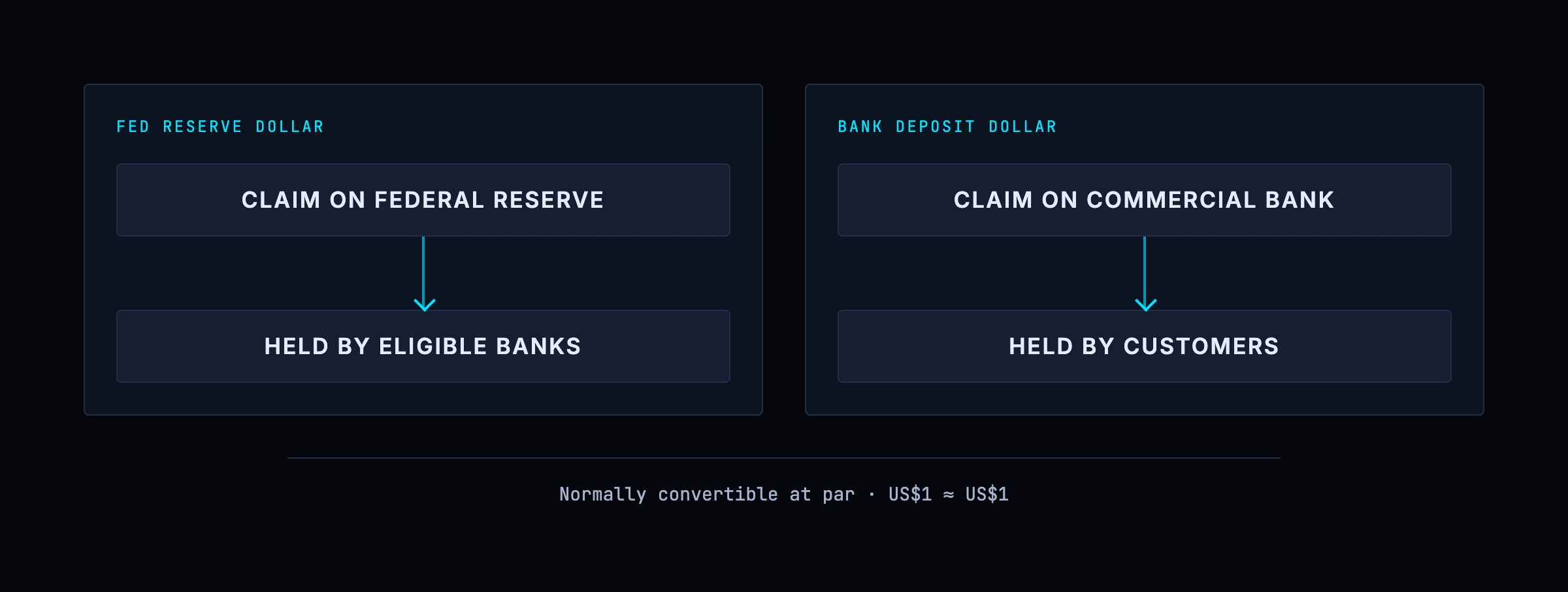
4. Your Deposit Is Not a Segregated Reserve Dollar
This is one of the most important misconceptions to eliminate.
Suppose Bank A has:
Customer deposits          $10 billion
Federal Reserve reserves    $1 billion
Loans                       $7 billion
Securities                  $2 billion
Other assets                $1 billion
There is no requirement that each customer's deposit correspond to a specifically tagged reserve dollar.
There is no Fed database entry saying:
Alice's first dollar -> reserve unit #A1001
Alice's second dollar -> reserve unit #A1002
Bob's dollar -> reserve unit #B4491
Money is fungible, and bank balance sheets are aggregated.
The bank owes its depositors collectively according to its deposit ledger. It holds a portfolio of assets to support its obligations.
That is why it is incorrect to ask where “Alice's specific reserve dollar” is sitting.
5. A Simple Hierarchy
A useful picture is:
FEDERAL RESERVE
      |
      | owes reserve balances
      v
COMMERCIAL BANK
      |
      | owes deposit balances
      v
CUSTOMER
The customer has a claim on the bank.
The bank has a claim on the Federal Reserve through its reserve balance, along with many other assets.
The customer's claim does not become a direct claim on the Fed merely because the commercial bank itself has a Fed account.
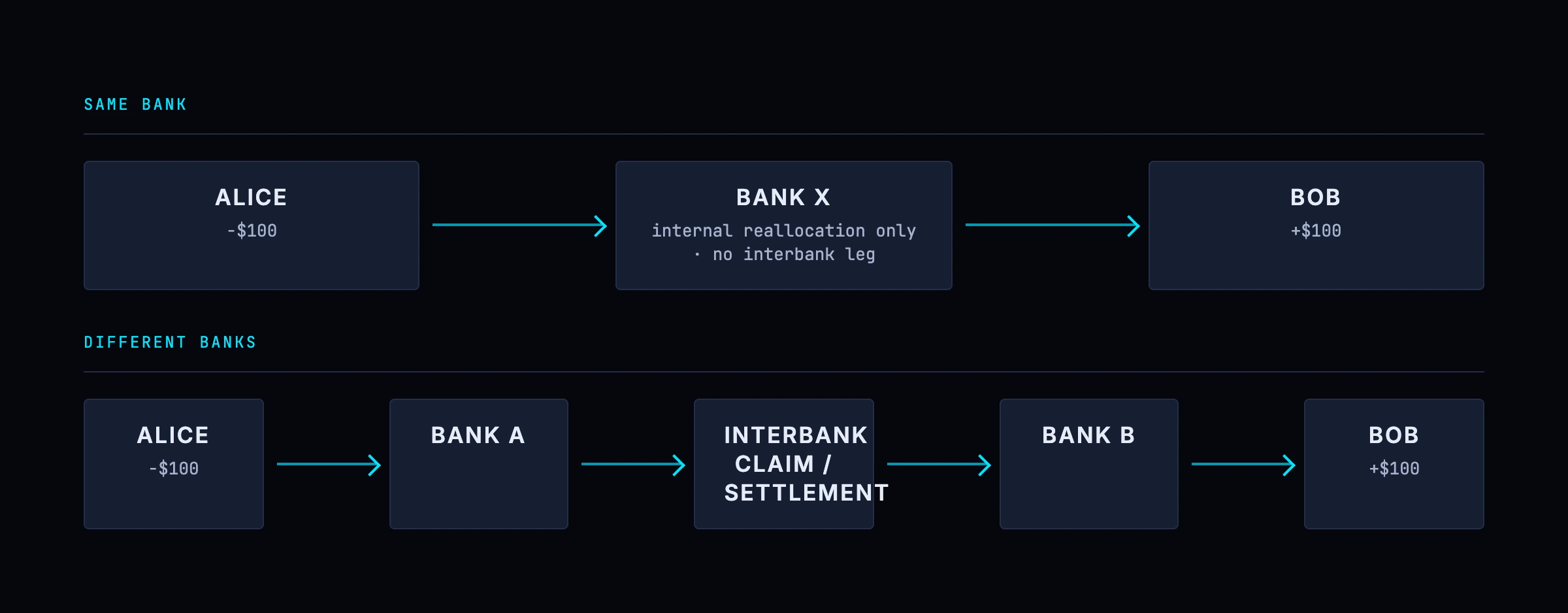
6. What Happens When a Customer Pays Another Customer at the Same Bank?
Suppose Alice and Bob both bank at JPMorgan.
Before:
JPMorgan owes Alice   $600,000
JPMorgan owes Bob            $0
Alice pays Bob US$600,000.
After:
JPMorgan owes Alice          $0
JPMorgan owes Bob      $600,000
JPMorgan's total deposit liability has not changed.
The Fed does not need to move reserves merely because JPMorgan changed which customer it owes.
This is a pure internal book transfer.
7. What Happens When the Customers Use Different Banks?
Now Alice banks at JPMorgan and Bob banks at Bank of America.
The customer-level liability has to migrate from one bank to another:
JPMorgan liability to Alice       -$600,000
BofA liability to Bob             +$600,000
Bank of America needs an offsetting asset or claim for taking on the new liability.
That may initially be an interbank receivable and may later settle through reserve balances or another clearing arrangement.
The operational mechanics are explained in How Bank Transfers Actually Work and Clearing vs. Settlement.
For real-world account structures used by financial institutions, the existing Faisal Khan page on settlement accounts expands on the operational side of these relationships.
8. Is One Type of Dollar “More Real” Than the Other?
“Real” is not a useful analytical category.
A better question is:
Who issued the claim, and what is the legal and credit character of that claim?
A reserve balance is a claim on the Federal Reserve.
A JPMorgan deposit is a claim on JPMorgan.
A Swiss-bank USD deposit is a claim on the Swiss bank.
All can be denominated in dollars.
They occupy different layers of the monetary hierarchy.
9. Why Central-Bank Money Sits at the Apex
Banks can accumulate IOUs against each other, but eventually institutions may want an asset that does not depend on the credit of the other commercial bank.
Suppose JPMorgan owes Bank of America US$50 million.
Bank of America has an asset:
Receivable from JPMorgan $50mIf JPMorgan settles by transferring Federal Reserve reserves, Bank of America can replace that asset with:
Federal Reserve reserves $50mThe commercial-bank obligation has been discharged using central-bank money.
This is why Federal Reserve reserves are central to final interbank settlement.
Fedwire explicitly provides finality to payments credited to Federal Reserve master accounts.
10. Does the Fed Control All Commercial-Bank Money Directly?
No.
The Fed can strongly influence financial conditions and bank balance-sheet behavior through monetary policy, interest rates, regulation, supervision, liquidity facilities, asset transactions, and the settlement environment.
But a commercial-bank deposit is not simply an entry on the Fed's customer ledger.
The banking system can expand or contract deposit money as banks lend, buy assets from nonbanks, receive repayments, sell assets, issue liabilities, and interact with other sectors.
The relationship is powerful but not one-for-one.
11. What About Physical Cash?
Physical Federal Reserve notes are central-bank money available to the public.
If a customer withdraws cash from a deposit account, the composition of money changes:
the bank deposit falls;
currency held by the public rises.
That is different from the cashless assumption used in many examples in this series.
The cashless assumption is helpful because it reveals the ledger mechanics without mixing in physical notes.
12. Why the Distinction Matters for Fintech and Payments
A payment company saying “we hold dollars” is incomplete.
Questions immediately follow:
Is the balance a bank deposit?
Is it an FBO ledger entry?
Is it a virtual-account sub-ledger?
Is it a safeguarded payment-institution balance?
Is it a stablecoin claim?
Is the underlying asset a commercial-bank deposit or central-bank money?
The legal issuer and account architecture determine credit risk, safeguarding, settlement access, and regulatory treatment.
The existing Faisal Khan page on named and virtual accounts is useful when applying these distinctions to real payment-company structures.
This page is part of How the US Dollar Is Created, the full primer on where dollars come from and how they move.
Frequently Asked Questions
Is a bank deposit legally the same as a Federal Reserve reserve balance?
No. They are liabilities of different issuers.
Does the Fed owe ordinary retail depositors their checking-account balances?
Normally no. The commercial bank owes the depositor.
Do banks need one reserve dollar for every deposit dollar?
No.
Why are bank deposits accepted at face value?
Because the banking and payment system is built to preserve par convertibility among high-quality commercial-bank deposits and central-bank money under normal conditions.
Can a commercial bank create Federal Reserve reserves?
No. Only the Federal Reserve creates its own reserve liabilities.
Can a commercial bank create deposits?
Yes. Bank lending and certain other asset transactions can create deposits.
Which kind of money do ordinary people mostly use electronically?
Commercial-bank deposit money.
Conclusion
The phrase “US dollar” hides a hierarchy.
Federal Reserve money is a liability of the central bank. Commercial-bank deposit money is a liability of a commercial bank. They usually trade at par, which makes the distinction invisible to ordinary users.
But the distinction explains almost everything that follows: money creation, interbank settlement, offshore dollars, bank liquidity, loan repayment, and financial crises.
Authoritative Sources
Federal Reserve — Comparing Means of Payment: What Role for a Central Bank Digital Currency?
Federal Reserve — A Lawyer's Perspective on U.S. Payment System Evolution and Money in the Digital Age
Federal Reserve — What is the money supply?
https://www.federalreserve.gov/faqs/money_12845.htm
Federal Reserve Financial Services — Fedwire Funds Service