
What Really Happens When Alice Sends Money to Bob at the Same Bank, Another Bank, or an Offshore Bank
That is not the best mental model.
A bank transfer is better understood as a coordinated change in liabilities and settlement claims across one or more ledgers.
1. How Bank Transfers Work When Alice and Bob Use the Same Bank
Alice has:
JPMorgan deposit $1,000,000Bob has:
JPMorgan deposit $0Alice pays Bob US$600,000.
JPMorgan can simply update its customer ledger:
BEFORE
Alice                 $1,000,000
Bob                           $0

AFTER
Alice                   $400,000
Bob                     $600,000
From JPMorgan's balance-sheet perspective:
Liability to Alice     -$600,000
Liability to Bob       +$600,000
Total JPMorgan deposits are unchanged.
No other bank needs to participate.
No Federal Reserve reserve movement is required solely because of this internal transfer.
The bank merely changed which customer it owes.

2. Different Banks Change the Problem
Now Alice banks at JPMorgan and Bob banks at Bank of America.
Alice instructs JPMorgan:
Send Bob US$600,000.
JPMorgan can reduce Alice's deposit:
Alice deposit -$600,000Bank of America credits Bob:
Bob deposit +$600,000But BofA has now accepted a US$600,000 liability to Bob.
Why should BofA do that?
Because BofA must receive or expect to receive a corresponding asset or settlement value.
3. The Interbank Receivable Version
Before final settlement, BofA could record:
BANK OF AMERICA

Asset:
JPMorgan owes BofA     +$600,000

Liability:
BofA owes Bob          +$600,000
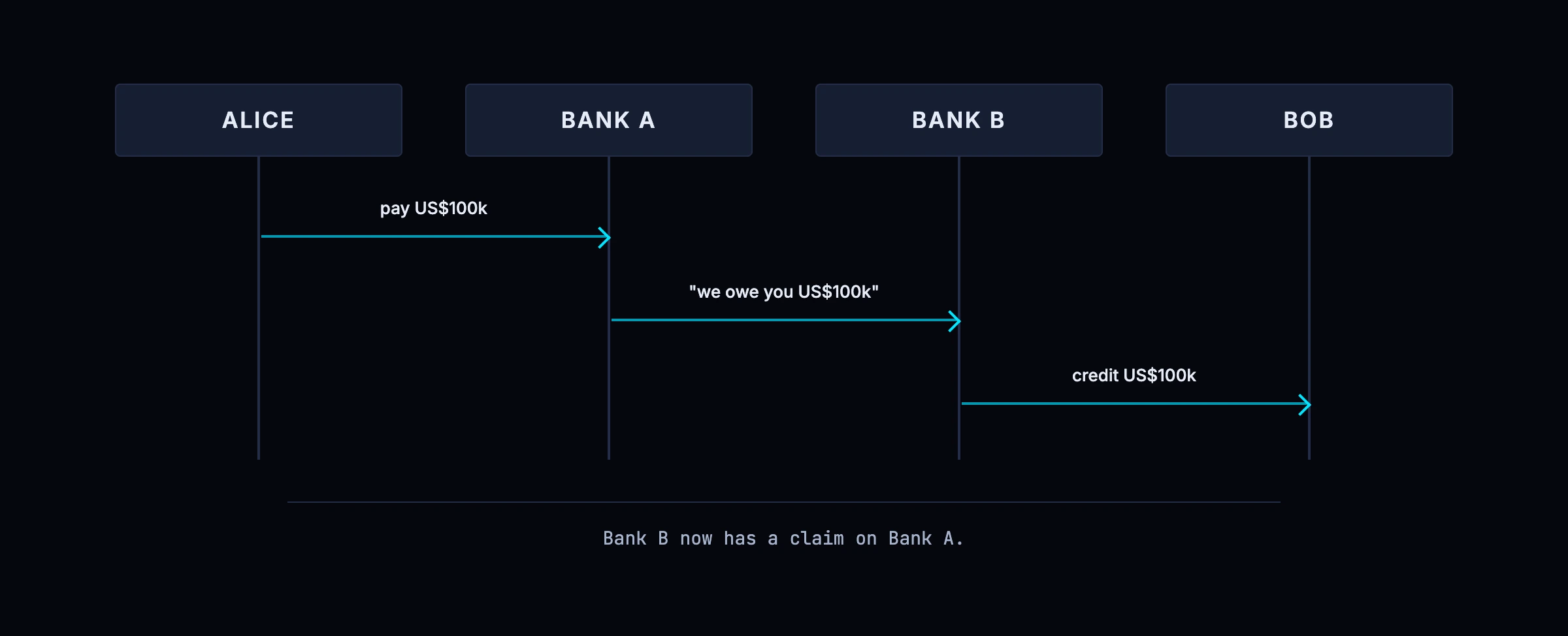
The customer's payment can therefore be represented before the two banks have necessarily exchanged final settlement assets.
The receiving bank's asset is initially a claim against the sending bank or against the clearing arrangement.
This explains why “Bob has been credited” and “the banks have fully settled” are conceptually different statements.
4. Settlement Through Federal Reserve Reserves
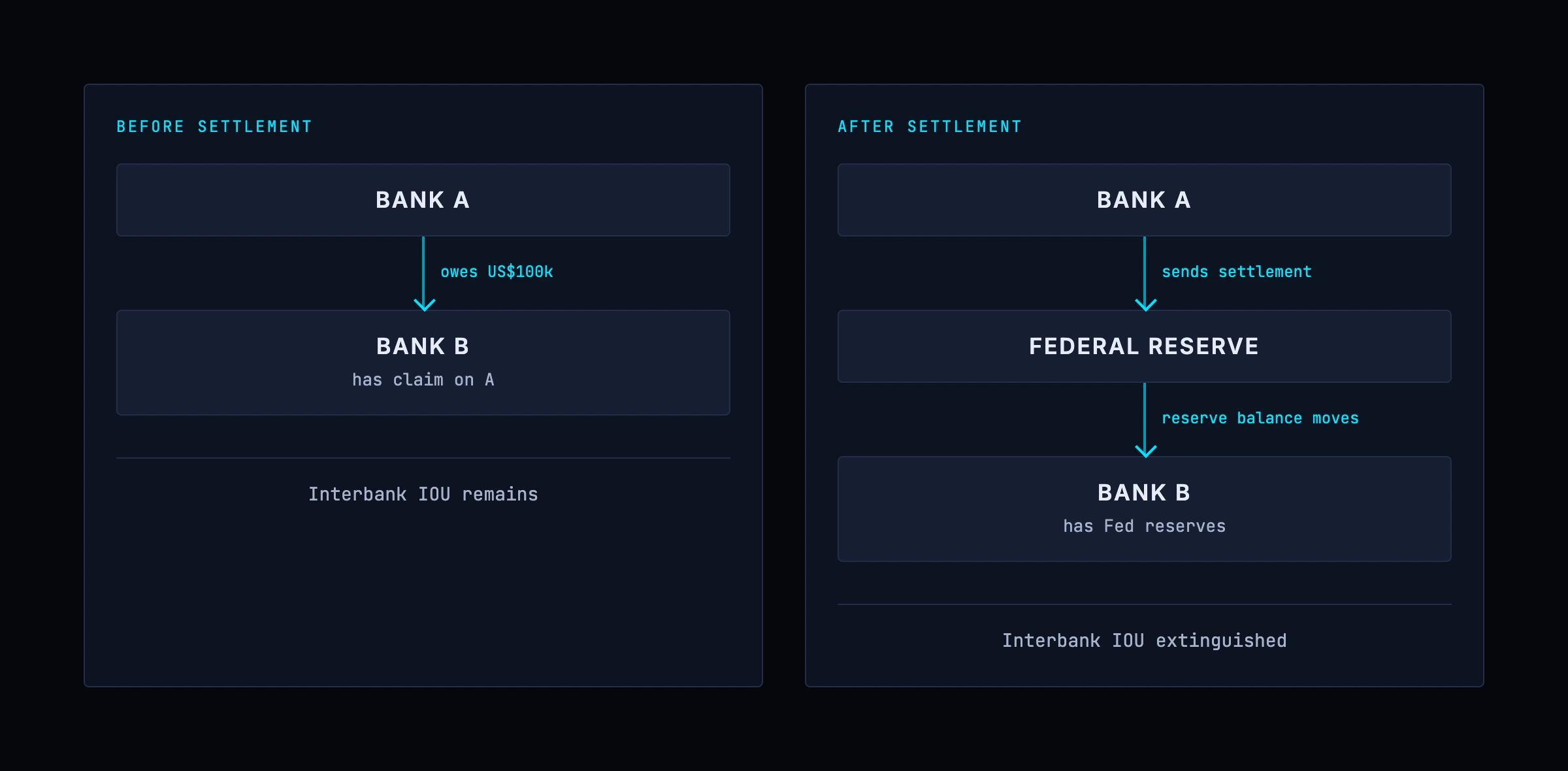
Suppose JPMorgan settles the US$600,000 obligation through Federal Reserve accounts.
The Fed's ledger changes:
JPMorgan reserves      -$600,000
BofA reserves          +$600,000
Bank of America's books change from:
Asset:
Receivable from JPM    $600,000
to:
Asset:
Federal Reserve reserves $600,000
Its liability to Bob remains:
Deposit owed to Bob $600,000The interbank IOU has been replaced with central-bank settlement money.
5. Why the Exact Gross Amount Does Not Always Need to Move
Suppose thousands of customers transact in both directions.
During the day:
JPM customers -> BofA customers       $100m
BofA customers -> JPM customers        $85m
The banks or payment system can determine the net position:
JPM owes BofA $15mOnly the net amount may need additional funding for final settlement, depending on the payment system and timing.
This is why clearing and netting can allow a very large volume of customer payments to occur with much less settlement liquidity.
The detailed systems are explained in Clearing vs. Settlement: Fedwire, CHIPS, and Finality.
6. Same Payment, Different Settlement Architecture
Alice paying Bob US$600,000 could be implemented through several architectures.
Direct Fedwire settlement
The sending bank originates a Fedwire transfer and the receiving bank receives final funds in its Federal Reserve master account.
CHIPS
The payment can be processed through CHIPS, where continuous matching, offsetting, and liquidity-saving mechanisms can reduce the funding needed relative to gross payment value.
Common correspondent
If both institutions maintain balances at the same correspondent bank, the correspondent may debit one bank's account and credit the other's on its own books.
Bilateral interbank credit followed by later settlement
One bank can temporarily hold a receivable against another before final settlement.
So the customer's instruction does not tell you the entire settlement architecture.
7. The Common Correspondent Example
Suppose Bank A and Bank B both maintain USD accounts with Citi.
Before:
CITI'S LEDGER

Bank A balance      $50m
Bank B balance      $20m
Bank A needs to pay Bank B US$5m.
Citi can record:
Bank A balance      -$5m
Bank B balance      +$5m
No separate US$5m Fedwire movement is necessarily required for that individual customer payment because the settlement occurred by reallocating Citi's liabilities internally.
Citi itself still has its broader liquidity and settlement position to manage.
8. What Does “Money Moved” Really Mean?
From Alice and Bob's perspective:
Alice balance went down
Bob balance went up
From the banks' perspective:
one deposit liability decreased
another deposit liability increased
interbank assets/liabilities changed
settlement assets may have changed
So “the money moved” is convenient language for a sequence of balance-sheet updates.
9. Now Make It Cross-Border
Bob in the United States wants to send US$250,000 to Carlos at Bank of BVI.
Assume Bank of BVI uses Standard Chartered New York as its USD correspondent.
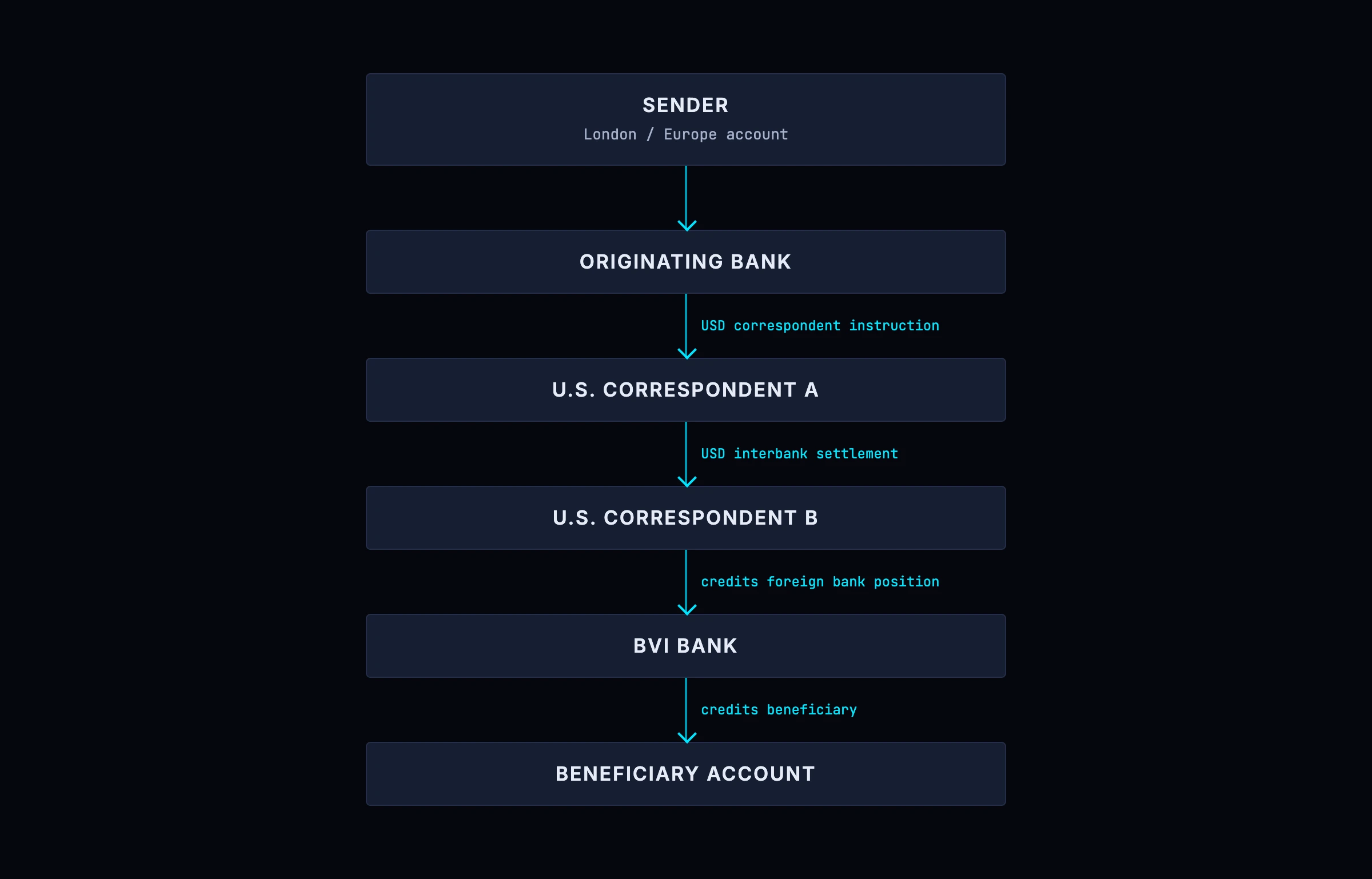
A simplified path is:
Bob
 |
 v
Bank of America
 |
 v
U.S. settlement layer
 |
 v
Standard Chartered New York
 |
 v
Bank of BVI
 |
 v
Carlos
Bank of America reduces Bob's deposit.
Standard Chartered receives settlement value.
Standard Chartered increases the balance it owes Bank of BVI.
Bank of BVI increases the balance it owes Carlos.
The result is a chain of claims:
Carlos
has claim on Bank of BVI

Bank of BVI
has claim on Standard Chartered

Standard Chartered
has U.S. settlement assets and other USD assets
This is why correspondent banking is fundamentally a ledger relationship rather than physical currency shipment.
The existing Faisal Khan page on correspondent banking relationships explains the operational nostro/vostro structure in more detail.
10. SWIFT Is Usually the Message, Not the Money
In cross-border banking, SWIFT is often used to transmit payment instructions and structured financial messages.
The message tells institutions what to do.
The actual settlement value is reflected through bank accounts, correspondent balances, domestic payment systems, or other settlement arrangements.
This is why saying “SWIFT moved the money” is usually imprecise.
SWIFT can carry the instruction; the money movement is represented by ledger changes elsewhere.
For a practical payments view, see Faisal Khan's existing Bank Transfers page.
11. Pending, Posted, Cleared, and Settled Are Different States
A customer interface may show a payment as:
pending;
posted;
completed.
Those labels do not always map one-to-one onto interbank settlement status.
A bank may give a customer provisional or final credit according to its rules even while back-end clearing or reconciliation continues.
For high-value systems, legal settlement finality has a precise meaning that can differ from the user-interface status.
This is another reason not to use the customer's screen as a complete picture of what happened between institutions.
12. The Five Questions to Ask About a Bank Transfer
When looking at any transfer, ask:
Which bank owes the sender before the transfer?
Which bank owes the recipient after the transfer?
What interbank claim is created?
What asset settles that interbank claim?
When does settlement become final?
These five questions reveal the actual architecture.
This page is part of How the US Dollar Is Created, the full primer on where dollars come from and how they move.
Frequently Asked Questions
Does a bank transfer literally move the same digital dollars between accounts?
Not necessarily. It changes ledger balances and claims.
If Alice and Bob use the same bank, are Fed reserves required?
Not for the internal transfer itself.
If they use different banks, must Fed reserves move immediately?
Not necessarily. An interbank claim can arise, and clearing/netting may precede settlement.
Why does the receiving bank credit Bob before settlement?
The bank can accept a receivable or payment-system claim, subject to its risk and system rules.
Can two banks settle at a common correspondent instead of directly at the Fed?
Yes, depending on the arrangement.
Is SWIFT the settlement system?
SWIFT primarily carries financial messages; settlement occurs through accounts and payment systems.
Conclusion
A bank transfer is not best understood as a digital object traveling from one customer account to another. One bank's liability to the sender decreases, another bank's liability to the receiver increases, and interbank claims are cleared and settled underneath.
That is the architecture hidden by the simple phrase “the money moved.”
Authoritative Sources
Federal Reserve — A Lawyer's Perspective on U.S. Payment System Evolution and Money in the Digital Age
Federal Reserve Financial Services — Fedwire Funds Service
https://www.frbservices.org/financial-services/wires
The Clearing House — CHIPS