
Is Bank-Created Money a U.S. Dollar Phenomenon, or Does the Same Mechanism Exist in Other Countries and Currencies?
Across most modern banking systems, customer deposits are liabilities of commercial banks, while central-bank reserves and physical currency are liabilities of the central bank. When a commercial bank makes an eligible loan and credits the borrower's account, it can create a new deposit in the relevant currency.
The legal, regulatory, reserve, liquidity, capital, deposit-insurance, and monetary-policy frameworks differ from country to country. But the core balance-sheet logic is widely shared.
1. The General Two-Layer Structure
A simplified monetary system usually contains at least two important forms of money.
Central-bank money
Issued as a liability of the central bank.
Examples include:
reserve or settlement balances held by eligible institutions;
physical notes where cash exists.
Commercial-bank money
Issued as a liability of banks to their customers.
Examples include:
checking/current accounts;
business deposits;
savings deposits;
other bank deposit balances.
The customer generally spends commercial-bank money, while banks use central-bank money or other accepted settlement assets to settle obligations between themselves.
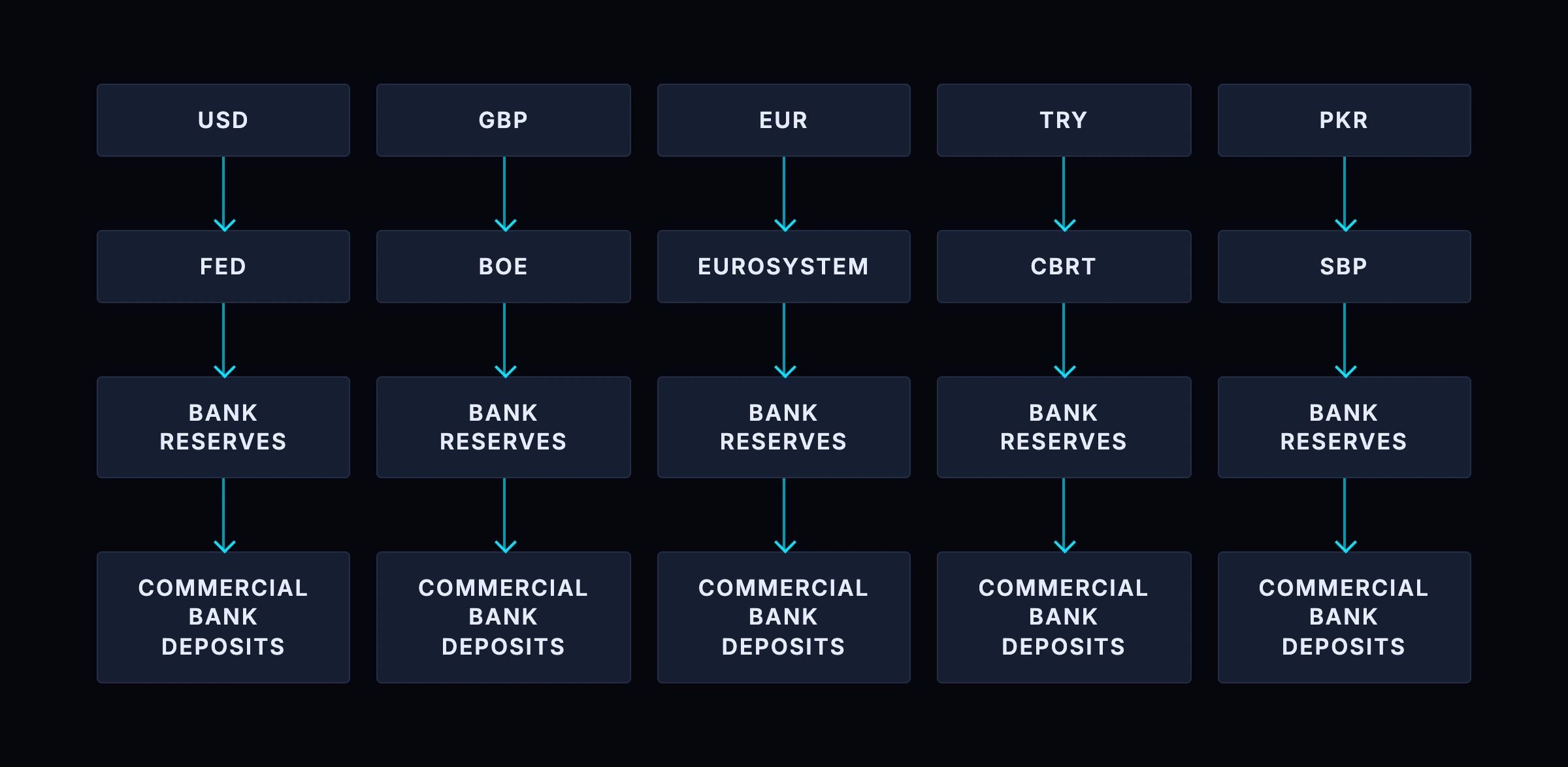
2. United States: USD
A U.S. bank lends Alice US$100,000:
BANK A

Asset:
Loan to Alice                +US$100,000

Liability:
Alice deposit                +US$100,000
The deposit is commercial-bank USD.
If Alice pays Bob at another bank, interbank settlement may involve Federal Reserve reserve balances or a clearing arrangement.
The Fed's reserve requirement ratios have been set at zero since 2020, so the modern U.S. system should not be taught using an automatic “bank receives US$100 of reserves and mechanically lends US$90” story.
Banks remain constrained by capital, liquidity, funding, risk, regulation, profitability, and payment outflows.
3. United Kingdom: GBP
The Bank of England has explicitly explained that when commercial banks make loans, they create deposits.
A simplified UK example:
UK COMMERCIAL BANK

Asset:
Loan to company               +£1m

Liability:
Company deposit               +£1m
The bank created commercial bank money denominated in pounds sterling.
It did not create Bank of England reserves.
The Bank of England creates central-bank money; commercial banks create deposit money.
4. Euro Area: EUR
A bank operating within the euro-area monetary system can create euro deposits through lending.
Simplified:
EURO-AREA BANK

Asset:
Corporate loan                 +€10m

Liability:
Corporate deposit              +€10m
The commercial bank has created a euro deposit.
The Eurosystem's central-bank money is a different layer used for eligible institutional settlement.
The Deutsche Bundesbank's educational materials similarly distinguish book money created by banks from central-bank money.
5. Türkiye: TRY
A Turkish bank that makes a TRY 10 million loan can, in simplified accounting, create:
TURKISH BANK

Asset:
TRY loan                      +TRY 10m

Liability:
Customer deposit              +TRY 10m
The deposit is a liability of the commercial bank denominated in Turkish lira.
It is not the same financial instrument as a reserve balance at the Central Bank of the Republic of Türkiye.
The exact regulatory and reserve framework is specific to Türkiye and can change over time.
6. Pakistan: PKR
The same conceptual accounting applies to a PKR-denominated bank loan:
PAKISTANI BANK

Asset:
PKR loan                      +PKR 100m

Liability:
Customer deposit              +PKR 100m
The commercial bank has created a PKR deposit liability.
The State Bank of Pakistan remains the issuer of central-bank money in the domestic monetary system.
Again, actual lending is constrained by Pakistan's regulatory, capital, liquidity, reserve, prudential, and credit rules.
7. Canada: CAD
A Canadian commercial bank can create a CAD deposit when it lends.
Bank of Canada settlement balances occupy the central-bank layer; commercial-bank deposits occupy the customer-money layer.
The terminology and operating framework differ from the United States, but the balance-sheet distinction remains recognizable.
8. Japan: JPY
A Japanese bank making a yen loan can create a yen deposit.
The Bank of Japan issues central-bank money; commercial banks issue deposit liabilities denominated in yen.
Again, the two forms normally trade at par for customers because banks honor transfers and withdrawals in the same unit of account.
9. Why This Does Not Mean Every Country Has the Same Monetary System
The common accounting mechanism does not erase national differences.
Countries can differ on:
reserve requirements;
liquidity ratios;
capital standards;
deposit insurance;
central-bank facilities;
collateral frameworks;
foreign-exchange controls;
interest-rate policy;
bank licensing;
permitted foreign-currency activities;
government deposit treatment;
payment-system access;
resolution regimes.
Therefore one should distinguish the generic balance-sheet mechanism from the country-specific regulatory architecture.
10. What About Countries That Use Another Country's Currency?
Some economies use a foreign currency as legal tender or operate under highly constrained monetary arrangements.
A dollarized economy illustrates an important point.
Its domestic government or central bank may not be able to create Federal Reserve reserves.
Yet commercial banks operating in that economy can still maintain USD deposits and make USD loans subject to their legal and funding framework.
The bank can create a USD-denominated deposit claim, but it must be able to fund external dollar outflows.
This resembles the foreign-bank dollar mechanism described in Can Foreign Banks Create US Dollars?.
11. What About Currency Boards?
A currency-board arrangement attempts to maintain a strong link between the domestic monetary base and a reserve anchor, often a foreign currency.
That constrains central-bank monetary issuance differently from an ordinary floating-currency regime.
It does not automatically mean commercial banks cease to create deposits through lending.
Commercial banks still operate balance sheets, although their funding and liquidity constraints can be materially influenced by the currency-board structure.
12. What About Islamic Banking?
Islamic financial structures can avoid conventional interest-bearing loan contracts and use financing structures such as murabaha, ijara, musharaka, and others.
The contractual form can differ substantially from a conventional loan.
However, from the monetary-system perspective, banks can still create deposit liabilities when financing transactions cause customer accounts to be credited, subject to the accounting and regulatory treatment of the product.
The exact mechanics must be analyzed product by product rather than assuming every Islamic financing contract behaves identically to a conventional loan.
13. Can a Bank Create Money in a Foreign Currency Too?
Potentially, yes.
A bank may operate books in several currencies.
For example, a Swiss bank might hold and create liabilities in:
CHF;
USD;
EUR;
GBP.
But foreign-currency banking creates additional funding and settlement risks.
A Swiss bank can create a USD deposit liability; it cannot create Federal Reserve reserves.
A Turkish bank can create a EUR liability if permitted; it cannot create Eurosystem central-bank reserves merely by typing an entry on its customer ledger.
Thus foreign-currency lending is usually more constrained by external funding, correspondent access, FX risk, and local regulation.
14. Why Central Banks Still Matter If Commercial Banks Create Most Deposits
Commercial banks do not operate independently of central banks.
Central banks influence or determine:
the price of central-bank liquidity;
policy interest rates;
settlement infrastructure;
collateral rules;
lender-of-last-resort facilities;
reserve remuneration;
regulatory environment in conjunction with other authorities;
broad monetary and financial conditions.
Banks create deposits, but they do so inside a monetary architecture whose ultimate settlement unit and policy framework are shaped by the central bank.
15. Bank Lending Is Not Unconstrained Money Printing
Across jurisdictions, commercial banks face a common practical reality:
Every new loan creates risk and potentially creates a deposit that can leave the bank.
The bank therefore needs:
capital to absorb losses;
liquidity to meet outflows;
funding;
credit underwriting;
access to payment systems or correspondents;
regulatory permission;
profitable pricing.
The mechanical ability to create a deposit entry does not imply unlimited economic capacity to expand lending.
16. Loan Repayment Works Similarly Across Systems
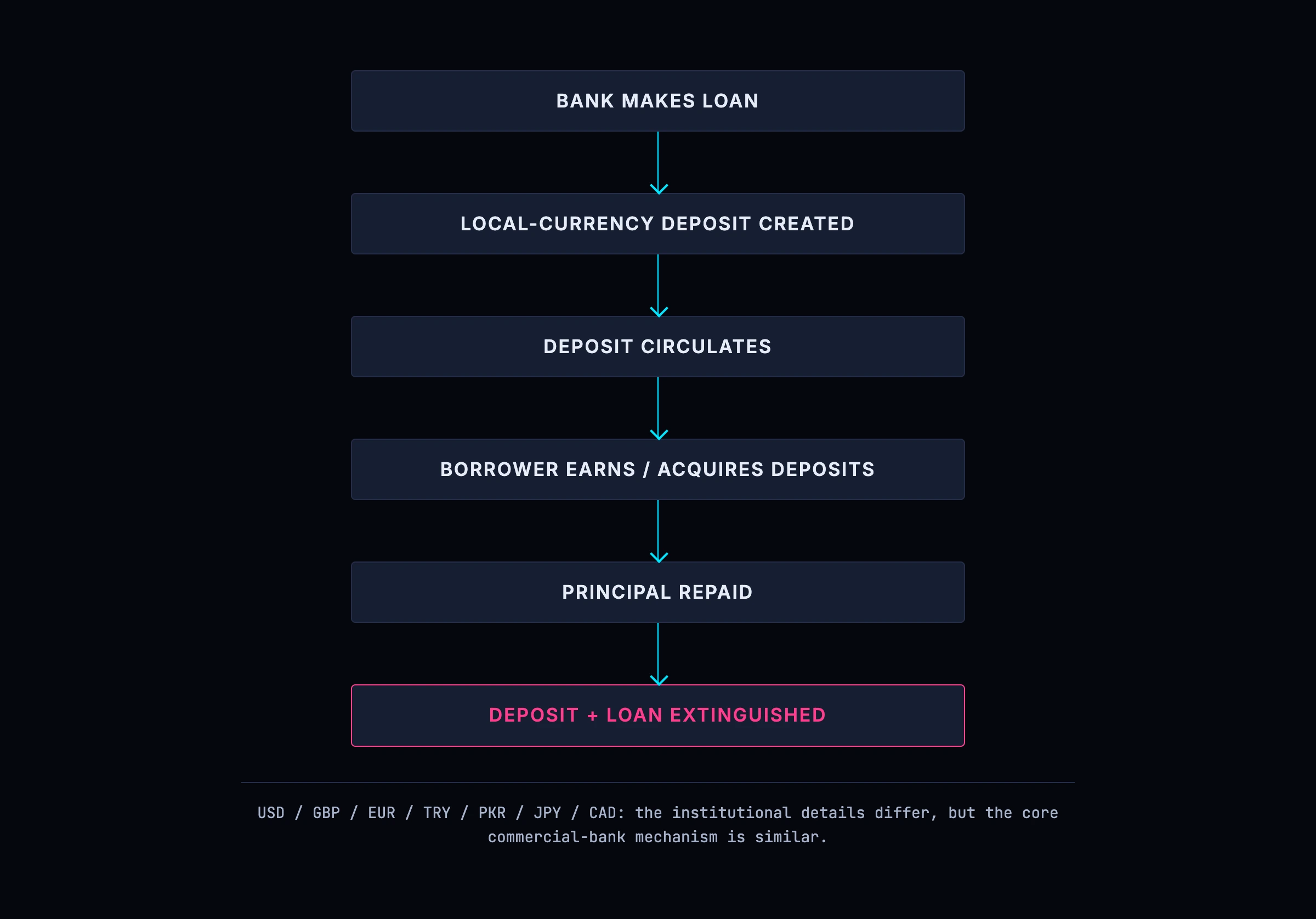
In a simplified same-bank repayment:
Loan asset                    -100
Customer deposit              -100
The commercial-bank money created by the loan is extinguished as principal is repaid.
This broad mechanism appears in central-bank educational explanations in multiple jurisdictions.
Thus commercial bank money is constantly being created and destroyed as balance sheets expand and contract.
17. A Comparative Table
Monetary Area | Central-Bank Layer | Commercial-Bank Layer | Typical Loan-Creation Entry |
|---|---|---|---|
United States | Federal Reserve reserves / notes | USD bank deposits | Loan +USD / Deposit +USD |
United Kingdom | Bank of England reserves / notes | GBP bank deposits | Loan +GBP / Deposit +GBP |
Euro area | Eurosystem central-bank money | EUR bank deposits | Loan +EUR / Deposit +EUR |
Türkiye | CBRT central-bank money | TRY bank deposits | Loan +TRY / Deposit +TRY |
Pakistan | SBP central-bank money | PKR bank deposits | Loan +PKR / Deposit +PKR |
Canada | Bank of Canada settlement money / notes | CAD bank deposits | Loan +CAD / Deposit +CAD |
Japan | Bank of Japan central-bank money | JPY bank deposits | Loan +JPY / Deposit +JPY |
This table is conceptual. The exact institutional rules differ materially by jurisdiction.
18. The Universal Mental Model
For almost any conventional banking system, ask:
Who issues the central-bank settlement asset?

Who issues customer deposits?

What happens when a deposit leaves one bank?

What asset settles between banks?

What legal and prudential constraints limit balance-sheet expansion?
Those questions travel surprisingly well across countries.
This page is part of How the US Dollar Is Created, the full primer on where dollars come from and how they move.
Frequently Asked Questions
Do banks create money in every country?
In most modern banking systems, commercial banks create deposit money through lending and other balance-sheet activity. The precise rules and constraints vary by jurisdiction.
Is all money created by central banks?
No. A large portion of everyday spendable money consists of commercial-bank deposits.
Can a commercial bank create central-bank reserves?
No. It can create its own deposit liabilities, not liabilities on the central bank's balance sheet.
Are foreign-currency deposits also created by banks?
They can be, subject to legal, regulatory, funding, liquidity, and FX constraints.
Does repayment destroy commercial-bank money in other countries too?
The generic balance-sheet logic of loan/deposit contraction applies broadly, though accounting and institutional details differ.
Does a 10% reserve requirement mean a bank can only lend 90% of deposits?
That mechanical textbook model is an oversimplification. Modern banking constraints include capital, liquidity, funding, risk, regulation, and settlement needs; reserve regimes also differ across countries and over time.
Authoritative Sources
Bank of England, Money creation in the modern economy: https://www.bankofengland.co.uk/quarterly-bulletin/2014/q1/money-creation-in-the-modern-economy
Bank of England, How is money created?: https://www.bankofengland.co.uk/explainers/how-is-money-created
Deutsche Bundesbank, The Origin of Money, Part II: Book Money: https://www.bundesbank.de/en/service/school-service/animation-videos/the-origin-of-money-part-ii-book-money-860052
Deutsche Bundesbank, The Origin of Money, Part III: Central Bank Money: https://www.bundesbank.de/en/service/school-service/animation-videos/the-origin-of-money-part-iii-central-bank-money-860058
Federal Reserve, Money Stock FAQs: https://www.federalreserve.gov/faqs/money_12845.htm
Federal Reserve, Reserve Requirements: https://www.federalreserve.gov/monetarypolicy/reservereq.htm
Conclusion
Commercial-bank money creation is a general feature of modern banking, not an American peculiarity. What changes from country to country is the currency, central bank, legal framework, prudential rules, funding structure, and payment architecture. The recurring distinction remains powerful: central banks issue central-bank money; commercial banks issue deposit money.