
Why a Swiss, British, Pakistani or BVI Bank Can Create USD-Denominated Deposits but Cannot Create Federal Reserve Money
The U.S. dollar is America's currency. Surely only the United States, the Federal Reserve, or American banks can create dollars.
That statement is only partly correct.
Only the Federal Reserve can create Federal Reserve liabilities, such as reserve balances. But a commercial bank outside the United States can create a deposit liability denominated in U.S. dollars, subject to its legal and regulatory authority and its ability to fund and settle those obligations.
That distinction resolves the apparent contradiction.
1. How Foreign Banks Create US Dollars as a Unit of Account
Imagine a Swiss bank signs a legal obligation saying:
We owe Company A US$100 million.
The denomination is USD.
The issuer of the promise is Swiss Bank.
Nothing about the dollar unit of account requires every obligation expressed in dollars to be issued directly by the U.S. government.
Individuals, companies, governments, and banks around the world can sign contracts denominated in USD.
The difference is that a regulated bank's deposit liability is widely accepted as money because the bank is expected to transfer or redeem that liability at par.
2. The Simple Swiss Bank Loan
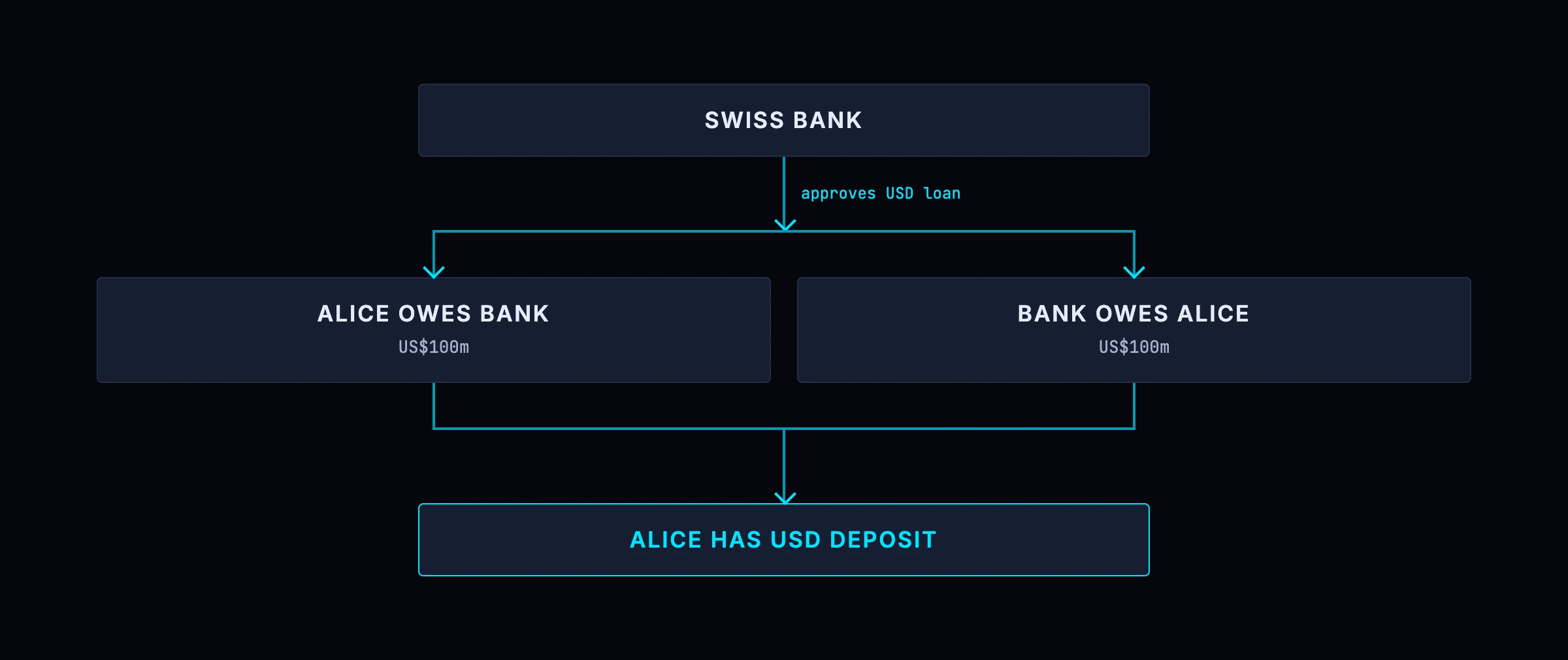
Swiss Bank approves a US$100 million loan to Alice Corporation.
It records:
SWISS BANK

ASSET
USD loan to Alice Corp.           +US$100m

LIABILITY
Alice Corp. USD deposit           +US$100m
Alice's account now shows:
USD 100,000,000No corresponding US$100 million Fed reserve entry had to appear at the moment of loan origination.
The Swiss bank created a USD-denominated commercial-bank deposit.
3. What Exactly Did the Swiss Bank Create?
It created this promise:
Swiss Bank owes Alice Corporation US$100 million.
It did not create this:
Federal Reserve owes Swiss Bank US$100 million more than before.
That is the distinction.
Foreign bank can create:
USD deposit liability

Foreign bank cannot create:
Federal Reserve reserve liability
4. Is the Deposit “Real”?
Yes, if by real we mean it is a valid bank deposit and enforceable obligation of the bank.
Alice can:
pay another Swiss Bank customer;
use the balance in treasury operations;
transfer it externally;
pledge the account subject to applicable rules;
use it to satisfy obligations;
convert it into another currency.
Its practical quality depends on the bank's solvency, liquidity, legal environment, and ability to honor payment instructions.
The same is true conceptually of a deposit at a U.S. commercial bank: the deposit is a liability of the bank, not a pile of Fed reserves owned directly by the customer.
5. What If Alice Pays Another Customer at the Same Swiss Bank?
Alice pays Bob Corporation US$40 million.
Both use Swiss Bank.
Swiss Bank changes two customer balances:
Alice Corp. deposit          -US$40m
Bob Corp. deposit            +US$40m
No external bank is needed.
The US$40 million circulates entirely within the Swiss institution.
6. What If Alice Sends US$100 Million to Chase?
This is the real test.
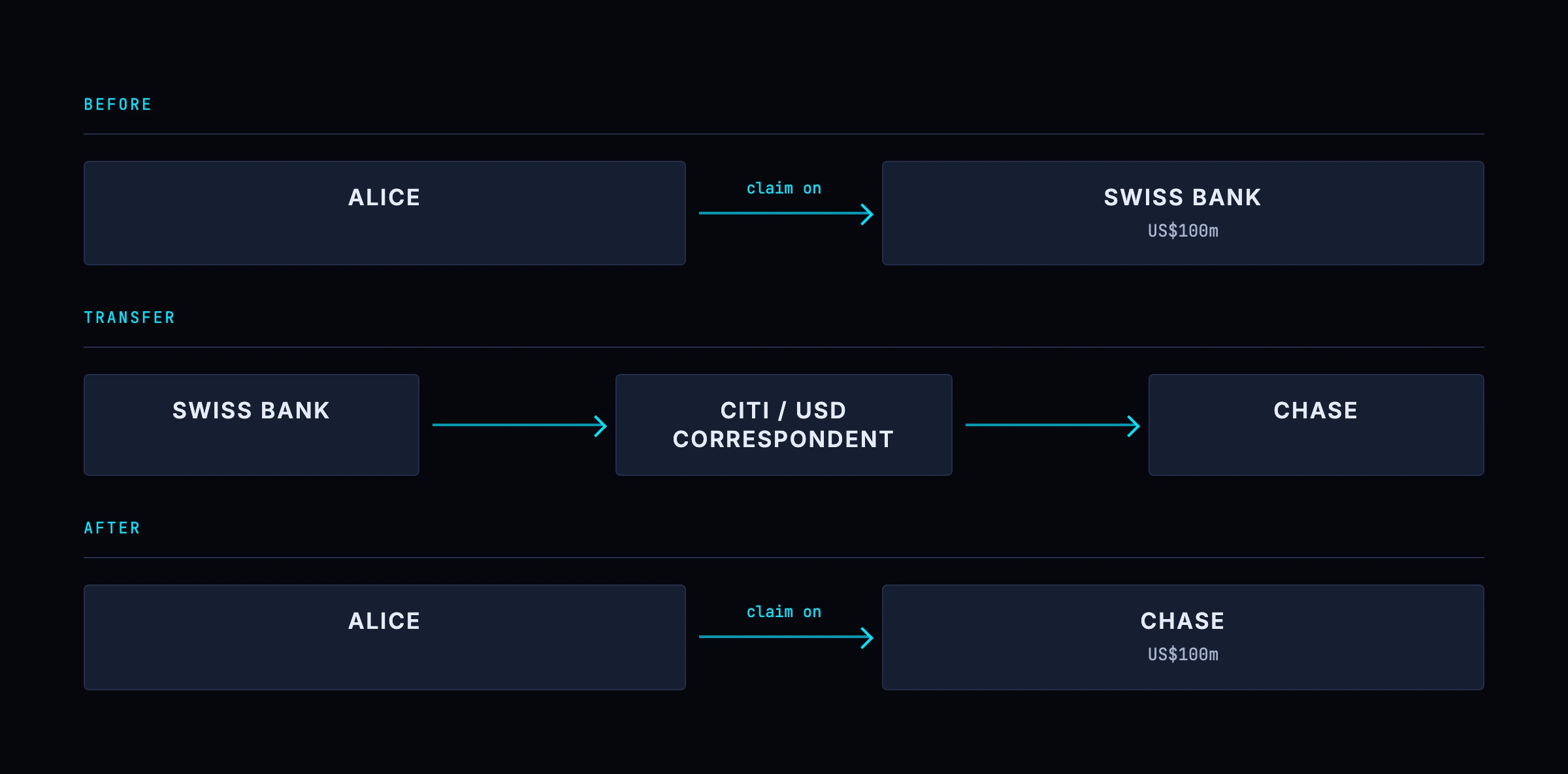
Alice tells Swiss Bank:
Send my US$100 million to Chase New York.
Swiss Bank cannot simply edit Chase's customer ledger.
It needs to deliver an acceptable interbank asset.
Suppose Swiss Bank has a USD correspondent account at Citi New York.
The chain might be:
Alice Corp.
    │
    ▼
Swiss Bank
    │
    ▼
Citi New York
    │
    ▼
U.S. clearing / settlement
    │
    ▼
Chase
    │
    ▼
Alice Corp. Chase account
Swiss Bank's deposit liability to Alice is extinguished as the payment leaves.
Its correspondent asset or other funding position is reduced.
Chase creates a new deposit liability to Alice when it receives settlement.
For the underlying payment sequence, see How Bank Transfers Actually Work.
7. What If Swiss Bank Has Only US$20 Million at Citi?
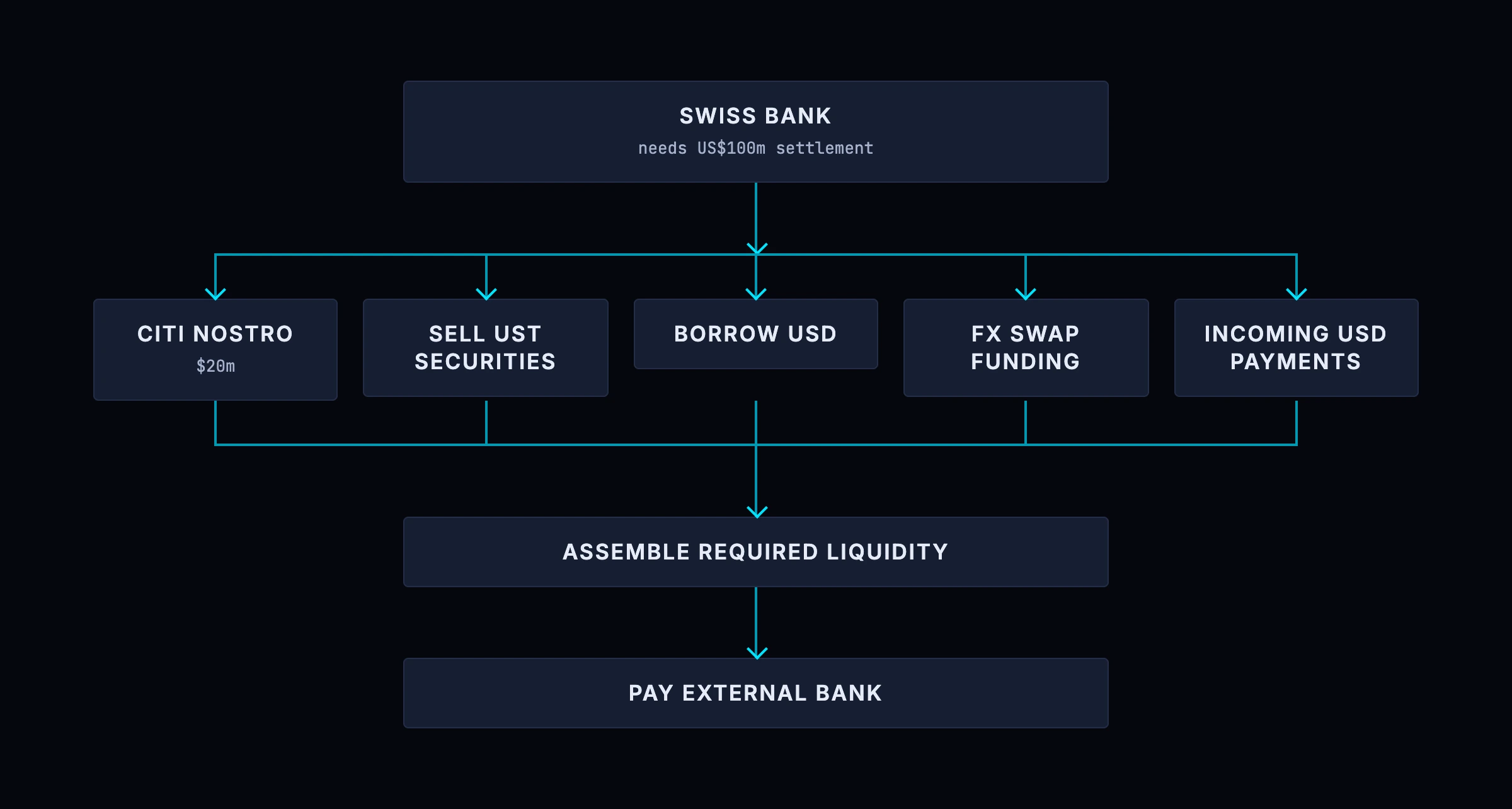
The US$100 million deposit is not automatically fake.
Swiss Bank may own:
USD correspondent cash              US$20m
U.S. Treasury securities            US$80m
USD loans                           US$700m
USD interbank claims                US$100m
Other USD assets                    US$100m
The bank can attempt to obtain the required liquidity by:
selling securities;
borrowing dollars;
attracting deposits;
using secured funding;
receiving incoming dollar payments;
borrowing from another bank;
using FX swaps;
accessing available central-bank or market facilities.
A bank is not expected to hold all customer deposits as idle cash.
It is expected to manage liquidity so valid withdrawals and transfers can be honored.
8. Why the Bank Cannot Create Unlimited Dollars
At first glance, if the bank can type US$100 million into Alice's account, why not create US$100 billion or US$1 trillion?
Because the deposit is a liability.
Each deposit creates an obligation that can leave the bank.
If customers spend those dollars externally, the bank needs funding and settlement assets.
The bank is also constrained by:
capital requirements;
liquidity requirements;
credit-risk limits;
foreign-currency position limits;
regulatory restrictions;
borrower creditworthiness;
market funding capacity;
profitability;
collateral availability;
internal risk appetite;
correspondent-bank willingness;
sanctions and AML controls;
local monetary and foreign-exchange rules.
Creating a liability is easy mechanically. Remaining able to honor it is the banking business.
9. A Pakistani Bank Example
Suppose a Pakistani bank is permitted to make a US$10 million foreign-currency loan to an eligible corporate borrower.
Simplified accounting:
PAKISTANI BANK

Asset:
USD loan to company            +US$10m

Liability:
Company USD deposit            +US$10m
The bank has created a USD-denominated deposit.
But Pakistan has not created Federal Reserve money.
If the company later sends US$10 million to a beneficiary in the United States, the Pakistani bank must obtain the necessary external USD settlement through correspondents or other funding channels.
Whether a particular Pakistani bank is legally permitted to make a particular foreign-currency loan is a separate regulatory question. Countries can place stringent controls on FX lending and deposit activity.
10. Does the Bank Need to “Own Dollars First”?
Not necessarily in the simplistic dollar-for-dollar sense.
A bank makes a loan by creating an asset and liability on its balance sheet.
But it must manage the consequences.
If the deposit remains at the same bank, little external liquidity may be required immediately.
If the deposit leaves, the bank must settle.
This produces a more accurate statement:
A bank does not necessarily need to possess the exact funding first in order to create a deposit, but it must be able to fund and settle the balance-sheet position it has created.
This is more accurate than either extreme:
“banks can only lend pre-existing deposits”; or
“banks can create unlimited money without funding constraints.”
Both are misleading.
11. Does This Happen Only With US Dollars?
No.
Banks can create deposit money in currencies in which they are permitted and operationally able to maintain assets and liabilities.
A London bank may create GBP deposits.
A Eurozone bank may create EUR deposits.
A Turkish bank may create TRY deposits.
Banks can also maintain foreign-currency books, subject to jurisdiction-specific rules.
The USD case is especially important because of the dollar's unusually large international role.
The wider cross-country model is explained in How Commercial Bank Money Is Created Around the World.
12. Why U.S. Correspondent Access Gives America Leverage
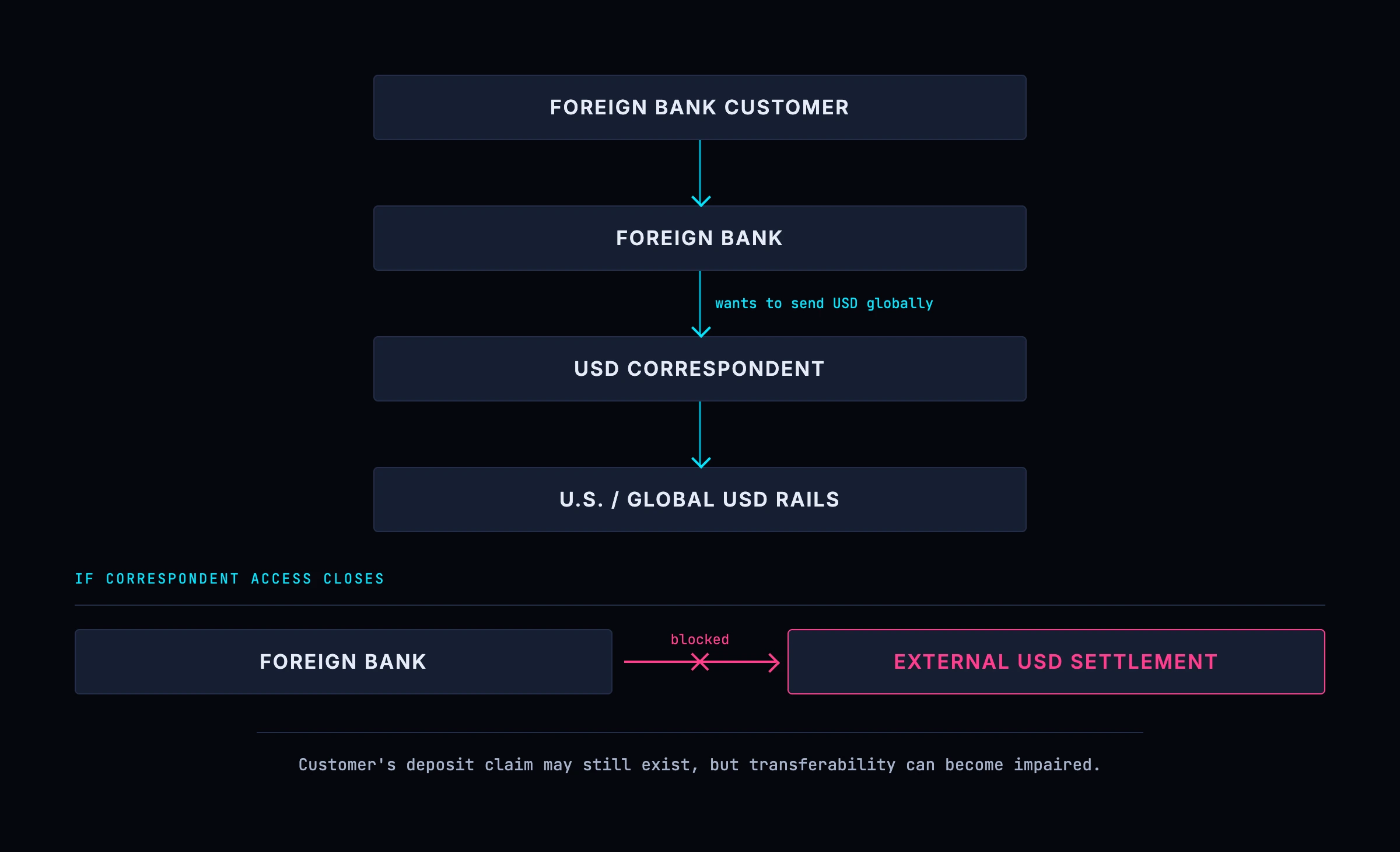
Although a foreign bank can create a USD liability, it often depends on access to the international dollar payment network to make that liability useful globally.
A foreign bank may rely on a correspondent such as a major U.S. or internationally connected bank.
If that relationship is terminated, the bank may still owe its customers dollars, but transferring those dollars internationally becomes much harder.
That is why correspondent-bank de-risking, sanctions, AML concerns, and USD clearing access can have outsized consequences for foreign financial institutions.
13. The Customer Does Not Own the Correspondent Balance
Suppose Bank of BVI has US$100 million at Standard Chartered and owes Customer X US$10 million.
Customer X does not directly own US$10 million of the Standard Chartered account.
Instead:
Standard Chartered owes Bank of BVI

Bank of BVI owes Customer X
These are separate legal relationships.
The customer's deposit is not a segregated slice of the bank's correspondent account unless a special legal structure says otherwise.
14. Can the Foreign Bank's Deposit Trade at One-for-One With Chase Dollars?
Normally, yes, if the bank is sound and can make payments at par.
A customer may experience:
US$100m at Swiss Bank
     ↓ transfer
US$100m at Chase
From the customer's perspective, nothing about the denomination changed.
Underneath, however, the issuer of the liability changed from Swiss Bank to Chase and interbank settlement occurred.
15. What Happens If the Foreign Bank Cannot Settle?
Then the distinction between bank money and central-bank money becomes painfully visible.
The customer may legally own a US$100 million claim but be unable to transfer it on demand.
Possible outcomes include:
delayed payments;
emergency borrowing;
asset sales;
capital raising;
regulatory intervention;
withdrawal limits;
restructuring;
insolvency proceedings.
The deposit was still a claim. The problem is that the issuer cannot perform as promised.
16. A Better Way to Say “Foreign Banks Create Dollars”
The phrase can sound more radical than it is.
The precise formulation is:
A foreign commercial bank can create a bank liability denominated in U.S. dollars through lending or other balance-sheet activity. It cannot create the Federal Reserve's own dollar liabilities.
That is the distinction worth remembering.
This page is part of How the US Dollar Is Created, the full primer on where dollars come from and how they move.
Frequently Asked Questions
Can a Swiss bank create US dollars?
It can create USD-denominated commercial-bank deposits. It cannot create Federal Reserve reserves.
Can a BVI bank make a USD loan without receiving the same amount from New York first?
Mechanically, a bank can create the loan and deposit simultaneously, subject to its legal and regulatory framework. It must subsequently manage funding and liquidity, especially if the deposit leaves the bank.
Are those foreign-created dollars real?
They are real claims against the foreign bank. Their practical value depends on the bank's ability to honor USD transfers and withdrawals at par.
Can the customer transfer them to Chase?
Yes, if the foreign bank can arrange external dollar settlement.
Can the foreign bank create Fed reserves?
No.
Why does it need a correspondent bank?
Correspondents provide access to external accounts, clearing, settlement, liquidity, and payment infrastructure the foreign bank may not access directly.
Authoritative Sources
BIS, International finance through the lens of BIS statistics: the global reach of currencies: https://www.bis.org/publications/qr-202406/international-finance-through-lens-bis-statistics-global-reach-currencies
BIS, The geography of dollar funding of non-US banks: https://www.bis.org/publ/qtrpdf/r_qt1812b.htm
Federal Reserve, A Lawyer's Perspective on U.S. Payment System Evolution and Money in the Digital Age: https://www.federalreserve.gov/econres/notes/feds-notes/a-lawyers-perspective-on-us-payment-system-evolution-and-money-in-the-digital-age-20220204.html
U.S. Treasury, TIC banking claims and liabilities to foreigners: https://home.treasury.gov/data/treasury-international-capital-tic-system-home-page/usbanking-claims-liabilities-foreigners
Conclusion
A foreign bank does not need the power to manufacture Federal Reserve reserves in order to create a USD-denominated bank deposit. It creates a promise payable in dollars. What disciplines that promise is the bank's need to remain solvent, obtain dollar funding, manage liquidity, and settle externally whenever its customers send money to other institutions.
That is why foreign-created commercial dollars can circulate internationally while the Federal Reserve remains the unique issuer of Federal Reserve dollars.