
A Banking Accounting Primer for People Who Do Not Have an Accounting Background
asset;
liability;
double-entry.
You do not need to become an accountant. You only need to learn to ask two questions:
Who owes me?
and
Whom do I owe?
Most of the balance-sheet mechanics in money creation follow from those two questions.
1. Asset: “Something Valuable Is Mine or Owed to Me”
An asset is something valuable you own or a claim you have against someone else.
Examples for an individual:
cash;
a house;
a bank deposit;
a loan someone owes you;
securities.
Examples for a bank:
loans to customers;
Federal Reserve reserves;
Treasury securities;
balances owed by other banks;
buildings and other property.
If Alice owes Bank A US$100,000, Bank A has an asset:
Loan receivable from Alice $100,0002. Liability: “I Owe Someone Else”
A liability is an obligation.
Examples for an individual:
mortgage;
credit-card debt;
personal loan.
Examples for a bank:
customer deposits;
borrowing from other banks;
bonds issued by the bank;
amounts payable to counterparties.
If your account shows US$50,000, the bank owes you US$50,000.
So your deposit is the bank's liability.
3. Double-Entry Banking and the IOU Analogy
Suppose John borrows US$100 from Faisal.
John writes:
I owe Faisal US$100.
There is only one IOU.
But two balance sheets describe it differently:
FAISAL
Asset: John owes me $100

JOHN
Liability: I owe Faisal $100
This is the foundation of financial accounting.
A financial claim often appears as:
Asset for Party A
=
Liability for Party B
4. Your Bank Account Is the Same Kind of Relationship
Suppose Bob's Bank of America app says:
Available balance: $600,000Bob describes this as:
I have US$600,000.
Accounting describes it more precisely:
BOB
Asset: claim against BofA       $600,000

BANK OF AMERICA
Liability: owed to Bob          $600,000
Both statements describe the same relationship.
This is why the bank does not show your checking balance under “assets.” It shows deposits under liabilities.

5. Why Does a Bank Need an Asset When It Creates a Deposit?
Suppose Bank of America credits Bob US$600,000 because JPMorgan instructed it to pay Bob.
Bank of America has just accepted a new obligation:
We owe Bob $600,000If BofA received nothing in exchange, it would simply become US$600,000 poorer.
Instead it might acquire:
JPMorgan owes BofA $600,000Now BofA has:
Asset:
Claim on JPMorgan             $600,000

Liability:
Deposit owed to Bob           $600,000
The bank accepted an obligation while acquiring an offsetting claim.
6. The Hotel Voucher Analogy
Imagine Faisal Hotel issues Bob a voucher promising US$600 of hotel services.
The hotel has created an obligation.
If it gave the voucher away for nothing, its economic position worsened.
But suppose another company gave the hotel a US$600 receivable in exchange.
Now:
Hotel asset: receivable       $600
Hotel liability: voucher      $600
The accounting is simply recording both economic consequences.
A bank issuing a deposit in exchange for a loan or another claim works on the same principle.
7. The House and Mortgage Analogy
You buy a US$500,000 house entirely with a mortgage.
Your personal balance sheet immediately has:
Asset:
House                        $500,000

Liability:
Mortgage                     $500,000
You gained a valuable asset and an obligation at the same time.
No accountant is needed to understand the reality.
Double-entry bookkeeping simply makes sure the financial records tell both halves of that story.
8. What Is Double-Entry Bookkeeping?
Double-entry bookkeeping means a transaction is recorded in a way that preserves the accounting equation and captures the complete economic event.
It does not mean keeping two secret books.
Suppose a business borrows US$1 million.
Recording only:
Cash +$1mwould be misleading.
The complete event is:
Asset:
Cash                         +$1m

Liability:
Loan payable                 +$1m
The business has more cash but also more debt.
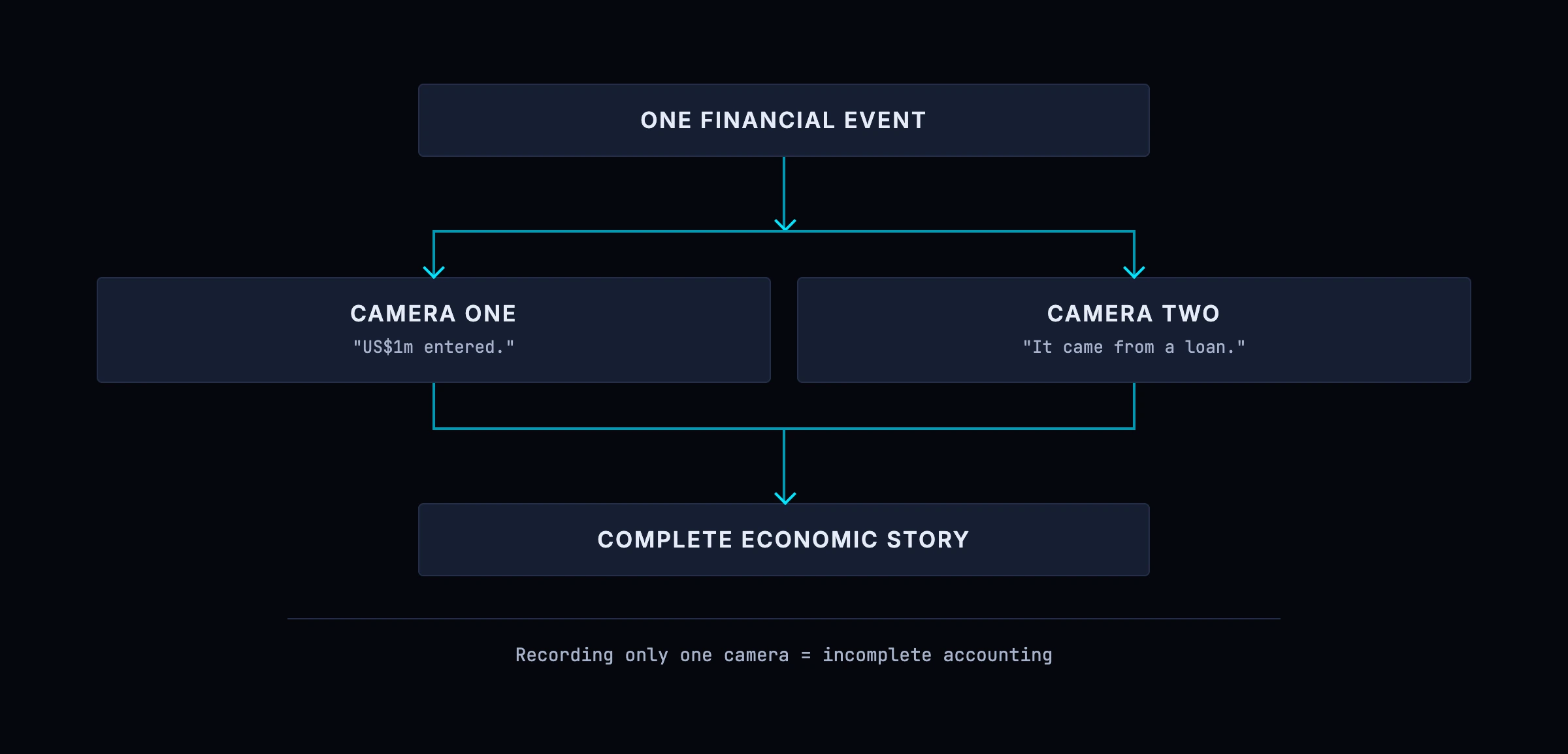
9. The Two-Camera Analogy
Imagine every transaction has two cameras.
Camera One:
US$1 million entered the company.
Camera Two:
The company borrowed US$1 million and now owes the lender.
If you watch only Camera One, you might think the company became richer.
The second camera shows why that conclusion is wrong.
Double-entry bookkeeping is the rule that says both cameras matter.
10. The Accounting Equation
The standard equation is:
Assets = Liabilities + EquityEquity is the residual belonging to the owners after liabilities are considered.
Suppose a bank has:
ASSETS
Loans                         $700m
Reserves                      $200m
Securities                    $100m
                              -----
Total                       $1,000m
and:
LIABILITIES AND EQUITY
Customer deposits             $850m
Bank borrowing                 $50m
Equity                        $100m
                              -----
Total                       $1,000m
The books balance.
11. Double-Entry Does Not Always Mean “One Asset and One Liability”
This is an important refinement.
A transaction can involve:
Asset up, liability up
Bank makes a new loan:
Loan asset       +$100
Deposit          +$100
Asset down, liability down
Borrower repays principal:
Loan asset       -$100
Deposit          -$100
One asset up, another asset down
Bank sells a Treasury security for reserves:
Security         -$100
Reserves         +$100
One liability up, another liability down
A bank can reclassify or replace funding obligations without changing total assets.
Double-entry is about complete balancing entries, not a rule that every event must create one asset and one liability.
12. Alice Pays Bob: The Accounting View
Alice banks at JPMorgan.
Bob banks at Bank of America.
Alice pays Bob US$600,000.
JPMorgan reduces:
Liability to Alice -$600,000Bank of America increases:
Liability to Bob +$600,000BofA also needs an asset or settlement value.
Initially:
Asset: JPMorgan owes BofA +$600,000Later, after settlement:
Asset: JPM receivable        -$600,000
Asset: Fed reserves          +$600,000
BofA's liability to Bob can remain unchanged throughout settlement.
This is the easiest way to see why clearing and settlement are separate stages.
For the payment sequence, see How Bank Transfers Actually Work.
13. Why a Loan Is an Asset to the Bank
A loan feels like “money leaving the bank,” so beginners often assume it must be a bank liability.
But the loan contract says the customer owes the bank.
That right to receive principal and interest is valuable.
Therefore:
Loan receivable = bank assetThe associated deposit is different:
Customer deposit = bank liabilityA bank therefore frequently has loans on the asset side and deposits on the liability side.
14. Why Interest Is Income, Not Principal
Suppose Alice owes US$100,000 principal plus US$5,000 interest.
When Alice pays US$5,000 of interest, the bank recognizes income rather than reducing the principal by US$5,000, unless the payment contract says otherwise.
The bank's earnings ultimately affect equity after expenses, taxes, distributions, and other accounting entries.
This distinction becomes essential in the “where does the interest come from?” question discussed in Where Does Bank-Loan Interest Come From?.
15. Why the Bank's Books Must Balance Even If the Bank Is Losing Money
A balanced balance sheet does not mean a bank is healthy.
Suppose a US$100 million loan becomes worthless.
The bank writes down the asset.
If liabilities remain unchanged, equity absorbs the loss:
Loan asset                    -$100m
Equity                        -$100m
The balance sheet still balances.
Accounting balance is a mathematical requirement, not a guarantee of solvency.
16. A Three-Sentence Accounting Dictionary
If you remember nothing else, remember:
Asset: Something valuable I own or someone owes me.
Liability: Something I owe someone else.
Double-entry: Record the complete financial event so the books remain balanced.
With those three sentences, most of the monetary mechanics in this series become readable.
This page is part of How the US Dollar Is Created, the full primer on where dollars come from and how they move.
Frequently Asked Questions
Is my bank deposit my asset?
Yes.
Is the same deposit a liability to the bank?
Yes.
Is my mortgage my asset?
No. It is your liability; the lender's claim against you is the lender's asset.
Why is a bank loan an asset to the bank?
Because the borrower owes the bank money.
Does double-entry mean there must always be two banks?
No. It refers to accounting entries, not the number of institutions.
Can a transaction involve two assets instead of an asset and liability?
Yes. One asset may be exchanged for another.
Does a balanced balance sheet mean a bank is financially safe?
No. A bank can be insolvent or undercapitalized while its accounting equation still balances.
Conclusion
Bank accounting is simply a disciplined language for promises and claims.
Once you see deposits as bank liabilities, loans as bank assets, and settlement balances as assets of banks and liabilities of the central bank, the creation and movement of money becomes far less mysterious.
Authoritative Sources
Federal Reserve — Commercial Bank Examination Manual: Deposit Accounts
https://www.federalreserve.gov/publications/files/cbem.pdf
Federal Reserve — A Lawyer's Perspective on U.S. Payment System Evolution and Money in the Digital Age
Bank of England — Money in the modern economy: an introduction