
A Plain-English Balance-Sheet Explanation of Reserves, Currency, Lending, Asset Purchases, and the Treasury
The Federal Reserve can create its own liabilities. The most important electronic liability for the banking system is the reserve balance. Physical Federal Reserve notes are another form of central-bank money, but the electronic reserve layer is the key to understanding interbank settlement.
The simplest way to understand Fed money creation is to watch both sides of the Federal Reserve's balance sheet.
1. How the Federal Reserve Creates Money: Both Sides of Every Entry
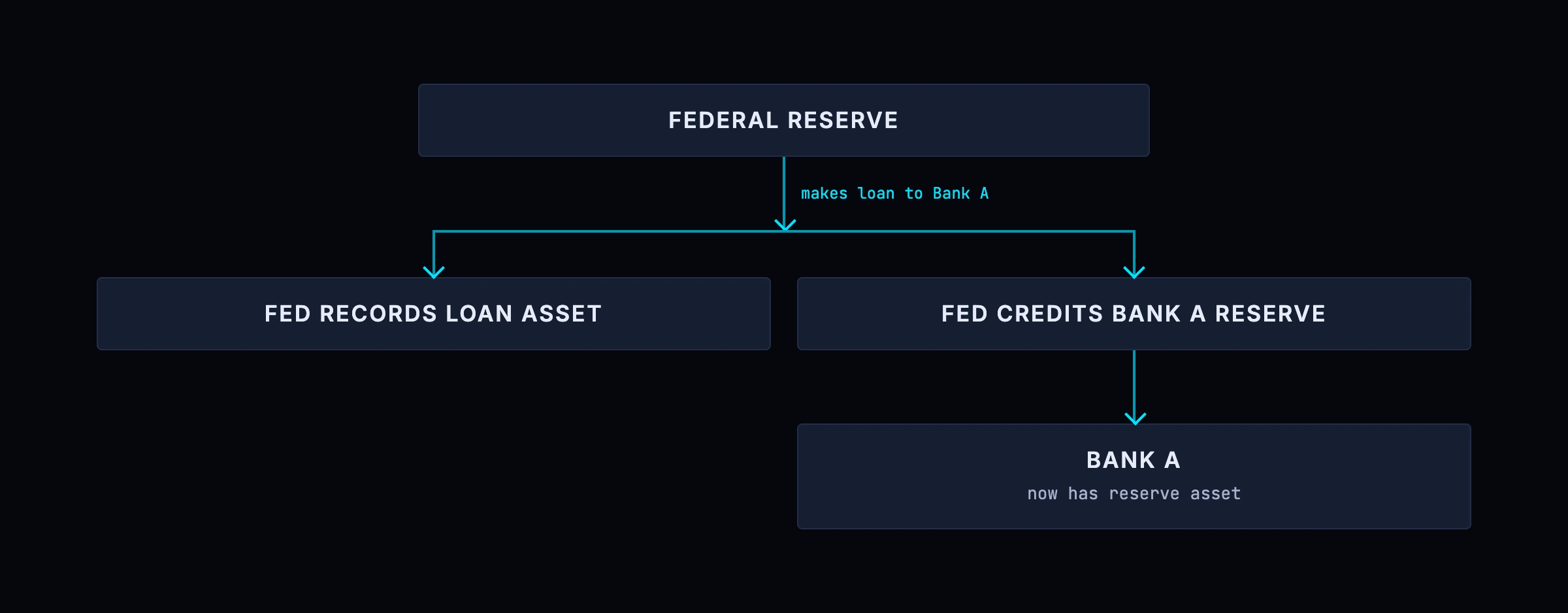
Suppose the Federal Reserve lends Bank A US$1 million.
The Fed records:
FEDERAL RESERVE

Assets                             Liabilities
------                             -----------
Loan to Bank A       +$1,000,000  Bank A reserves   +$1,000,000
The Federal Reserve now owns a claim on Bank A.
Bank A now owns an additional US$1 million reserve balance.
No previous depositor had to surrender a US$1 million reserve balance for this entry to occur.
The Fed expanded its own balance sheet.
That is central-bank money creation.
2. Fed Asset Purchases Can Also Create Reserves
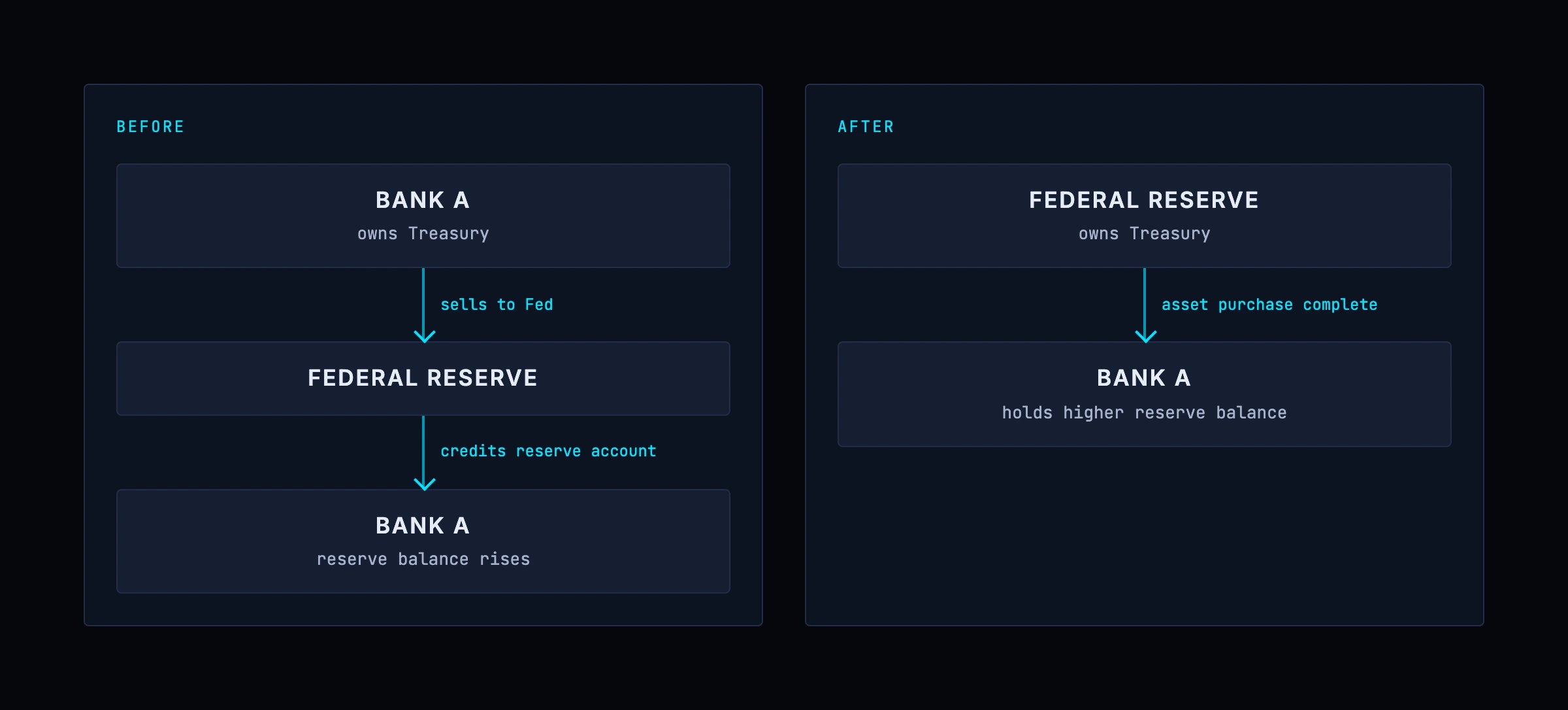
Suppose the Federal Reserve purchases a Treasury security from Bank A for US$1 million.
Very simplified:
FEDERAL RESERVE

Asset:
Treasury security             +$1,000,000

Liability:
Bank A reserves               +$1,000,000
Bank A's own balance sheet might change from:
Treasury security             -$1,000,000
Federal Reserve reserves      +$1,000,000
The bank exchanged one asset for another.
If the Fed purchases a security from a nonbank customer, the mechanics can additionally create a commercial-bank deposit because the nonbank needs to be credited by its bank while the bank receives reserves.
This distinction matters:
a Fed purchase from a bank can increase reserves without necessarily increasing a nonbank deposit at the same moment;
a Fed purchase from a nonbank normally involves both additional reserves for the banking system and a deposit credit for the seller.
Federal Reserve research explicitly describes these deposit-creation mechanics.
3. What Are Reserve Balances Used For?
Reserve balances are central-bank money used by eligible institutions for purposes including:
interbank settlement;
meeting payment obligations;
liquidity management;
monetary-policy implementation;
settlement of certain clearing arrangements.
Ordinary households do not usually maintain reserve accounts at the Federal Reserve.
That is why your checking-account balance is not simply the same thing as a reserve balance.
For the distinction, see Federal Reserve Money vs. Commercial Bank Money.
4. A Toy “Day One” Economy
Suppose we create an imaginary economy with five commercial banks and no cash.
The Fed lends each bank US$1 million.
Bank A reserves      $1m
Bank B reserves      $1m
Bank C reserves      $1m
Bank D reserves      $1m
Bank E reserves      $1m
                     ---
Total reserves       $5m
At the Fed, the simplified asset side contains US$5 million of loans to the five banks.
The liability side contains US$5 million of reserve balances.
This thought experiment is useful, but it should not be mistaken for a literal description of how the real U.S. banking system “started” or how banks normally obtain all of their reserves. In reality, reserve balances are affected by Federal Reserve asset holdings, Treasury activity, currency demand, interbank payments, Federal Reserve lending, and other balance-sheet factors.
The point of the toy example is simply to show that reserve money is a Fed liability created through a Fed balance-sheet transaction.
5. Does the Federal Reserve “Have” the Money Before Creating It?
This question applies household logic to a central bank.
If you lend someone US$1,000, you normally need to obtain the US$1,000 first.
A central bank issuing its own liabilities is in a different position.
The Fed can credit an eligible reserve account while acquiring an asset or making a loan.
The constraint is therefore not “did the Fed previously save the reserve dollars?”
The relevant constraints are institutional and macroeconomic:
Federal Reserve Act authority;
collateral and facility rules;
monetary-policy objectives;
financial-stability considerations;
inflation and economic conditions;
the structure of the Fed's balance sheet.
6. What About Banknotes?
Physical dollars are different from reserve balances but are also part of central-bank money.
The Bureau of Engraving and Printing physically produces Federal Reserve notes, but they are issued into circulation through the Federal Reserve system. Commercial banks obtain currency to meet customer demand, with the corresponding accounting reflected in their reserve/cash positions.
In a cashless thought experiment, this layer is removed so that the reader can see the electronic architecture clearly.
7. Does the U.S. Treasury Create Dollars?
This is one of the most common sources of confusion.
The Treasury and the Federal Reserve are separate institutions with different legal roles.
The Treasury:
collects taxes;
issues Treasury securities;
spends pursuant to law and appropriations;
maintains the Treasury General Account at the Federal Reserve;
issues coins through the U.S. Mint.
The Federal Reserve:
issues Federal Reserve liabilities;
operates monetary-policy tools;
maintains reserve accounts;
provides payment and settlement infrastructure;
acts as fiscal agent for the Treasury in important functions.
When the Treasury spends, banking-system reserves and deposits can be affected. But it is analytically sloppy to say that ordinary Treasury spending simply means “the Treasury printed the money.”
The exact result depends on the funding and settlement sequence, including taxes, debt issuance, the Treasury General Account, and Federal Reserve operations.
8. Does Quantitative Easing Create Money?
Quantitative easing involves central-bank asset purchases.
At the Fed level, those purchases create reserve balances when the Fed pays for assets.
If the seller is a nonbank, the payment normally also creates a commercial-bank deposit for the seller.
A simplified nonbank example:
FED buys security from Pension Fund

FED
Asset: security                 +$1m
Liability: reserves             +$1m

PENSION FUND'S BANK
Asset: reserves                 +$1m
Liability: pension deposit      +$1m

PENSION FUND
Asset: security                 -$1m
Asset: bank deposit             +$1m
The nonbank changed the composition of its assets from a security to a bank deposit, while reserves in the banking system increased.
9. What Happens When the Fed Shrinks Its Balance Sheet?
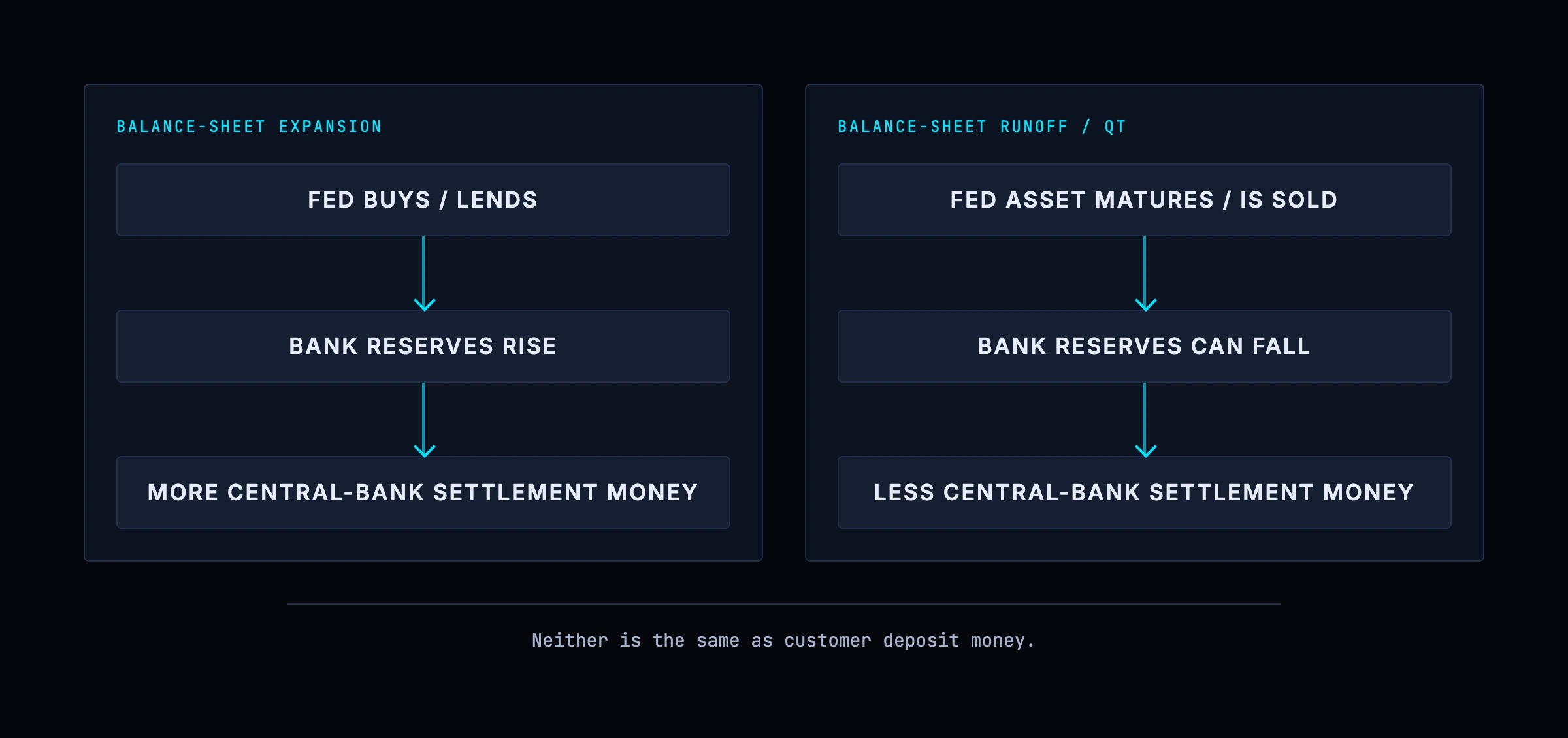
The reverse process can reduce reserve balances.
For example, when Fed assets run off or assets are sold, payments associated with those transactions can reduce reserve balances depending on counterparties and the accompanying balance-sheet movements.
This is one reason quantitative tightening can drain reserves from the banking system.
The Fed has noted that reductions in its securities holdings can drain reserves and deposits from the banking system.
10. Are Reserves the Same as “Money in Circulation”?
Be precise.
The phrase “money in circulation” can mean different things.
The Federal Reserve's monetary base includes:
currency in circulation; and
reserve balances.
Broader monetary aggregates include commercial-bank deposits and other highly liquid instruments.
So saying “the Fed created US$5 million” in a toy example should be translated as:
The Fed created US$5 million of central-bank reserve liabilities.
It does not automatically mean the public now has US$5 million of checking-account deposits.
11. Can Commercial Banks Spend Reserves on Ordinary Goods?
Not in the same way a household spends its checking deposit.
Reserve balances circulate within the eligible settlement system. A bank does not hand a retail borrower a slice of its Fed reserve account.
When a commercial bank lends to a customer, it normally credits a deposit account. If that customer sends the deposit to another bank, reserve settlement may follow between the banks.
This distinction is central to How Commercial Banks Create Money.
12. Reserve Requirements Are Not the Modern Lending “Throttle” People Often Imagine
Many older textbook explanations say:
A bank receives US$1,000, must hold 10% in reserves, and can lend US$900.
That framework can be useful for certain historical or classroom exercises, but it is misleading as a literal explanation of U.S. banking in 2026.
The Federal Reserve reduced reserve requirement ratios to zero in March 2020, and official 2026 materials state that the ratios remain zero.
This does not mean reserves are irrelevant.
Banks still need liquidity and settlement capacity, and the distribution and price of reserves matter. It means the mechanical fixed-reserve-ratio multiplier is not the governing description of how modern U.S. banks decide whether they can originate another loan.
13. The Fed Creates the Apex Asset, Not Every Dollar Claim
The most important conclusion is:
Federal Reserve
creates Federal Reserve liabilities

Commercial banks
create commercial-bank liabilities

Foreign banks
can create USD-denominated liabilities
The Federal Reserve sits at the apex of official U.S. dollar settlement, but the global supply of dollar-denominated financial claims is much broader than the Fed's own balance sheet.
That is why the rest of this series is necessary.
This page is part of How the US Dollar Is Created, the full primer on where dollars come from and how they move.
Frequently Asked Questions
Can the Fed create reserves electronically?
Yes. Reserve balances are electronic Fed liabilities created through Fed balance-sheet operations.
Does the Fed need tax revenue before it can create reserves?
No. Federal Reserve reserve creation is not funded the way a household funds spending.
Does QE always create deposits?
A Fed purchase from a nonbank normally results in a deposit credit to the nonbank seller along with increased reserves. A purchase directly from a bank can principally exchange one bank asset for reserves.
Does the Fed give reserves directly to ordinary borrowers?
No. Commercial banks normally give borrowers deposits.
Are reserve requirements 10% in the United States?
No. As of 2026, Federal Reserve reserve requirement ratios remain zero.
Is the Treasury the same as the Federal Reserve?
No. They are distinct institutions with different functions.
Conclusion
The Federal Reserve creates central-bank money by creating its own liabilities, especially reserve balances, against assets on its balance sheet. This is different from commercial banks creating deposits through lending.
Once those two layers are separated, the rest of the monetary system becomes much easier to follow.
Authoritative Sources
Federal Reserve — Reserve Requirements
https://www.federalreserve.gov/monetarypolicy/reservereq.htm
Federal Reserve — Understanding Bank Deposit Growth during the COVID-19 Pandemic
Federal Reserve — What is the money supply?
https://www.federalreserve.gov/faqs/money_12845.htm
Federal Reserve — Why does the Federal Reserve lend money to banks?
https://www.federalreserve.gov/faqs/banking_12841.htm
Deutsche Bundesbank — The Origin of Money, Part III: Central Bank Money