
How US-Dollar Deposits, Loans and Banking Activity Can Exist Outside the United States Without Every Dollar Sitting in New York
That can happen in a narrow correspondent-balance sense, but it is not a complete description of the international dollar system.
Foreign banks can maintain USD assets and liabilities on their own balance sheets. They can make dollar loans and create dollar-denominated deposits. They can borrow dollars from other foreign banks. They can fund themselves using securities markets and derivatives. Only some of that activity requires a contemporaneous movement in a U.S. bank account.
This international network is commonly associated with the Eurodollar system.
1. The Eurodollar System Has Nothing to Do With the Euro
A Eurodollar is not a euro and does not have to be located in Europe.
Historically, the term refers broadly to U.S.-dollar deposits or dollar banking activity outside the United States.
A USD deposit at a bank in London, Switzerland, Singapore, the Cayman Islands, or another non-U.S. location can be part of this offshore dollar system.
The core idea is geographical and institutional:
The obligation is denominated in U.S. dollars, but the institution owing those dollars is outside the domestic U.S. banking system.
2. Begin With a Foreign Bank's Correspondent Account
Assume Bank of BVI maintains a USD correspondent account at Standard Chartered New York.
Bank of BVI sees:
Asset:
USD nostro at Standard Chartered NY       US$200m
Standard Chartered sees the mirror image:
Liability:
USD owed to Bank of BVI                   US$200m
This US$200 million clearly touches the U.S. banking system.
If another U.S. bank sends funds to Bank of BVI, settlement may increase Standard Chartered's reserve position and its liability to Bank of BVI.
For the operational mechanics of such relationships, see correspondent banking relationships.
3. But Bank of BVI Can Have More Than US$200 Million of USD Deposits
Suppose Bank of BVI's balance sheet is:
BANK OF BVI — USD BOOK

ASSETS
Nostro at Standard Chartered          US$200m
USD corporate loans                   US$700m
U.S. Treasury securities              US$150m
Other USD claims                       US$50m
                                      -------
Total USD assets                    US$1.100bn

LIABILITIES
USD customer deposits                 US$900m
USD interbank borrowing               US$100m
Other USD liabilities                 US$100m
                                      -------
Total USD liabilities               US$1.100bn
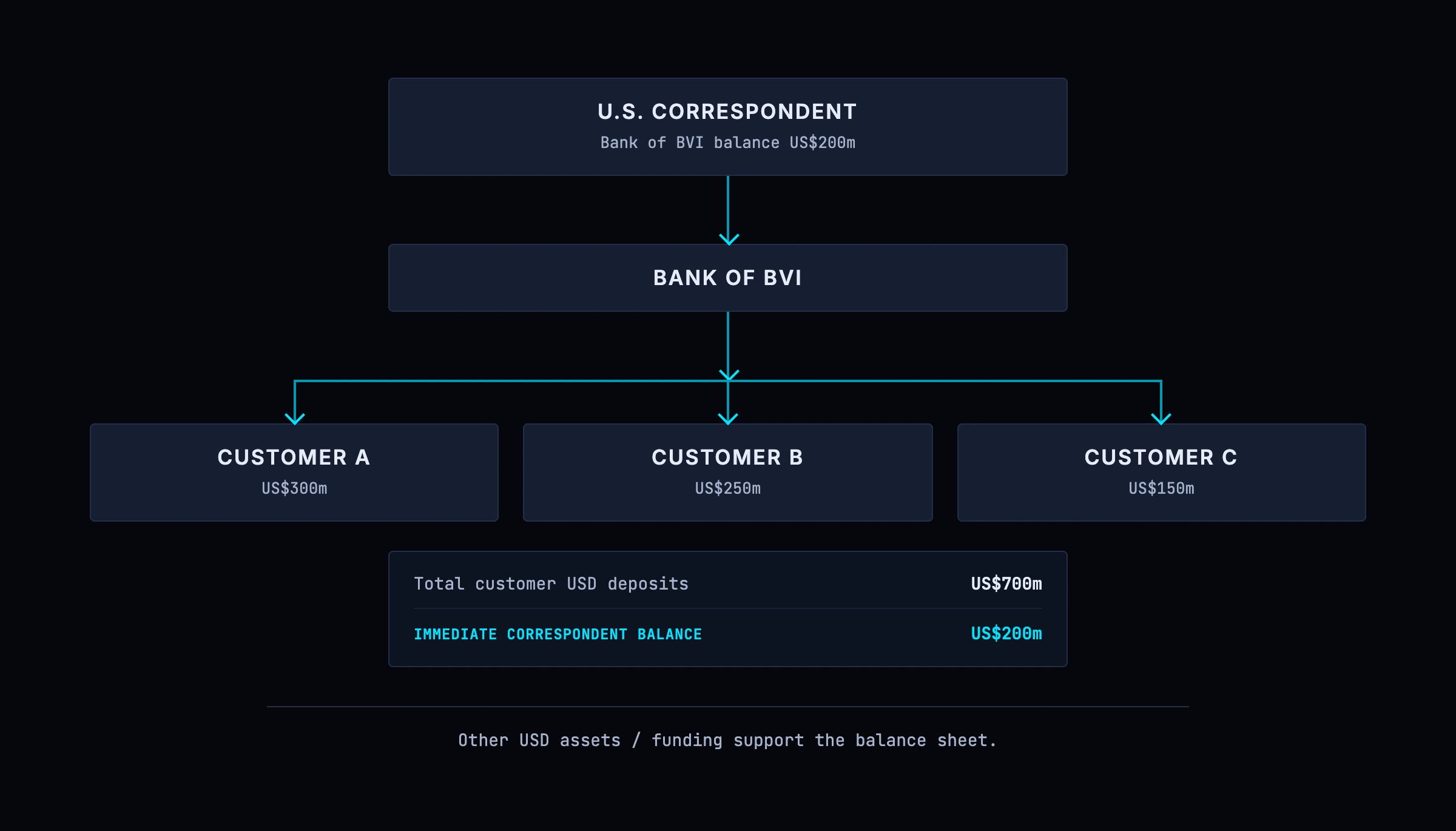
Customers have US$900 million of USD deposits.
Only US$200 million happens to sit in the bank's U.S. correspondent account.
There is no contradiction.
The bank also owns loans, securities, and other dollar assets.
4. The Foreign Bank Can Create Another USD Deposit Through Lending
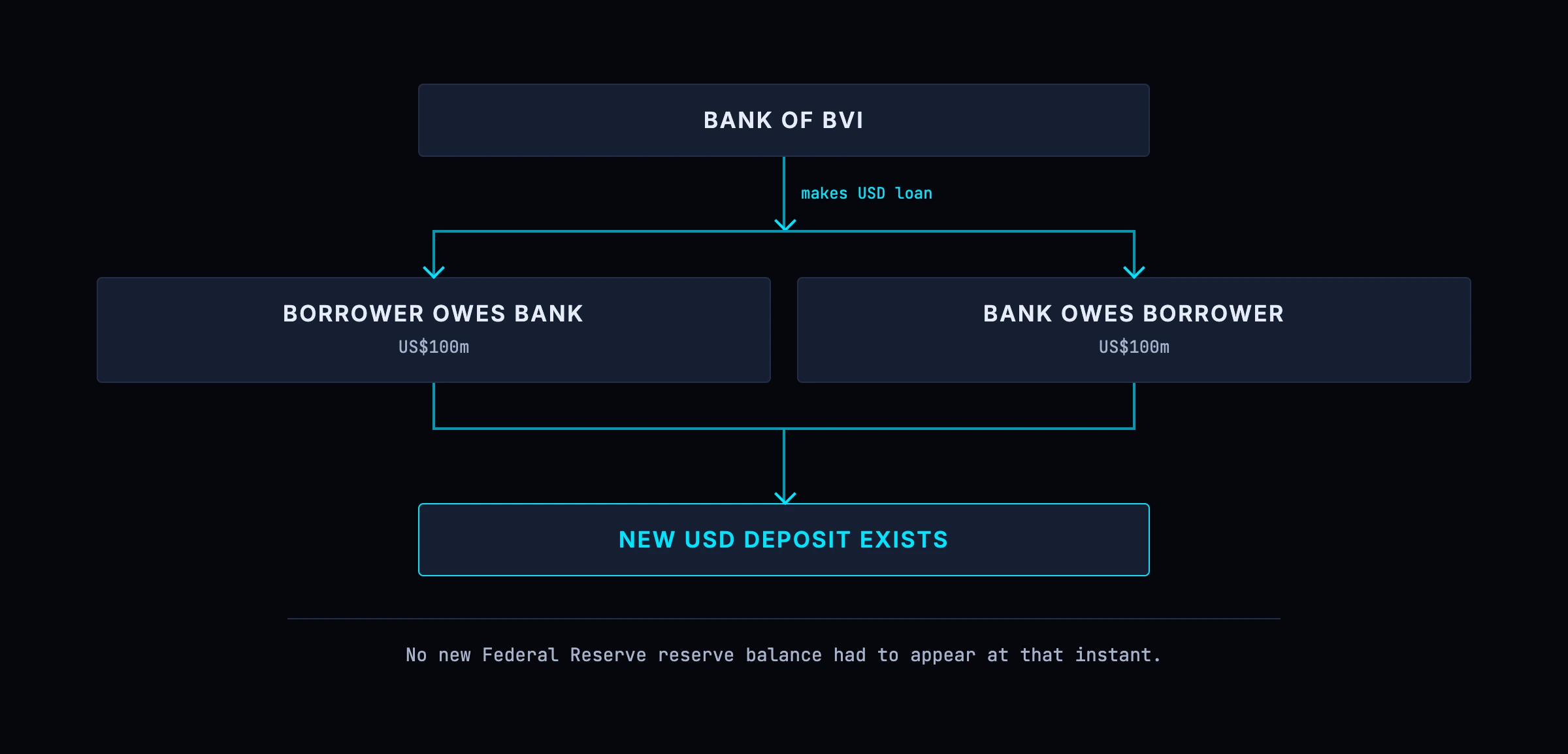
Suppose Bank of BVI lends Maria US$100 million.
It can record:
Asset:
USD loan to Maria                 +US$100m

Liability:
Maria USD deposit                 +US$100m
Bank of BVI's USD balance sheet expands.
No Federal Reserve reserve balance necessarily changes at that instant.
No U.S. correspondent account necessarily receives US$100 million.
A new USD-denominated commercial-bank liability was created outside the United States.
This is the essence of why offshore dollar liabilities can exceed the balances foreign banks directly hold in U.S. correspondents.
5. Is That Really a Dollar?
It is a real USD-denominated bank claim.
Maria can see:
USD balance: US$100,000,000Bank of BVI legally owes her that amount according to the account terms.
But her deposit is not a Federal Reserve liability.
It is a Bank of BVI liability denominated in the U.S. dollar unit of account.
That distinction is identical in concept to the difference between a Chase deposit and a Federal Reserve reserve balance, except that the foreign bank also faces cross-border funding and settlement constraints.
6. What Happens If Maria Pays Another Bank of BVI Customer?
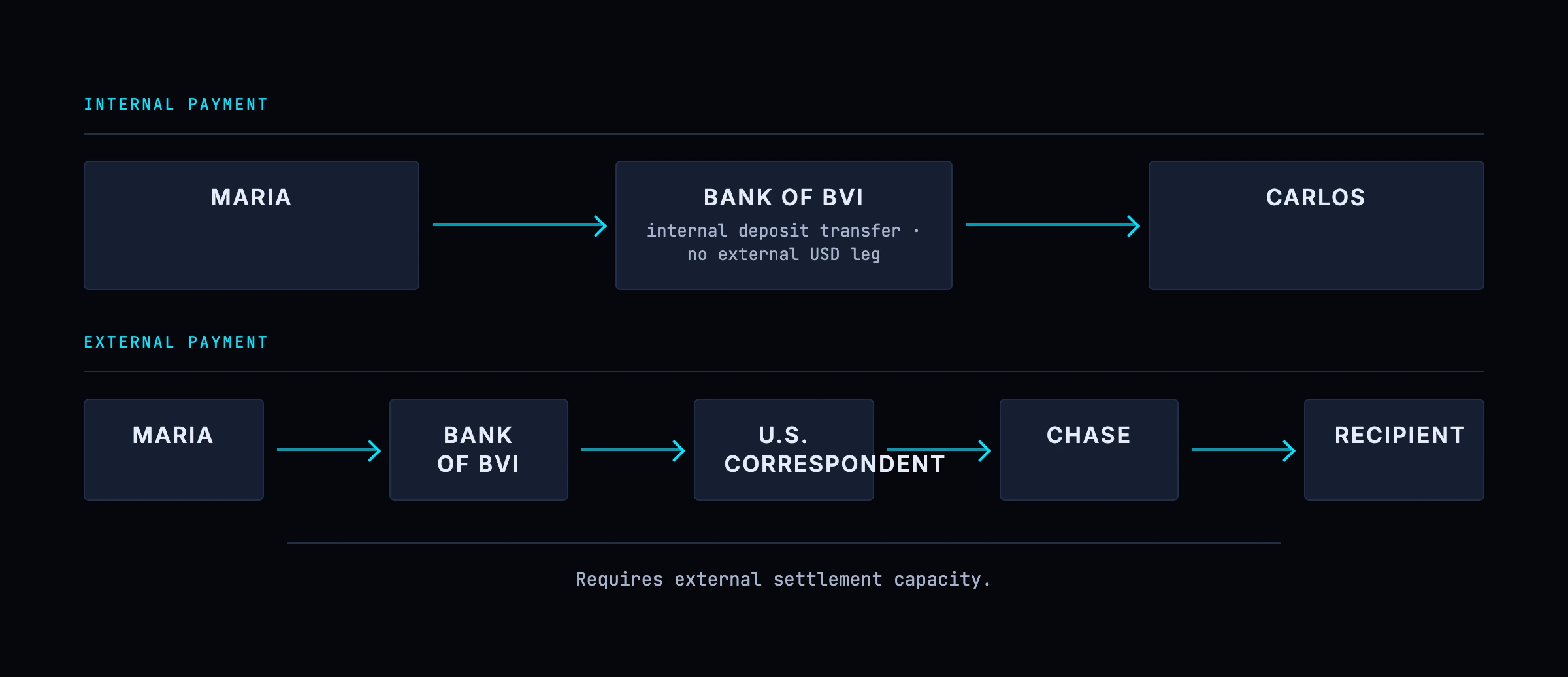
Suppose Maria pays Carlos US$25 million and Carlos also banks at Bank of BVI.
Bank of BVI can simply change its internal ledger:
Maria deposit             -US$25m
Carlos deposit            +US$25m
The total USD deposits at Bank of BVI are unchanged.
No correspondent bank needs to be involved.
No Federal Reserve balance needs to move.
The offshore USD deposit has circulated entirely within the foreign bank's own ecosystem.
7. What If Maria Sends US$100 Million to Chase?
Now the bank must perform externally.
Maria instructs Bank of BVI:
Send US$100 million to my Chase account in New York.
Bank of BVI must deliver a claim acceptable to the external dollar system.
It could instruct Standard Chartered to use Bank of BVI's correspondent balance.
Simplified:
Bank of BVI deposit owed to Maria          -US$100m

Bank of BVI nostro at SCB                  -US$100m

SCB / U.S. settlement chain                 US$100m

Chase deposit owed to Maria                +US$100m
The foreign-bank liability has been transformed into a Chase liability through settlement.
This is why a foreign-bank-created dollar can have value outside its home ecosystem: the foreign bank has mechanisms for external dollar funding and settlement.
8. The Foreign Bank Does Not Need Dollar-for-Dollar Correspondent Cash
A foreign bank does not normally keep one idle correspondent dollar for every dollar of customer deposits.
It manages a portfolio of USD assets and liabilities.
Possible USD assets include:
correspondent balances;
U.S. Treasury securities;
dollar-denominated corporate loans;
interbank loans;
bonds;
secured financing claims;
other liquid securities.
Possible USD funding sources include:
customer deposits;
interbank borrowing;
wholesale funding;
bond issuance;
repos;
FX swaps and forwards;
central-bank facilities in exceptional circumstances.
The central problem is not whether every deposit is “backed by a dollar in New York.”
It is whether the institution can meet its USD obligations as they fall due.
9. Liquidity vs. Solvency
This produces two different failure modes.
Liquidity problem
The bank may own valuable USD assets but cannot obtain enough immediately transferable dollars today.
Solvency problem
The value of the bank's assets may be insufficient to cover its liabilities.
A bank can be solvent but temporarily illiquid.
It can also be both illiquid and insolvent.
The distinction matters because a customer deposit can be a legally valid US$100 million claim while the issuing bank nevertheless struggles to make the payment immediately.
10. Why the Dollar System Extends Far Beyond Fed Reserves
If only Federal Reserve reserves counted as dollars, the global dollar system would be dramatically smaller than it actually is.
Instead, banks around the world maintain USD balance sheets and create dollar-denominated credit.
BIS research estimated that non-U.S. banks had about US$21 trillion in dollar liabilities at the end of 2023, with about three quarters—roughly US$16 trillion—booked outside the United States.
Those figures are not equivalent to “US$21 trillion of deposits” and should not be described that way. They are broader bank dollar liabilities. But they illustrate the enormous scale of dollar banking beyond the United States.
11. Offshore Dollars Are Not Necessarily Tax-Haven Dollars
The word offshore can suggest secrecy jurisdictions.
That is misleading.
A dollar deposit at a major London, Frankfurt, Tokyo, Toronto, Singapore, or Swiss banking institution is also outside the United States.
The international dollar system exists because USD is extensively used for:
trade invoicing;
commodities;
cross-border lending;
securities issuance;
corporate treasury;
international banking;
derivatives;
reserves;
investment portfolios.
Tax-haven banking is only one small and highly visible narrative within a much larger global dollar system.
12. Why Foreign Banks Want USD Funding
A foreign bank may make dollar loans to:
exporters;
importers;
multinational corporations;
commodity traders;
shipping companies;
investment funds;
governments;
financial institutions.
If the bank owns USD assets, it generally needs USD liabilities or hedges to manage currency and funding risk.
That is why dollar funding markets are global.
13. FX Swaps Create Another Layer
A bank may need dollars temporarily without taking a conventional USD deposit.
It can use an FX swap: exchange one currency for dollars now while agreeing to reverse the exchange later.
Economically, this can create a future dollar payment obligation even though conventional accounting presentation may not show it as a normal USD loan liability.
BIS research has highlighted the enormous scale of these off-balance-sheet dollar obligations.
This is one reason the complete global “dollar system” is larger and more complex than ordinary bank-deposit statistics suggest.
14. Why Correspondent Banks Still Matter
If foreign banks can create USD deposits, why do they need New York correspondents?
Because internal creation is not the same thing as external settlement.
A bank can write:
Customer USD deposit +US$100mon its own ledger.
It cannot write:
Federal Reserve reserve account +US$100mon the Fed's ledger.
To send dollars through the external U.S. banking system, a foreign institution generally needs an appropriate path through correspondents, branches, clearing members, market funding, or other settlement arrangements.
Losing that access can severely impair a bank's ability to provide international USD payments.
15. Does Every Offshore Dollar Eventually “Come Home” to the Fed?
No, not on every transaction.
Two customers of the same foreign bank may exchange USD deposits entirely internally.
Two foreign banks may settle through a shared correspondent.
Banks may net reciprocal payment obligations.
Offshore interbank markets can create and extinguish claims without every gross payment triggering a matching Federal Reserve movement.
However, access to high-quality dollar settlement assets and funding becomes critical whenever external obligations must be discharged.
16. A Hierarchy of Offshore Claims
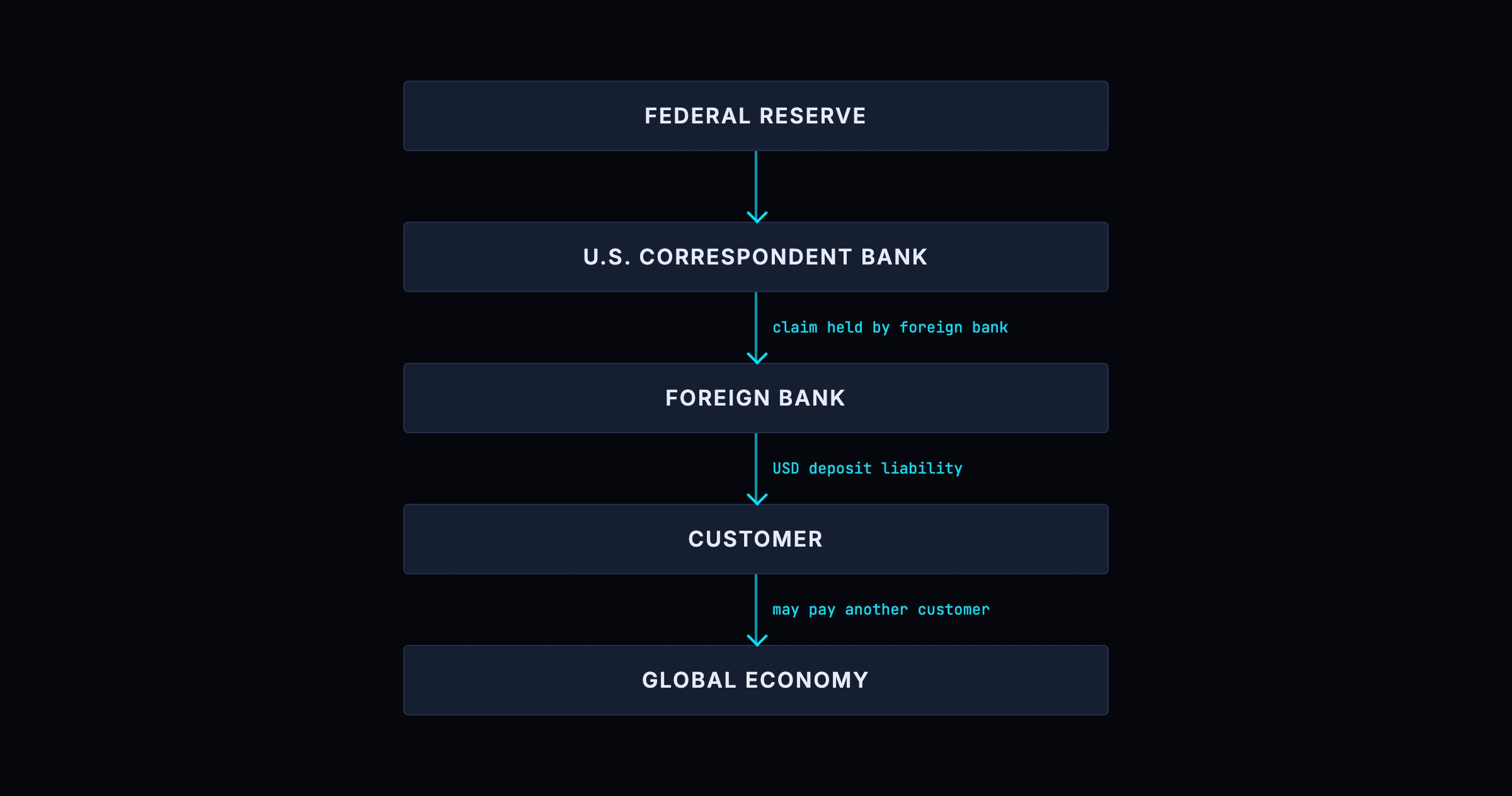
Consider:
Federal Reserve
      │
      │ reserve liability
      ▼
Standard Chartered New York
      │
      │ correspondent liability
      ▼
Bank of BVI
      │
      │ customer deposit liability
      ▼
Carlos
Carlos says:
I have US$10 million.
Correct.
More precisely:
Carlos owns a US$10 million claim against Bank of BVI.
Bank of BVI may own a claim against Standard Chartered.
Standard Chartered may hold Federal Reserve reserves and other USD assets.
These are different claims, all denominated in the same unit.
17. Why They Normally Trade at Par
Under normal banking conditions:
US$1 at Bank of BVI
≈
US$1 at Swiss Bank
≈
US$1 at Chase
because each institution is expected to honor valid transfer or redemption instructions at par.
If confidence in a bank's solvency or liquidity collapses, its deposit claim may no longer be viewed as perfectly equivalent to a deposit at a stronger institution.
The apparent sameness of all bank dollars therefore depends on institutional credibility and payment convertibility.
18. Why the Offshore Dollar System Matters During Crises
Foreign banks can become structurally dependent on dollar funding.
During market stress, depositors and wholesale lenders may pull dollar funding while borrowers still owe the bank dollars.
The result can be a dollar funding squeeze.
This helps explain why central-bank dollar liquidity arrangements and swap lines have become important in major global crises: they address shortages of high-quality dollar funding without implying that all offshore dollar deposits had previously been sitting at the Federal Reserve.
This page is part of How the US Dollar Is Created, the full primer on where dollars come from and how they move.
Frequently Asked Questions
What is an offshore dollar?
Broadly, a USD-denominated deposit, loan, claim, or financial obligation booked outside the domestic United States.
Is a Eurodollar a euro?
No. It is a U.S.-dollar concept. The name is historical.
Can a foreign bank create USD deposits?
Yes, subject to legal, regulatory, capital, liquidity, funding, and risk constraints. It cannot create Federal Reserve reserves.
Does every offshore dollar have an equivalent dollar at a U.S. correspondent?
No. Foreign banks can own USD loans, securities, interbank claims, and other assets. Their customer USD deposits do not need to equal their correspondent cash balances dollar-for-dollar.
Can an offshore dollar be transferred to Chase?
Yes, if the issuing bank can obtain and deliver the required external USD settlement through its correspondent or other funding arrangements.
Does the Federal Reserve know every offshore USD deposit?
No. The international system is measured through multiple national and international reporting systems, not a single Fed ledger.
Related Pages in This Primer
Authoritative Sources
BIS, International finance through the lens of BIS statistics: the global reach of currencies: https://www.bis.org/publications/qr-202406/international-finance-through-lens-bis-statistics-global-reach-currencies
BIS, The geography of dollar funding of non-US banks: https://www.bis.org/publ/qtrpdf/r_qt1812b.htm
BIS, Dollar funding of non-US banks through Covid-19: https://www.bis.org/publications/qr-202103/dollar-funding-non-us-banks-through-covid-19
U.S. Treasury, TIC U.S. Banking Claims on and Liabilities to Foreigners: https://home.treasury.gov/data/treasury-international-capital-tic-system-home-page/usbanking-claims-liabilities-foreigners
Federal Reserve, A Lawyer's Perspective on U.S. Payment System Evolution and Money in the Digital Age: https://www.federalreserve.gov/econres/notes/feds-notes/a-lawyers-perspective-on-us-payment-system-evolution-and-money-in-the-digital-age-20220204.html
Conclusion
The offshore dollar system is not a warehouse of American money that has physically left the United States. It is an international network of USD-denominated bank balance sheets. Foreign banks can borrow dollars, lend dollars, create dollar deposits, hold dollar securities, and settle through correspondents and markets. What they cannot create is the Federal Reserve's own settlement liability.
The key distinction is therefore between creating a dollar-denominated bank promise and creating the central-bank asset ultimately used for U.S. settlement.