
What the Federal Reserve Knows Exactly, What Banks Report, What M1 and M2 Measure, and Why the Offshore Dollar System Has No Single Master Total
The answer depends entirely on which layer of the dollar system is being measured.
The Federal Reserve can measure its own liabilities with extraordinary precision because those balances are on its own books. U.S. commercial-bank deposits are also measured closely through bank records and regulatory/statistical reporting. But the broader worldwide universe of USD-denominated claims is not contained in one global ledger.
1. How Much US Dollar Money Exists Depends on Which Dollars
The word dollars may refer to very different financial instruments:
Federal Reserve notes in circulation;
reserve balances held at Federal Reserve Banks;
demand deposits at U.S. commercial banks;
savings and other liquid deposits;
time deposits;
retail money-market balances included in broader monetary aggregates;
USD deposits at foreign banks;
interbank USD claims;
dollar securities;
dollar obligations created through derivatives and FX swaps.
There is no useful single number called “all dollars” unless the definition is specified first.
2. Federal Reserve Reserves Are Directly Observable by the Fed
Suppose JPMorgan has a reserve balance of US$80 billion.
That account is maintained at the Federal Reserve.
The Fed does not need JPMorgan to estimate it. The balance is part of the Fed's own liability ledger.
Conceptually:
FEDERAL RESERVE

Reserve liability to JPMorgan       US$X
Reserve liability to BofA           US$Y
Reserve liability to Citi           US$Z
...
The sum of those balances is therefore highly precise.
As of September 16, 2026, the Federal Reserve's H.4.1 release reported about US$2.922 trillion of “other deposits held by depository institutions,” the line corresponding closely to reserve balances in the consolidated statement. The weekly reserve-balances presentation reported the same order of magnitude. This is a dated snapshot, not a permanent number.
3. Currency Is Also Measured
Physical Federal Reserve notes are another central-bank liability.
Even though this primer often assumes a cashless economy to simplify the mechanics, actual U.S. monetary statistics include currency.
The Federal Reserve reported roughly US$2.48 trillion of currency in circulation in mid-September 2026.
The location of every banknote is not individually known. But the aggregate amount outstanding can be measured from Federal Reserve balance-sheet and currency records.
4. Commercial-Bank Deposits Are Not on the Fed's Customer Ledger
Suppose Bank A owes its customers:
Alice                       US$100,000
Bob                         US$250,000
Company X                    US$12m
Company Y                    US$83m
...
Total deposits              US$400bn
Bank A knows these balances at the account level.
The Federal Reserve does not need to operate one nationwide real-time database listing every retail and corporate depositor to measure the banking system statistically.
Banks maintain their own customer ledgers and provide extensive regulatory and statistical reports.
So two different types of knowledge exist:
Bank-level knowledge:
Exact customer ledger positions

System-level statistical knowledge:
Aggregated and reported deposit totals
5. If There Are US$4 Trillion of Deposits, Are They All Accounted For?
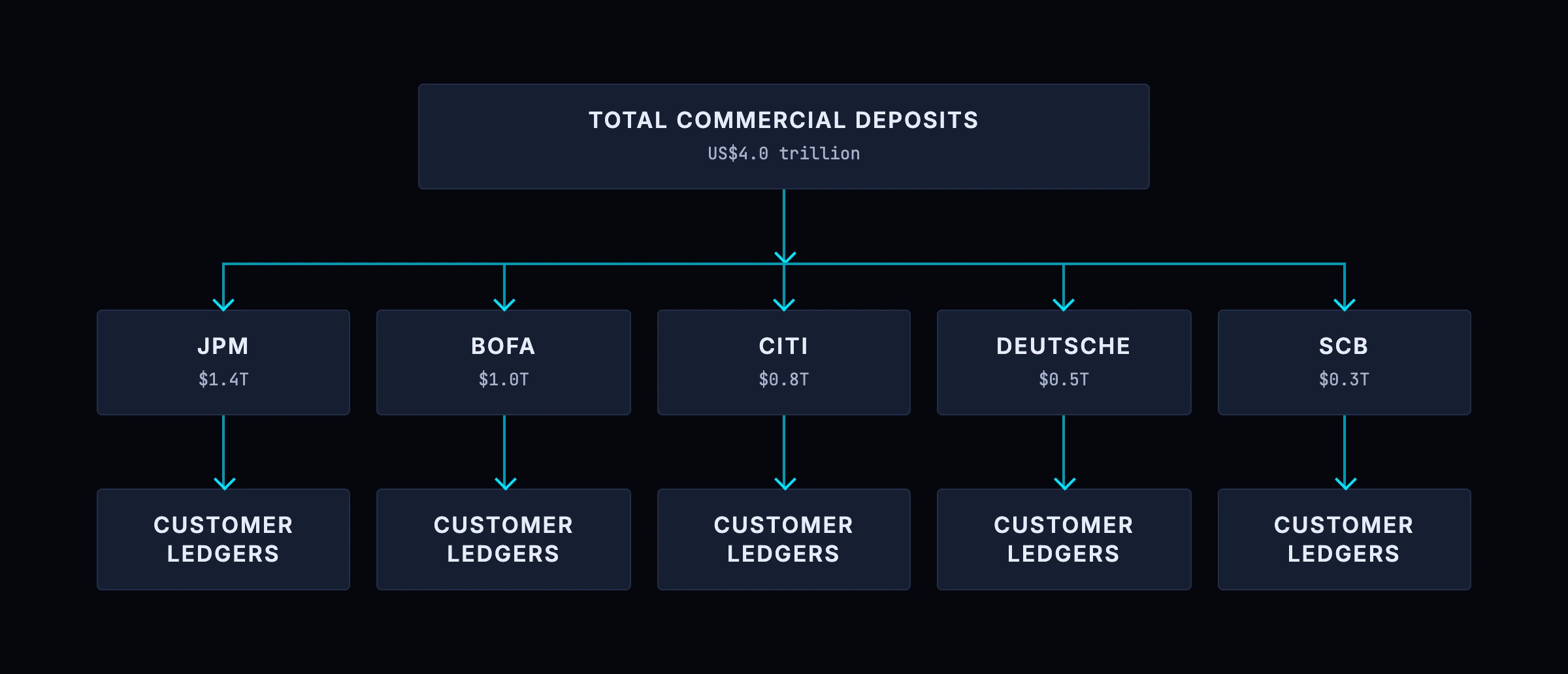
In a simplified five-bank economy, yes.
Suppose:
JPMorgan                  US$1.4T
Bank of America           US$1.0T
Citi                      US$0.8T
Deutsche                  US$0.5T
Standard Chartered        US$0.3T
                          -------
Total                     US$4.0T
Each bank knows precisely which customer accounts make up its share.
Collectively, every dollar of the US$4 trillion is represented as a liability somewhere in the banking system.
But “where” means:
Which institution owes the deposit, and to which account holder?
It does not mean each deposit dollar has a unique physical or electronic token at the Federal Reserve.
6. Why Interbank Claims Must Be Treated Carefully
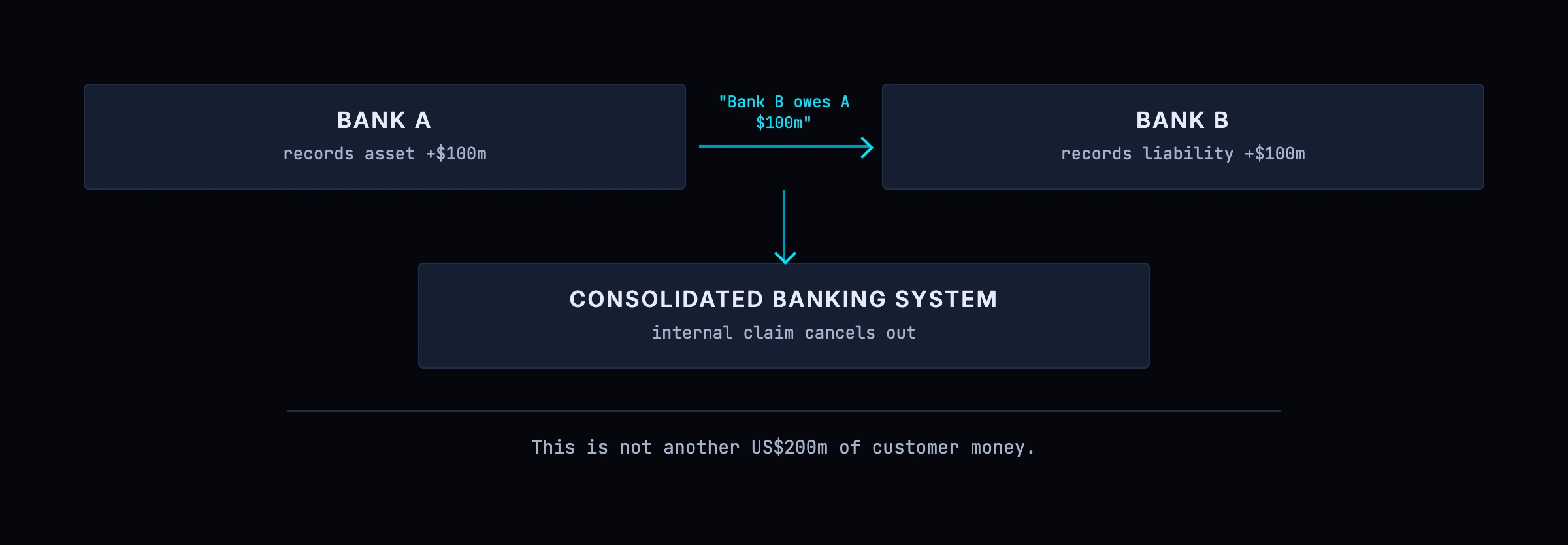
Suppose JPMorgan owes Bank of America US$100 million.
Bank of America records:
Asset: claim on JPMorgan US$100mJPMorgan records:
Liability to BofA US$100mIf one simply added every balance-sheet item throughout the system, the same relationship would appear twice.
When economists consolidate the banking sector, many interbank assets and liabilities cancel against one another.
That is why measuring “money” is not equivalent to adding every number printed on every bank balance sheet.
7. M1 and M2 Are Defined Measures, Not “All Dollars”
The Federal Reserve publishes monetary aggregates in its H.6 release.
As of the August 25, 2026 release, covering July 2026, seasonally adjusted components of M1 included approximately:
Currency                     US$2.383T
Demand deposits              US$7.088T
Other liquid deposits       US$10.416T
                            ---------
M1                          US$19.886T
These definitions matter. M1 is not simply “commercial-bank-created money.” It includes physical currency, which is central-bank money, as well as several categories of deposit money.
M2 is broader still, adding specified forms of time deposits and retail money-market fund balances under the Federal Reserve's published methodology.
Therefore statements such as “there are X trillion dollars” are meaningless without saying whether X refers to reserves, monetary base, M1, M2, bank deposits, currency, or another measure.
8. The Monetary Base Is Different From M1
The Federal Reserve defines the monetary base as:
Currency in circulation
+
Reserve balances
That is central-bank money in a broad operational sense.
M1 includes large quantities of commercial-bank deposit money in addition to currency.
This is why the quantity of spendable deposit money can be much greater than the quantity of reserve balances.
The relationship is not a simple one-for-one backing ratio.
9. Do Banks Report Every Customer Balance to the Government in Real Time?
Not as one universal customer-by-customer live money register.
Banks maintain detailed account records because they must know exactly what they owe each depositor.
Regulators and statistical agencies receive multiple forms of reporting at different frequencies and levels of aggregation.
For example, U.S. banks submit regulatory reports that provide detailed balance-sheet information. The Federal Reserve also collects data used in its weekly, monthly, and quarterly statistical publications.
The important distinction is:
The information exists at the banking-system level, but it is distributed across institution-level ledgers and regulatory reporting systems rather than one public real-time master customer ledger.
10. What About Dollars Held by Foreigners at U.S. Banks?
Suppose a Swiss company holds US$20 million at JPMorgan New York.
That is still a JPMorgan liability booked within the U.S. banking system.
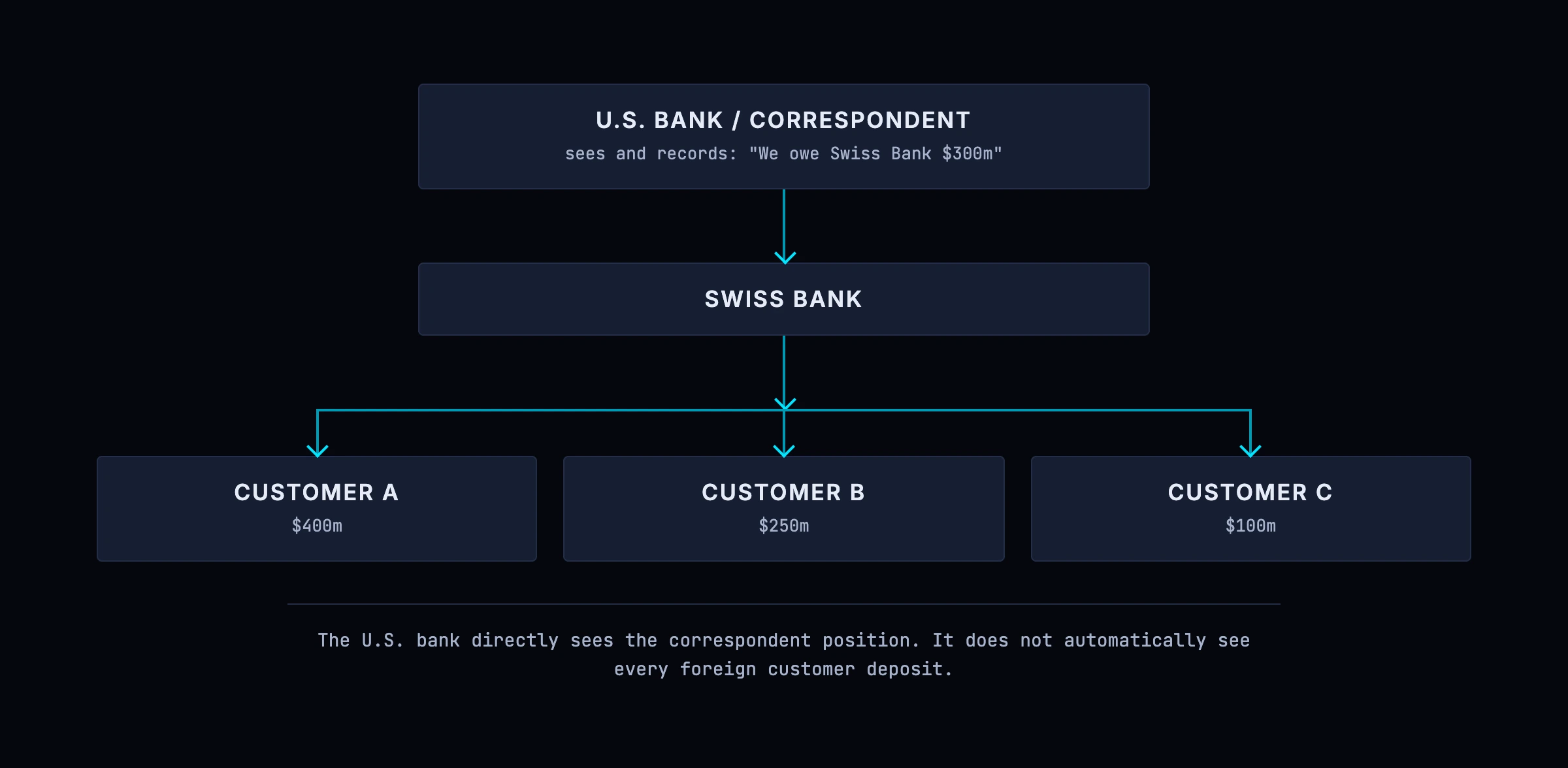
Likewise, if Bank of BVI maintains US$500 million with a U.S. correspondent, the U.S. correspondent knows it owes Bank of BVI that amount.
The U.S. Treasury's Treasury International Capital, or TIC, system collects substantial information about U.S. banking claims on and liabilities to foreign residents.
This allows authorities to measure important portions of cross-border U.S. financial positions.
The detailed structure of correspondent accounts is explained in the site's existing correspondent banking relationships resource.
11. Why That Still Does Not Reveal Every Offshore Dollar
Suppose Bank of BVI has:
USD balance at U.S. correspondent       US$200m
USD customer deposits                   US$900m
USD loans                               US$700m
Other USD assets                        US$200m
The U.S. correspondent may directly observe its US$200 million liability to Bank of BVI.
It does not follow that the correspondent sees every one of Bank of BVI's US$900 million customer deposits.
Those deposits are liabilities on Bank of BVI's own ledger.
This is why one cannot discover the entire offshore dollar system merely by adding foreign-bank correspondent balances in New York.
12. Treasury Itself Acknowledges Measurement Limits
Cross-border financial statistics have limitations.
The holder visible to a U.S. reporting institution may be a foreign bank, custodian, nominee, or intermediary rather than the ultimate beneficial owner.
Some international positions can therefore be difficult to assign perfectly by geography or ultimate owner.
The Treasury's TIC documentation and survey releases explicitly discuss such reporting and attribution limitations.
That does not make the system unobservable. It means the measurement is statistical and institutional rather than a universal account-by-account world ledger.
13. The BIS Helps Measure the International Dollar System
The Bank for International Settlements aggregates cross-border banking statistics from participating jurisdictions.
BIS research reported that non-U.S. banks had about US$21 trillion of dollar liabilities at the end of 2023, with roughly three quarters—about US$16 trillion—booked outside the United States.
That figure is extraordinarily important conceptually.
It demonstrates that:
USD liabilities outside the United States
≠
USD balances directly recorded at U.S. banks
A foreign bank can have a large USD balance sheet containing loans, securities, interbank claims, and customer deposits even though only a portion of its liquidity is held in U.S. correspondent accounts.
The mechanics are covered in The Offshore Dollar and Eurodollar System.
14. Off-Balance-Sheet Dollar Obligations Make “How Many Dollars?” Even Harder
Banks and nonbanks can acquire dollar exposure through FX swaps, forwards, derivatives, repo transactions, and other instruments.
Some obligations are economically dollar obligations without appearing as ordinary USD customer deposits.
BIS analysis has emphasized that FX swaps and related instruments can create very large off-balance-sheet dollar payment obligations.
So the phrase “all dollars in existence” becomes even less precise once the question extends beyond monetary deposits into the wider financial system.
15. Three Levels of Visibility
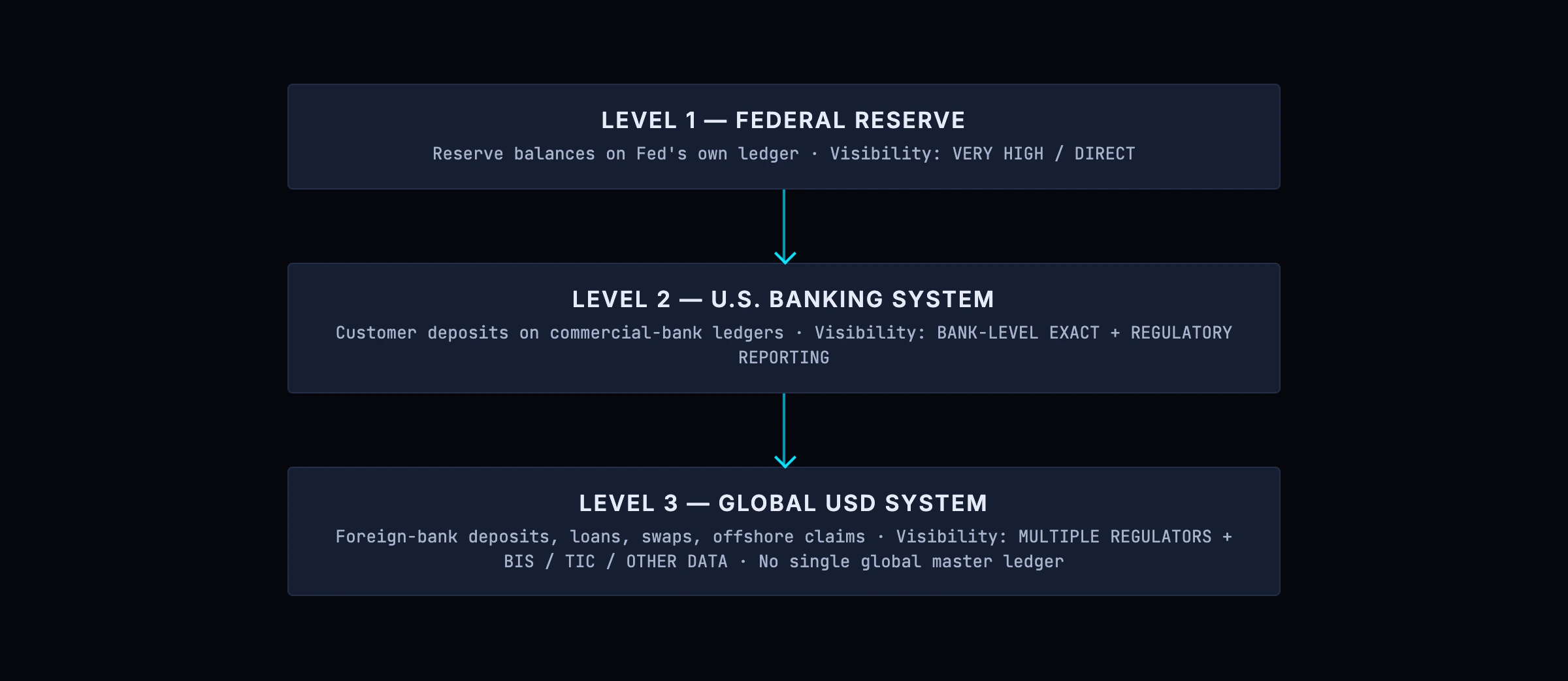
A useful framework is:
Level One — Federal Reserve liabilities
Known directly by the Federal Reserve.
Examples:
reserve balances;
Federal Reserve notes outstanding.
Level Two — U.S. commercial-bank deposits and domestic money aggregates
Known in great detail by individual institutions and measured through regulatory/statistical reporting.
Level Three — worldwide USD-denominated banking and financial claims
Measured through national reporting, correspondents, Treasury TIC, BIS statistics, market data, custodians, derivatives reporting, and other sources.
No one organization maintains an exact instantaneous ledger of the entire global universe.
16. Can Money Ever Be “Between Banks”?
Operationally, payments can be pending, clearing, provisionally credited, queued, or awaiting final settlement.
So asking where a particular dollar is at one millisecond can be less meaningful than asking which institutions currently have the relevant legal claims and obligations.
Payment systems keep records of these states.
For a detailed explanation, see Clearing vs. Settlement: Fedwire, CHIPS and Final Payment.
17. What the Government Can Know vs. What It Cannot Know
A concise formulation is:
QUESTION                                              ANSWER

How many reserve balances exist at the Fed?           Very precisely.

How much U.S. currency has been issued/outstanding?    Very closely measured.

How many deposits do U.S. banks report?                Closely measured statistically.

Does each bank know its own customer balances?         Yes, operationally it must.

Does the U.S. have a live global customer-level
ledger of every USD deposit on Earth?                  No.

Can the offshore USD system be measured?               Yes, substantially, but statistically.

Can one number capture every USD financial claim,
derivative and promise worldwide?                      No useful exact real-time total.
This page is part of How the US Dollar Is Created, the full primer on where dollars come from and how they move.
Frequently Asked Questions
Does the Fed know exactly how many reserve dollars exist?
Yes, reserve balances are liabilities maintained on Federal Reserve books.
Does the Fed know exactly how much money every American has in the bank?
Individual banks maintain those customer ledgers. Authorities receive extensive reports, but the monetary system is not one single public real-time customer-account database.
If US$4 trillion of deposits exist, can the banks collectively identify them?
Yes. Each deposit is a liability on some institution's ledger, subject to ordinary operational and reconciliation issues.
Is M1 the same thing as commercial-bank money?
No. M1 includes currency as well as demand deposits and other liquid deposits.
Is the monetary base the same as M1?
No. The monetary base consists of currency in circulation plus reserve balances, while M1 includes substantial commercial-bank deposit money.
Does the U.S. know exactly how many dollars are offshore?
No. It measures major components, but foreign-bank USD liabilities can be created and booked outside the United States, and no global master ledger exists.
Authoritative Sources
Federal Reserve, H.6 Money Stock Measures: https://www.federalreserve.gov/releases/h6/
Federal Reserve, H.4.1 Factors Affecting Reserve Balances: https://www.federalreserve.gov/releases/h41/
Federal Reserve, Money Stock FAQs: https://www.federalreserve.gov/faqs/money_12845.htm
U.S. Treasury, TIC U.S. Banking Claims on and Liabilities to Foreigners: https://home.treasury.gov/data/treasury-international-capital-tic-system-home-page/usbanking-claims-liabilities-foreigners
U.S. Treasury, Description of the TIC System: https://home.treasury.gov/data/treasury-international-capital-tic-system-home-page/description-of-TIC-system
BIS, International finance through the lens of BIS statistics: the global reach of currencies: https://www.bis.org/publications/qr-202406/international-finance-through-lens-bis-statistics-global-reach-currencies
Conclusion
The government does not face a choice between “knowing every dollar” and “having no idea.” Different layers are known in different ways. Federal Reserve liabilities are directly visible to the Fed. U.S. bank deposits are known by the banks and extensively measured through reporting. Cross-border dollar positions are captured through multiple official statistical systems. The worldwide offshore and synthetic dollar system, however, is too distributed to exist as one exact real-time master ledger.
The correct first question is always: which definition of money are we trying to measure?