
Why “The Money Went Offshore” Usually Means Loss of Immediate Visibility or Control—not That the Accounting Trail Vanished
It's offshore. The money is gone.
That is usually a dramatic simplification.
In a regulated banking transfer, the money does not normally become accounting-invisible merely because it crosses a border. Banks create records. Correspondents create records. Payment systems create records. Customer ledgers change. The hard part may be identifying the ultimate beneficial owner, obtaining records across jurisdictions, freezing assets fast enough, and following subsequent layers of transfers.
The distinction is:
Traceable in principle is not the same as immediately visible, legally obtainable, or recoverable in practice.
1. Offshore Bank Transfers: Build the Movie Scenario
Assume a trading company in London has US$10 million at Bank London.
A criminal causes the funds to be transferred to XYZ Holdings at Bank of BVI.
Assume:
Bank London's USD correspondent is JPMorgan New York;
Bank of BVI's USD correspondent is Standard Chartered New York;
Standard Chartered and JPMorgan settle through an appropriate U.S. clearing or settlement path.
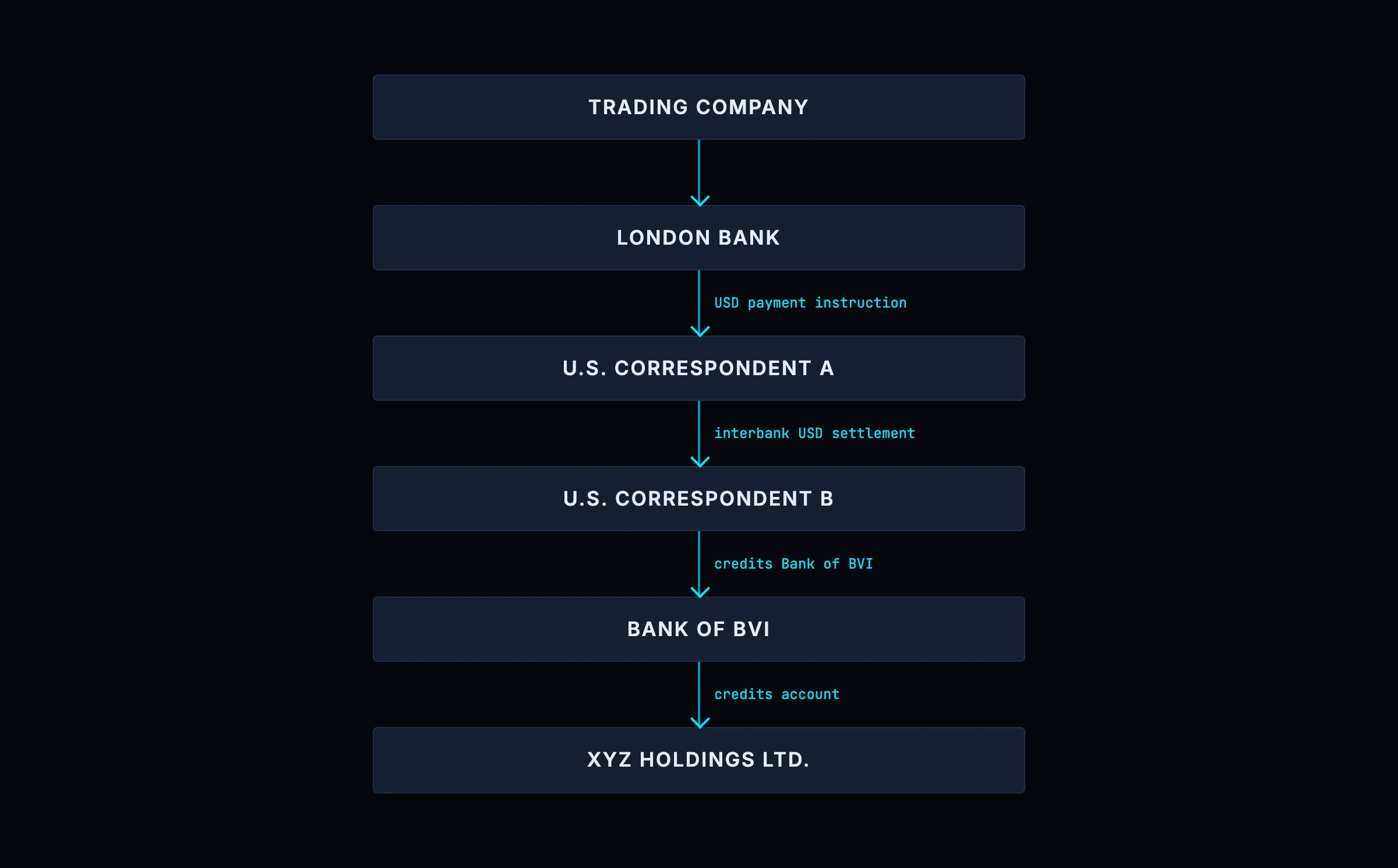
A simplified chain is:
TRADING COMPANY
Bank London
    │
    │ US$10m payment order
    ▼
JPMorgan New York
    │
    │ interbank USD payment
    ▼
Standard Chartered New York
    │
    │ credits Bank of BVI position
    ▼
BANK OF BVI
    │
    │ credits customer ledger
    ▼
XYZ Holdings Ltd.
US$10m
No stage requires the money to become invisible.
2. What Does the Originating Bank Know?
Bank London knows a great deal because the transaction started on its own customer ledger.
It can normally identify such facts as:
the debited customer account;
transaction amount;
transaction time and date;
payment instructions;
destination bank information supplied in the order;
beneficiary information available to it;
authentication and approval events;
internal fraud and compliance alerts;
the payment route used.
In the U.S., covered funds transfers are subject to recordkeeping and information-transmission requirements under the Bank Secrecy Act framework. Other jurisdictions have their own rules, and international standards also emphasize payment transparency.
The point is not that every jurisdiction uses identical fields. The point is that regulated bank payments generate records.
3. What Does the Correspondent Bank Know?
Suppose JPMorgan sends a payment to Standard Chartered for Bank of BVI.
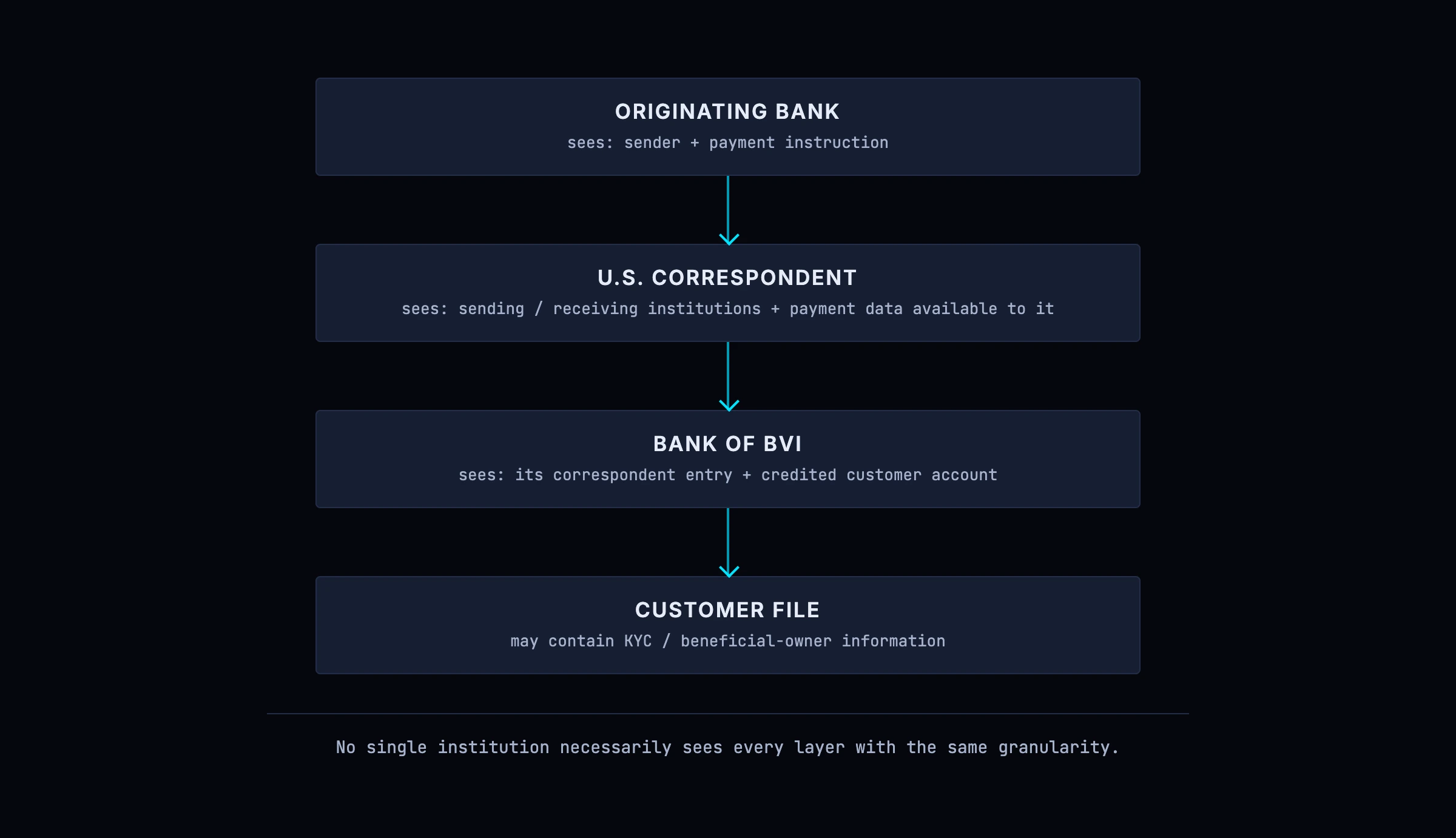
JPMorgan and Standard Chartered generally know the banking counterparties and payment-message information relevant to the transfer.
What Standard Chartered may see at its own ledger level is:
We owe Bank of BVI an additional US$10m.It may also receive originator, beneficiary, and intermediary information through payment messages depending on the structure and applicable rules.
But it does not necessarily maintain Bank of BVI's complete internal customer ledger.
That distinction is crucial.
4. What Does Bank of BVI Know?
Bank of BVI knows which of its customer accounts received the US$10 million.
For example:
BANK OF BVI

Asset / correspondent position      +US$10m

Liability:
XYZ Holdings deposit                 +US$10m
So the accounting trail has not ended.
It has moved onto Bank of BVI's books.
The harder question can become:
Who actually owns or controls XYZ Holdings?
5. Beneficial Ownership Is Different From Account Location
Suppose Bank of BVI's records show:
Account holder:
XYZ Holdings Ltd.
That does not necessarily answer:
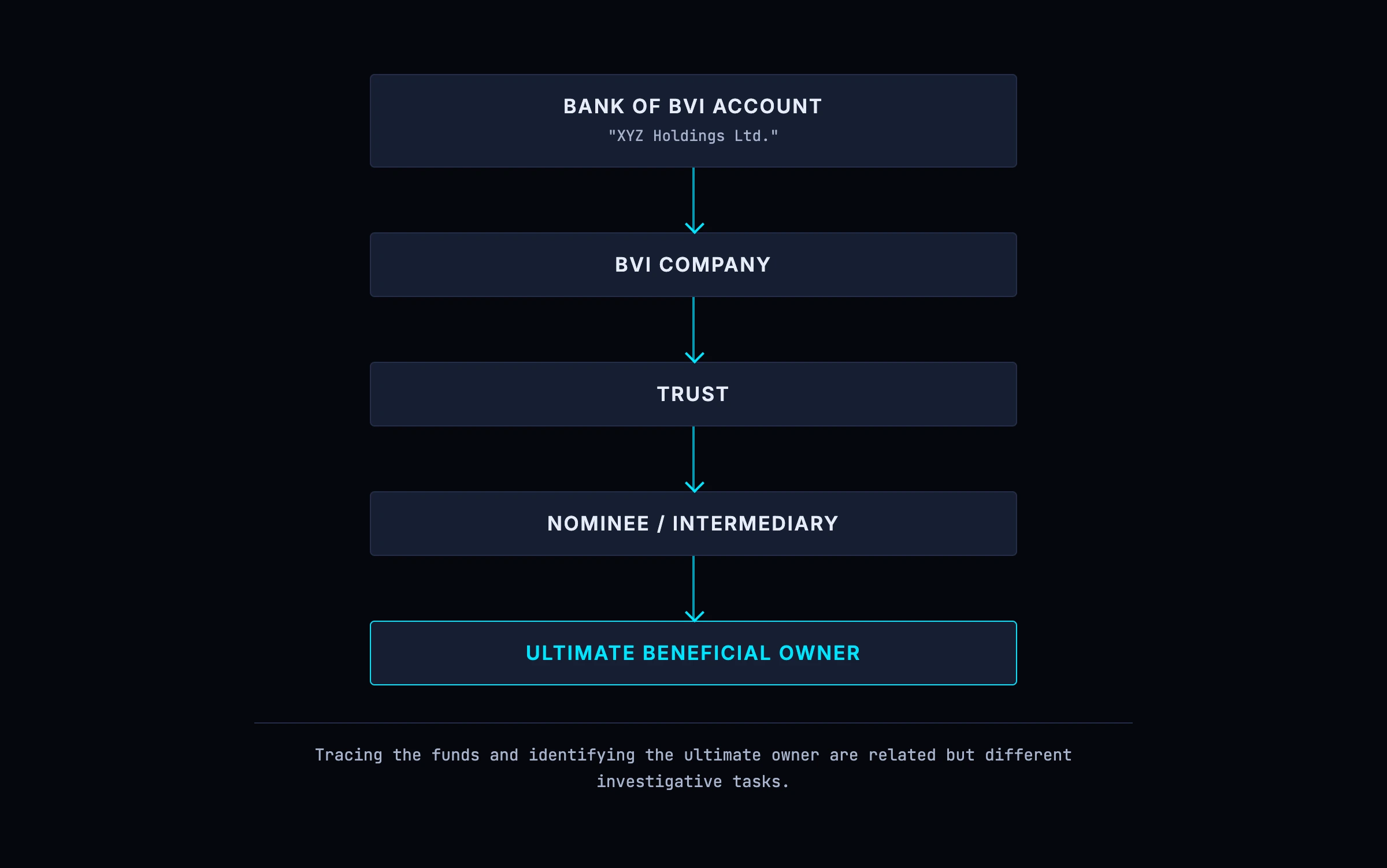
Who is the human being who ultimately owns or controls XYZ Holdings?The ownership structure might involve:
XYZ Holdings Ltd.
       │
       ▼
Holding Company A
       │
       ▼
Trust or foundation
       │
       ▼
Nominee / fiduciary relationship
       │
       ▼
Ultimate beneficial owner
Modern AML frameworks place substantial emphasis on identifying beneficial owners, but the quality, accessibility, timeliness, and legal treatment of that information can differ across countries and structures.
This is where “offshore opacity” can arise.
6. The Money Did Not Disappear; Jurisdiction Changed
A London bank cannot simply log into a BVI bank's internal system because it wants to investigate a payment.
Law-enforcement and regulatory authorities may need to use:
domestic legal process;
requests to foreign authorities;
mutual legal assistance mechanisms;
regulatory information sharing;
subpoenas or production orders where applicable;
freezing or restraint orders;
correspondent-bank inquiries;
civil litigation discovery in appropriate cases.
The exact mechanism depends on the countries, institutions, offense, and legal framework.
So “gone offshore” can mean:
The next critical records are controlled by a foreign institution and foreign legal process.
That is not the same as saying no records exist.
7. Timing Can Matter More Than Traceability
Imagine investigators can reconstruct the payment perfectly two months later.
That does not mean the original US$10 million is still sitting in the first BVI account.
The recipient may have made additional lawful or unlawful transfers.
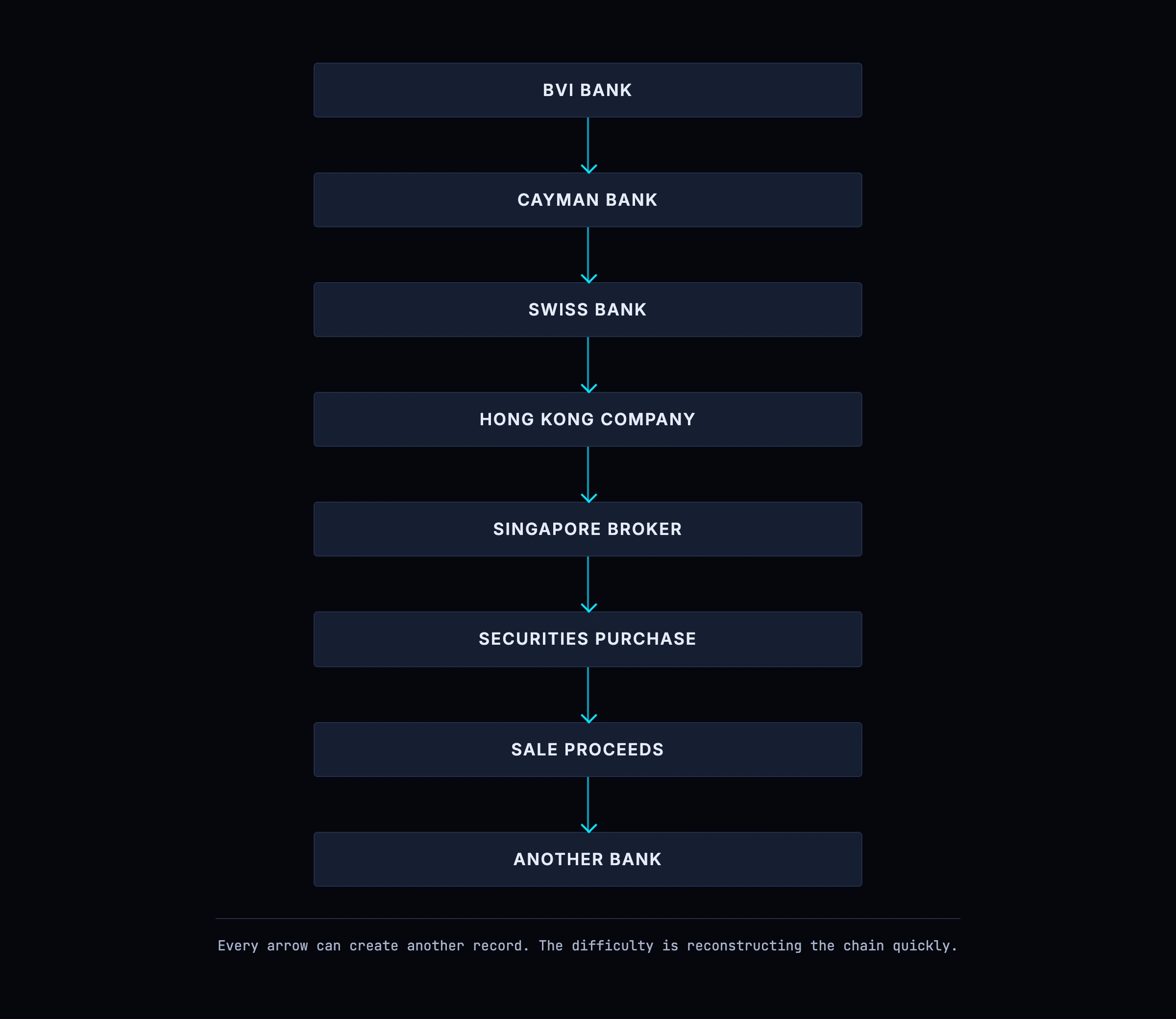
A sequence might look like:
Bank of BVI
   │
   ▼
Bank in Jurisdiction 2
   │
   ▼
Brokerage in Jurisdiction 3
   │
   ▼
Securities purchase
   │
   ▼
Sale proceeds
   │
   ▼
Another financial institution
Each step can create new records and new legal claims.
But asset recovery becomes harder because investigators must follow the sequence quickly and satisfy the legal requirements of each relevant jurisdiction.
8. Layering Does Not Mean the Ledger Stops
In AML terminology, layering broadly refers to transactions designed to make the origin or ownership of funds harder to follow.
It can involve multiple transfers, entities, jurisdictions, assets, or intermediaries.
The important conceptual point for this primer is simple:
More layers
≠
no records
Rather:
More layers
=
more records in more places that must be connected
That distinction is often lost in popular culture.
9. What Can a U.S. Correspondent See About a Foreign Bank's Customers?
This depends on the payment structure and information in the payment messages.
A U.S. correspondent knows its direct customer: the foreign respondent bank.
It may also receive information identifying underlying originators and beneficiaries for individual payments.
However, the correspondent does not automatically possess a complete copy of every account and transaction on the foreign bank's books.
For example:
Standard Chartered's ledger:
Liability to Bank of BVI       US$500m

Bank of BVI's internal ledger:
Customer A                      US$20m
Customer B                      US$35m
Customer C                      US$10m
...
Those are different layers of recordkeeping.
10. U.S. Funds-Transfer Records Are Designed to Aid Traceability
For covered U.S. funds transmittals, FinCEN's Travel Rule requires specified originator and recipient-related information to accompany qualifying transfers through covered financial institutions.
U.S. bank recordkeeping requirements also require covered transfer information to be retained and retrievable for specified periods.
FinCEN has explicitly explained that these requirements help authorities determine the source and recipient of transfers in criminal, tax, and regulatory investigations.
This does not mean every international transfer is instantly available to every investigator. It means the banking architecture is intentionally record-generating rather than anonymous by design.
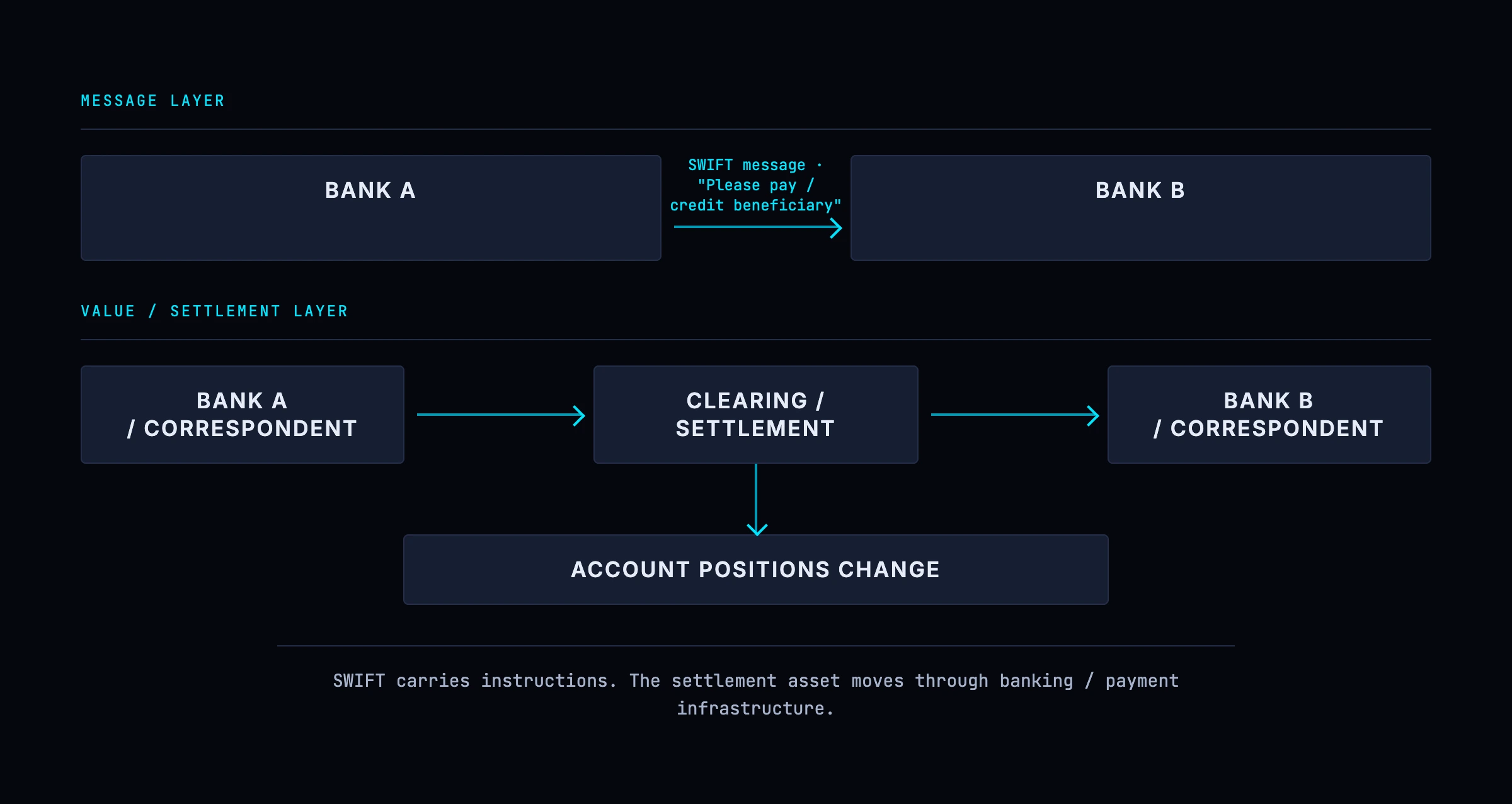
11. SWIFT Does Not “Hold the Money”
Another common misconception is that money sits “inside SWIFT.”
SWIFT is principally a financial messaging network.
Banks use messages to communicate payment instructions and other financial information.
The actual financial claims and settlement occur on bank and payment-system ledgers.
Therefore a SWIFT message can be evidence of a payment instruction, but SWIFT itself is not the bank account in which the US$10 million ultimately resides.
The Federal Reserve itself describes SWIFT as a messaging service and not a payment or settlement system.
12. A Correspondent Transfer Can Occur Without a Fedwire for Every Gross Payment
Suppose two banks maintain balances through the same correspondent.
The correspondent may be able to change its internal liabilities:
Bank A balance              -US$10m
Bank B balance              +US$10m
No separate US$10 million Fedwire transfer necessarily occurs for that internal book transfer.
Similarly, payment systems can net obligations.
This is why reconstructing a cross-border payment requires understanding the actual chain of accounts and messages rather than assuming every USD payment maps one-for-one to a specific Fed reserve movement.
For the distinction, see Clearing vs. Settlement: Fedwire, CHIPS and Final Payment.
13. Can Authorities Freeze the Correspondent Account Instead?
That depends on the legal facts and authority.
A correspondent account belongs to the respondent bank, not automatically to the respondent bank's customer.
If Bank of BVI owes Customer X US$10 million, Customer X does not necessarily own a segregated US$10 million slice of Bank of BVI's Standard Chartered balance.
Therefore tracing a customer claim and legally restraining a correspondent asset are not conceptually identical actions.
Legal process, property rights, sanctions rules, forfeiture law, contractual structures, and jurisdiction determine what can be restrained.
14. Why Offshore Banking Historically Offered More Secrecy
Historically, some offshore centers combined features such as:
strong bank-secrecy laws;
limited public company ownership information;
bearer or nominee arrangements;
trusts and foundations;
slower cross-border legal cooperation;
less-developed AML systems.
That could make beneficial ownership and asset recovery difficult.
Over time, international standards, KYC requirements, beneficial-ownership initiatives, tax-information exchange regimes, sanctions compliance, and correspondent-bank due diligence have changed that environment considerably.
“Offshore” is therefore not synonymous with “untraceable.”
15. Tax Planning, Tax Evasion and Criminal Proceeds Are Different Questions
Holding money in an offshore bank is not inherently illegal.
Businesses and individuals can have legitimate reasons for foreign accounts, including:
international trade;
foreign investment;
treasury operations;
currency diversification;
regional business operations;
asset management.
Whether taxes must be reported or paid depends on the relevant taxpayer, residence, source-of-income, account-reporting, entity, treaty, and local-law rules.
The banking-mechanics question is separate:
Does moving money offshore erase its ledger history?
Generally, no.
16. The Correct Movie Translation
When a movie says:
The US$10 million reached BVI. It's gone.
A more technically accurate statement would be:
The US$10 million has been credited to an account at a foreign institution. We may no longer have immediate control over the assets or direct access to the receiving bank's customer records. We need to identify the beneficial owner, invoke the necessary legal process, and prevent further transfers.
Less cinematic, much more accurate.
17. A Complete Traceability Map
ORIGINATOR
Trading Company
      │
      │ customer-account records
      ▼
BANK LONDON
      │
      │ outgoing payment records
      ▼
JPMORGAN / CORRESPONDENT
      │
      │ interbank records + message data
      ▼
STANDARD CHARTERED
      │
      │ respondent-bank account records
      ▼
BANK OF BVI
      │
      │ internal customer ledger
      ▼
XYZ HOLDINGS
      │
      │ corporate / beneficial-ownership records
      ▼
ULTIMATE BENEFICIAL OWNER
Each arrow can involve a different database, institution, regulator, and legal regime.
That is the traceability challenge.
This page is part of How the US Dollar Is Created, the full primer on where dollars come from and how they move.
Frequently Asked Questions
Does money become untraceable when it reaches an offshore bank?
Not automatically. Regulated bank transfers generally create records. The difficulty can be access, beneficial ownership, jurisdiction, speed, and subsequent layering.
Can the U.S. correspondent identify every customer of the foreign bank?
No. It knows its respondent bank and may receive underlying payment-party information, but the foreign bank's full customer ledger remains a separate system.
Does SWIFT hold transferred money?
No. SWIFT is a financial messaging service, not itself the settlement account holding the funds.
Can a BVI bank's customer deposit be traced back to a U.S. correspondent balance one-for-one?
Not necessarily. The customer owns a claim on the BVI bank. The BVI bank separately owns assets, which may include correspondent balances.
Is an offshore bank account illegal?
No. Legality depends on the account, owner, activity, reporting, tax, sanctions, and other applicable laws—not simply on being offshore.
Why can recovery be difficult even if the transfer is traceable?
Because tracing evidence and obtaining legal control over assets are different tasks, especially when several jurisdictions and entities are involved.
Authoritative Sources
FinCEN, Funds “Travel” Regulations: Questions & Answers: https://www.fincen.gov/resources/statutes-regulations/guidance/funds-travel-regulations-questions-answers
FFIEC BSA/AML Manual, Funds Transfers Recordkeeping: https://bsaaml.ffiec.gov/manual/AssessingComplianceWithBSARegulatoryRequirements/09
FATF Recommendations: https://www.fatf-gafi.org/en/publications/Fatfrecommendations/Fatf-recommendations.html
Federal Reserve, Private-Sector Systems / SWIFT oversight description: https://www.federalreserve.gov/paymentsystems/over_pssystems.htm
U.S. Treasury, TIC U.S. Banking Claims on and Liabilities to Foreigners: https://home.treasury.gov/data/treasury-international-capital-tic-system-home-page/usbanking-claims-liabilities-foreigners
Conclusion
Offshore banking changes the institution, jurisdiction, and often the ownership structure through which a dollar claim is held. It does not normally make the accounting trail disappear. The more accurate problem is fragmented visibility: one bank sees the sender, another sees an interbank payment, the receiving bank sees its customer, and corporate records may be needed to identify the beneficial owner.
The money is not “gone” merely because it is offshore. What may be gone is immediate access, jurisdictional control, or the time needed to stop the next transfer.