
Plain-English Definitions for Central-Bank Money, Commercial-Bank Money, Payments, Correspondent Banking, Offshore Dollars and Double-Entry Accounting
A recurring rule throughout the glossary is to identify whose asset and whose liability a financial claim is. The same dollar amount can be an asset to one party and a liability to another.
Asset
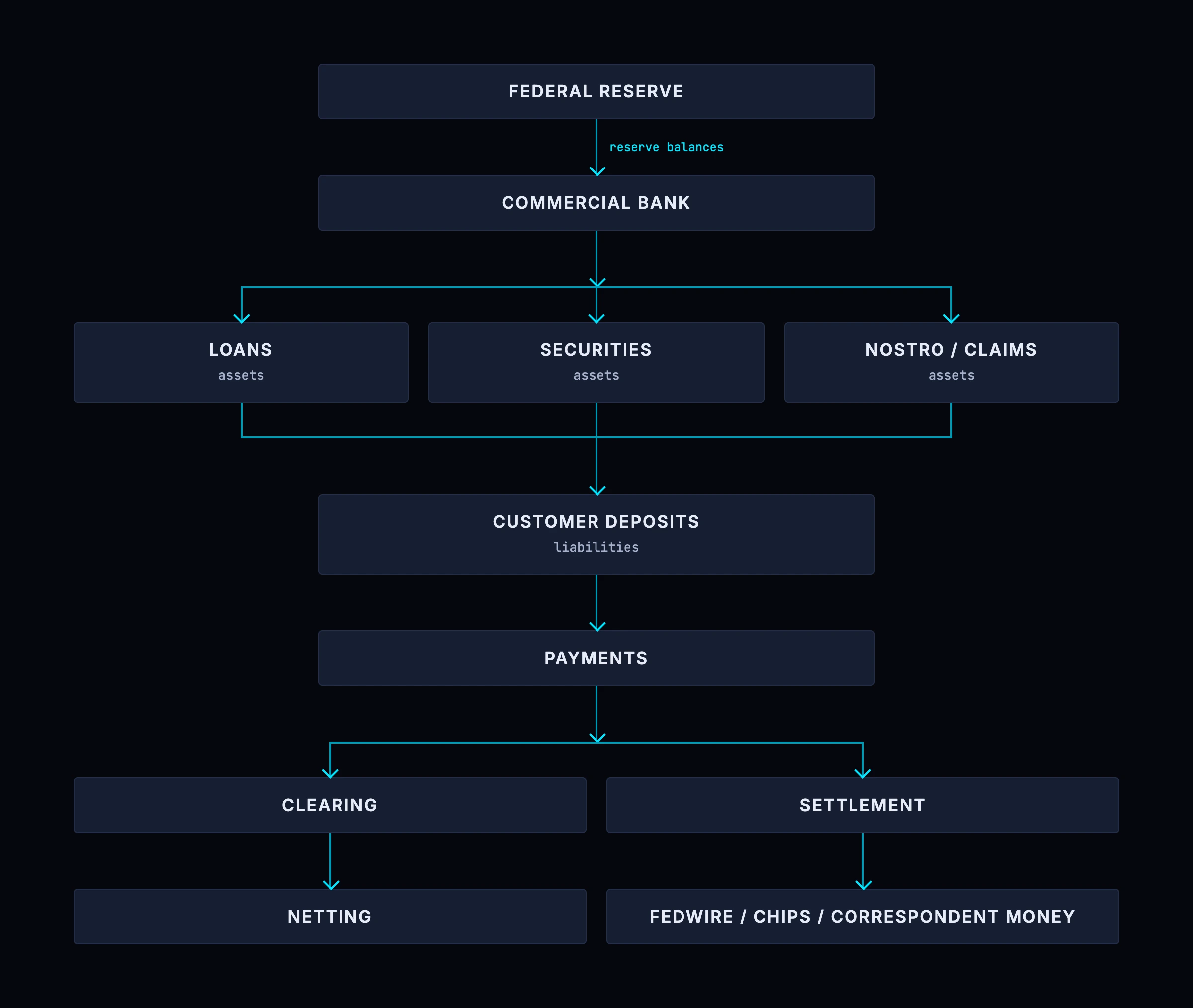
Something of economic value owned by an individual or institution, including a claim on someone else. A bank loan is an asset of the bank because the borrower owes the bank money.
Liability
An obligation owed to another party. A customer deposit is a liability of the bank because the bank owes the customer the deposit balance.
Equity
The residual interest belonging to a bank's owners after liabilities are subtracted from assets. Losses generally reduce equity; retained profits generally increase it.
Balance Sheet
A statement of an institution's assets, liabilities, and equity at a point in time. The foundational relationship is Assets = Liabilities + Equity.
Double-Entry Bookkeeping
The accounting system in which a transaction is recorded through offsetting entries so the complete economic event is captured and the accounting equation remains balanced.
Debit
An accounting entry. Whether a debit increases or decreases an account depends on the account type. In simplified banking explanations, it is often clearer for beginners to say which asset or liability rises or falls rather than relying on debit/credit jargon.
Credit
An accounting entry paired with a debit. A credit does not automatically mean money received; its effect depends on the account type.
Central-Bank Money
Money that is a liability of a central bank. In the United States this includes Federal Reserve notes and reserve balances held at Federal Reserve Banks.
Commercial-Bank Money
Money represented by deposit liabilities of commercial banks and other deposit-taking institutions. A checking-account balance is the classic example.
Federal Reserve Reserve Balance
An electronic liability of the Federal Reserve held in an eligible institution's account at a Federal Reserve Bank. Banks use reserves for settlement and liquidity purposes.
Federal Reserve Note
Physical U.S. paper currency issued within the Federal Reserve system. It is a central-bank liability, unlike a commercial bank deposit.
Monetary Base
A Federal Reserve measure consisting of currency in circulation plus reserve balances. It should not be confused with M1 or M2.
M1
A Federal Reserve monetary aggregate containing currency, demand deposits, and other liquid deposits under the Fed's published definition.
M2
A broader Federal Reserve monetary aggregate that includes M1 plus specified time-deposit and retail money-market fund components under the Fed's methodology.
Money Supply
A general term for measured quantities of money. The exact meaning depends on the measure being used, such as monetary base, M1, M2, or another definition.
Deposit
A liability of a bank to its customer. To the customer, the deposit is an asset—a claim against the bank.
Demand Deposit
A deposit generally available for withdrawal or payment on demand, subject to account terms. It is an important component of transaction money.
Loan
A contractual claim under which the borrower owes money to the lender. On a bank's balance sheet, a performing loan is generally an asset.
Loan Origination
The process by which a loan is created. When a bank originates a loan and credits the borrower's deposit account, it can simultaneously create a loan asset and a deposit liability.
Principal
The amount of a loan outstanding before interest and certain fees. Repayment of bank-loan principal normally reduces both the loan asset and deposit money used for repayment.
Interest
The price paid for borrowing or earned on lending or deposits. Interest payments are economically different from principal repayments because they are income to the lender rather than cancellation of principal.
Money Creation
An increase in money balances. In this primer, the phrase can refer either to central-bank money creation or commercial-bank deposit creation; the distinction must always be stated.
Money Destruction
The reduction or extinguishment of money balances. A standard example is commercial-bank deposit money being extinguished when bank-loan principal is repaid.
Settlement
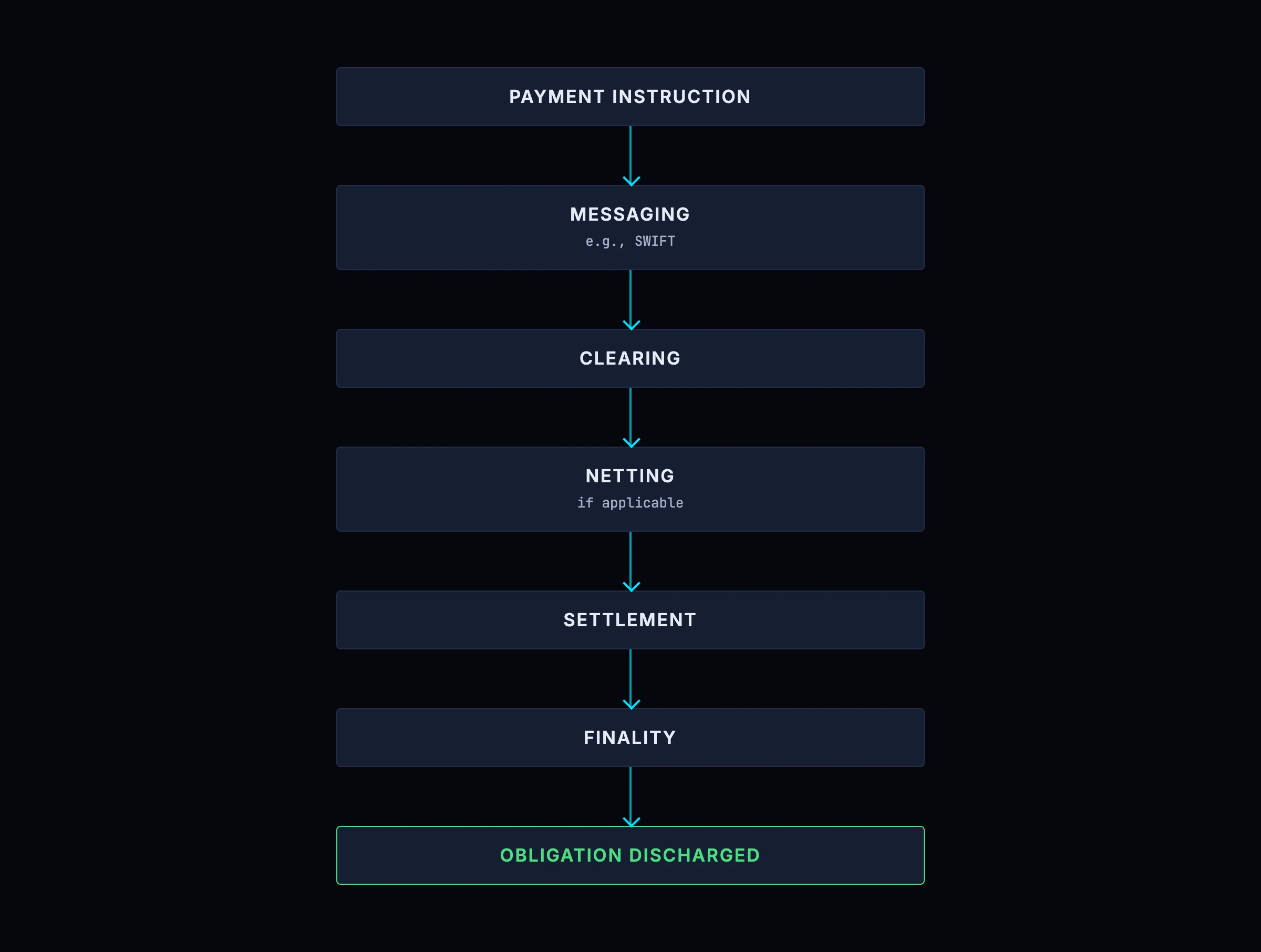
The discharge of a payment obligation using an agreed settlement asset. Between U.S. banks, Federal Reserve balances can provide final settlement.
Clearing
The process of transmitting, reconciling, confirming, and/or calculating payment obligations before final settlement. Clearing can include netting.
Finality
The point at which a payment or settlement is legally and operationally final under the applicable system rules, subject to the precise legal framework.
Gross Settlement
Settlement of payments individually rather than only after offsetting them against other obligations.
Net Settlement
Settlement based on net obligations after offsetting eligible reciprocal payment claims.
Netting
The process of offsetting amounts owed in opposite directions so only a net amount remains to be settled.
Fedwire Funds Service
The Federal Reserve Banks' real-time gross settlement service for high-value U.S. dollar payments. Transfers are settled through Federal Reserve accounts and are designed to provide finality.
CHIPS
The Clearing House Interbank Payments System, a private-sector U.S. high-value dollar payment system that uses sophisticated clearing and liquidity-saving mechanisms with settlement finality under its rules.
ACH
Automated Clearing House, a batch-oriented electronic payment network widely used for payroll, bill payments, debits, credits, and other U.S. payments. Its mechanics differ from Fedwire and CHIPS.
SWIFT
A global financial messaging network used by banks and financial institutions. SWIFT carries messages; it is not itself a bank account or settlement asset.
Payment Message
An instruction or financial message containing information needed to initiate, route, process, or report a payment. A message is not the same thing as the money or settlement asset.
Correspondent Bank
A bank that provides accounts or banking services to another bank, often enabling cross-border payments, clearing, cash management, or access to a currency the respondent bank cannot settle directly.
Respondent Bank
The bank receiving correspondent services from another institution.
Nostro Account
Literally 'our account with you.' From Bank A's perspective, its account held at Bank B is Bank A's nostro account.
Vostro Account
Literally 'your account with us.' From Bank B's perspective, an account it maintains for Bank A can be described as Bank A's vostro.
Due From Bank
An accounting description for amounts a bank is owed by another bank, such as a correspondent balance.
Due To Bank
An accounting description for amounts a bank owes another bank.
Interbank Claim
A financial claim one bank has on another bank.
Interbank Liability
An amount a bank owes another bank.
Reserve Requirement
A rule, where applicable, requiring specified reserve treatment against defined deposit liabilities. In the United States, reserve requirement ratios have been set to zero since March 2020; reserve requirements should not be confused with all liquidity or capital constraints.
Capital Requirement
A prudential requirement governing the amount and quality of bank capital relative to risk exposures. Capital limits bank balance-sheet expansion by requiring loss-absorbing resources.
Liquidity Requirement
A prudential requirement or internal constraint intended to ensure a bank can meet cash and settlement outflows without unacceptable disruption.
Liquidity
The ability to meet payment obligations when they fall due. A bank can have positive net worth but still experience a liquidity crisis.
Solvency
The condition in which an institution's assets are sufficient relative to its liabilities and obligations. Solvency is distinct from immediate liquidity.
Credit Risk
The risk that a borrower or counterparty will fail to pay what it owes.
Counterparty Risk
The risk that the other party to a financial contract or payment obligation will fail to perform.
Funding
The liabilities and other sources a bank uses to finance its assets and meet cash-flow needs, including deposits, wholesale borrowing, bond issuance, repo, and other sources.
Wholesale Funding
Funding obtained from institutional or market counterparties rather than ordinary retail deposits.
Repo
A repurchase agreement: a form of secured financing in which securities are sold with an agreement to repurchase them, economically functioning as collateralized borrowing/lending.
Collateral
An asset pledged or otherwise available to secure an obligation and reduce the lender's credit exposure.
Discount Window
Federal Reserve lending facilities through which eligible depository institutions can borrow from the Federal Reserve under applicable terms and collateral requirements.
Lender of Last Resort
The central-bank function of providing liquidity to solvent or eligible institutions during stress under defined legal and policy frameworks.
Open-Market Operations
Central-bank transactions in securities or other instruments used to implement monetary policy and influence reserve conditions or interest rates.
Quantitative Easing
Large-scale central-bank asset purchases intended to ease financial conditions. When the Fed purchases securities, the balance-sheet effect depends on the seller and banking chain, but reserves generally increase.
Quantitative Tightening
Reduction of a central bank's securities holdings or balance sheet over time, generally reducing reserve balances relative to what they otherwise would be, all else equal.
Treasury General Account (TGA)
The U.S. Treasury's principal operating account at the Federal Reserve. Treasury spending and tax receipts move balances between the TGA and the banking system, affecting reserves.
U.S. Treasury
The fiscal authority of the U.S. federal government. It taxes, spends, and issues Treasury securities. It is institutionally distinct from the Federal Reserve.
Federal Reserve
The central bank of the United States, consisting of the Board of Governors and Federal Reserve Banks within the statutory Federal Reserve System.
Treasury Security
Debt issued by the U.S. Treasury, including bills, notes, and bonds. Treasury securities are assets to their holders and liabilities of the U.S. government.
Bank Reserve
In this primer, usually a reserve balance at the central bank. It should not be confused with a customer's commercial-bank deposit.
Excess Reserves
A historical/analytical term for reserve balances above required amounts. In a zero-reserve-requirement U.S. environment, the older required-vs-excess framing is less useful than it once was.
Eurodollar
A U.S.-dollar-denominated deposit or dollar banking activity outside the United States. The term is historical and does not mean euro currency.
Offshore Dollar
A broad informal term for USD-denominated deposits, loans, claims, or financial activity booked outside the United States.
Foreign-Currency Deposit
A bank deposit denominated in a currency different from the bank's home-country currency, subject to local regulation and the bank's funding and settlement capacity.
FX Swap
A transaction involving an exchange of currencies now and a reverse exchange at a future date. It can provide synthetic or temporary dollar funding and create future dollar payment obligations.
Foreign Exchange Risk
The risk that currency movements affect the value of assets, liabilities, income, or capital.
Dollar Funding
The process of obtaining U.S. dollar liabilities or liquidity needed to finance USD assets or meet dollar payment obligations.
Dollarization
Use of a foreign currency—often USD—as a major or official domestic currency. A dollarized country does not thereby acquire the ability to create Federal Reserve reserves.
Currency Board
A monetary arrangement in which the domestic monetary base is tightly linked to an anchor currency under defined reserve and convertibility rules.
Par
A one-for-one nominal relationship. A US$1 commercial-bank deposit normally transfers at par into another US$1 commercial-bank deposit when the system functions normally.
Convertibility
The practical or legal ability to exchange one monetary claim into another at the promised rate, such as transferring a bank deposit into another bank's deposit at par.
Fungibility
The property that one unit of an asset or money is interchangeable with another equivalent unit. Borrowers do not need to repay a loan with the exact same deposit units originally created.
Velocity of Money
A concept describing how frequently money balances are used in transactions over a period. The same unit of money can support multiple payments.
Stock
A quantity measured at a point in time, such as US$20 trillion of deposits on a particular date.
Flow
A quantity measured over a period, such as US$100 trillion of payments during a year.
Bank Run
A rapid withdrawal or transfer of deposits driven by concerns about a bank's safety or liquidity. It can force the bank to obtain liquidity or sell assets quickly.
Deleveraging
Reduction of debt and balance-sheet leverage. Broad principal repayment or credit contraction can reduce commercial-bank deposits, all else equal.
Default
Failure to make a required payment or otherwise satisfy a debt obligation. Default is different from repayment: a loan asset may be written down while deposits previously created and spent can remain elsewhere.
Charge-Off
An accounting recognition that some or all of a loan is unlikely to be collected. It reduces the recorded loan asset and affects earnings/equity; it is not the same as the borrower repaying principal.
Write-Down
A reduction in the carrying value of an asset to reflect impairment or loss.
Deposit Insurance
A statutory or institutional protection for eligible deposits up to applicable limits, intended in part to protect depositors and reduce destabilizing runs. Coverage differs by country and account type.
Beneficial Owner
The natural person or persons who ultimately own or control a legal entity, account, or arrangement under the applicable legal definition.
KYC
Know Your Customer: processes used by financial institutions to identify and understand customers in accordance with legal, regulatory, and risk requirements.
AML
Anti-Money Laundering: laws, controls, monitoring, reporting, and risk-management measures intended to prevent and detect laundering and related financial crime.
Travel Rule
A U.S. Bank Secrecy Act requirement for specified information to accompany covered funds transmittals through certain financial institutions. Other jurisdictions and FATF standards have analogous payment-transparency requirements.
Layering
A money-laundering concept referring broadly to transactions intended to make the source, ownership, or movement of funds harder to follow. More layers generally create more records across more institutions; they do not inherently erase the trail.
Beneficiary Bank
The financial institution at which the recipient of a payment holds the credited account.
Originating Bank
The financial institution that accepts or initiates a customer's payment order at the beginning of a bank-transfer chain.
Intermediary Bank
A bank between the originating and beneficiary institutions that helps transmit or settle a payment.
Beneficiary
The person or entity intended to receive a payment.
Originator
The person or entity that initiates a payment.
Money Multiplier
A textbook concept linking a monetary base to broader money through assumed reserve behavior. A fixed mechanical reserve-ratio multiplier is not an adequate description of modern U.S. bank lending.
Fractional-Reserve Banking
A broad phrase describing systems in which banks do not hold central-bank reserves or cash equal to 100% of customer deposits. The phrase can mislead if it implies banks simply relend a fixed fraction of pre-existing deposits.
Seigniorage
Income associated with issuing money, commonly discussed in relation to central-bank currency issuance. It is distinct from commercial-bank interest income.
Unit of Account
The monetary unit in which prices, debts, contracts, and financial statements are expressed, such as USD, EUR, GBP, or JPY.
Medium of Exchange
An asset or claim commonly accepted to make payments for goods, services, or financial obligations.
Store of Value
An asset's ability to preserve purchasing power or value over time, subject to inflation, credit risk, market risk, and other factors.
Payment Rail
The infrastructure, network, or arrangement used to transmit payment instructions and/or settle obligations, such as Fedwire, ACH, CHIPS, card networks, or correspondent banking routes.
Payment Finality
The legal and operational condition under which a settled payment cannot ordinarily be revoked by the sending participant except under specific rules or legal processes.
Intraday Liquidity
Funds or credit available during the business day to support payment and settlement obligations before end-of-day positions are finalized.
Overdraft
A negative account or settlement position permitted under defined terms. In bank payment systems, intraday overdrafts may be subject to collateral, limits, pricing, and regulation.
Reconciliation
The process of comparing records from different systems or ledgers to identify and resolve discrepancies.
General Ledger
The core accounting record that aggregates an institution's financial accounts. Customer subledgers feed into general-ledger balances.
Subledger
A detailed ledger supporting a general-ledger account, such as the millions of individual customer balances that make up a bank's total deposit liability.
Ledger Money
An informal description for money represented by entries on financial ledgers rather than physical cash. Commercial-bank deposits and central-bank reserve balances are both ledger-based but are liabilities of different issuers.
IOU
An informal term for an obligation to pay. It is a useful analogy for understanding deposits and interbank claims, although legal bank deposits are more sophisticated than ordinary personal IOUs.
Five Definitions to Remember First
If the full glossary is too much to absorb initially, remember these five:
Asset: something valuable you own or somebody owes you.
Liability: something you owe somebody else.
Commercial-bank deposit: your asset and your bank's liability.
Federal Reserve reserve balance: a bank's asset and the Federal Reserve's liability.
Settlement: the process that finally discharges an obligation between financial institutions.
Those five definitions unlock much of the rest of the primer.
Related Pages in This Primer
This page is part of How the US Dollar Is Created, the full primer on where dollars come from and how they move.
Conclusion
Banking vocabulary becomes much easier once every term is attached to a balance sheet. When encountering an unfamiliar phrase, ask which institution owes the obligation, which institution owns the claim, what currency it is denominated in, and what settlement asset would be required if the claim moved elsewhere. Those questions turn abstract terminology into concrete financial relationships.