

Payroll payments are the most fundamental obligation any business has to its workforce. Paying employees accurately, on time, in the right currency, and through the right disbursement channel is a compliance obligation, a trust relationship, and an operational challenge that scales with every hire. For businesses operating domestically with a straightforward employee base, payroll is solved by payroll software. For businesses paying employees or contractors across multiple countries, in multiple currencies, through varied disbursement channels including bank transfer, prepaid card, and mobile wallet, payroll payments become a cross-border payment challenge with significant regulatory, banking, and compliance dimensions. Faisal Khan LLC advises businesses and payment operators on payroll payment infrastructure, connects them to payroll banking partners, multi-currency disbursement solutions, and international payroll providers, and helps structure the compliant payroll payment flows that globally distributed workforces require.
Domestic Payroll Payments: The Foundation
For US-based employers, domestic payroll disbursement runs through ACH:
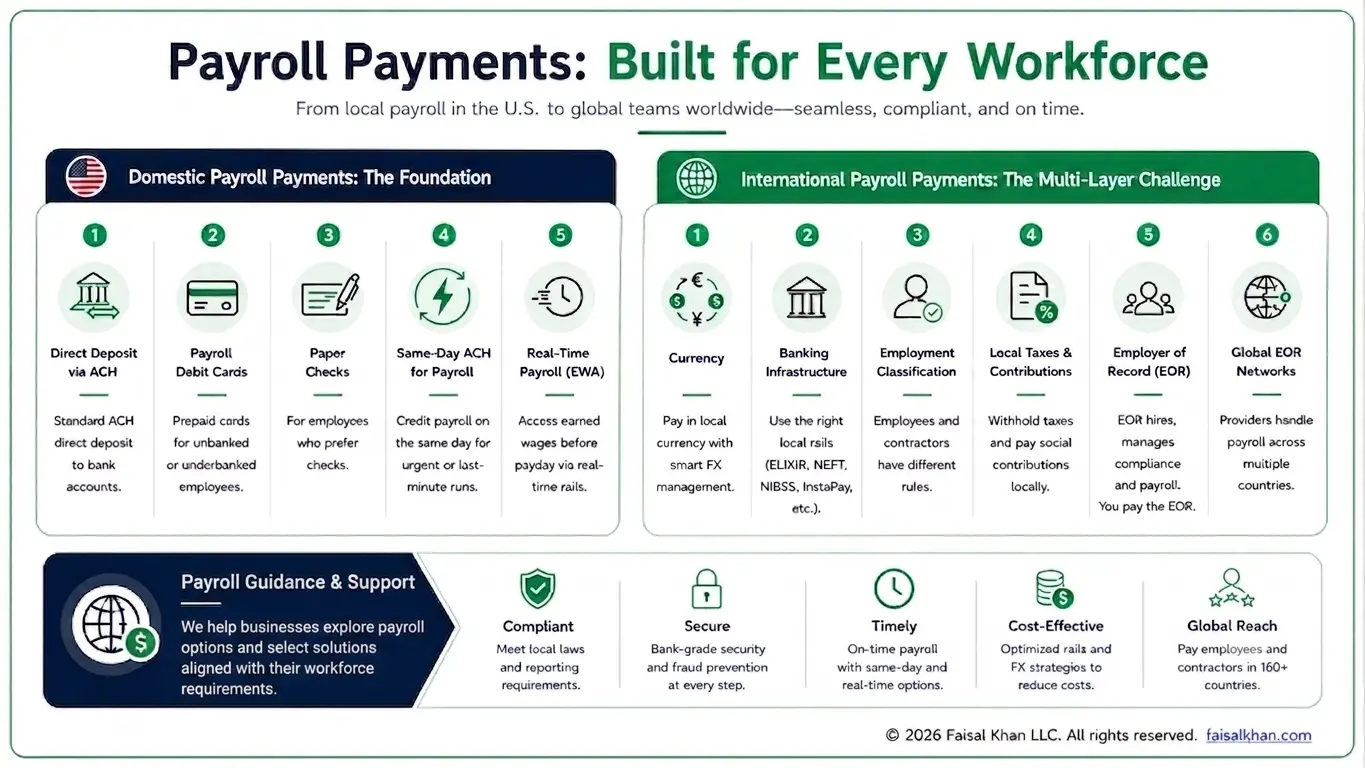
Direct deposit via ACH: The standard mechanism for US payroll. The employer (or their payroll processor) initiates an ACH batch that credits each employee's bank account on payday. Straightforward for employees with bank accounts. Requires an ACH origination agreement with the employer's bank.
Payroll debit cards: For unbanked or underbanked employees who cannot or do not want to receive direct deposit into a bank account, payroll debit cards (also called payroll cards) provide an alternative. A prepaid debit card is loaded with the employee's pay each payday. The card can be used at ATMs and point-of-sale terminals. Under Regulation E, employees must be offered an alternative to payroll cards in most states.
Paper checks: The legacy payroll disbursement method, still used for employees who decline direct deposit and payroll card options, and in some jurisdictions where paper check issuance remains common.
Same-Day ACH for payroll: Same-Day ACH, introduced by NACHA, allows payroll to be credited on the same business day for last-minute or corrective payroll runs. Important for emergency payments and corrections.
Real-time payroll: Emerging products allow employees to access earned wages before their scheduled payday (Earned Wage Access or EWA). These products use real-time payment rails (RTP, FedNow) or faster ACH to push available wages on demand. Regulatory treatment of EWA is evolving at both state and federal levels.
International Payroll Payments: The Multi-Layer Challenge
Paying employees and contractors across international borders multiplies the complexity at every layer:
Currency: International employees are paid in their local currency. For a US company paying an engineer in Poland, the payroll amount is set in US dollars but disbursed in Polish zloty. Managing currency conversion, deciding who bears the FX risk (employer or employee), and ensuring the employee receives the right amount after conversion requires currency management infrastructure.
Banking infrastructure in receiving countries: Each country has its own domestic payment system. Poland has ELIXIR. India has NEFT and IMPS. Nigeria has NIBSS NIP. The Philippines has InstaPay. Getting the right account details (IBAN in Europe, IFSC + account number in India, account number + bank code in Nigeria) and routing through the right clearing system are the operational basics of international payroll disbursement.
Employment classification: Whether your international worker is an employee (requiring local employment registration, social contributions, and compliance with local labor law) or an independent contractor (with different legal, tax, and payment implications) fundamentally changes the compliance framework.
Local payroll tax and social contribution: For employees (not contractors), the employer typically has obligations to withhold income tax and pay social contributions in the employee's home country. This usually requires a local entity, employer-of-record arrangement, or local payroll service provider in each country where employees are based.
Employer of Record (EOR): A widely used solution for international payroll. The EOR is a local entity in the employee's country that hires the employee on your behalf, handles all local employment law, payroll tax, and social contribution obligations, and pays the employee. You pay the EOR. Companies like Deel, Remote, Rippling, and Papaya Global operate large EOR networks across many countries.
Payroll Cards and Alternative Disbursement for Global Workforces
Not all international employees have bank accounts. In markets with lower banking penetration (parts of Sub-Saharan Africa, South Asia, Southeast Asia), reaching employees with payroll payments requires alternative disbursement channels:
Mobile money payroll: Crediting employee wages to their mobile money account (M-Pesa, MTN Mobile Money, bKash, Easypaisa). This is increasingly the practical payroll solution for workers in markets where mobile money penetration is high but banking penetration is low.
International prepaid payroll cards: Cards issued by an international prepaid program that can be used globally. Useful for contractor workforces that move between countries. Requires a licensed card program with international acceptance.
Crypto and stablecoin payroll: Some employers, particularly in the crypto industry and for international contractor populations, are paying wages in stablecoins (USDT, USDC). The employee receives value in a stable digital asset and converts to local fiat as needed. This is operationally convenient for cross-border payments but has regulatory and tax implications in most jurisdictions.
We connect businesses to the payroll disbursement solutions appropriate for their workforce geography: from ACH-based domestic payroll for US businesses, to multi-currency international payroll infrastructure for globally distributed teams, to mobile money and alternative channel disbursement for workforces in lower-banking-penetration markets.
Frequently Asked Questions
What is the difference between paying employees and paying contractors internationally?
Employees create local employment obligations: registration with local tax authorities, payroll tax withholding, social contribution payments, compliance with local labor law (minimum wage, benefits, termination rights). Contractors (independent contractors or freelancers) are paid as vendors: no payroll tax withholding, no social contributions, but the classification must be genuine. Misclassifying employees as contractors creates significant legal and tax exposure. The threshold between employee and contractor varies by country and is increasingly scrutinized.
Can I pay international employees from my US bank account via wire transfer?
Technically yes, but it is not optimal for ongoing payroll. Individual SWIFT wires for each employee are expensive, slow, and administratively intensive. International payroll platforms (Deel, Remote, Papaya Global) or specialist cross-border payroll payment providers aggregate international disbursements and route them through local clearing at much lower cost and with better employee experience.
Do I need to register a local entity in each country where I have employees?
Not necessarily, if you use an Employer of Record. An EOR employs the worker locally, handles all local compliance, and bills you for the employment cost. This is typically more cost-effective than establishing local entities in countries where you have only one or a few employees. For countries where you have significant headcount, local entity establishment and direct employment may be preferable.
What are Earned Wage Access products and are they regulated?
Earned Wage Access (EWA) allows employees to access wages they have already earned before their scheduled payday. It is offered by providers like Earnin, DailyPay, and Payactiv, typically through a payroll integration. Regulatory treatment varies significantly by state in the US: some states classify EWA as consumer credit (requiring lending licenses), others have created specific EWA registration categories, and others have no specific framework yet. Any business considering EWA as a product needs state-by-state regulatory analysis.
Build Payroll Payment Infrastructure That Works for Your Workforce
Payroll payments are where employment and payment infrastructure intersect. Getting them right means employees paid accurately and on time, regulatory obligations met, and banking infrastructure that handles the volume and complexity of your workforce's geography. Faisal Khan LLC advises businesses on payroll payment infrastructure, connects them to international payroll providers, EOR platforms, and multi-currency disbursement solutions, and helps businesses understand the compliance requirements for paying employees and contractors across borders. For payment operators building payroll card or EWA products, we advise on the regulatory landscape and connect to the banking partnerships these products require.