
To understand the CFA franc system, you need to understand three institutional pillars:
BCEAO
BEAC
the euro-peg / convertibility framework
BCEAO
The Central Bank of West African States (BCEAO) issues the XOF for the WAEMU/UEMOA zone.
Its responsibilities include:
Currency issuance,
Regional monetary policy,
Payment systems,
And price stability.
BEAC
The Bank of Central African States (BEAC) issues the XAF for the CEMAC zone.
Its responsibilities include:
Currency issuance,
Regional monetary policy,
Reserve management,
Payment systems,
And foreign-exchange regulation within CEMAC.
The Euro Peg
The official fixed parity is:
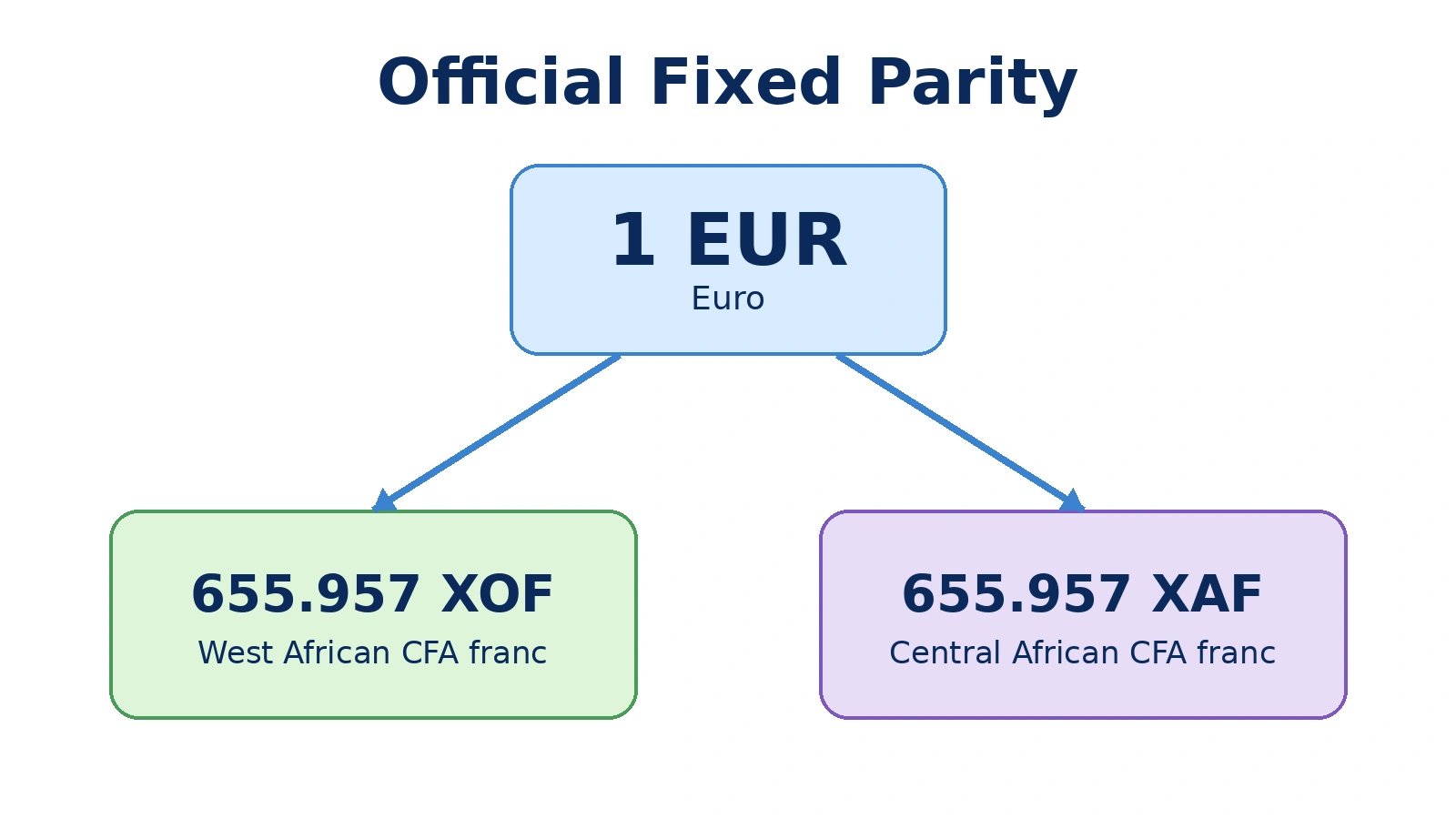
This is the central anchor of the system.
France’s role
Official monetary-cooperation documents describe a convertibility guarantee framework associated with France.
For most businesses, the practical relevance is this:
The currencies are anchored to the euro;
This supports stability and predictability;
But the framework also means the currencies do not float independently.
Why businesses should care
If you are structuring payments, collections, or treasury flows in these regions, knowing the institutional structure helps you understand:
Why the currencies are stable versus EUR,
Why the USD relationship changes,
Why the two CFA francs share the same nominal value,
And why local-currency operations remain region-specific.
Related pages
Primary and authoritative sources
This content cluster was researched and updated for September 2026. Exchange rates versus currencies other than the euro vary over time. For operations, always confirm the current rate, the sending/receiving bank’s terms, and any country-specific compliance requirements.