
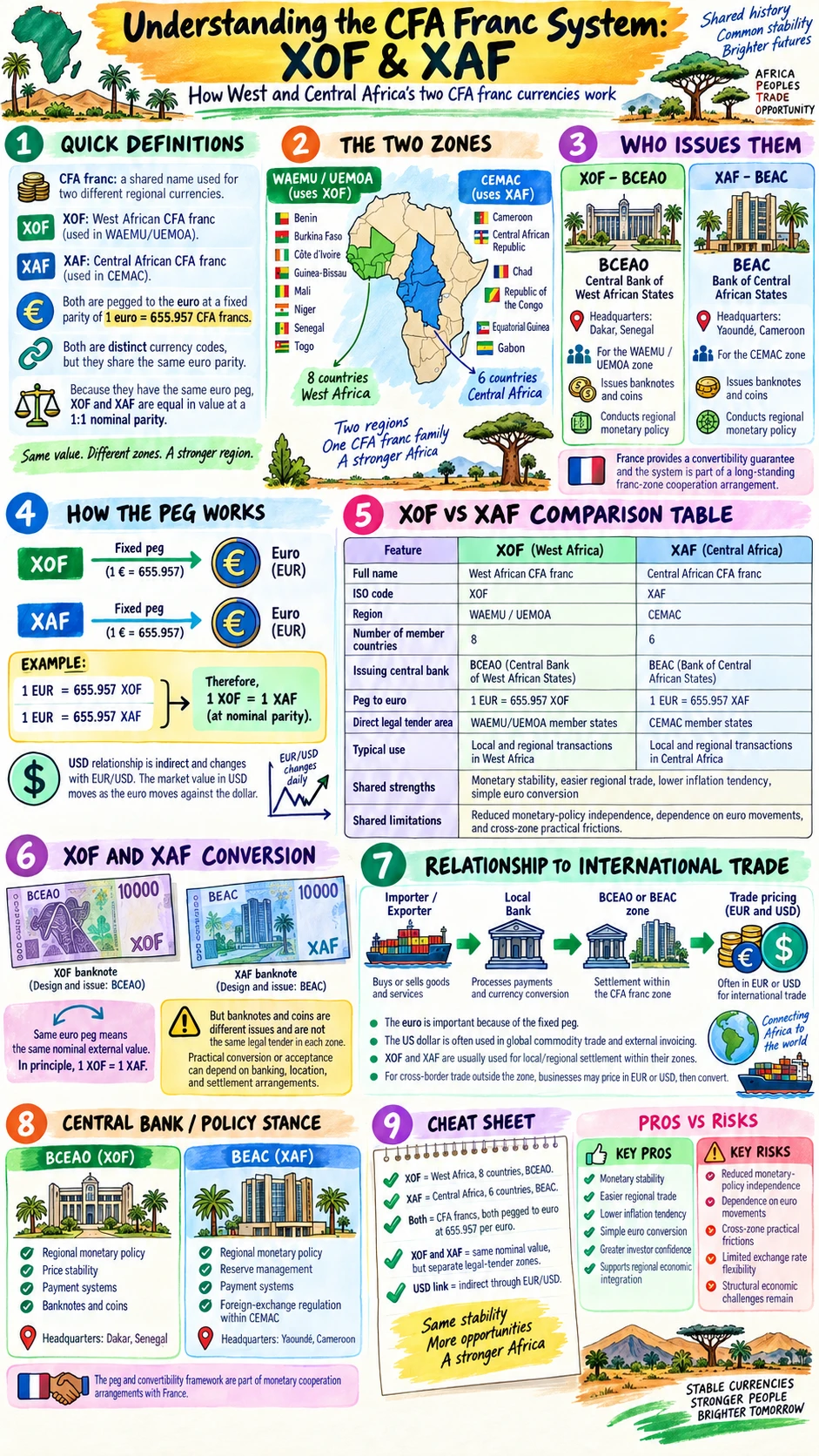
The term CFA franc sounds like a single currency. In practice, it refers to two regional currencies that share a common history and the same fixed peg to the euro:
XOF — the West African CFA franc, used in the WAEMU/UEMOA zone.
XAF — the Central African CFA franc, used in the CEMAC zone.
They are similar, but they are not identical.
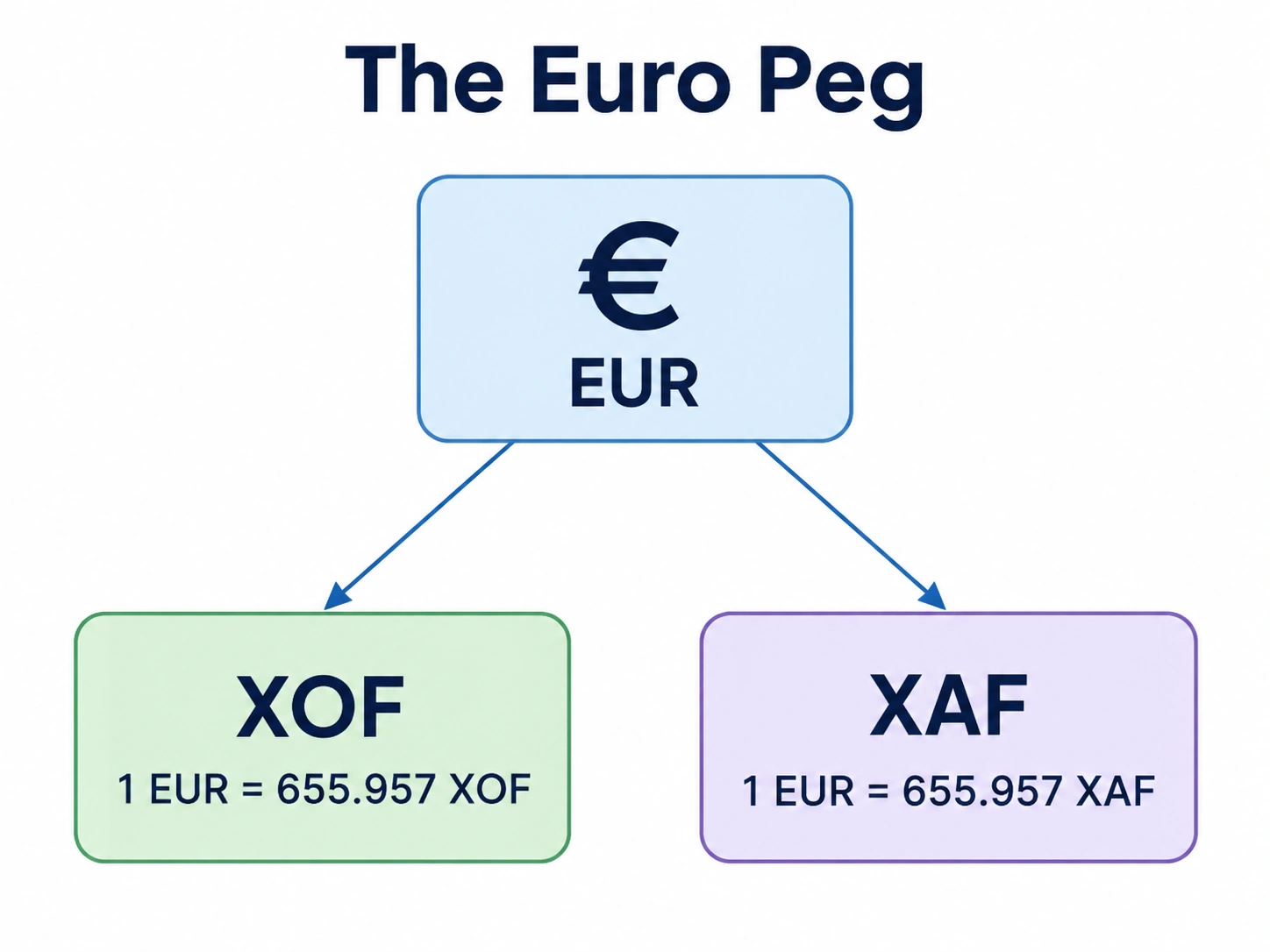
They share the same fixed parity to the euro:

Because both currencies are pegged at the same rate to the euro, XOF and XAF have the same nominal external value. But they are issued by different central banks, used in different regional monetary unions, and are not the same legal tender in the same countries.
That distinction matters for anyone dealing with trade, treasury, banking, remittances, or cross-border payments into West or Central Africa.
The Shortest Possible Explanation
XOF = West African CFA franc.
XAF = Central African CFA franc.
BCEAO issues XOF for the 8 WAEMU/UEMOA countries.
BEAC issues XAF for the 6 CEMAC countries.
Both are pegged to the euro at 655.957 per euro.
Therefore, 1 XOF and 1 XAF have the same nominal value.
But they are different currencies operationally because they belong to different monetary unions and are not used in the same legal-tender areas.
1. The two currencies at a glance
XOF
The West African CFA franc has ISO code XOF. It is used by the eight member states of the West African Economic and Monetary Union, commonly referred to in French as UEMOA and in English as WAEMU:
Benin
Burkina Faso
Côte d’Ivoire
Guinea-Bissau
Mali
Niger
Senegal
Togo
XOF is issued by the BCEAO — the Central Bank of West African States.
Read the dedicated child page: Understanding XOF
XAF
The Central African CFA franc has ISO code XAF. It is used by the six member states of the Central African Economic and Monetary Community, or CEMAC:
Cameroon
Central African Republic
Chad
Republic of the Congo
Equatorial Guinea
Gabon
XAF is issued by the BEAC — the Bank of Central African States.
Read the dedicated child page: Understanding XAF
2. Why there are two CFA francs
The phrase “CFA franc” is really a family name.
Historically, the franc zone developed as a shared monetary system linked to France. Over time, two regional African monetary unions evolved with separate regional central banks:
BCEAO in West Africa
BEAC in Central Africa
The result is not one Africa-wide CFA franc. It is two regional CFA-franc currencies, each tied to a different monetary union and central bank.
This is why you should never say:
CFA franc means the same currency everywhere in francophone Africa.
That is too loose and often wrong in operational contexts.
3. The two zones and the countries that use them
WAEMU / UEMOA zone XOF
This zone consists of eight countries in West Africa that share:
A common currency (XOF),
A common central bank (BCEAO),
And a regional monetary framework.
XOF is the local and regional settlement currency across this zone.
CEMAC zone XAF
This zone consists of six countries in Central Africa that share:
A common currency (XAF),
A common central bank (BEAC),
And a regional monetary framework.
XAF is the local and regional settlement currency across this zone.
4. The Euro Peg: The single most important feature
The defining feature of both XOF and XAF is their fixed peg to the euro.
This has several consequences.
First consequence: XOF and XAF move with the euro
Because the currencies are pegged to the euro, they have a stable relationship with EUR.
If the euro strengthens against the U.S. dollar, XOF and XAF also tend to strengthen against the U.S. dollar.
If the euro weakens against the U.S. dollar, XOF and XAF tend to weaken against the U.S. dollar.
That means the relationship to USD is indirect, not fixed.
Second consequence: Simple euro conversion
For treasurers and cross-border traders, this peg makes euro-linked pricing easier to model.
If a contract is written in euros, the local-currency equivalent in XOF or XAF is mechanically predictable.
Third consequence: Monetary discipline and trade-offs
A fixed peg can support:
Sability,
Lower inflation tendencies,
And predictability for external trade.
But it also means the currency union has less exchange-rate flexibility and less country-by-country monetary-policy independence.
5. Are XOF and XAF equal to each other?
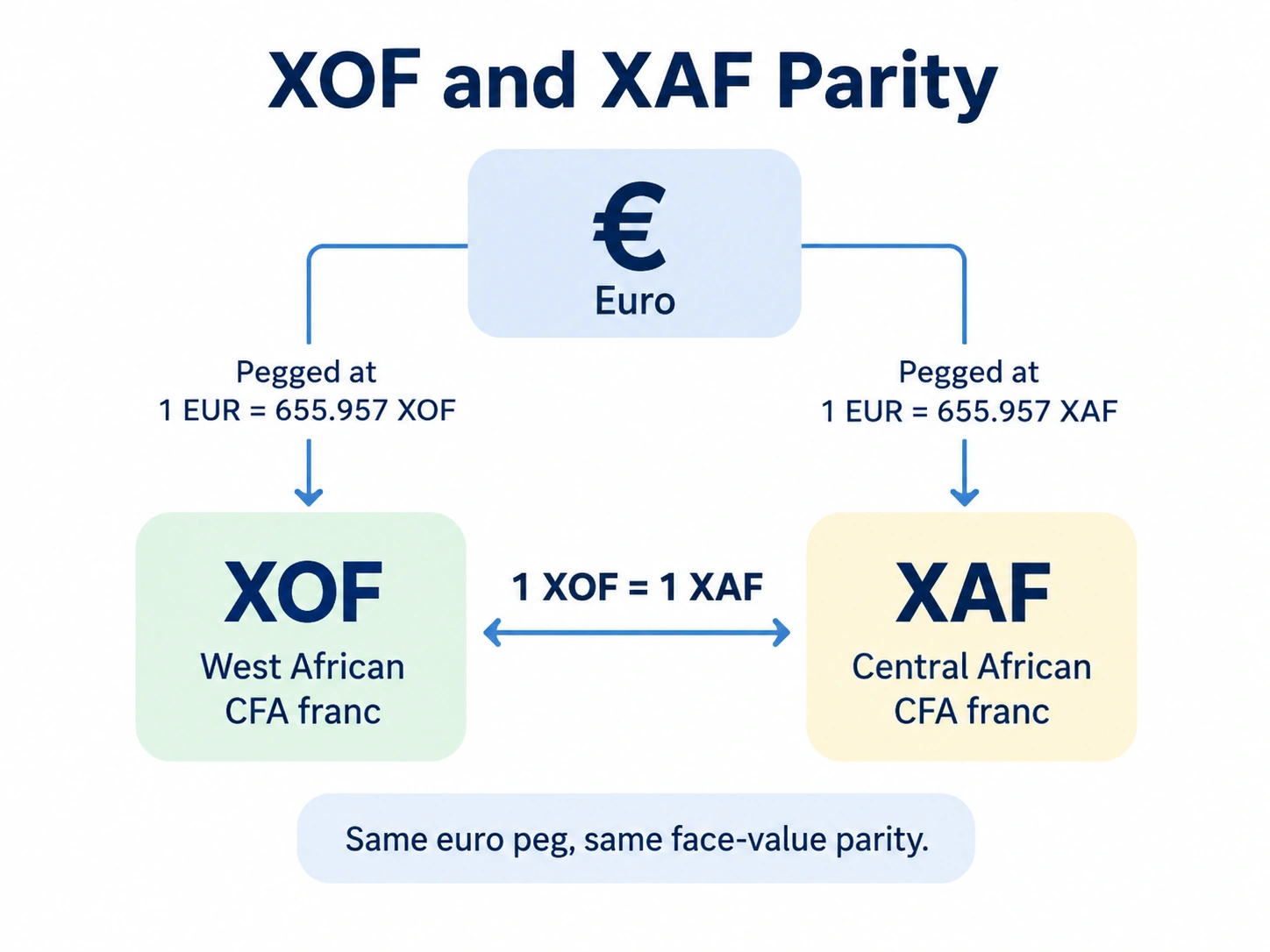
In terms of nominal external value, yes.
Since both currencies are pegged to the euro at the same parity, you can say:
But you must immediately add the operational caveat:
They are not the same legal tender in the same territories.
That means:
A WAEMU-zone note is not simply the ordinary domestic currency note of a CEMAC country;
The notes and coins are issued by different central banks;
Practical conversion and settlement can depend on banks, counterparties and location;
Acceptance across zones is not just a casual over-the-counter assumption.
This is one of the most misunderstood points in the subject.
Read the detailed comparison page: XOF vs XAF: same value, different zones
6. Who creates the currencies?
BCEAO creates XOF
The BCEAO is the Central Bank of West African States, headquartered in Dakar, Senegal.
Its main roles include:
Issuing notes and coins,
Conducting regional monetary policy,
Promoting price stability,
Operating regional payment systems,
Supporting the functioning of the monetary union.
BEAC creates XAF
The BEAC is the Bank of Central African States, headquartered in Yaoundé, Cameroon.
Its main roles include:
Issuing notes and coins,
Conducting regional monetary policy,
Reserve management,
Payment-system oversight,
Foreign-exchange regulation and monetary coordination within the CEMAC zone.
Read: BCEAO, BEAC and how the euro peg works
7. What role does France still play?
This topic is politically sensitive, so it should be described precisely.
The official monetary-cooperation framework has historically included:
The fixed parity to the euro,
A convertibility guarantee framework associated with the French Treasury,
And broader franc-zone cooperation.
From a practical business perspective, the main point is not the politics. The main point is this:
The stability of the euro peg is a core design feature of the system.
This helps explain why many descriptions of XOF/XAF mention both the regional central bank and France in the same breath.
8. How XOF and XAF relate to trade
For international trade, the currencies play two different roles:
Local and regional role
Within their own monetary zones, XOF and XAF are natural settlement currencies for:
Payroll,
Local supplier payments,
Domestic invoices,
Local treasury,
And regional intra-zone trade.
External trade role
When businesses trade outside the zone, the picture changes.
Cross-border trade may be priced in:
EUR, because of the fixed peg and commercial links with Europe;
USD, because the dollar dominates many international commodity and trade flows;
or in local currency where commercially practical.
A common structure is:
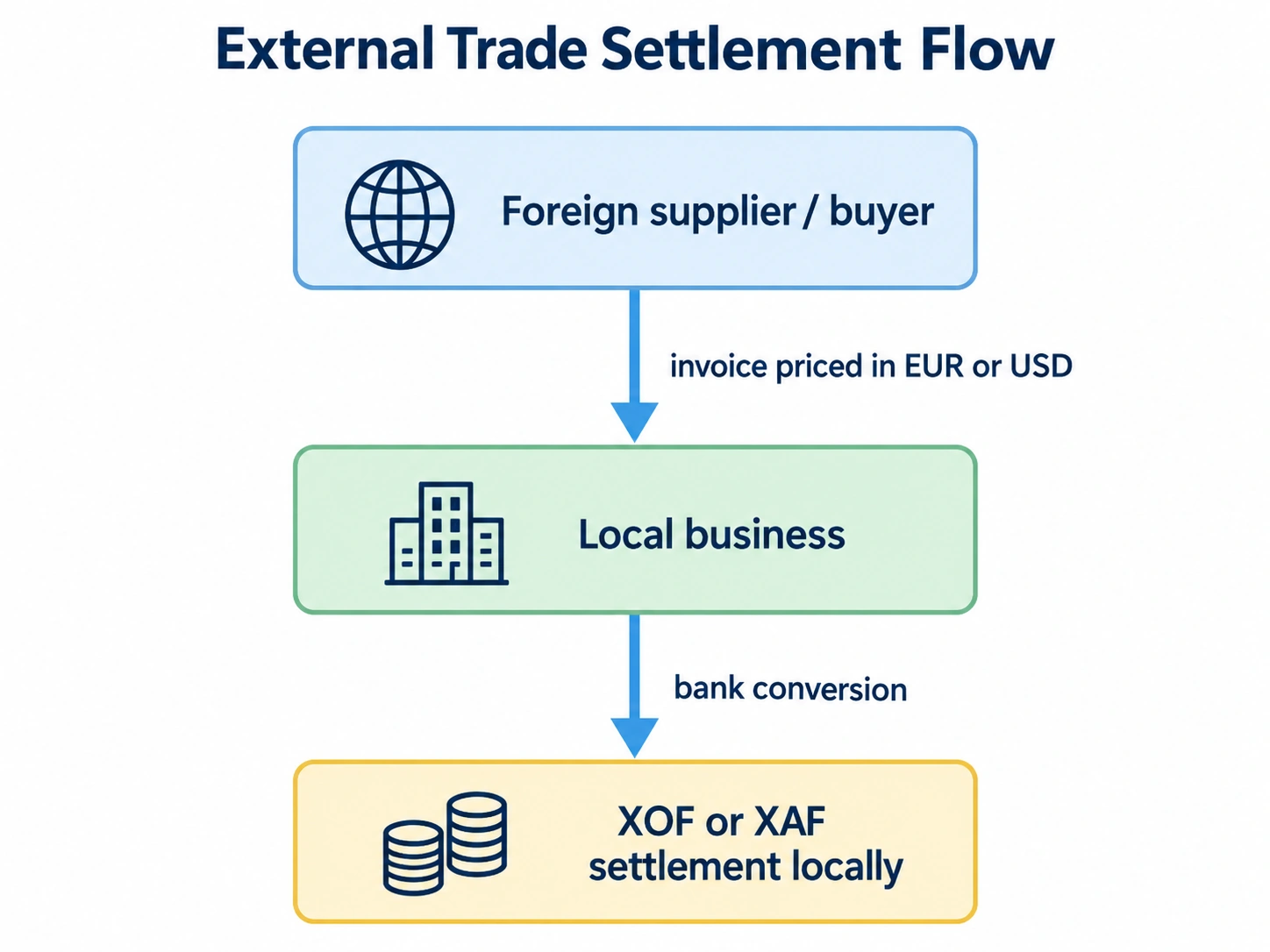
The fixed euro peg makes euro-linked trade particularly predictable. USD-linked trade, however, will still vary because EUR/USD moves.
Read the practical page: Paying suppliers and collecting in XOF and XAF
9. Relationship to the U.S. dollar
A lot of people ask:
What is the USD peg?
There is no direct USD peg.
The currencies are pegged to the euro, not the dollar.
So conceptually:
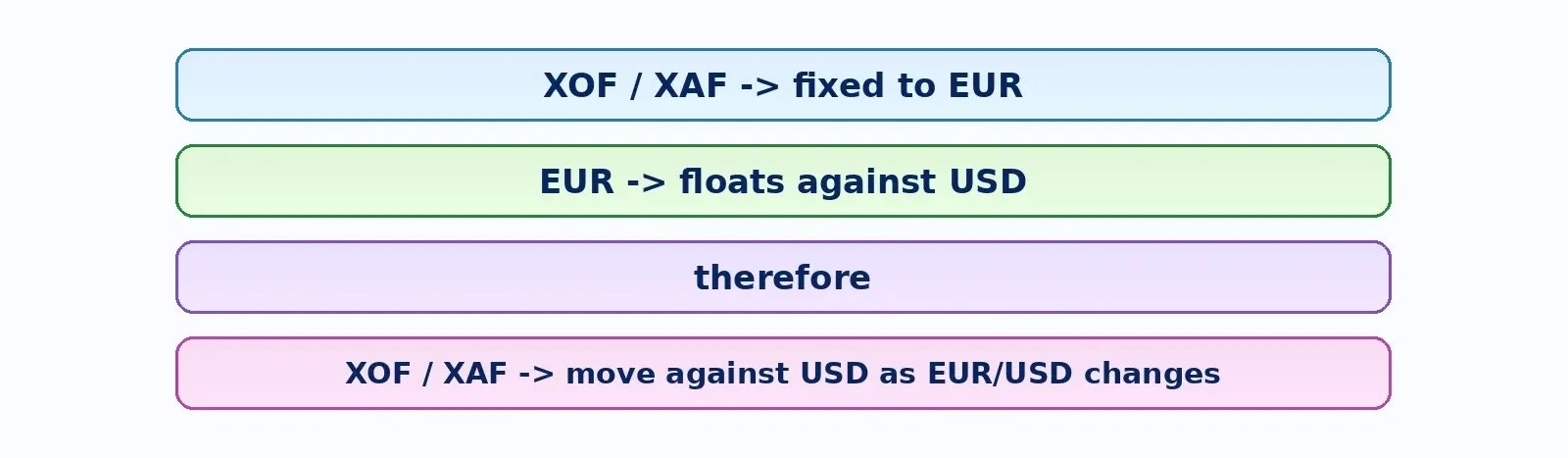
This means the XOF/USD or XAF/USD rate on a given day is a byproduct of:
The fixed CFA/euro parity; and
The current EUR/USD market rate.
In official daily rate publications, you therefore see a variable XOF/USD or XAF/USD rate.
10. Strengths of the system
Stability
The fixed peg provides a relatively stable monetary anchor.
Simplicity for euro-linked business
Businesses pricing in EUR can model costs and receipts more easily.
Regional integration
A common currency reduces frictions inside each monetary union.
Lower inflation tendency
Official sources regularly frame the peg as a factor supporting monetary stability and comparatively lower inflation over long periods.
11. Limitations and trade-offs
Less monetary-policy independence
Individual member countries do not each run a separate national currency policy.
Dependence on euro movements
A strong or weak euro affects competitiveness and external pricing.
Limited exchange-rate flexibility
The zones do not have a freely floating currency that can adjust independently to local shocks.
Cross-zone and external frictions
Even though XOF and XAF have the same nominal value, they operate in separate regional systems.
12. A practical example
Assume a Senegalese importer buys goods from Europe.
The contract may be priced in EUR.
Because the XOF peg is fixed:
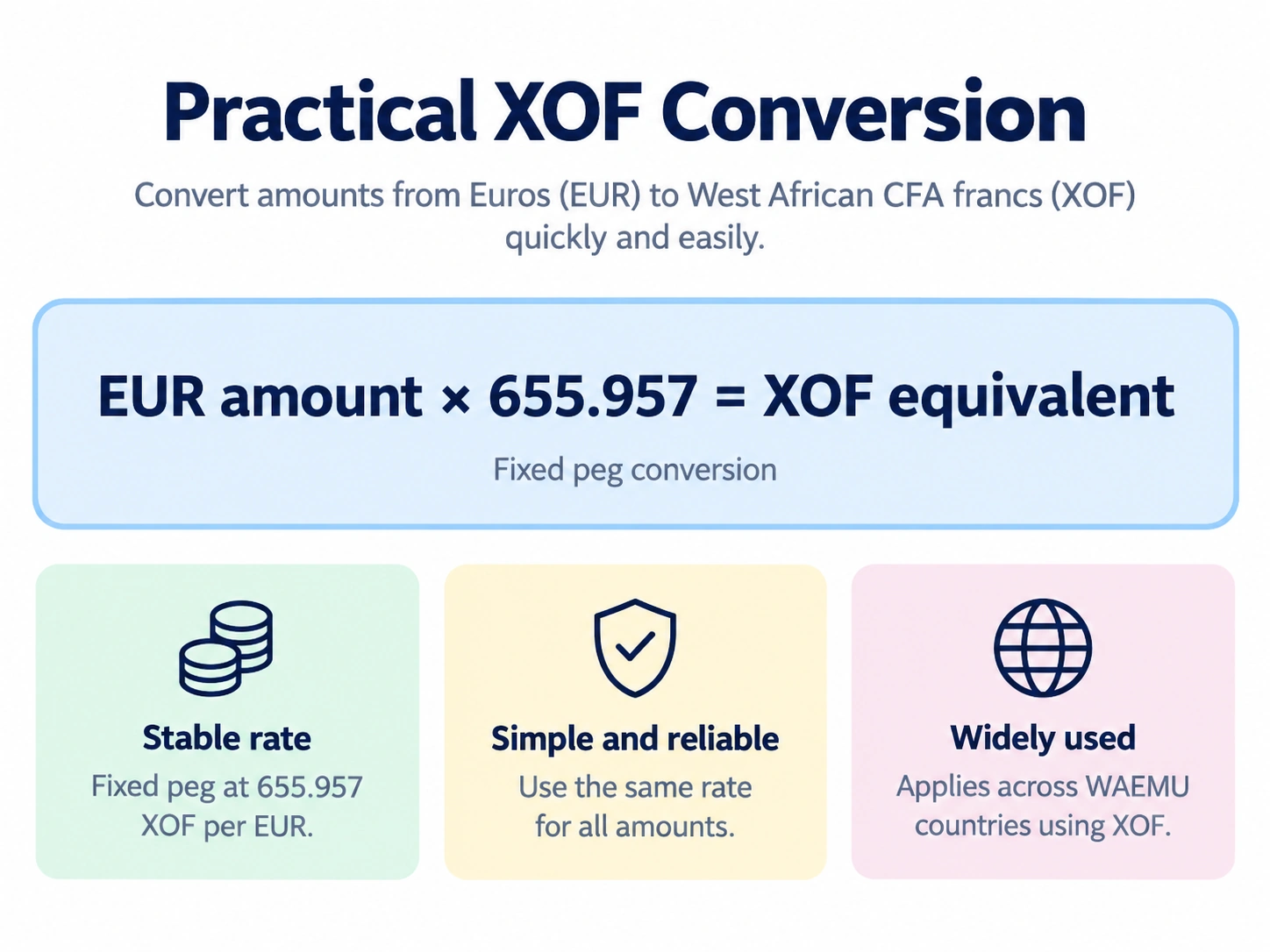
That gives the importer strong predictability.
Now assume a Cameroonian business buys a globally priced commodity in USD.
The local XAF cost depends on:
The USD price,
The EUR/USD market relationship,
And the resulting implied XAF/USD rate.
So the euro peg helps with monetary stability, but it does not eliminate external FX exposure to the dollar.
13. Quick comparison table
Feature | XOF | XAF |
|---|---|---|
Full name | West African CFA franc | Central African CFA franc |
ISO code | XOF | XAF |
Zone | WAEMU / UEMOA | CEMAC |
Number of countries | 8 | 6 |
BCEAO | BEAC | |
Euro peg | 1 EUR = 655.957 XOF | 1 EUR = 655.957 XAF |
Relationship to USD | indirect through EUR/USD | indirect through EUR/USD |
Same nominal value as the other? | yes | yes |
Same legal-tender territory as the other? | no | no |
14. FAQ
Is XOF the same as XAF?
Not exactly. They share the same nominal external value because both are pegged to the euro at the same rate, but they are separate currencies operationally, issued by different central banks, and used in different monetary unions.
How many countries use XOF?
Eight: Benin, Burkina Faso, Côte d’Ivoire, Guinea-Bissau, Mali, Niger, Senegal and Togo.
How many countries use XAF?
Six: Cameroon, Central African Republic, Chad, Republic of the Congo, Equatorial Guinea and Gabon.
Is XOF stronger than XAF?
No. They share the same nominal value via the same euro peg.
Are XOF and XAF pegged to the U.S. dollar?
No. They are pegged to the euro.
Why does the USD rate change if the euro peg is fixed?
Because EUR/USD changes. The fixed peg is to EUR, not to USD.
Can I assume XOF notes are freely accepted in XAF countries?
No. That is not a safe practical assumption. They are separate legal-tender systems, even if their nominal external value is the same.
Related pages
Start With the Flow of Funds
If your business is paying into West Africa or Central Africa, start by mapping:
currency used → country → bank account location → pricing currency → settlement currency → FX conversion point → correspondent/payment route.
That one exercise usually reveals whether you are really dealing with a local-currency transaction, a euro-linked trade payment, or a dollar-priced cross-border settlement.
Primary and authoritative sources
This content cluster was researched and updated for September 2026. Exchange rates versus currencies other than the euro vary over time. For operations, always confirm the current rate, the sending/receiving bank’s terms, and any country-specific compliance requirements.