
Stablecoin Settlement Must Be a Separate, Disclosed Leg
A gaming business may ask whether a separate stablecoin leg can be used for lawful corporate treasury after merchant revenue has settled.
Can we collect locally in India, pay local obligations, and convert the remaining corporate revenue into USDT for treasury or settlement?
That can be a legitimate architecture question only after the underlying revenue is lawful.
It is not a workaround for prohibited online-money-game pay-ins or payouts.
The correct sequence is:
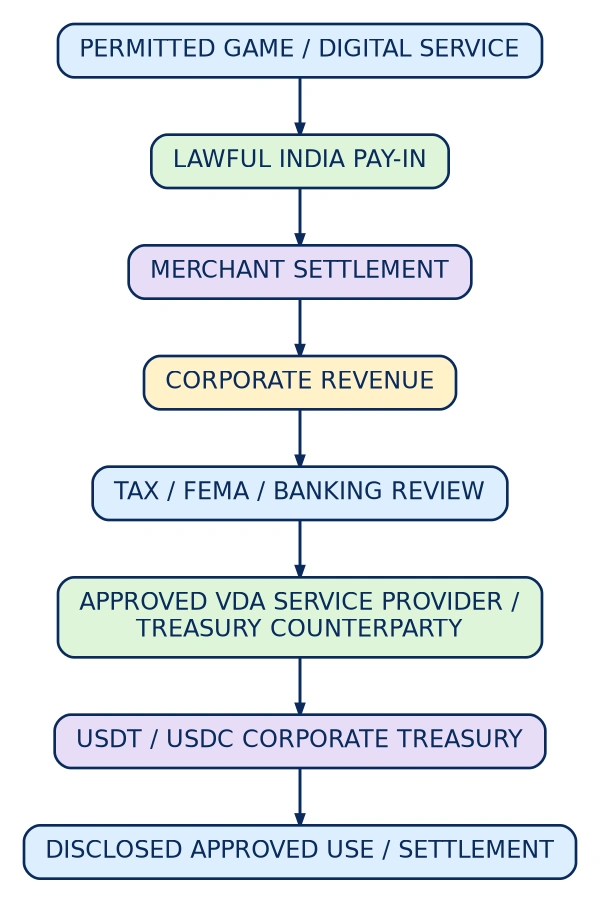
Why the Separation Matters
The operator should be able to prove the complete source and use of funds. A well-documented stablecoin payment structure should show:
how INR was earned;
that the payment provider onboarded the actual activity;
who legally owns the settled funds;
when customer/third-party obligations end;
when funds become corporate treasury;
which entity purchases/receives the stablecoin;
which VDA service provider/counterparty is used; and
where the stablecoin is ultimately sent.
This is what makes the stablecoin leg auditable. The generic mechanics of stablecoin settlement are separate from the threshold question of whether the India gaming revenue itself was lawfully earned.
India VDA AML/CFT Framework
FIU-IND maintains AML/CFT guidance and registration requirements for virtual digital asset service providers carrying on covered VDA activities.
For a commercial structure, provider due diligence can include:
FIU-IND status of the VDA counterparty where applicable;
KYC/KYB;
source of wealth where required;
wallet screening;
transaction monitoring;
sanctions screening;
Travel Rule controls where applicable;
wallet ownership;
corporate authority; and
accounting/tax treatment.
Stablecoin infrastructure should make the flow more transparent, not less.
What Not to Do
Do not use USDT/USDC to:
disguise wagering proceeds;
bypass a payment-provider prohibition;
pay prohibited gaming winnings;
conceal merchant identity;
move third-party customer funds as if they were corporate treasury;
obscure settlement destination; or
avoid required banking/VDA disclosures.
A chain transaction creates a record. It does not erase the original economic purpose.
Corporate Treasury Use Case
A permitted gaming publisher may:
collect lawful India revenue;
pay refunds, taxes and local expenses;
establish the residual corporate amount;
use an approved VDA/FX counterparty under an analyzed structure;
acquire stablecoin for disclosed treasury/settlement purposes; and
deliver it to a verified corporate wallet/counterparty.
The legal, tax and foreign-exchange analysis should be done before implementing this flow.
Stablecoin vs. Conventional Cross-Border Settlement
Compare:
Factor | Bank/Fiat Cross-Border | Stablecoin Treasury |
|---|---|---|
Banking visibility | High | Must still be disclosed where relevant |
Settlement hours | Bank/corridor dependent | Network dependent, often 24/7 |
FX/VDA conversion | Fiat FX | Fiat/VDA conversion required |
Counterparty risk | Bank/payment provider | VDA provider + token/network/custody |
AML controls | Banking/KYB/TM | KYB + blockchain/VDA controls |
Regulatory analysis | Payments/FEMA/tax | Payments/FEMA/tax + VDA |
This is a treasury optimization question, not a gaming-law exception.
Related India Gaming Payment Topics
For the entity and offshore merchant-settlement questions that come before any treasury conversion, use Payments for Foreign Gaming Companies Serving India.
FAQ
Can an India gaming company convert revenue to USDT?
Potentially as a separately analyzed corporate treasury transaction if the underlying revenue is lawful and the VDA, banking, tax and foreign-exchange requirements are satisfied.
Can USDT be used to settle user winnings from prohibited online money games?
It should not be treated as a workaround. The underlying activity and economic purpose remain the threshold issue.
Does using an offshore exchange remove India VDA obligations?
Do not assume so. India has applied AML/CFT registration obligations to VDA service providers serving Indian clients/activities under its framework. Current counterparty status should be checked.
Should user wallets receive corporate treasury transfers?
Only where there is a legitimate, documented payment purpose. Corporate treasury and customer payments should not be casually mixed.
Request an India Gaming Payments Feasibility Assessment
Do not start with, “Who can give me Paytm, PhonePe, Google Pay, UPI or a wallet?”
Start with the transaction.
Send us:
the exact game or product type;
whether a user pays to participate, accesses by subscription, or places any stake;
whether a user can receive cash, transferable value, redeemable credits, tokens, or other winnings;
whether the game has an OGAI determination or registration;
the operating entity and country of incorporation;
whether there is an Indian entity;
required pay-in methods;
required payout methods;
average and maximum ticket size;
expected transactions per day and monthly value;
whether funds belong to the business or to users/third parties;
settlement currency and desired settlement country;
any cross-border treasury or stablecoin requirement; and
a simple flow-of-funds diagram.
We will separate the legal-classification issue from the payments issue, identify the infrastructure that may be supportable, and determine whether there is a credible provider-introduction path.
Regulatory References
Press Information Bureau — A New Era of Online Gaming Governance, 30 April 2026
FIU-IND — Downloads and VDA Service Provider AML/CFT Guidance
Regulatory status note: This page reflects the legal and payment-framework position reviewed on 17 September 2026. Product classification, payment-system rules, and provider policies can change and should be re-checked for a live implementation.