
The Real Problem Is Not “Which Indian Wallet Can I Connect To?”
A gaming operator may come to the market asking for:
UPI;
Paytm;
PhonePe;
Google Pay;
BHIM;
wallet acceptance;
API-based collections;
automated player payouts;
an Indian settlement account;
or a local payment partner.
That sounds like a provider-sourcing problem.
In 2026, it is not.
The first question is now:
Is the underlying game and transaction legally capable of being processed through India's banking and payment system?
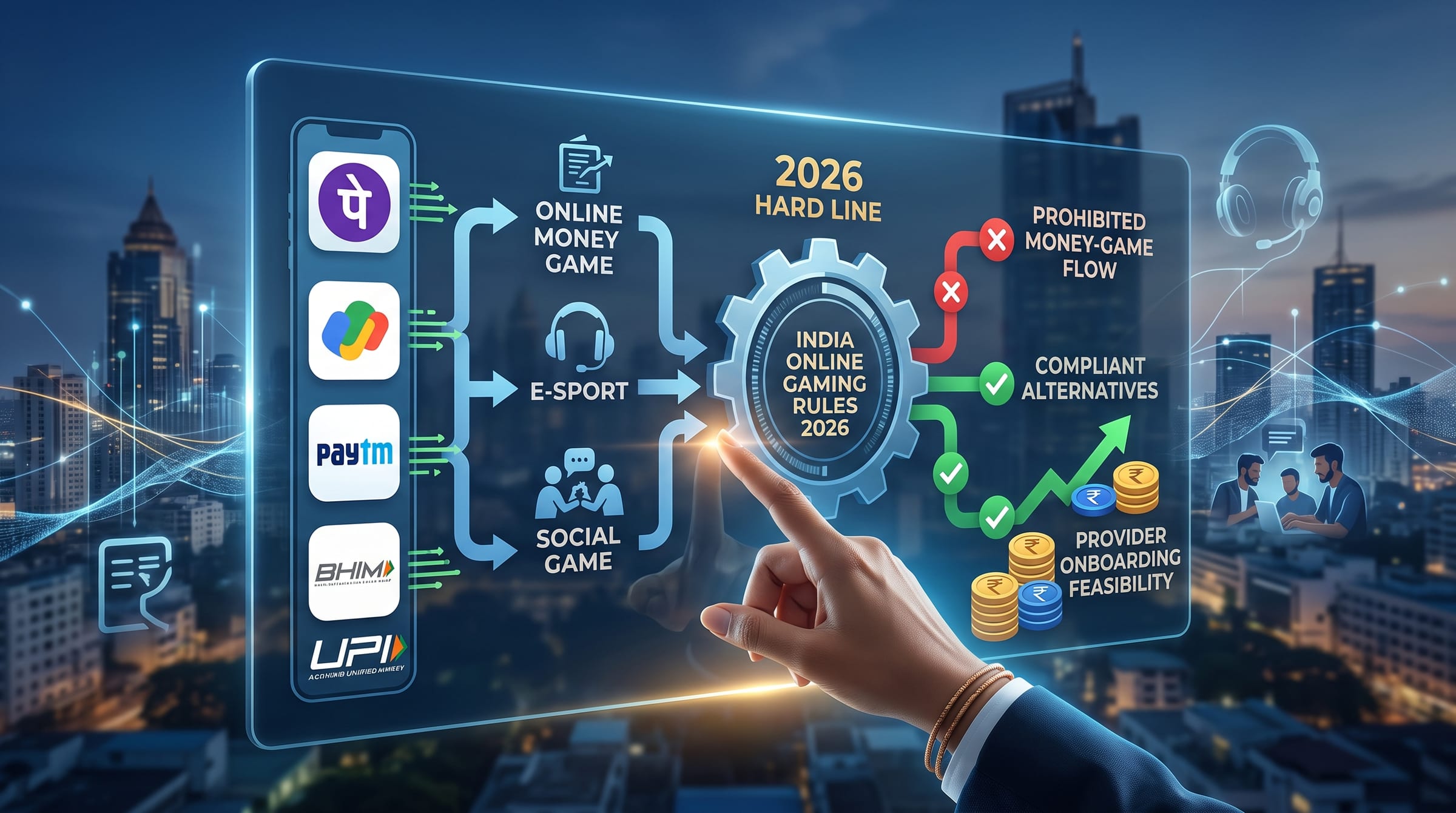
India's Promotion and Regulation of Online Gaming Act, 2025, operationalized by the Promotion and Regulation of Online Gaming Rules, 2026 from 1 May 2026, created a national framework that distinguishes:
online money games;
e-sports; and
online social games.
An online money game can be prohibited even if the underlying game is based on skill. The old commercial assumption that “skill game = payment processing may be available” is therefore no longer a safe starting point.
Section 7 of the Act separately prohibits a bank, financial institution, or other person facilitating financial transactions from processing or authorizing funds toward an online money gaming service.
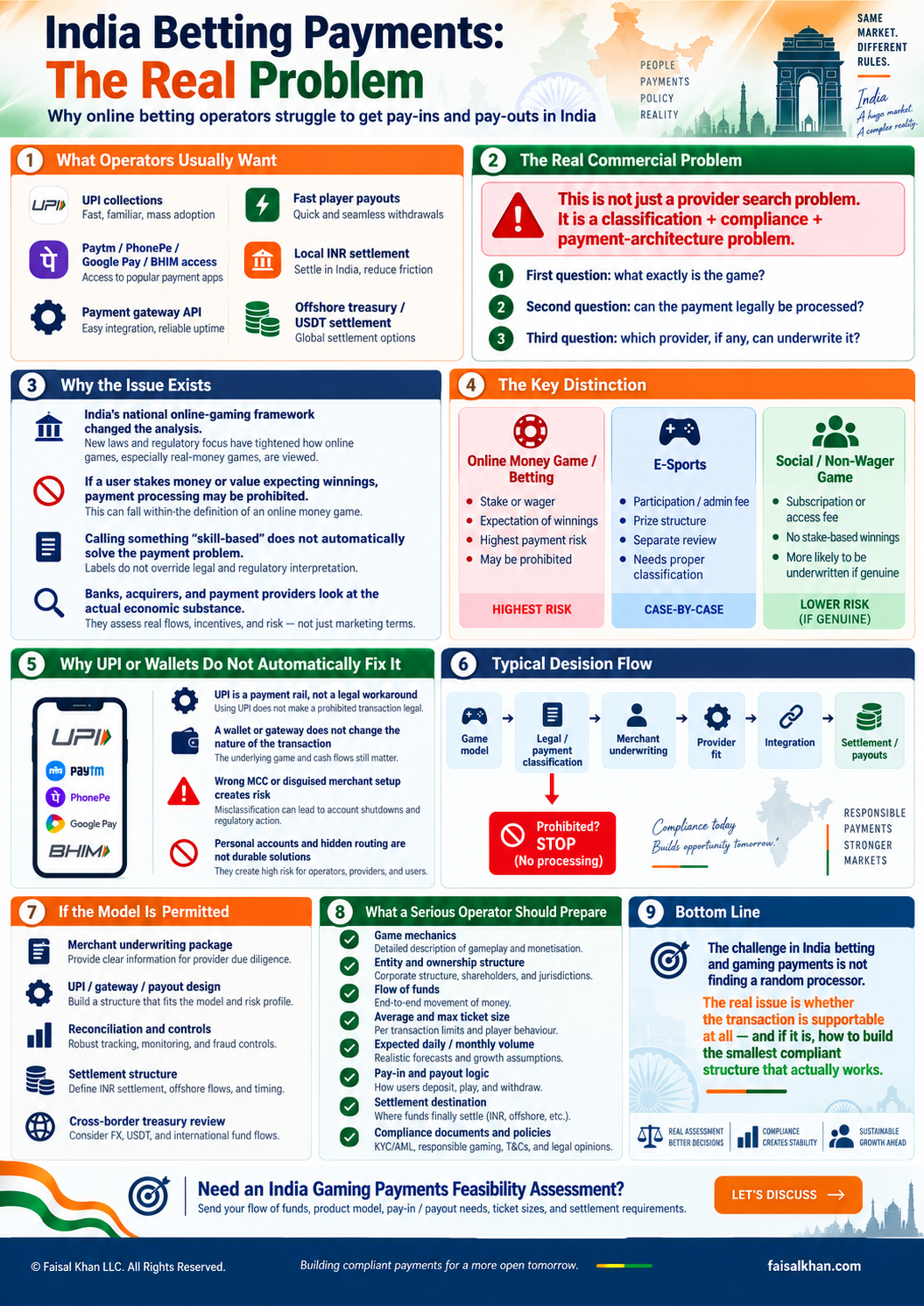
That makes gaming payments in India a classification + underwriting + payment-architecture problem.
Only after the business model survives that test does it make sense to ask which payment gateway, acquiring bank, payment aggregator, UPI integration, payout provider, or settlement structure is commercially available.
The 2026 Hard Line: What Kind of Game Is Being Paid For?
Model | Core Payment Characteristic | Current Payment Question |
|---|---|---|
Online money game | User pays money or other stakes in expectation of monetary or other enrichment/winnings | Processing is prohibited under the Act |
E-sport | Recognized competitive format; participation/admin fees and performance-linked prize money may be permitted; no bets/wagers/stakes | Determine/registration status, then payment onboarding |
Online social game | Entertainment/recreation/skill development without staking or expectation of winnings; access/subscription fee may be possible if not a stake | Classification, merchant underwriting, then payment onboarding |
Ordinary digital content/game purchase | User buys access, software, content, subscription, virtual item or service without prohibited wagering mechanics | Normal payment analysis plus gaming-sector underwriting |
Cross-border treasury | Company moves its own lawful proceeds between entities/countries | Separate FEMA, banking, tax, VDA and settlement analysis |
The commercial implication is simple:
We do not try to force a payment provider onto a transaction that the payment provider is legally prohibited from processing. We first classify the transaction, then build the smallest compliant payment structure that works.
The Commercial Problem We Solve
A serious operator does not merely need a QR code.
It may need to solve all of the following simultaneously:
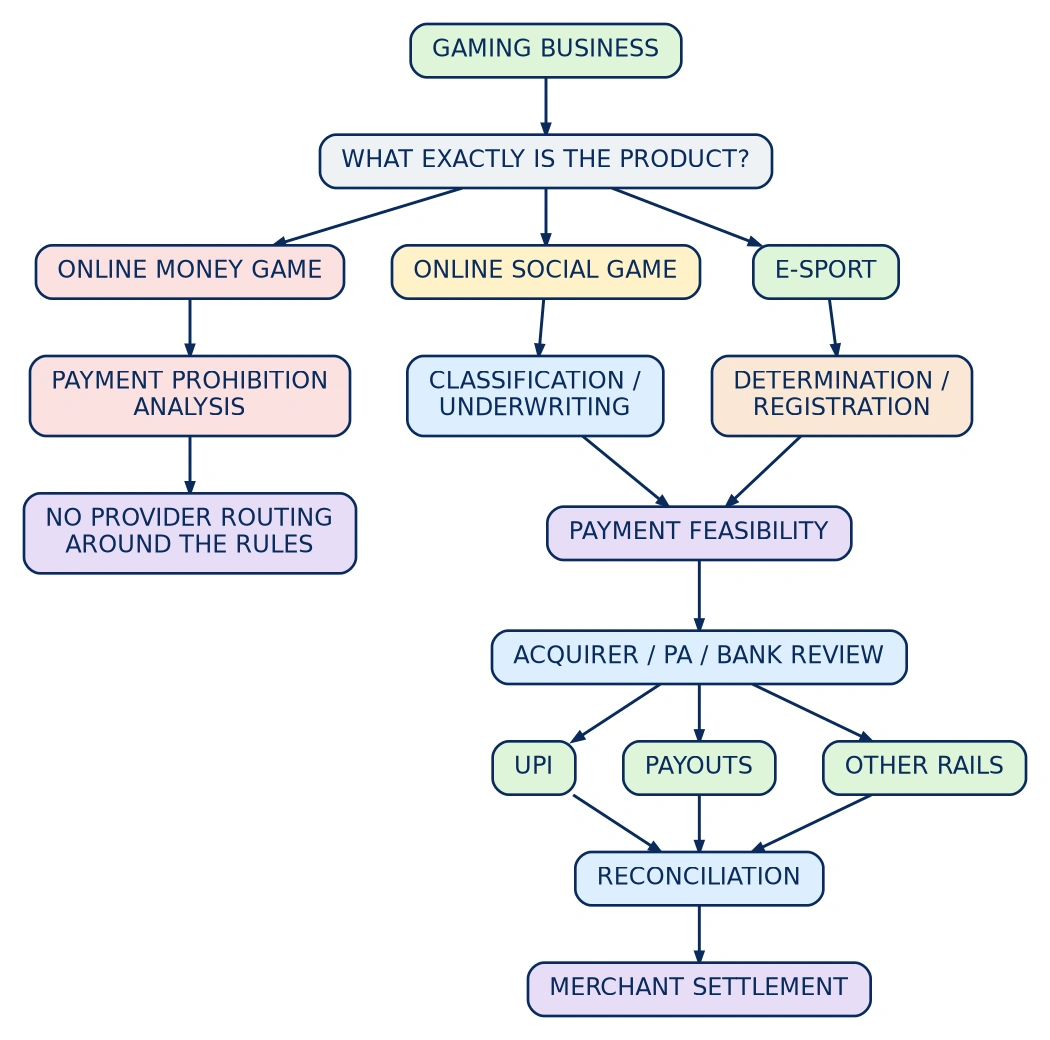
For a permitted model, the solution may involve a specialist payment processing relationship built around the actual merchant category and transaction flow, including:
an acquiring bank;
an RBI-regulated payment aggregator;
UPI merchant acceptance;
cards or net banking where supported;
PPI/wallet acceptance where the relevant program supports the merchant;
payout/disbursement APIs;
local corporate banking;
merchant settlement;
API orchestration;
refunds;
fraud controls;
KYB/EDD;
transaction monitoring;
an India operating entity where needed;
and, separately, lawful cross-border corporate settlement.
The payment stack is the end of the analysis, not the beginning.
UPI, Paytm, PhonePe, Google Pay and BHIM Are Not All the Same Thing
Operators frequently say:
We need PhonePe, Google Pay, Paytm or BHIM.
For merchant architecture, that is imprecise.
UPI is the payment system. Consumer applications such as PhonePe, Google Pay and BHIM can provide the payer-facing experience. Merchant acceptance is normally enabled through the merchant's acquiring bank/payment provider relationship, which assigns the merchant configuration, including the appropriate merchant category code.
NPCI states that a merchant wanting to accept UPI must partner with an acquiring bank. Integration can include QR, Intent, application-based and Collect modes. This acquiring relationship sits inside the broader payment network infrastructure that determines how a merchant reaches domestic rails.
So the practical question is not:
Can I connect directly to every UPI app?
It is:
Which regulated acquiring/payment relationship will onboard this exact gaming business, assign the correct merchant classification, and permit its transaction flow?
That distinction matters enormously in gaming.
Typical Permitted Social-Gaming Pay-In Flow
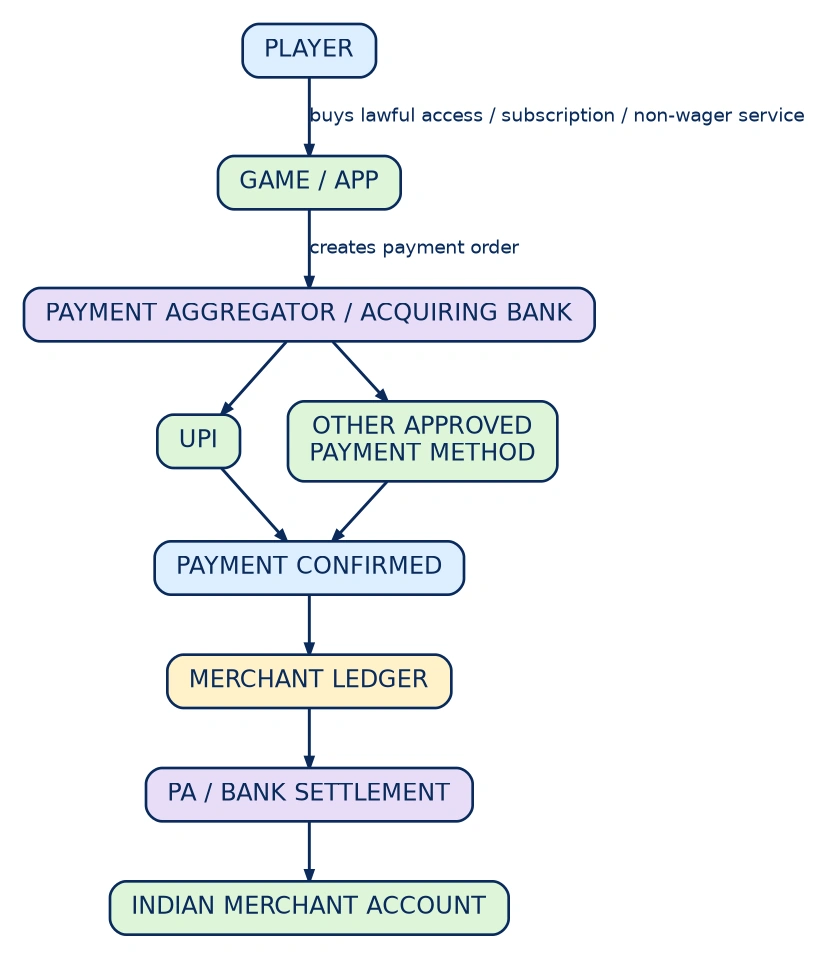
The payment description, website/app mechanics, merchant category, and provider application must all describe the same economic activity.
Typical E-Sports Fee and Prize Flow
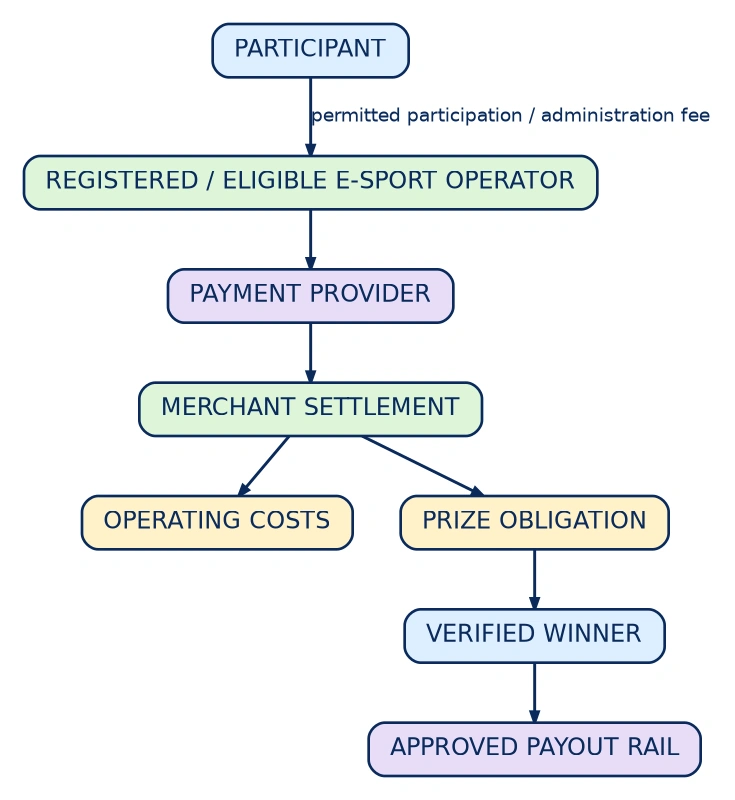
The core distinction is that a permitted participation fee is not a disguised wager. The game mechanics, prize structure, registration/determination status, and payment provider's underwriting all matter.
What a Prohibited Money-Game Payment Flow Looks Like
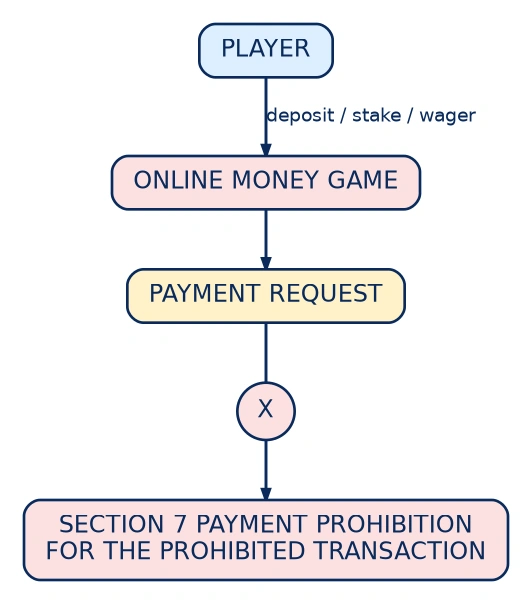
Changing the front-end label from “bet” to “wallet load,” “game credit,” “skill fee,” “token,” or “subscription” does not solve the problem if the economic substance is still a stake made in expectation of winnings.
Neither does routing through:
personal UPI IDs;
unrelated merchants;
incorrect MCCs;
nested payment accounts;
third-party collection accounts;
offshore wallets;
or crypto/stablecoins.
Those structures create additional banking, AML, fraud and misrepresentation risks rather than a durable payment solution.
What We Can Potentially Structure
For a business whose activity is permitted and supportable, the engagement can address:
Requirement | Potential Workstream |
|---|---|
Determine whether payments are supportable | Game/payment-flow classification and feasibility review |
Accept INR from Indian users | UPI/acquirer/payment aggregator assessment |
Integrate via API | Gateway/API architecture, webhook and reconciliation requirements |
Pay users or counterparties | Payout/disbursement architecture for permitted obligations |
Handle refunds | Provider-supported refund flow and ledger design |
High transaction count | Throughput, limits, reconciliation and exception handling |
Small tickets | Cost-per-transaction and automation design |
Foreign parent / no India presence | Entity, merchant-of-record and cross-border structure review |
India settlement | Appropriate merchant/corporate account structure |
Provider onboarding | KYB, ownership, source-of-funds, policies, flow of funds, product evidence |
E-sports | Determination/registration and payment-provider readiness |
Social gaming | Classification and non-wager monetization/payment architecture |
Stablecoin treasury | Separate lawful post-settlement corporate treasury analysis |
The objective is the same as with any difficult payment project:
Build the smallest compliant structure that actually works and can survive provider due diligence.
High-Volume, Small-Ticket Gaming Changes the Engineering
A gaming app can have relatively low individual transaction values while producing extremely high payment counts.
A representative requirement may involve:
₹500–₹1,000 routine pay-ins;
occasional ₹1,000–₹2,500 transactions;
large daily transaction counts;
rapid payout expectations;
frequent retries;
user-level reconciliation;
refund handling;
duplicate callback protection;
and 24/7 operational expectations.
At that scale, the provider question is only part of the problem.
The operator also needs:
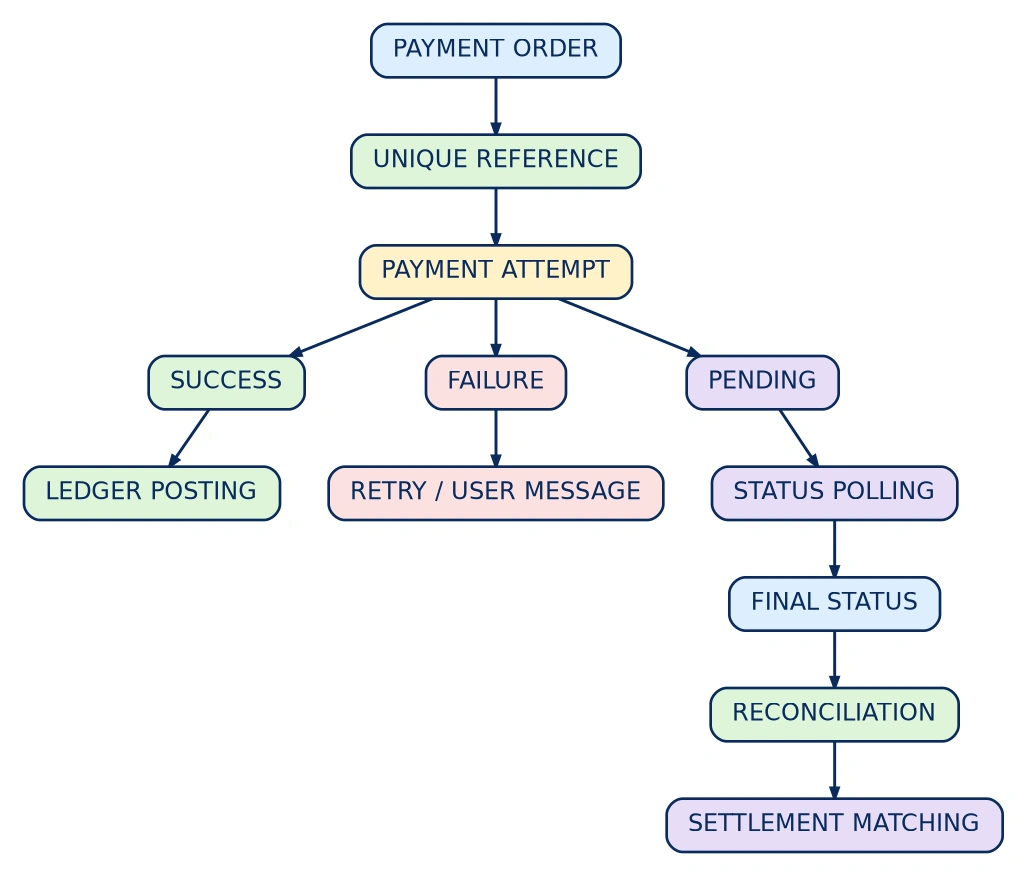
A technically weak integration can create a major financial-control problem even when the payment relationship itself is valid.
What About a Foreign Gaming Company With No Indian Presence?
A foreign operator cannot assume that the absence of an Indian company removes India from the analysis.
The 2025 Act has extraterritorial reach for covered online gaming services offered within India.
Separately, a foreign company seeking Indian merchant collections can face questions around cross-border payment structure as well as:
who the merchant of record is;
whether local merchant onboarding is available;
whether an Indian entity is required by the selected provider;
permitted cross-border payment architecture;
tax;
FEMA;
settlement ownership;
contractual relationships;
OGAI determination/registration status where applicable; and
whether the provider will underwrite the specific business at all.
This is why “just give us an API” is rarely a complete commercial brief.
Read: Payments for Foreign Gaming Companies Serving India
Pay-Outs Are a Separate Workstream
Collections and payouts should not be treated as one product.
A permitted gaming business may need payouts for:
e-sports prize money;
refunds;
promotional rewards that do not convert the game into a prohibited money game;
vendor payments;
affiliate payments;
payroll or contractors;
or other legitimate obligations.
Each payout type should be mapped to:
the legal obligation;
the beneficiary;
the source account;
the payout rail;
KYC/KYB status;
limits;
reconciliation; and
tax/reporting consequences.
Read: Gaming Payouts in India
Stablecoin or USDT Settlement Is Not a Workaround
A gaming operator may legitimately have a separate corporate treasury question:
After lawful merchant revenue settles, can the company move corporate treasury value cross-border or convert part of its treasury into USDT/USDC?
That is a different transaction from taking a prohibited wager.
India's VDA framework brings AML/CFT obligations for VDA service providers, including FIU-IND registration requirements for covered activities. A separate stablecoin settlement design can also raise FEMA, tax, banking and counterparty questions.
A stablecoin layer should therefore be analyzed as a disclosed corporate treasury/settlement leg after lawful revenue exists—not as a device for hiding the origin or purpose of a prohibited gaming transaction.
Read: Stablecoin Settlement for India Gaming Businesses
Provider Underwriting Is the Commercial Bottleneck
For a permitted model, provider approval will usually depend on a coherent underwriting package.
Expect to provide a file that satisfies normal KYB and enhanced due diligence expectations, including:
certificate of incorporation;
ownership and beneficial-owner information;
director information;
operating jurisdictions;
game URLs and app-store links;
product walkthrough;
terms and conditions;
privacy policy;
refund policy;
grievance process;
age/user safety controls;
game classification/determination/registration evidence where applicable;
exact payment purpose;
expected transaction count and value;
average and maximum ticket;
expected refund/payout behavior;
chargeback/fraud data if available;
flow of funds;
settlement account details;
source of funds;
processor history; and
an explanation of any crypto/stablecoin exposure.
A provider should not be asked to discover the business model during onboarding.
We prepare the transaction story first.
Read: Gaming Merchant Underwriting in India
Use Cases
1. Subscription-Based Social Gaming App
The user pays a monthly access fee. The payment does not create a wager, stake or expectation of cash winnings.
Need: UPI collections, recurring commercial logic where supported, refunds, reconciliation and merchant settlement.
2. E-Sports Tournament Platform
Players pay a permissible participation/admin fee and eligible winners receive performance-linked prizes.
Need: registration/determination analysis, pay-in processing, prize payout rail, beneficiary verification and reconciliation.
3. Free-to-Play Game With Paid Digital Features
The user buys digital access, cosmetics or other in-game products that are not redeemable as money and do not create a wagering entitlement.
Need: merchant acquiring, UPI, cards/other methods, fraud controls and settlement.
4. Foreign Game Publisher Selling to India
A non-Indian company wants INR collection from Indian users.
Need: classification, foreign-company onboarding analysis, merchant-of-record/entity options, permitted cross-border settlement.
5. Existing “Skill Gaming” Operator After the 2026 Rules
The operator historically processed entry fees and cash winnings on the theory that the game was skill-based.
Need: immediate product/payment classification under the new national framework before any processor search.
Related India Gaming Payment Guides
The broader India gaming-payments framework branches into focused implementation questions:
FAQ
Can an online gambling or sports betting business get UPI processing in India?
For an online money game covered by the 2025 Act, the problem is not finding a more tolerant UPI provider. The Act prohibits the relevant online money gaming activity and separately prohibits facilitation of its financial transactions. A provider search should not proceed until the product is classified.
Does calling a game “skill-based” solve the payment problem?
No. The statutory definition of an online money game expressly reaches games based on skill, chance, or both when the required money/stake and expected-winnings characteristics are present.
Can a permitted gaming app accept UPI?
Potentially, yes, subject to the game's legal classification and the acquiring bank/payment provider's underwriting. NPCI describes UPI merchant acceptance as an acquiring relationship, not merely an app connection.
Do I need separate integrations for Google Pay, PhonePe and BHIM?
Usually the commercial architecture should start with UPI merchant acceptance through the acquiring/payment relationship. Individual app experiences ride on the UPI ecosystem; the exact supported modes depend on the provider integration.
Can a gaming company use a personal UPI account to collect user money?
That is not a credible commercial architecture. A serious merchant should be onboarded under its actual business, correct merchant classification and approved settlement structure.
Can I use a different MCC to get approved?
The acquiring relationship should reflect the merchant's actual activity. Misclassification can lead to rejection, suspension, settlement holds, compliance escalation or account closure.
Can an offshore company simply collect in India without an Indian entity?
Not automatically. The gaming law can apply to offshore services offered in India, and merchant/payment onboarding has its own entity and settlement requirements. The structure has to be evaluated.
Can an e-sports platform collect participation fees?
The Act recognizes e-sports and permits participation fees for entry/admin costs within the statutory framework, while excluding bets/wagers/stakes. The specific game also sits within the 2026 determination/registration framework and provider underwriting.
Can a social game charge users?
A social game can have a subscription or one-time access fee if the economics do not amount to staking/wagering or an expectation of winnings. Product mechanics matter more than labels.
Can I pay prizes through UPI?
The correct answer depends on whether the underlying prize/payment is permissible, the game classification, beneficiary verification, provider capabilities and payout program terms.
Can collected INR be converted to USDT?
That is not a generic “yes.” Lawfully earned corporate funds may have a separate treasury/conversion question, but VDA AML/CFT, banking, FEMA, tax and counterparty requirements must be reviewed. USDT is not a lawful workaround for prohibited wagering collections.
What information do you need before approaching providers?
A concise flow of funds, exact game mechanics, monetization, entity structure, OGAI status where relevant, payment methods, average/max ticket, transaction count/value, settlement destination, payout logic and compliance documentation.
Request an India Gaming Payments Feasibility Assessment
Do not start with, “Who can give me Paytm, PhonePe, Google Pay, UPI or a wallet?”
Start with the transaction.
Send us:
the exact game or product type;
whether a user pays to participate, accesses by subscription, or places any stake;
whether a user can receive cash, transferable value, redeemable credits, tokens, or other winnings;
whether the game has an OGAI determination or registration;
the operating entity and country of incorporation;
whether there is an Indian entity;
required pay-in methods;
required payout methods;
average and maximum ticket size;
expected transactions per day and monthly value;
whether funds belong to the business or to users/third parties;
settlement currency and desired settlement country;
any cross-border treasury or stablecoin requirement; and
a simple flow-of-funds diagram.
We will separate the legal-classification issue from the payments issue, identify the infrastructure that may be supportable, and determine whether there is a credible provider-introduction path.
Regulatory References
Press Information Bureau — A New Era of Online Gaming Governance, 30 April 2026
FIU-IND — Downloads and VDA Service Provider AML/CFT Guidance
Regulatory status note: This page reflects the legal and payment-framework position reviewed on 17 September 2026. Product classification, payment-system rules, and provider policies can change and should be re-checked for a live implementation.