
The API Is Not the Payment License
A payment provider may give the developer excellent API documentation.
That does not determine whether the merchant is eligible to process the underlying transaction.
For gaming, keep two workstreams separate:
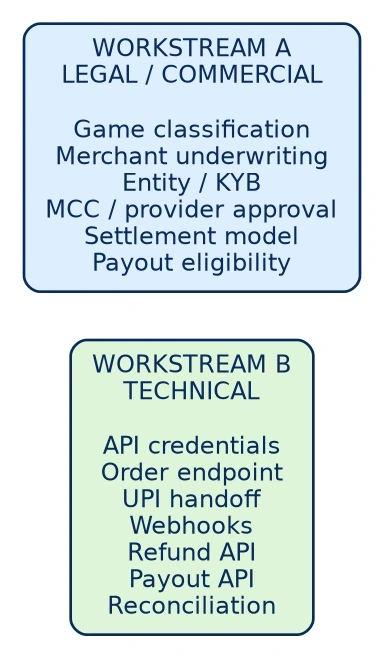
Both must be complete.
Reference Pay-In Architecture
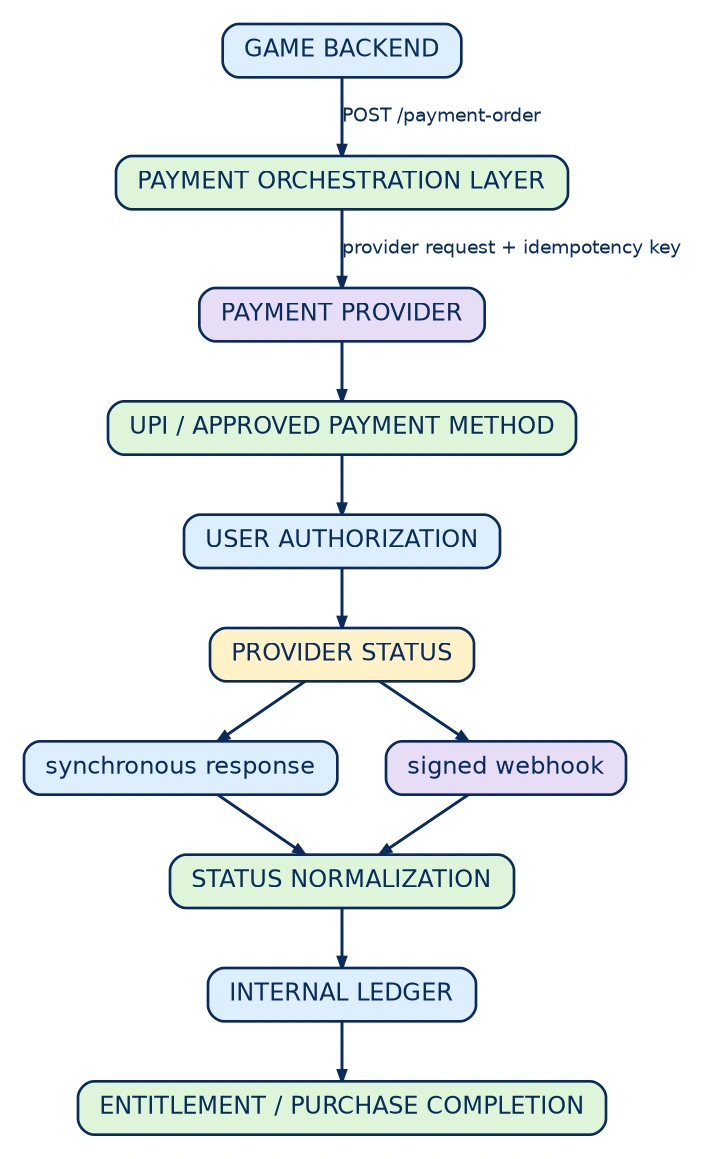
Never grant a monetary entitlement solely because the client device says the payment succeeded. The API is only one layer of the broader payment processing relationship, which also includes acquiring, settlement, refunds, and provider controls.
The backend should validate the provider status.
Idempotency Is Mandatory
A user may tap twice, a bank or rail may respond late, and a payment network can produce asynchronous states that the application must handle correctly.
A network may retry.
A provider may send the same webhook multiple times.
Your system should be able to receive the same event repeatedly without posting money repeatedly.
A good transaction record includes:
internal order ID;
provider order ID;
payment ID;
user ID;
amount;
currency;
purpose;
status;
provider status;
created time;
last update;
settlement reference;
refund reference; and
idempotency key.
Pending Transactions
Gaming products often create user frustration when money is debited but the game does not immediately receive confirmation.
Build a clear pending-state machine:
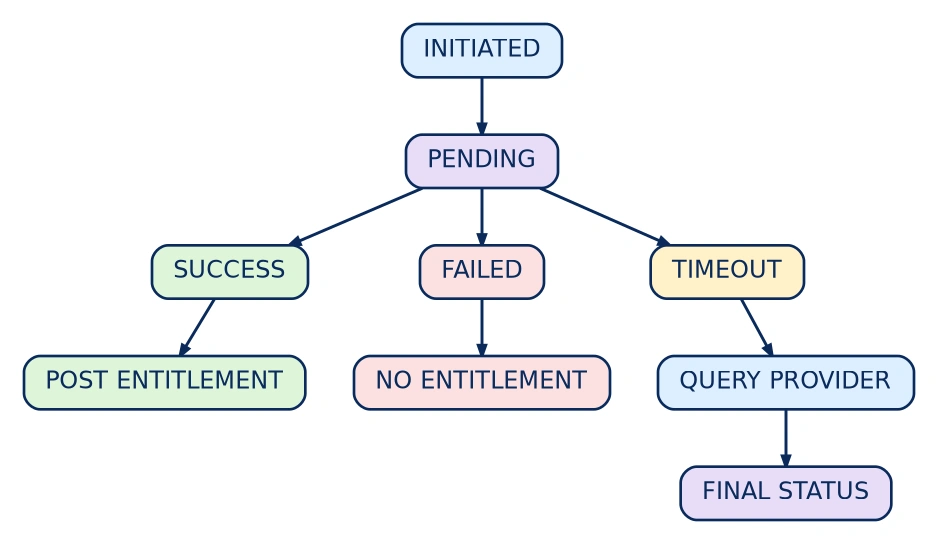
Customer support should see the same transaction state that finance sees.
Payout API Architecture
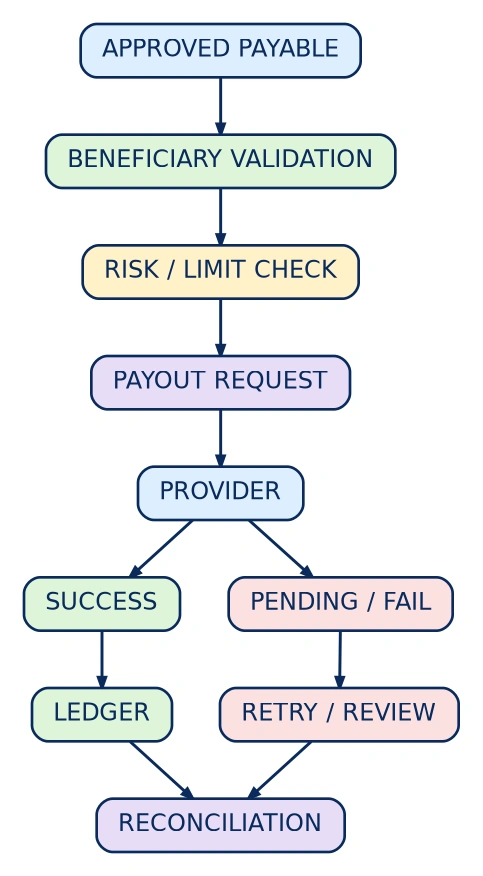
Do not permit a frontend to call the payout provider directly.
Security and Operational Controls
At minimum:
keep secrets server-side;
use scoped API keys where available;
verify webhook signatures;
IP allowlist where appropriate;
rotate credentials;
use maker/checker for sensitive manual payouts;
log administrative actions;
maintain replay protection;
enforce idempotency;
encrypt sensitive data;
minimize payment data storage;
monitor abnormal velocity; and
maintain provider failover plans.
Reconciliation
The API integration is not finished until finance can answer:
Does the provider's view of money equal our view of money, and does the bank settlement equal the provider's view?
Daily reconciliation should compare:
provider transaction data; and
bank settlement.
Exceptions should become cases, not spreadsheet mysteries.
Related India Gaming Payment Topics
Commercial provider selection belongs in Payment Gateway for Gaming Apps in India. For very large transaction counts and liquidity planning, use High-Volume Small-Ticket Gaming Payments in India.
FAQ
Should the mobile app store the payment provider secret key?
No. Sensitive provider credentials should remain on controlled server-side infrastructure.
Can I trust a success message on the phone?
Use authoritative provider/server verification and webhook/status handling. Client-side success alone is insufficient for financial ledger posting.
How should duplicate webhooks be handled?
Use the provider event ID/payment ID plus idempotent state-transition logic so replayed events do not post duplicate value.
Do I need a separate payout API?
Often yes. Pay-in acceptance and outbound disbursement may be separate provider products with separate underwriting.
Request an India Gaming Payments Feasibility Assessment
Do not start with, “Who can give me Paytm, PhonePe, Google Pay, UPI or a wallet?”
Start with the transaction.
Send us:
the exact game or product type;
whether a user pays to participate, accesses by subscription, or places any stake;
whether a user can receive cash, transferable value, redeemable credits, tokens, or other winnings;
whether the game has an OGAI determination or registration;
the operating entity and country of incorporation;
whether there is an Indian entity;
required pay-in methods;
required payout methods;
average and maximum ticket size;
expected transactions per day and monthly value;
whether funds belong to the business or to users/third parties;
settlement currency and desired settlement country;
any cross-border treasury or stablecoin requirement; and
a simple flow-of-funds diagram.
We will separate the legal-classification issue from the payments issue, identify the infrastructure that may be supportable, and determine whether there is a credible provider-introduction path.