
Low Ticket Size Does Not Mean Low Complexity
Gaming payment profiles often look simple at the individual transaction level:
₹500;
₹750;
₹1,000;
occasionally ₹1,500–₹2,500.
But at high frequency, operational risk becomes the dominant issue.
A one-percent exception rate across a very large transaction population can produce a large customer-service and reconciliation burden.
Before scaling, the business needs both:
a legally supportable gaming/payment model; and
an architecture designed for transaction volume.
The High-Volume Control Loop
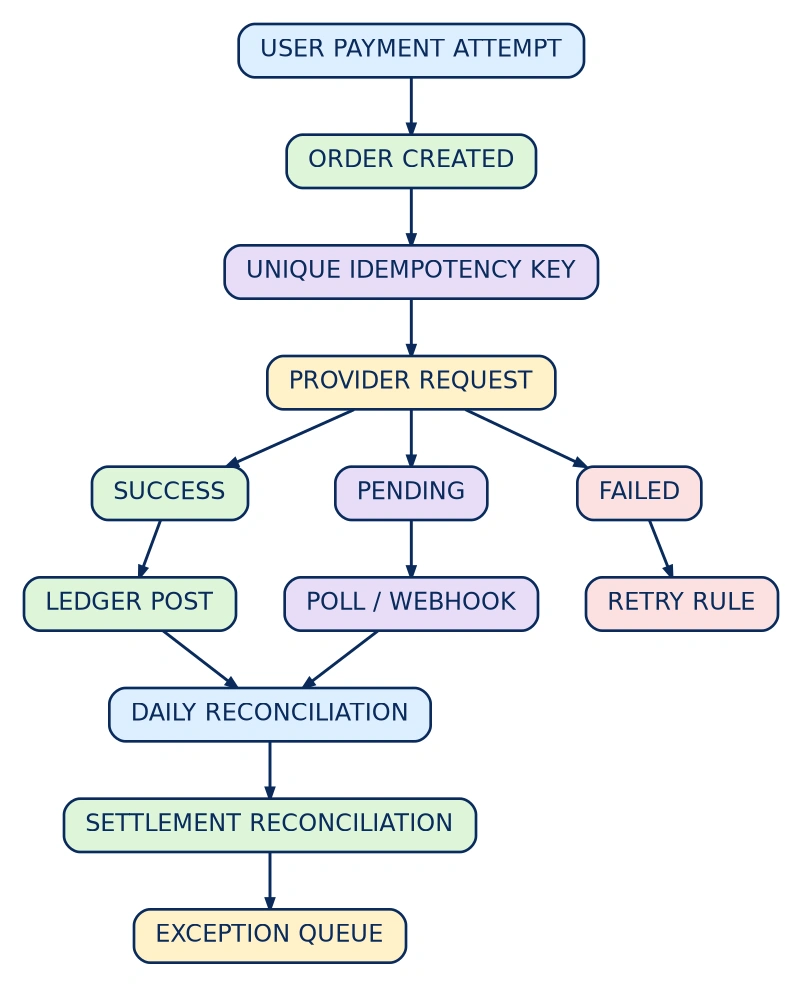
This is not merely software hygiene. It is a financial-control system.
Metrics That Matter
At scale, measure:
authorization/success rate;
pending rate;
failure rate by bank/provider;
duplicate-payment rate;
timeout rate;
refund rate;
payout failure rate;
average ticket;
peak TPS;
daily value;
daily transaction count;
settlement variance;
unreconciled items;
fraud rate;
support contacts per 1,000 payments; and
provider downtime.
Do not judge a provider solely on headline MDR. At scale, differences in payment network behavior, status handling, and settlement timing can matter as much as the quoted rate.
Provider Capacity and Commercial Terms
A serious payment processing provider discussion should disclose expected:
daily transactions;
peak-hour transactions;
daily value;
monthly value;
average ticket;
maximum ticket;
pay-in/payout ratio;
refund behavior;
seasonality;
expected growth; and
integration modes.
The provider can then evaluate limits, risk controls and commercial pricing.
Hiding volume until after onboarding is a poor way to build a stable relationship.
Reconciliation Architecture
At minimum, reconcile three ledgers:
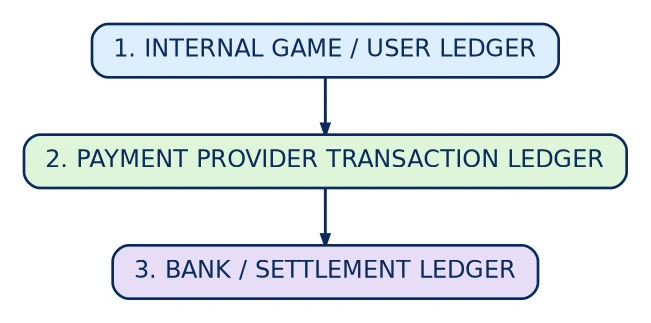
Every monetary event should be traceable across all three.
A game balance should never be treated as proof that external money actually settled.
Payout Liquidity
High-volume gaming can create a mismatch between:
incoming payment timing;
provider settlement timing;
outgoing prize/refund timing; and
bank availability.
Build a liquidity forecast.
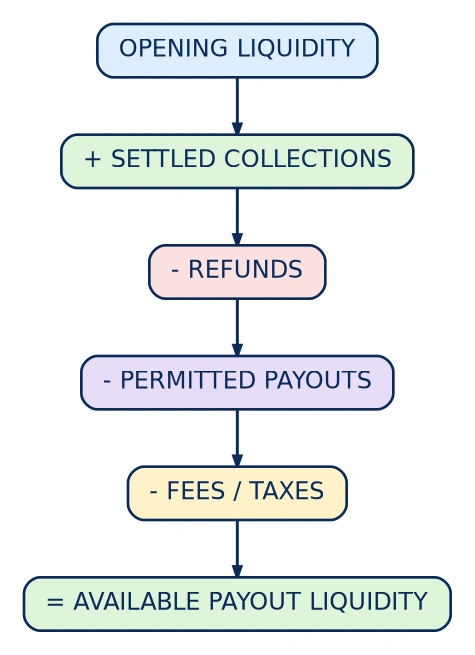
The business should know this number continuously.
Use Cases
Mass-Market Social Game
High user count, small digital purchases, no cash wagering.
E-Sports Platform
Large tournament participation volume and scheduled prize obligations.
Promotional Campaign
Large number of permitted reward/refund transactions over a short period.
Related India Gaming Payment Topics
Provider selection is covered in Payment Gateway for Gaming Apps in India, while webhook, idempotency, and ledger implementation belong in Gaming Payment API Integration in India.
FAQ
Is ₹500–₹1,000 a normal technical profile for digital gaming payments?
It is a plausible small-ticket profile, but provider suitability depends on the actual game, user base, transaction count and risk—not merely ticket size.
Should I use multiple providers for high volume?
For a permitted business, redundancy can improve resilience. Routing should be transparent and approved, not used to circumvent limits or risk policies.
What is the most important implementation control?
Accurate idempotent ledger posting plus end-to-end reconciliation. Without that, duplicate callbacks and pending transactions can become financial losses.
Can payouts happen before collections settle?
That is a treasury/liquidity decision and may be constrained by provider/account rules. If the business advances its own funds, the accounting should show that clearly.
Request an India Gaming Payments Feasibility Assessment
Do not start with, “Who can give me Paytm, PhonePe, Google Pay, UPI or a wallet?”
Start with the transaction.
Send us:
the exact game or product type;
whether a user pays to participate, accesses by subscription, or places any stake;
whether a user can receive cash, transferable value, redeemable credits, tokens, or other winnings;
whether the game has an OGAI determination or registration;
the operating entity and country of incorporation;
whether there is an Indian entity;
required pay-in methods;
required payout methods;
average and maximum ticket size;
expected transactions per day and monthly value;
whether funds belong to the business or to users/third parties;
settlement currency and desired settlement country;
any cross-border treasury or stablecoin requirement; and
a simple flow-of-funds diagram.
We will separate the legal-classification issue from the payments issue, identify the infrastructure that may be supportable, and determine whether there is a credible provider-introduction path.