
The Gateway Is Not the First Decision
When a gaming company says:
We need a payment gateway in India.
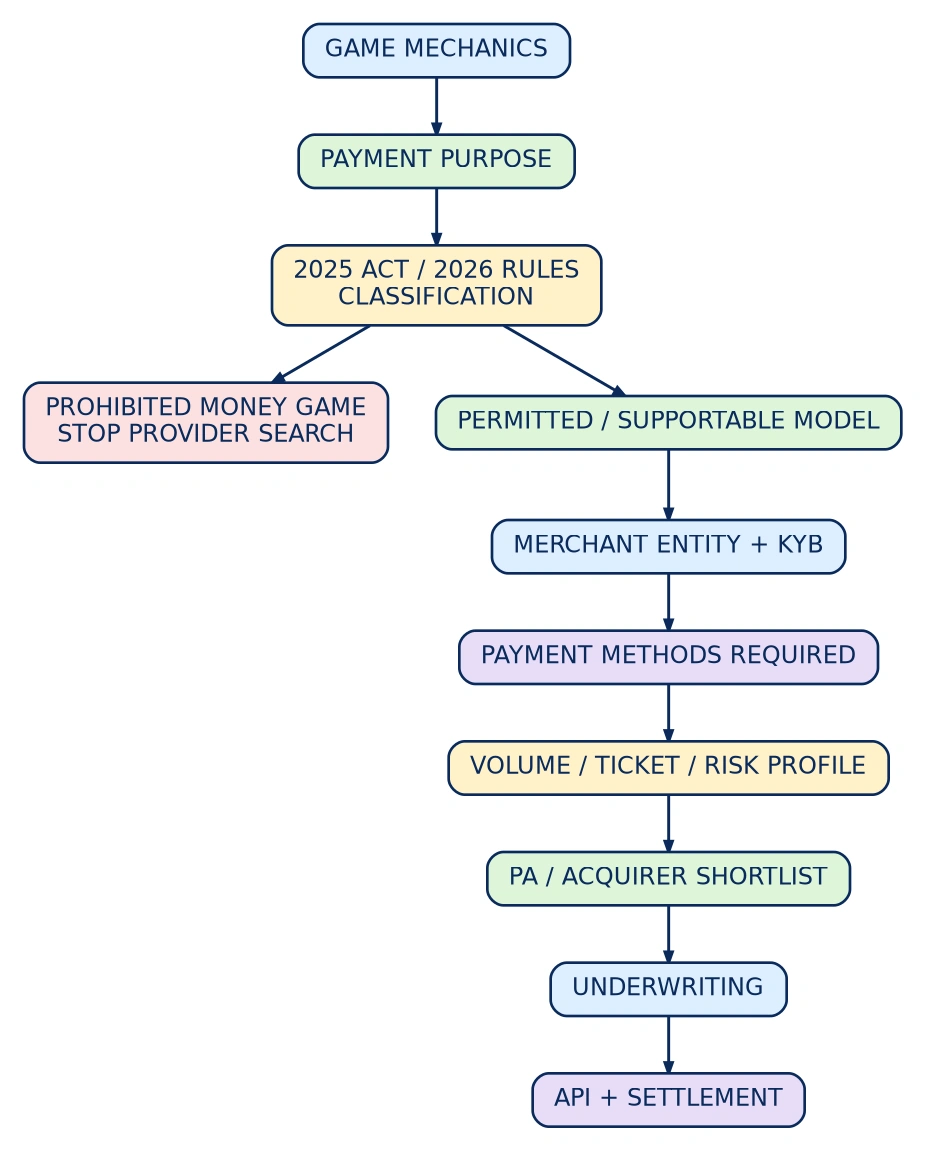
there are really four questions:
Is the game legally processable?
What entity will be the merchant?
Which payment methods are required?
Which regulated provider will underwrite that exact model?
A gateway can be the technical interface. A payment aggregator may additionally handle merchant funds and settlement. The bank/acquirer remains central to merchant acceptance.
The right provider search begins only after the gaming activity is accurately classified.
Payment Provider Selection Flow
What Providers Need to Underwrite
Gaming is not an industry where a one-line merchant description is sufficient.
A strong onboarding file should include:
product description;
screenshots or demo access;
game rules;
monetization;
user journey;
whether value can be withdrawn;
whether rewards can be transferred or monetized;
legal opinion/classification support where needed;
OGAI status;
corporate records;
UBOs/directors;
policies;
transaction profile;
historical processing;
fraud and refund metrics;
bank account;
settlement requirement; and
all countries served.
This is where many commercially viable merchants fail: they approach the provider before the story is complete.
Payment Gateway vs. Payment Aggregator vs. Acquirer
Use the terms carefully.
Payment gateway: primarily transmits payment instructions/data and provides technical integration.
Payment aggregator: contracts with merchants and may collect/settle merchant funds within the regulated framework.
Acquiring bank: provides merchant acceptance infrastructure and settlement relationships. The broader payment processing stack determines how gateway, acquirer, payment method, and settlement responsibilities fit together.
UPI app: consumer-facing application used by the payer; not a substitute for merchant acquiring.
For a gaming operator, the provider stack may contain several of these parties.
A “High-Risk Gateway” Is Not a Legal Exception
Gaming is often called high-risk in the acquiring industry.
That does not mean every legally prohibited gaming product can be accepted by a specialist high-risk provider.
“High-risk but permitted” and “prohibited” are different categories.
A useful provider search targets:
providers whose risk policy supports the permitted gaming model and whose regulated banking/acquiring relationships are willing to settle it.
Commercial Selection Criteria
For a permitted gaming app, compare providers on:
UPI availability;
supported integration modes;
other local payment methods;
payout APIs;
settlement cycle;
reserves/security requirements;
transaction limits;
pricing;
refund mechanics;
reconciliation files/APIs;
webhook quality;
uptime;
fraud tools;
dispute support;
sub-merchant rules;
foreign ownership tolerance;
permitted settlement accounts; and
gaming-sector policy.
Price should not be the first filter. Stability and permission are worth more than a low MDR on a relationship that will be terminated. For card acceptance or specialized acquiring, the underlying merchant account relationship can be just as important as the gateway layer.
Use Cases
Indian Social Gaming Company
Needs UPI + cards/other methods for subscriptions and digital access.
E-Sports Operator
Needs participation-fee collection plus a separate prize-payout workflow.
Foreign Game Publisher
Needs India collections but lacks an Indian entity; requires entity and settlement feasibility before processor sourcing.
Large Existing Merchant Changing Providers
Needs migration planning, dual processing during transition, reconciliation mapping and settlement continuity.
Related India Gaming Payment Topics
Once a provider is selected, Gaming Payment API Integration in India covers webhooks, idempotency, and reconciliation. If UPI is the primary collection rail, UPI for Gaming Apps in India covers merchant acquiring and UPI-specific onboarding.
FAQ
Which is the best payment gateway for gaming in India?
There is no useful answer without the exact game model. A provider may support digital games but refuse cash-prize gaming, or support e-sports only after classification/registration review.
Can an offshore gateway process Indian users?
That does not remove Indian gaming, payments, banking, foreign-exchange or provider-risk considerations. The full flow must be evaluated.
Can I have more than one payment provider?
For a permitted business, redundancy can be sensible, but every provider must onboard the real merchant/activity. Multi-processing is not a method for hiding volume or prohibited activity.
What should I send before you look for a provider?
Send the game mechanics, entity chart, payment flow, OGAI status, transaction profile, required methods, settlement destination and payout requirements.
Request an India Gaming Payments Feasibility Assessment
Do not start with, “Who can give me Paytm, PhonePe, Google Pay, UPI or a wallet?”
Start with the transaction.
Send us:
the exact game or product type;
whether a user pays to participate, accesses by subscription, or places any stake;
whether a user can receive cash, transferable value, redeemable credits, tokens, or other winnings;
whether the game has an OGAI determination or registration;
the operating entity and country of incorporation;
whether there is an Indian entity;
required pay-in methods;
required payout methods;
average and maximum ticket size;
expected transactions per day and monthly value;
whether funds belong to the business or to users/third parties;
settlement currency and desired settlement country;
any cross-border treasury or stablecoin requirement; and
a simple flow-of-funds diagram.
We will separate the legal-classification issue from the payments issue, identify the infrastructure that may be supportable, and determine whether there is a credible provider-introduction path.
Regulatory References
Press Information Bureau — A New Era of Online Gaming Governance, 30 April 2026
FIU-IND — Downloads and VDA Service Provider AML/CFT Guidance
Regulatory status note: This page reflects the legal and payment-framework position reviewed on 17 September 2026. Product classification, payment-system rules, and provider policies can change and should be re-checked for a live implementation.