
UPI Is a Merchant-Acquiring Question
A common request is:
Connect our game to PhonePe, Google Pay, Paytm and BHIM.
The better commercial question is:
Who will onboard the merchant for UPI, under what merchant classification, for what exact gaming activity?
NPCI explains that a merchant accepts UPI by partnering with an acquiring bank. The acquiring side supplies the merchant UPI infrastructure and merchant identification, and assigns the merchant category code.
That means a gaming company should not build its strategy around individual payer apps.
The architecture is:
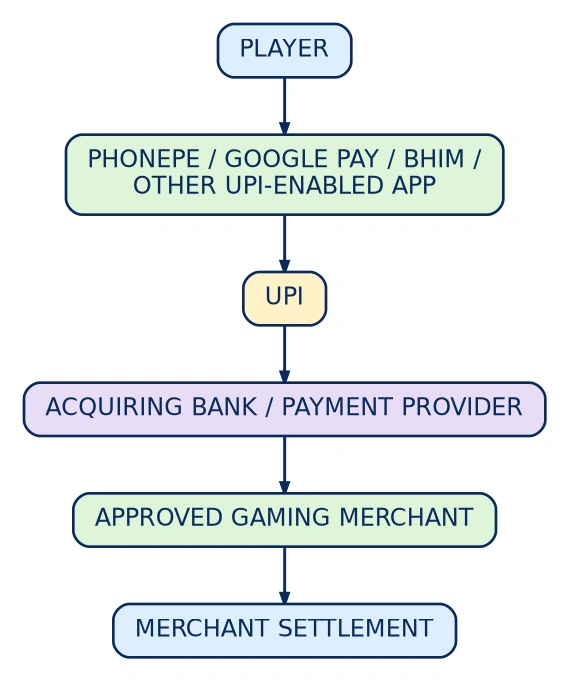
The payer may choose among compatible UPI apps. The harder issue is whether the merchant itself is eligible for onboarding.
The Gaming Classification Comes First
Since 1 May 2026, India's online-gaming framework makes a fundamental distinction between prohibited online money games and permitted categories such as eligible e-sports and online social games.
If the user pays or deposits money or another stake in expectation of winnings, the operator must not assume that “skill-based” mechanics preserve UPI eligibility.
For a prohibited online money game, Section 7 of the 2025 Act creates a payment-facilitation prohibition.
For a permitted model, UPI may become a normal merchant-onboarding question.
Typical UPI Integration for a Permitted Gaming Product
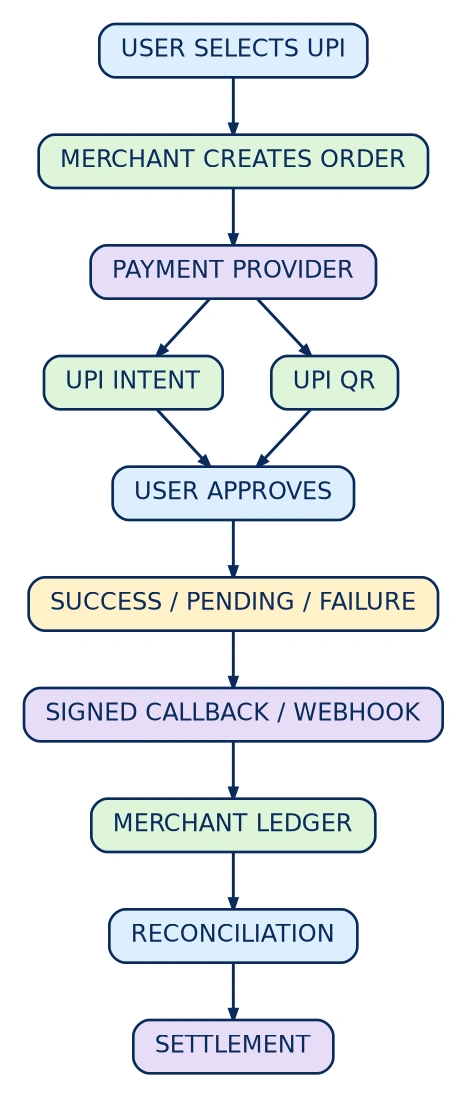
A production integration should handle duplicate callbacks, pending transactions, late success, refunds and settlement-file matching. UPI should be treated as part of the underlying payment network infrastructure, with the merchant's acquiring relationship determining how that rail is accessed.
What the Acquirer Will Care About
A gaming merchant should expect scrutiny of:
the exact game;
URL/app;
legal entity;
beneficial owners;
game classification;
OGAI determination/registration where applicable;
whether users stake money or value;
whether rewards can be withdrawn or monetized;
terms and conditions;
refund policy;
age and user-safety controls;
projected transaction count/value;
average and maximum ticket;
payout model;
fraud profile; and
merchant category.
The merchant's application, website and actual transaction behavior must tell the same story.
UPI Apps vs. Wallets
Paytm, PhonePe and other brands may provide multiple financial products. Do not assume that every brand is simply a “wallet.” The broader distinctions between stored value, payment apps, and wallet acceptance are covered in our digital wallets guide.
Likewise, Google Pay and BHIM should not be treated as acquiring banks merely because a consumer can use them to initiate UPI payments.
For merchant strategy, separate:
payment rail — UPI;
consumer app — payer interface;
acquirer/payment provider — merchant onboarding and processing relationship;
merchant bank account — settlement destination; and
payout provider — outbound disbursements, if required.
That decomposition prevents a large amount of wasted provider outreach.
Use Cases
Social Gaming Subscription
A user pays for access to a non-wager social game.
Potential architecture: UPI pay-in → merchant settlement → ordinary corporate use of funds.
Digital Game Purchase
A user buys a non-redeemable digital feature or access entitlement.
Potential architecture: UPI pay-in → digital entitlement → merchant settlement.
E-Sports Participation Fee
A recognized/registered e-sport charges a permissible participation or administration fee.
Potential architecture: classification/registration → UPI merchant processing → settlement → separately controlled prize-payment workflow.
Related India Gaming Payment Topics
UPI is the inbound collection rail. If the operating model also requires outbound disbursements, Gaming Payouts in India covers beneficiary controls, payout funding, and reconciliation. For the complete classification and payment-architecture picture, use Gambling & Sports Betting Pay-Ins and Pay-Outs in India.
FAQ
Is UPI itself a wallet?
No. UPI is a payment system that supports bank-account-based payments. Wallet/PPI products are a separate category, although eligible full-KYC PPIs can interoperate with UPI under the applicable framework.
Does a merchant need a UPI ID?
The acquiring/payment setup will provide the merchant configuration appropriate to the integration, which can include merchant identifiers and UPI acceptance details.
Can a gaming merchant use UPI Collect?
NPCI lists Collect among available integration modes, but the actual mode offered to a merchant depends on the acquiring/provider relationship and current product rules.
Is UPI available 24/7?
UPI payments operate on a 24/7 basis. Merchant settlement mechanics depend on the provider agreement and payment structure.
Will an acquirer onboard any “gaming” merchant?
No. The provider will examine the actual product and regulatory status, not just the word “gaming.”
Request an India Gaming Payments Feasibility Assessment
Do not start with, “Who can give me Paytm, PhonePe, Google Pay, UPI or a wallet?”
Start with the transaction.
Send us:
the exact game or product type;
whether a user pays to participate, accesses by subscription, or places any stake;
whether a user can receive cash, transferable value, redeemable credits, tokens, or other winnings;
whether the game has an OGAI determination or registration;
the operating entity and country of incorporation;
whether there is an Indian entity;
required pay-in methods;
required payout methods;
average and maximum ticket size;
expected transactions per day and monthly value;
whether funds belong to the business or to users/third parties;
settlement currency and desired settlement country;
any cross-border treasury or stablecoin requirement; and
a simple flow-of-funds diagram.
We will separate the legal-classification issue from the payments issue, identify the infrastructure that may be supportable, and determine whether there is a credible provider-introduction path.
Regulatory References
Press Information Bureau — A New Era of Online Gaming Governance, 30 April 2026
FIU-IND — Downloads and VDA Service Provider AML/CFT Guidance
Regulatory status note: This page reflects the legal and payment-framework position reviewed on 17 September 2026. Product classification, payment-system rules, and provider policies can change and should be re-checked for a live implementation.