
“It Is Skill-Based” Is No Longer the Payment Answer
Many Indian gaming businesses historically built their regulatory and processor narrative around one sentence:
This is a game of skill. Under the national online-gaming framework now in force, that statement by itself is insufficient.
The definition of an online money game expressly reaches games based on:
skill;
chance; or
both,
when the statutory money/stake and expected-winnings characteristics are present.
Therefore, the payment analysis has to examine economic mechanics, not marketing terminology.
The Monetization Test
Ask these questions in order:
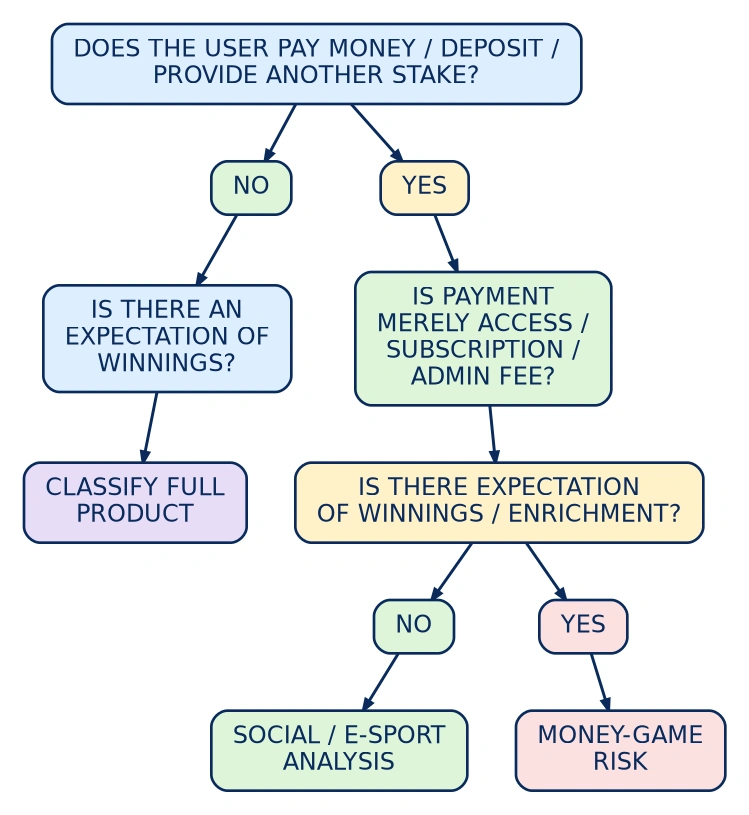
Also examine whether credits, tokens, virtual assets or rewards can be:
redeemed;
sold;
transferred;
converted;
used outside the game; or
otherwise monetized.
Substance controls.
Skill-Based Does Not Mean Payment-Provider Approved
Even when a game is not a prohibited online money game, a provider may still decline it after its own risk assessment based on:
internal risk policy;
age/user-safety concerns;
prize mechanics;
refund/chargeback exposure;
fraud;
foreign ownership;
high volume;
unclear classification;
weak documentation; or
banking partner restrictions.
Legal permissibility and provider appetite are two separate gates.
How a Skill-Oriented Business Can Become Easier to Underwrite
The clearest file shows:
what the user pays for;
what the user receives;
whether the payment affects eligibility for a prize;
whether any item of value is staked;
whether any reward is cash/redeemable/transferable;
the operator's revenue model;
OGAI determination/registration status;
user safety controls;
terms and conditions; and
exact payment and payout flows.
If the game is truly a social game or e-sport, the economics should be demonstrably consistent with that classification. Where card acquiring is also required, the operator may separately need a specialist merchant account that accepts the approved activity.
Use Cases
Paid Puzzle App With No Cash Winnings
User pays subscription/access. The product is assessed as a social/digital entertainment model, then payment onboarding is pursued.
Tournament-Based E-Sport
A participation/admin fee may be possible within the statutory e-sports model, but the determination/registration process and provider due diligence are part of the architecture.
Cash-Prize Skill Contest Funded by Entry Stakes
Calling the underlying contest “skill” does not by itself remove online-money-game risk. This requires classification before any payment-provider search.
Related India Gaming Payment Topics
A product that qualifies as e-sport should move to the E-Sports Payments in India framework. A non-wager recreational product should instead use the Online Social Gaming Payments in India model.
FAQ
Are all skill games prohibited in India?
No. The framework does not ban all online games involving skill. The important distinction is whether the product is an online money game or a permitted e-sport/social game.
Can a social game charge a subscription?
Potentially yes, provided the fee is an access/subscription charge rather than a stake or wager tied to expected winnings.
Is a virtual coin considered harmless because it is not INR?
Not necessarily. The statute's concept of “other stakes” and the Rules' determination factors make redeemability, transferability and economic value relevant.
Should we get classification before approaching a payment gateway?
For borderline gaming models, that can materially improve provider conversations and reduce the risk of onboarding under a misunderstood business model.
Request an India Gaming Payments Feasibility Assessment
Do not start with, “Who can give me Paytm, PhonePe, Google Pay, UPI or a wallet?”
Start with the transaction.
Send us:
the exact game or product type;
whether a user pays to participate, accesses by subscription, or places any stake;
whether a user can receive cash, transferable value, redeemable credits, tokens, or other winnings;
whether the game has an OGAI determination or registration;
the operating entity and country of incorporation;
whether there is an Indian entity;
required pay-in methods;
required payout methods;
average and maximum ticket size;
expected transactions per day and monthly value;
whether funds belong to the business or to users/third parties;
settlement currency and desired settlement country;
any cross-border treasury or stablecoin requirement; and
a simple flow-of-funds diagram.
We will separate the legal-classification issue from the payments issue, identify the infrastructure that may be supportable, and determine whether there is a credible provider-introduction path.
Regulatory References
Press Information Bureau — A New Era of Online Gaming Governance, 30 April 2026
FIU-IND — Downloads and VDA Service Provider AML/CFT Guidance
Regulatory status note: This page reflects the legal and payment-framework position reviewed on 17 September 2026. Product classification, payment-system rules, and provider policies can change and should be re-checked for a live implementation.