
The Best Payment Opportunity May Be the Non-Wager Game
India's 2025 Act does not prohibit all online gaming.
It expressly recognizes online social games.
The key is that the game is not structured around staking money or other value in expectation of winnings.
This creates a commercially important category for products that can use mainstream payment methods without introducing a wagering mechanic, including:
subscription games;
paid-access games;
educational games;
recreational games;
casual games;
digital-item purchases;
premium features; and
other non-wager monetization.
Social Game Monetization Architecture
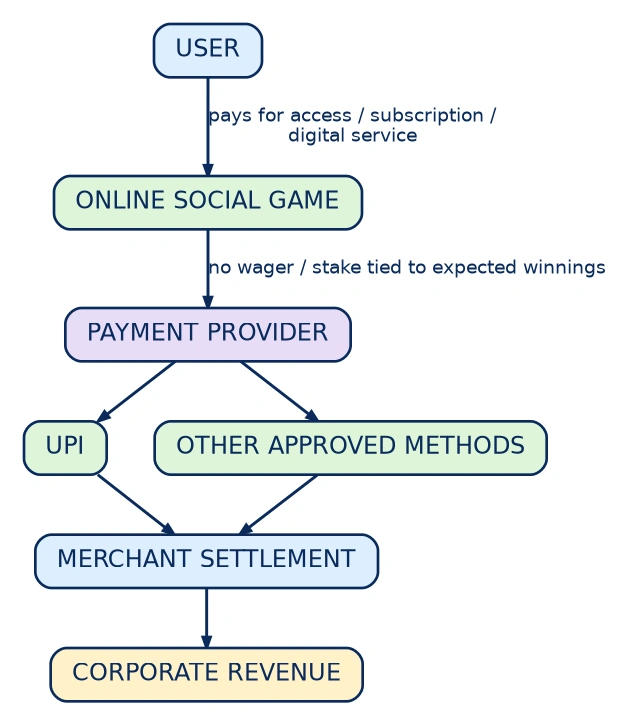
The economics should match the product description. For consumer payment choice, the operator can then evaluate appropriate digital wallet and UPI acceptance without changing the underlying product classification.
Subscription Fee vs. Stake
This distinction is central.
A fee looks more like a genuine access charge when:
the user buys access to the service;
the fee is not pooled as a wager;
paying more does not create a larger cash-winning opportunity;
the user does not expect the fee itself to generate winnings;
digital items are not cash-redeemable stakes; and
the platform's communications do not market the payment as a path to monetary enrichment.
Labels are not decisive. Mechanics are.
Digital Items and Virtual Currency
A social game can use internal digital items, but payment design becomes more sensitive when items can be:
transferred to other users;
sold;
cashed out;
exchanged externally;
converted into prizes; or
used as the economic stake for a contest.
If value can leave the closed game economy, classification should be reviewed carefully.
Provider Onboarding
For a straightforward social game, the payment processing provider file should still include:
app/game description;
user journey;
pricing;
virtual-item mechanics;
confirmation that there is no cash wagering;
reward mechanics;
refund policy;
age/user-safety controls;
terms;
entity/UBO documents;
volumes;
ticket sizes;
settlement account; and
A clear product is easier to underwrite.
Use Cases
Monthly Subscription Game
User pays a fixed monthly fee for access.
One-Time Premium Unlock
User buys permanent access to premium levels or features.
Cosmetic Digital Purchases
User buys non-cash-redeemable items that do not determine cash winnings.
Educational Game
School, parent or individual pays for access to learning/gameplay content.
Related India Gaming Payment Topics
For UPI merchant onboarding, use UPI for Gaming Apps in India. If the product has a contest, prize, or paid-participation mechanic close to the classification boundary, use Skill Gaming Payments in India.
FAQ
Can a social game charge money?
The statutory definition allows subscription or one-time access fees when they are not stakes/wagers and the game does not involve an expectation of winnings in the prohibited sense.
Can a social game give rewards?
Rewards require careful design. Redeemable, transferable or monetizable rewards can affect classification, especially if payment is tied to eligibility or expected enrichment.
Does a social game need OGAI registration?
The 2026 Rules do not make registration automatic for every social game; requirements can depend on notification, determination and the specific regulatory pathway. Current status should be checked before launch/onboarding.
Can a social game use UPI?
Potentially, subject to merchant/acquirer underwriting and correct classification.
Request an India Gaming Payments Feasibility Assessment
Do not start with, “Who can give me Paytm, PhonePe, Google Pay, UPI or a wallet?”
Start with the transaction.
Send us:
the exact game or product type;
whether a user pays to participate, accesses by subscription, or places any stake;
whether a user can receive cash, transferable value, redeemable credits, tokens, or other winnings;
whether the game has an OGAI determination or registration;
the operating entity and country of incorporation;
whether there is an Indian entity;
required pay-in methods;
required payout methods;
average and maximum ticket size;
expected transactions per day and monthly value;
whether funds belong to the business or to users/third parties;
settlement currency and desired settlement country;
any cross-border treasury or stablecoin requirement; and
a simple flow-of-funds diagram.
We will separate the legal-classification issue from the payments issue, identify the infrastructure that may be supportable, and determine whether there is a credible provider-introduction path.
Regulatory References
Press Information Bureau — A New Era of Online Gaming Governance, 30 April 2026
FIU-IND — Downloads and VDA Service Provider AML/CFT Guidance
Regulatory status note: This page reflects the legal and payment-framework position reviewed on 17 September 2026. Product classification, payment-system rules, and provider policies can change and should be re-checked for a live implementation.