
E-Sports Is Not the Same as Online Betting
India's national framework expressly recognizes e-sports as a distinct category.
The statutory concept allows participation fees for entry or administrative costs and performance-based prize money, while excluding bets, wagers and other stakes.
The 2026 Rules add a determination/registration framework for e-sports.
That creates a real payment opportunity—but it still requires careful product and provider onboarding.
E-Sports Payment Model
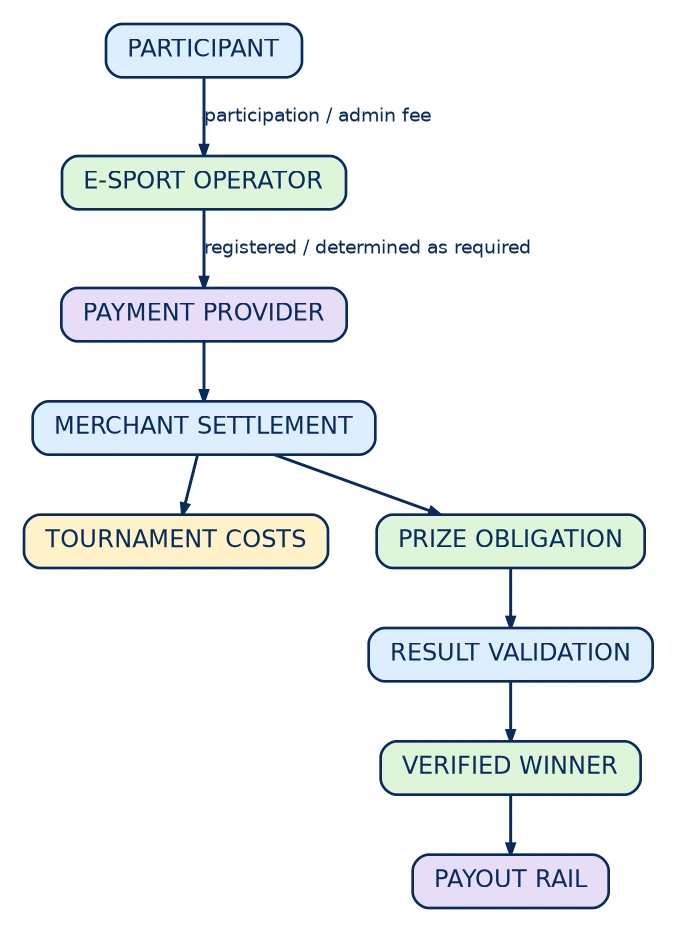
The commercial file should be able to show that the fee is not a disguised wager.
Registration and Determination Matter
For e-sports, the 2026 Rules establish a formal regulatory path through the Online Gaming Authority of India.
Provider onboarding should therefore include the relevant:
determination;
registration certificate;
recognition status under the applicable sports framework;
game rules;
tournament format;
fee calculation;
prize structure; and
user safety/grievance controls.
A payment provider should not have to infer whether a competition is actually e-sport.
Pay-In Requirements
Common requirements may include a compliant payment processing relationship able to support:
UPI;
cards or other provider-supported methods;
QR/Intent flows;
entry-order references;
team/participant attribution;
refunds for canceled events;
settlement reporting; and
bulk reconciliation.
Each tournament should have a financial identity in the ledger, and the selected rails should be mapped against the provider's supported payment networks.
Prize Payout Requirements
A prize payout process should connect:
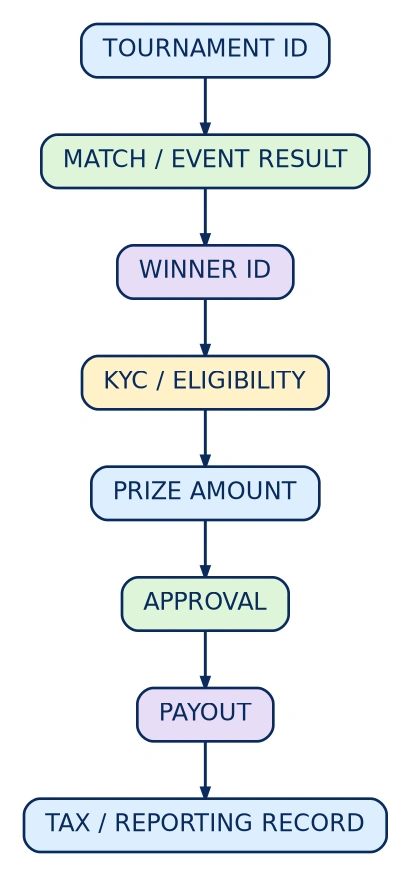
The product team, finance team and payout ledger should agree on the same winner and amount.
Use Cases
Professional Tournament Organizer
Collects participant/admin fees and pays performance-based prizes.
E-Sports Platform
Hosts multiple tournament organizers and needs a more complex merchant/sub-merchant analysis.
International E-Sports Brand Entering India
Needs classification/registration plus local payment acceptance and permitted cross-border corporate settlement.
Related India Gaming Payment Topics
UPI collection mechanics are covered in UPI for Gaming Apps in India, while the outbound prize leg is covered in Gaming Payouts in India.
FAQ
Can an e-sports operator charge an entry fee in India?
The Act recognizes participation fees for entry/admin costs within its e-sports definition, subject to the complete statutory and registration framework. The fee cannot be a bet/wager/stake.
Can prize money be paid?
Performance-based prize money can fit the e-sports framework. Provider approval, eligibility controls and applicable tax/reporting still have to be addressed.
Is every online competitive game automatically an e-sport?
No. The formal framework, recognition and determination/registration requirements matter.
Can an overseas e-sports company collect India fees?
Potentially, but the foreign-operator structure, India regulatory status, merchant onboarding and settlement path require review.
Request an India Gaming Payments Feasibility Assessment
Do not start with, “Who can give me Paytm, PhonePe, Google Pay, UPI or a wallet?”
Start with the transaction.
Send us:
the exact game or product type;
whether a user pays to participate, accesses by subscription, or places any stake;
whether a user can receive cash, transferable value, redeemable credits, tokens, or other winnings;
whether the game has an OGAI determination or registration;
the operating entity and country of incorporation;
whether there is an Indian entity;
required pay-in methods;
required payout methods;
average and maximum ticket size;
expected transactions per day and monthly value;
whether funds belong to the business or to users/third parties;
settlement currency and desired settlement country;
any cross-border treasury or stablecoin requirement; and
a simple flow-of-funds diagram.
We will separate the legal-classification issue from the payments issue, identify the infrastructure that may be supportable, and determine whether there is a credible provider-introduction path.
Regulatory References
Press Information Bureau — A New Era of Online Gaming Governance, 30 April 2026
FIU-IND — Downloads and VDA Service Provider AML/CFT Guidance
Regulatory status note: This page reflects the legal and payment-framework position reviewed on 17 September 2026. Product classification, payment-system rules, and provider policies can change and should be re-checked for a live implementation.