
No Indian Company Does Not Mean No Indian Regulation
A foreign gaming operator may say:
We are incorporated in Dubai, Singapore, Europe or elsewhere. We only need an API to collect from India.
That does not answer the regulatory or payment question.
India's 2025 online-gaming law has extraterritorial application to covered services offered within India.
The payments side then adds separate questions about:
merchant onboarding;
entity eligibility;
foreign exchange;
taxes;
beneficial ownership;
payment aggregator/acquirer policy;
game classification; and
provider risk appetite.
The Foreign-Operator Decision Tree
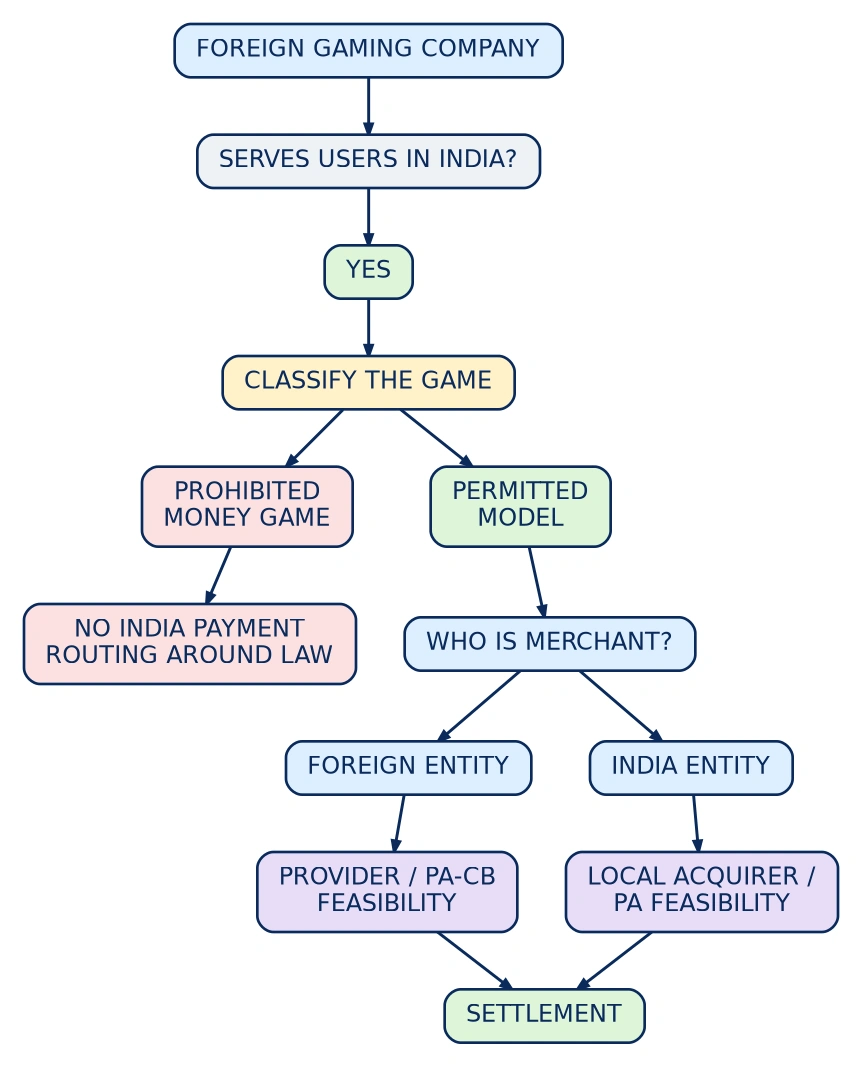
The specific structure depends on provider capabilities and applicable Indian payments/foreign-exchange rules.
Merchant of Record Matters
The entity presented to the payment provider should be the entity that genuinely contracts with the user and earns the revenue, unless a legitimate merchant-of-record structure is being used.
Provider questions will include:
Which company owns the app?
Which company contracts with users?
Which company issues the invoice/receipt?
Which company bears refund liability?
Which company owns the game IP?
Which company receives settlement?
Is there a local subsidiary?
Why is money being settled offshore?
What does the user believe they are buying?
These answers should align.
When an Indian Entity May Help
An Indian subsidiary can make some operational elements easier, but incorporation is not a magic solution. Where settlement requires a dedicated business account, the distinction between pooled infrastructure and named accounts should also be understood.
It may help with:
local merchant contracts;
Indian bank accounts;
local tax administration;
vendor relationships;
local staff; and
provider onboarding.
But if the underlying game is prohibited, an Indian subsidiary does not make the transaction processable.
Cross-Border Settlement Is a Separate Leg
For lawful merchant revenue, map domestic collection and cross-border payment treasury separately.
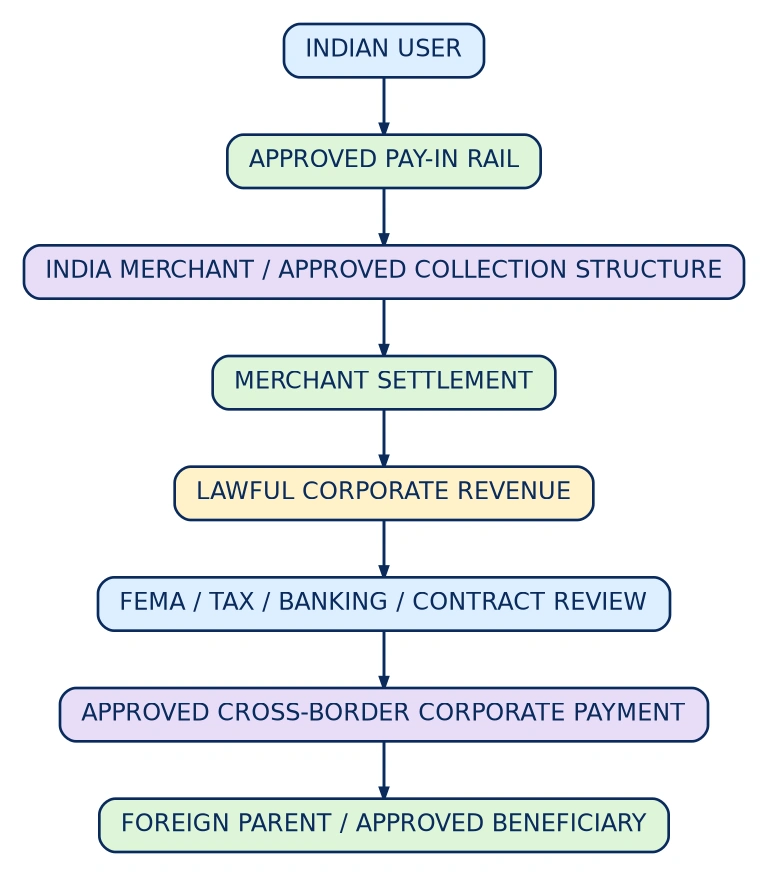
Do not blur user funds and corporate treasury.
Provider Pack for a Foreign Operator
Prepare:
foreign incorporation documents;
UBO/director data;
ownership chart;
Indian entity documents if any;
app and game URLs;
India user terms;
game classification;
OGAI status;
India revenue model;
payment methods;
projected India volume;
average/max ticket;
settlement country/currency;
intercompany agreements;
tax/FEMA advice where relevant;
bank account details;
payout requirements; and
A provider should be able to see exactly where India ends and the foreign treasury leg begins.
Related India Gaming Payment Topics
If the foreign operator plans to use USDT or USDC only after lawful merchant revenue has settled, Stablecoin Settlement for India Gaming Businesses covers that separate treasury leg.
FAQ
Can a foreign company get UPI acceptance in India directly?
Possibly under specific provider/cross-border structures, but it is provider- and activity-dependent. Gaming classification comes first.
Do we have to open an Indian company?
Not always for every type of lawful digital commerce, but gaming-sector and provider requirements may make a local entity relevant. The answer should be determined from the flow, not assumed.
Can an offshore company process online money-game transactions because it has no Indian office?
No such assumption should be made. The Act is expressly drafted to reach covered services offered within India from outside India.
Can India revenue be settled to a foreign account?
Lawful cross-border merchant settlement may be possible within applicable payment/FEMA/tax rules and provider structures. It should be designed as a disclosed, documented leg.
Request an India Gaming Payments Feasibility Assessment
Do not start with, “Who can give me Paytm, PhonePe, Google Pay, UPI or a wallet?”
Start with the transaction.
Send us:
the exact game or product type;
whether a user pays to participate, accesses by subscription, or places any stake;
whether a user can receive cash, transferable value, redeemable credits, tokens, or other winnings;
whether the game has an OGAI determination or registration;
the operating entity and country of incorporation;
whether there is an Indian entity;
required pay-in methods;
required payout methods;
average and maximum ticket size;
expected transactions per day and monthly value;
whether funds belong to the business or to users/third parties;
settlement currency and desired settlement country;
any cross-border treasury or stablecoin requirement; and
a simple flow-of-funds diagram.
We will separate the legal-classification issue from the payments issue, identify the infrastructure that may be supportable, and determine whether there is a credible provider-introduction path.
Regulatory References
Press Information Bureau — A New Era of Online Gaming Governance, 30 April 2026
FIU-IND — Downloads and VDA Service Provider AML/CFT Guidance
Regulatory status note: This page reflects the legal and payment-framework position reviewed on 17 September 2026. Product classification, payment-system rules, and provider policies can change and should be re-checked for a live implementation.