
“We Need Every Wallet” Usually Means Something Else
A gaming business may produce a list of consumer brands and say this is a wallet-integration problem. The first distinction is whether the operator actually needs UPI, a stored-value PPI, or another form of wallet acceptance.
Any one of these will do.
That list may mix:
UPI apps;
prepaid wallets/PPIs;
bank apps;
legacy products;
discontinued or transformed brands; and
payment gateways.
The first task is therefore normalization.
Do not build a payment strategy around a stale list of wallet names.
Build it around the required capability.
Capability Map
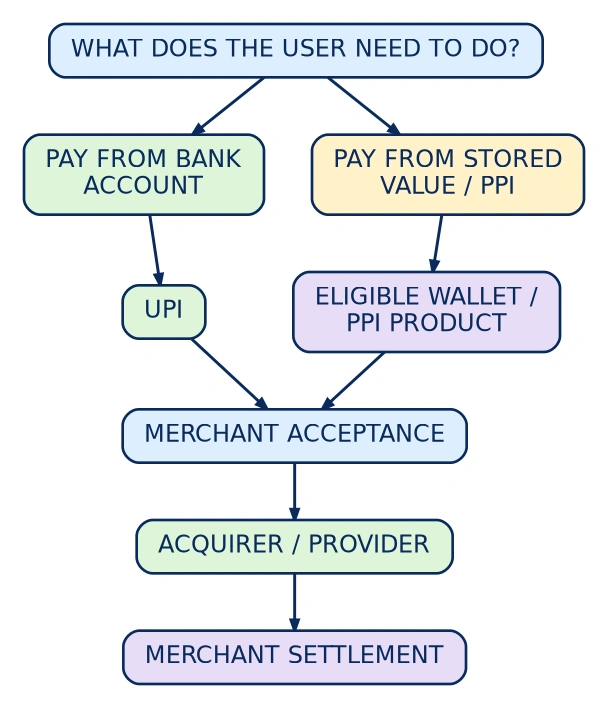
Many consumers can use a familiar app to make a UPI payment without the merchant holding a commercial contract with that app brand itself. The merchant-facing access point remains the relevant payment network and acquiring relationship.
UPI and PPI Interoperability
NPCI describes full-KYC prepaid payment instruments as capable of UPI interoperability under the applicable framework. The broader digital wallets category remains useful for understanding how stored-value products differ from account-to-account UPI payments.
That does not mean every wallet will onboard every gaming merchant.
The game/activity still has to be:
legally supportable;
within provider policy;
correctly classified;
correctly coded; and
commercially approved.
Why Legacy Wallet Lists Are Dangerous
India's consumer-payments market changes quickly.
A provider name that was commercially important several years ago may now:
operate a different product;
be integrated into another ecosystem;
no longer onboard merchants;
no longer offer the same wallet;
or be irrelevant compared with UPI.
For SEO, individual brand names can be useful as search language.
For actual implementation, current provider capabilities must be verified at the time of onboarding.
Merchant Acceptance Matters More Than Brand Coverage
The core requirement should be written like this:
We need a regulated provider able to onboard our permitted gaming model and accept mainstream Indian digital payment methods, with API access, clear settlement, refunds and high-volume support.
That statement is much more useful than:
We need Paytm.
Use Cases
Social Game
Needs broad consumer pay-in coverage for lawful subscriptions or purchases.
E-Sports
Needs approved participation-fee acceptance plus separate prize payouts.
Foreign Publisher
Needs local Indian payment acceptance while preserving transparent offshore settlement.
Related India Gaming Payment Topics
For UPI-specific merchant onboarding, use UPI for Gaming Apps in India. For processor selection and underwriting, use Payment Gateway for Gaming Apps in India.
FAQ
Are PhonePe and Google Pay wallets?
They are commonly described by consumers as payment apps, but merchant architecture should distinguish UPI functionality from regulated wallet/PPI products.
Do I need a direct contract with every app?
Not necessarily. UPI merchant acceptance is normally established through the acquiring/payment relationship.
Can a gaming operator accept prepaid-wallet funds?
Only if the specific merchant/activity is permitted and supported by the relevant PPI/provider program.
Why not create a page for every wallet brand?
That would create thin, overlapping pages and stale content. One wallet-category page plus the UPI page captures the commercial intent without unnecessary SEO cannibalization.
Request an India Gaming Payments Feasibility Assessment
Do not start with, “Who can give me Paytm, PhonePe, Google Pay, UPI or a wallet?”
Start with the transaction.
Send us:
the exact game or product type;
whether a user pays to participate, accesses by subscription, or places any stake;
whether a user can receive cash, transferable value, redeemable credits, tokens, or other winnings;
whether the game has an OGAI determination or registration;
the operating entity and country of incorporation;
whether there is an Indian entity;
required pay-in methods;
required payout methods;
average and maximum ticket size;
expected transactions per day and monthly value;
whether funds belong to the business or to users/third parties;
settlement currency and desired settlement country;
any cross-border treasury or stablecoin requirement; and
a simple flow-of-funds diagram.
We will separate the legal-classification issue from the payments issue, identify the infrastructure that may be supportable, and determine whether there is a credible provider-introduction path.