
China’s e-CNY is often grouped together with stablecoins because both are digital.
It is one of the guides in our China Payments section.
That comparison is superficial.
The e-CNY is part of China’s sovereign monetary system. USDC and USDT are privately issued dollar-linked digital assets.
Start with the hierarchy
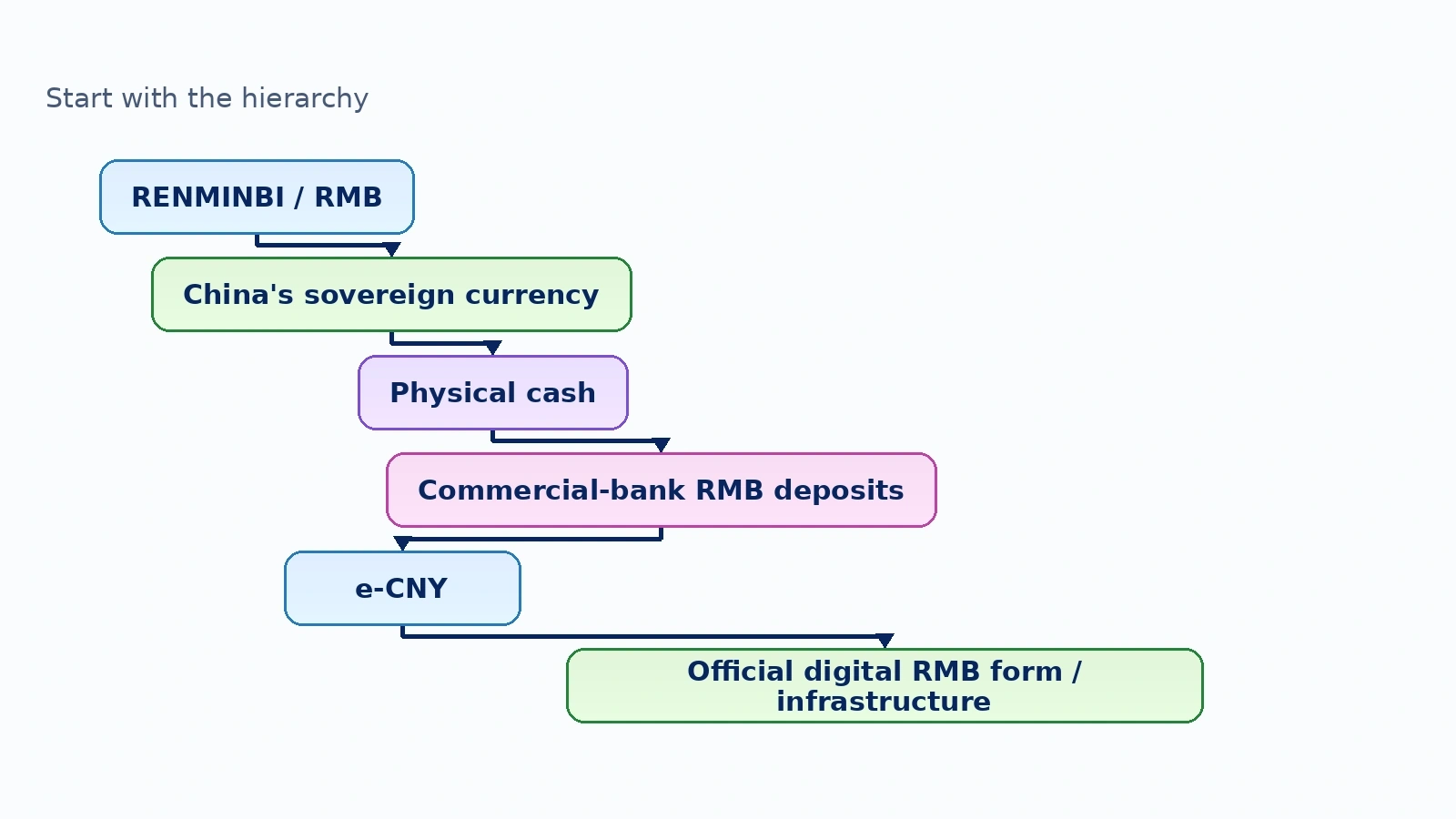
Offshore CNH is still RMB exposure in the offshore financial system.
USDC and USDT sit outside this hierarchy.
CNY bank money
Most RMB already exists electronically as commercial-bank deposits.
A bank-app balance is not automatically e-CNY.
e-CNY
E-CNY is an official central-bank digital-currency initiative developed within China’s regulated monetary framework.
Its policy objective is not to become an unregulated cryptocurrency.
USDC / USDT
USDC and USDT generally represent private claims or instruments designed to track the U.S. dollar, operating on public or permitted blockchain networks.
Their legal and regulatory treatment depends on jurisdiction.
Mainland China’s virtual-currency restrictions apply to private virtual-currency activity.
Comparison
Feature | e-CNY | CNY bank deposit | CNH | USDC / USDT |
|---|---|---|---|---|
Denomination | RMB | RMB | RMB | USD-linked |
Monetary system | Official Chinese | Chinese banking system | Offshore RMB ecosystem | Private stablecoin ecosystem |
Typical network | Official e-CNY infrastructure | Banking rails | Offshore banking / FX / CIPS-related rails | Blockchain networks |
Mainland treatment | Official | Official | Permitted cross-border RMB context | Virtual-currency restrictions |
Main use | Digital sovereign payments | General banking | Offshore trade/finance/hedging | Offshore digital value transfer |
Is e-CNY a blockchain stablecoin?
No.
Do not describe it as China’s USDT.
That misses the institutional design.
Can e-CNY replace CNY?
e-CNY is denominated in the same sovereign currency. The strategic question is distribution and payment infrastructure, not a new exchange rate.
You do not expect a separate USD/e-CNY rate and USD/CNY rate in the way traders distinguish USD/CNH from USD/CNY.
Can e-CNY be used cross-border?
China has explored and developed cross-border digital-currency use cases, but cross-border functionality remains subject to regulatory design and participating infrastructures.
The existence of a CBDC does not mean unrestricted global movement of RMB.
Why China can support e-CNY while restricting stablecoins
Because the policy questions are different.
With e-CNY, the sovereign monetary authority controls or defines the monetary framework.
With private stablecoins, authorities face questions about:
private issuance;
monetary substitution;
capital movement;
AML;
financial stability;
investor protection;
cross-border regulatory reach.
China’s policy can therefore simultaneously promote official digital RMB and restrict private virtual-currency activity.
Related guides
Primary and authoritative sources
This primer was researched and updated for September 2026. Regulatory requirements can change, and transaction-level treatment depends on the parties, banks, purpose of payment, documentation, and jurisdictions involved.
State Administration of Foreign Exchange (SAFE), first-half 2026 foreign-exchange press conference
SAFE, reforms facilitating cross-border trade and investment
Hong Kong Monetary Authority (HKMA), Linked Exchange Rate System terminology
China State Council Information Office, September 2026 RMB internationalization policy
Library of Congress, May 2026 summary of China's February 2026 virtual-currency and stablecoin rules