

China payments represent one of the most complex cross-border payment challenges in the world. China's payment market is simultaneously one of the largest and most technologically advanced in the world, dominated by two super-apps (Alipay and WeChat Pay) that together process trillions of dollars in annual transactions, and also one of the most restricted, with capital controls that limit cross-border flows, a banking system that is largely closed to foreign institutions for domestic settlement, and regulatory requirements that make international payment infrastructure significantly more complex than most other major markets.
For businesses wanting to receive payments from Chinese customers, send money to Chinese suppliers, or build payment flows that touch China, understanding how China payments actually work is the essential starting point. Faisal Khan LLC advises businesses on China payment strategy, connects them to the banking, licensing, and payment infrastructure partners that make cross-border China payments workable, and helps structure compliant payment flows through one of the world's most challenging payment jurisdictions.
What are you trying to do?
China payment requirements become easier to understand when the commercial objective is clear. Choose the problem that most closely matches yours:
- Pay a Chinese supplier in USD, CNY, CNH or HKD
- Prepare the documents required for a supplier payment
- Compare deposits, letters of credit, open-account terms and documentary collections
- Calculate the true FX and banking cost
- Investigate a delayed, rejected, returned or short-paid transfer
- Review sanctions, ownership, goods and payment-flow compliance
- Assess an offshore stablecoin-funded structure
- Review China supplier payments for a particular industry
The first question is not which payment application is cheapest. It is who is paying whom, for what commercial purpose, into which beneficiary account, in which currency, and with what supporting evidence.
China's Domestic Payment Landscape
Understanding China's domestic payment infrastructure is foundational to understanding cross-border China payments:
Alipay (Ant Group): The payments arm of Alibaba. Over 1.3 billion users. Integrated with Taobao, Tmall, and most Chinese e-commerce and offline retail. Widely used by Chinese consumers traveling or shopping internationally.
WeChat Pay (Tencent): Embedded within WeChat, China's dominant social and communications super-app. Over 1 billion active users. QR code and in-app payments are ubiquitous for both online and offline commerce in China.
UnionPay: China's national bank card network, operating alongside (and often below) Alipay and WeChat Pay in the card infrastructure. UnionPay cards are issued by Chinese banks and can be used internationally wherever UnionPay is accepted (increasingly globally). For international businesses, UnionPay acceptance can capture Chinese card spending internationally.
- CIPS (Cross-Border Interbank Payment System): CIPS provides clearing and settlement infrastructure for cross-border and offshore RMB payments. It is not simply China's version of SWIFT. SWIFT primarily supplies global financial messaging, while CIPS provides RMB-focused clearing and settlement. The two can operate within the same payment chain.
Digital RMB (e-CNY): China's central bank digital currency, currently in advanced pilot stage across multiple cities. Intended for domestic retail payments but with potential cross-border implications as it scales.
Capital Controls: The Core Constraint in Cross-Border China Payments
China's capital controls are the single most important regulatory factor shaping cross-border China payment flows. The State Administration of Foreign Exchange (SAFE) regulates all cross-border capital movements. Key restrictions include:
Individual annual quota: Chinese residents are permitted to convert up to USD 50,000 equivalent in foreign currency per year through official banking channels. Above this threshold, central bank approval is required. This limit fundamentally constrains personal cross-border payments from China.
Corporate cross-border restrictions: Chinese companies can make and receive cross-border payments within specific categories (trade settlement, service payments, approved investment) with appropriate documentation. Capital account transactions (equity, loan flows, investment) require SAFE approval.
RMB convertibility: The Chinese renminbi (yuan, RMB/CNY) is partially convertible. The Offshore RMB (CNH, traded outside mainland China, primarily in Hong Kong) trades separately from the onshore CNY and may carry a different exchange rate. Cross-border RMB flows require specific regulatory authorization in most cases.
These controls mean that moving money into or out of China is never simply a banking and payment rails question. It is also a regulatory and compliance question that requires understanding what type of transaction is being processed and whether it falls within permissible categories.
How Businesses Accept Payments From Chinese Customers
For international businesses selling to Chinese customers (either online or in-person at tourist destinations), accepting the payment methods Chinese customers actually use is critical:
Alipay and WeChat Pay for international merchants: Both Alipay and WeChat Pay offer international merchant programs that allow foreign businesses to accept payments from Chinese users. The mechanism varies:
Alipay Global: Allows international merchants to accept Alipay payments from Chinese users. Settlement is in the merchant's local currency. Requires an Alipay merchant agreement, typically facilitated through an authorized reseller or payment processor.
WeChat Pay for International Merchants: Similar structure. Settlement in local currency via partner payment processors.
In-person, this typically involves QR code-based payment: the customer scans the merchant's QR code or the merchant scans the customer's QR code using the Alipay or WeChat Pay app.
UnionPay card acceptance: International merchants with card acceptance infrastructure can enable UnionPay acceptance through their acquirer. Many international acquirers and payment gateways now support UnionPay alongside Visa and Mastercard.
Online, integration with these wallets requires connecting through an authorized processor (Adyen, Stripe, 2C2P, and others offer Alipay and WeChat Pay integration for e-commerce).
How Businesses Pay Chinese Suppliers
Paying Chinese suppliers in USD or RMB via international wire is the standard approach for B2B trade payment, but it comes with specific considerations:
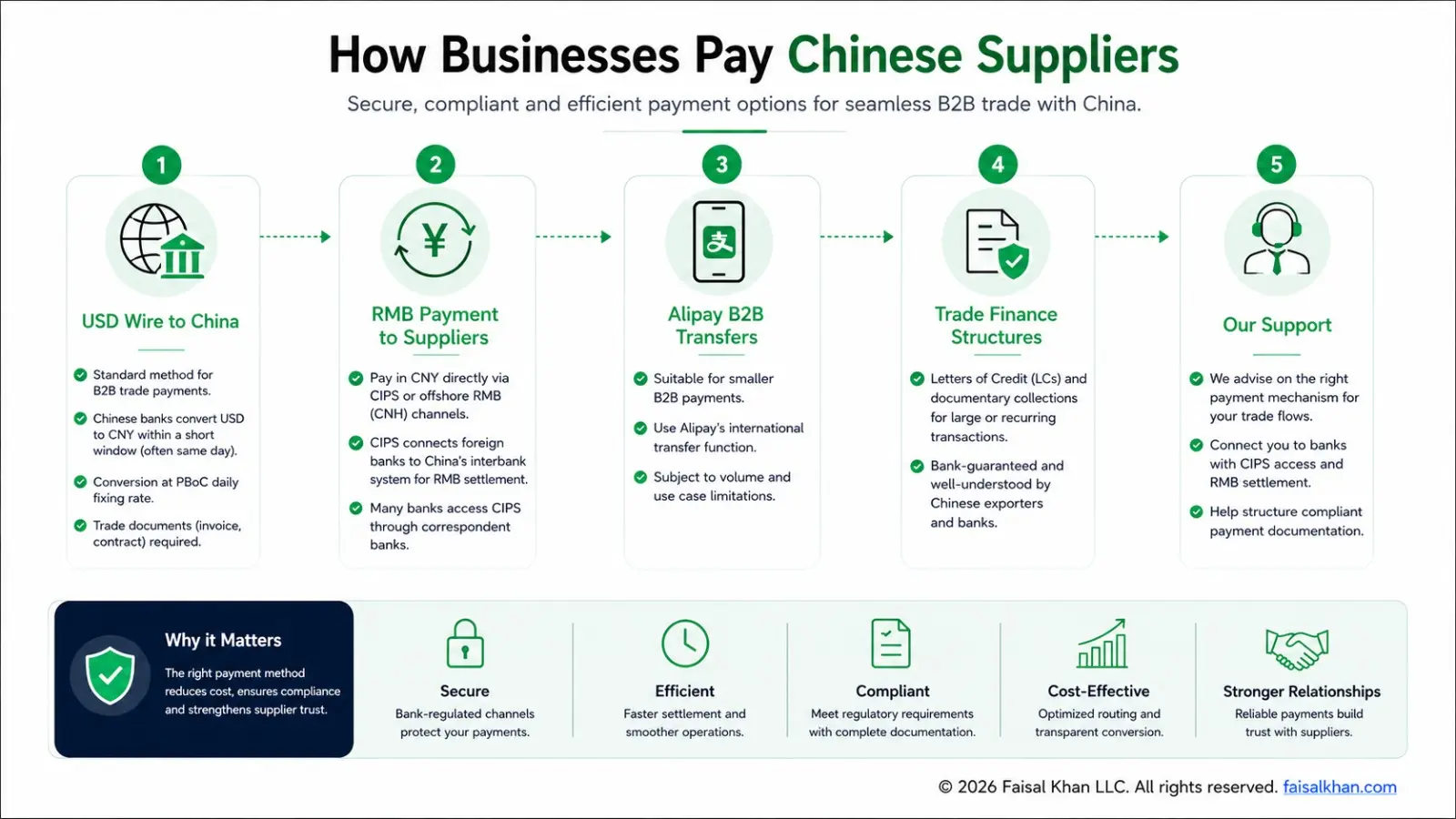
- USD payments to Chinese suppliers: Eligible Chinese companies can receive foreign-currency payments for genuine commercial transactions, subject to their account capabilities, trade documentation and bank review. Whether the supplier retains the foreign currency or converts it into RMB depends on the account, transaction, applicable rules and bank procedures. The buyer should confirm the beneficiary's accepted currency before sending.
RMB payment to Chinese suppliers: Paying in CNY directly is possible through CIPS or through offshore RMB (CNH) channels. CIPS connects foreign banks to the Chinese interbank system for RMB settlement. Not all international banks are direct CIPS participants, but many access CIPS through correspondent banks.
- Specialized platform arrangements: Some marketplaces and approved cross-border platforms provide supplier-payment facilities for eligible transactions. Limits, supported goods, payer eligibility, documentation, settlement currency and beneficiary requirements vary. A consumer-wallet transfer should not be assumed to be a substitute for a documented commercial payment.
Trade finance structures: For large, recurring supplier relationships, letters of credit (LCs) and documentary collections provide a structured, bank-guaranteed payment mechanism that is well-understood by Chinese exporters and their banks.
We advise businesses on the most appropriate payment mechanism for their specific China trade flows, connect them to banking partners with CIPS connectivity and RMB settlement capability, and help structure compliant payment documentation.
Frequently Asked Questions
Can I accept WeChat Pay or Alipay payments on my website without being in China?
Yes. Both WeChat Pay and Alipay have international merchant programs for cross-border e-commerce. You can accept payments from Chinese users through these wallets even if your business and website are based outside China. Integration is typically through an authorized processor (Adyen, Stripe, Checkout.com, and others have these integrations). Settlement is in your local currency.
How do I receive a large payment from a Chinese company?
Large cross-border payments from Chinese companies require proper trade documentation (purchase contract, invoice, proof of goods or services delivery) for the Chinese company's bank to process the outbound transfer. The payment will typically arrive as a SWIFT wire in USD. Ensure your bank is prepared to receive and process the wire and that you have the documentation to confirm the commercial nature of the transaction if your bank requests it.
What are the RMB CNY and CNH exchange rates and which applies to me?
CNY is the onshore renminbi, traded only within mainland China. CNH is the offshore renminbi, traded primarily in Hong Kong and other offshore centers. The two rates are usually close but can diverge under market stress or regulatory intervention. Foreign businesses receiving Chinese payment settlement typically deal with CNH (offshore) rates. The spread between CNY and CNH represents an opportunity or a cost depending on which direction you are converting.
Is CIPS a replacement for SWIFT for China payments?
Not currently. CIPS is designed to facilitate international RMB transactions and reduce dependence on SWIFT for China-related flows, but SWIFT remains the dominant messaging standard for international USD payments to and from China. CIPS and SWIFT can be used complementarily: CIPS for RMB settlement, SWIFT for USD. Most international banks access CIPS as indirect participants through larger banks that are direct CIPS members.
China trade payments by industry
The payment rail may be similar across sectors, but the documents, transaction timing, goods risk and reconciliation requirements can differ materially.
- Food importers and restaurant wholesalers: recurring payments, inspection and shipment records, perishability and supplier verification.
- Wine and beverage importers: licensing, labeling, duties, shipment documents and distributor relationships.
- Machinery importers: deposits, production milestones, inspections and high-value balance payments.
- Textile and apparel importers: samples, production deposits, multiple factories and purchase-order reconciliation.
- Electronics companies: precise product descriptions, end use and possible export-control considerations.
- Medical-device companies: regulated products, quality documentation, tooling and contract-manufacturing relationships.
- Freight forwarders and customs brokers: payments to agents, carriers and overseas offices, with careful separation between company funds and customer funds.
Explore China supplier payments by industry
China Currency and Payments Guides
The terminology, the rails and the rules behind a China payment, one guide at a time. Start with the overview of China's currency system if CNY, CNH and HKD still blur together.
RMB, CNY, CNH, HKD, USD & Stablecoins: China’s Currency and Cross-Border Payment System Explained
CIPS Explained: How China’s Cross-Border RMB Payment System Works
Stablecoin Payments to China: USDC, USDT, Hong Kong and the Fiat Off-Ramp
e-CNY vs CNY, CNH, USDC and USDT: China’s Digital Yuan Explained
Request a China Trade Payment Feasibility Review
If you are paying suppliers in Mainland China or Hong Kong, provide:
- Your company's legal name and jurisdiction
- The supplier's legal name and location
- Goods or services being purchased
- Invoice and funding currencies
- Average and maximum transaction size
- Expected monthly volume and payment count
- Beneficiary-account country and currency
- Source and ownership of funds
- Current bank or payment provider
- The precise problem you are trying to solve
Faisal Khan LLC can assess the flow, identify structural gaps, source potential regulated providers and coordinate introductions. Faisal Khan LLC does not take custody of or transmit client funds.