
The Cross-Border Interbank Payment System (CIPS) is one of the key infrastructures supporting international use of the renminbi.
For how CIPS fits alongside the other China payment routes, see the China Payments hub.
CIPS is frequently called China’s SWIFT. That description is incomplete.
What CIPS actually does
Under its current business rules, CIPS provides fund clearing and settlement services for participants’:
Cross-border RMB payments.
Offshore RMB payments.
Financial-market transactions.
Other approved business.
That makes CIPS a payment, clearing and settlement infrastructure, not merely a communications network.
Direct participants
A direct participant has a CIPS account and handles eligible activity directly through CIPS.
Indirect participants
An indirect participant does not maintain its own CIPS settlement account. It uses a direct participant to access the system.
Conceptually:
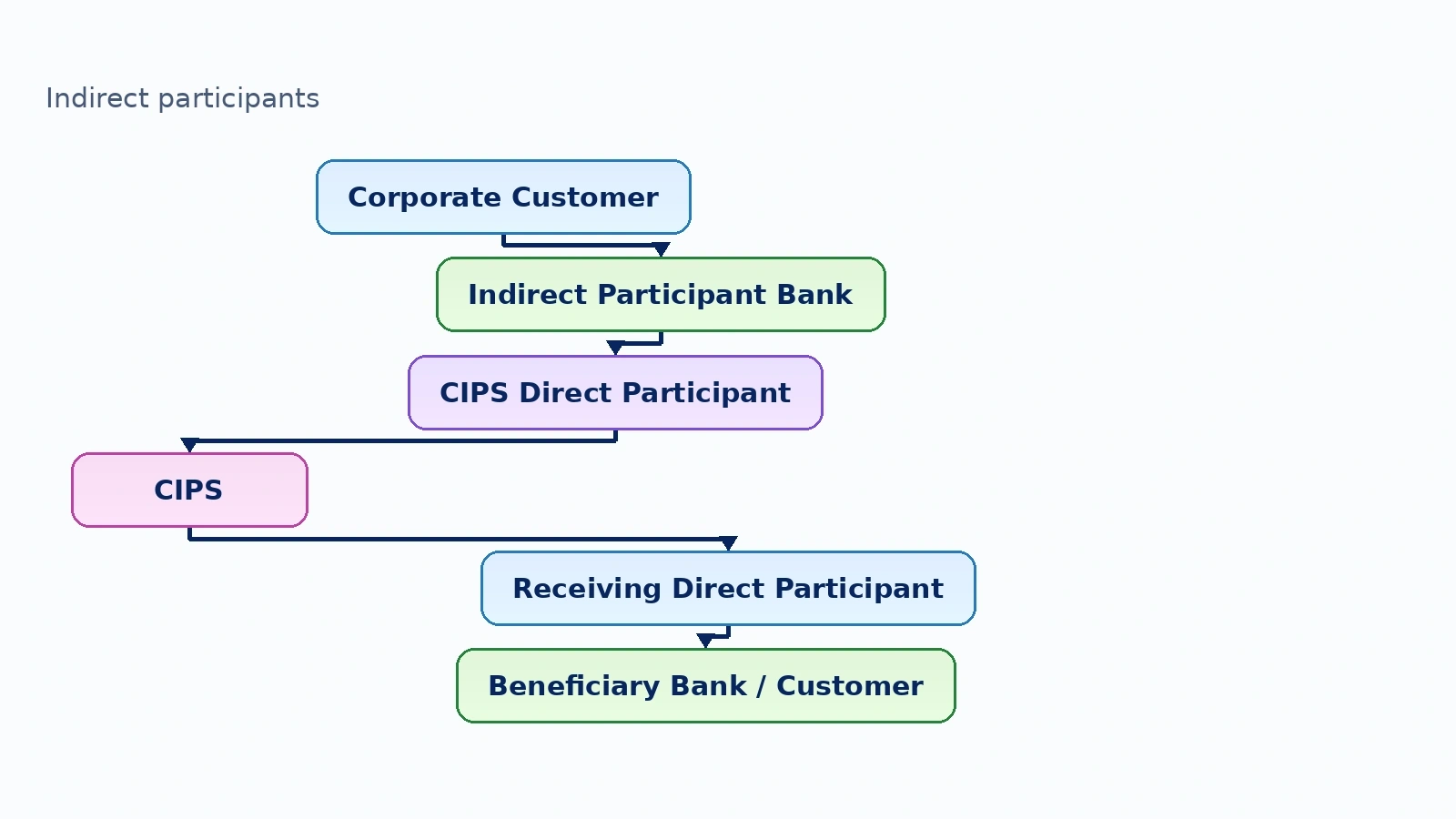
The exact chain can vary.
CIPS versus SWIFT
A useful simplification:
CIPS | SWIFT |
|---|---|
Clearing and settlement infrastructure for cross-border/offshore RMB | Global financial messaging network and standards |
RMB-centric | Multi-currency/global |
Can maintain settlement relationships with participants | Does not itself function as the underlying bank account for every payment |
PBOC-supervised framework | International cooperative messaging infrastructure |
The systems can coexist.
CIPS adopted ISO 20022 standards and was designed for interoperability with global financial messaging practices.
Example: European company pays Chinese exporter in RMB
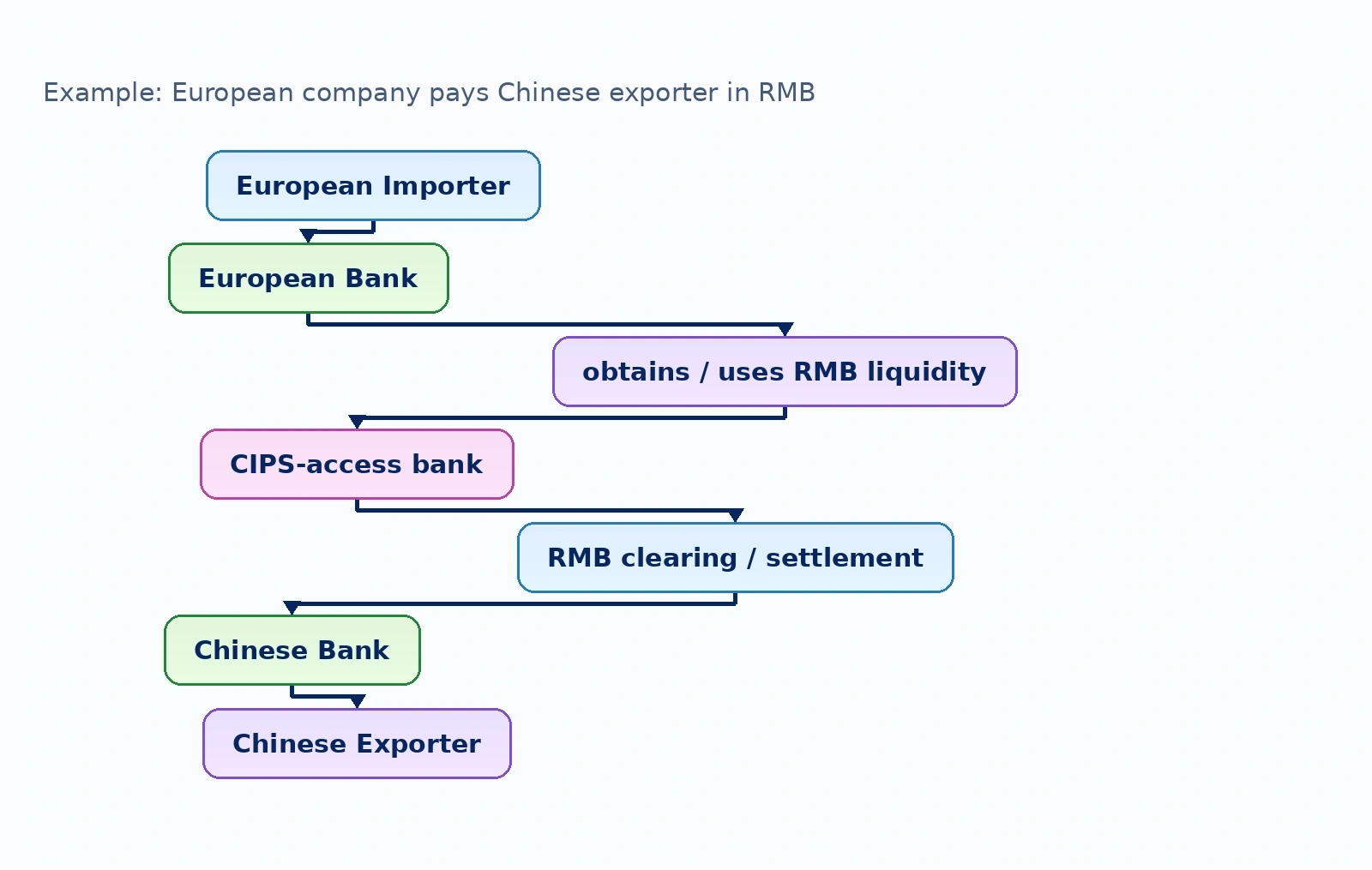
The importer does not need to understand every internal settlement hop. Its bank does.
The importer does need to provide accurate:
Beneficiary details.
Payment purpose.
Invoice and contract information.
Currency.
Amount.
Does CIPS eliminate correspondent banking?
Not universally, banking relationships still matter.
An institution’s ability to originate or receive a transaction depends on:
Direct/indirect CIPS participation.
Correspondent relationships.
Liquidity.
Compliance.
Local regulation.
Beneficiary-bank capabilities.
What the importer should ask its provider
An importer rarely needs to design the interbank route. It does need clear operational answers:
- Can the provider deliver RMB to this specific beneficiary bank and account?
- Is the beneficiary account able to receive the instructed currency?
- What payment-purpose information must accompany the transfer?
- Which commercial documents are required before release?
- Can intermediary or beneficiary-bank fees be deducted?
- What is the expected settlement window?
- Is end-to-end tracking available?
- What happens if the beneficiary bank rejects or cannot apply the payment?
The practical question is not whether CIPS sounds faster than SWIFT. It is whether the provider can deliver the required currency through a transparent, documented and supportable route.
Does CIPS mean RMB is freely convertible?
No.
Payment infrastructure and capital-account convertibility are different issues.
CIPS can make permitted RMB transactions operationally more efficient without removing China’s regulatory framework governing which transactions are permitted.
Why CIPS matters strategically
CIPS:
Provides dedicated infrastructure for RMB internationalization.
Shortens some RMB clearing chains.
Supports cross-border trade and investment.
Expands global RMB accessibility.
Reduces exclusive dependence on legacy correspondent structures for RMB settlement.
Supports China’s objective of broader RMB use.
What CIPS does not mean
It does not mean:
Every global bank can send any RMB transaction.
Documentation is unnecessary.
Capital controls disappear.
Sanctions screening disappears.
SWIFT becomes irrelevant.
Stablecoins can be injected into CIPS directly as commercial settlement assets.
Request a China Trade Payment Feasibility Review
Provide the beneficiary bank, the currency you need delivered, the invoice, the amount and your current provider.
Faisal Khan LLC can assess the flow, identify structural gaps, source potential regulated providers and coordinate introductions. Faisal Khan LLC does not take custody of or transmit client funds.
Related guides
Primary and authoritative sources
This primer was researched and updated for September 2026. Regulatory requirements can change, and transaction-level treatment depends on the parties, banks, purpose of payment, documentation, and jurisdictions involved.
State Administration of Foreign Exchange (SAFE), first-half 2026 foreign-exchange press conference
SAFE, reforms facilitating cross-border trade and investment
Hong Kong Monetary Authority (HKMA), Linked Exchange Rate System terminology
China State Council Information Office, September 2026 RMB internationalization policy
Library of Congress, May 2026 summary of China's February 2026 virtual-currency and stablecoin rules