
China’s cross-border payment system is easier to understand when payments are viewed as regulated economic transactions, not merely bank transfers.
This page covers the foreign-exchange framework; the wider China Payments section covers currencies, rails and supplier payments.
The key institution is the State Administration of Foreign Exchange (SAFE).
What SAFE does
SAFE is responsible for major parts of China’s foreign-exchange administration and cross-border capital monitoring framework.
Its functions include:
Monitoring cross-border capital flows;
Supervising the foreign-exchange market;
Administering foreign-exchange settlement and sales;
Supporting orderly convertibility reforms;
Implementing and supervising FX rules.
The authenticity principle
A core practical concept is that banks may need to establish that an underlying cross-border transaction is authentic and compliant.
That is why a bank may ask for:
Commercial contract;
Invoice;
Customs records;
Shipping documentation;
Service agreement;
Tax material;
Investment registration;
Shareholder documentation;
Loan documentation;
Proof of source of funds.
Current account
Current-account activity generally covers ordinary economic transactions such as:
Trade in goods;
Trade in services;
Income;
Certain transfers.
China has progressively simplified many legitimate current-account payment processes.
Capital account
Capital-account activity can include:
Direct investment;
Portfolio investment;
Foreign debt;
Outbound investment;
Equity transactions;
Securities activity.
These categories can involve more controls, registrations, quotas or specific procedures.
Why this matters
Suppose a foreign company sends US$1 million to China.
The bank cannot determine regulatory treatment from the amount alone.
US$1 million could be:
Payment for machinery;
Software services;
Shareholder capital;
A loan;
An acquisition payment;
A dividend-related flow;
A refund;
An advance payment.
Each has a different economic and regulatory character.
Same business, same management
SAFE and the PBOC have increasingly coordinated RMB and foreign-currency treatment under a principle described as same business, same management.
From the enterprise perspective, this is important.
Cross-border use of RMB is not meant to become a loophole around controls that would apply if the same transaction were conducted in USD.
The regulatory focus is the business activity and purpose, not merely the currency.
RMB is becoming more important
SAFE reported that in the first half of 2026:
Total cross-border receipts and payments by non-bank sectors reached US$9.2 trillion; and RMB represented 52.9% of cross-border settlements.
This demonstrates that RMB is no longer a peripheral currency in China’s own cross-border economy.
Trade documentation architecture
A well-designed payment file should be internally consistent.
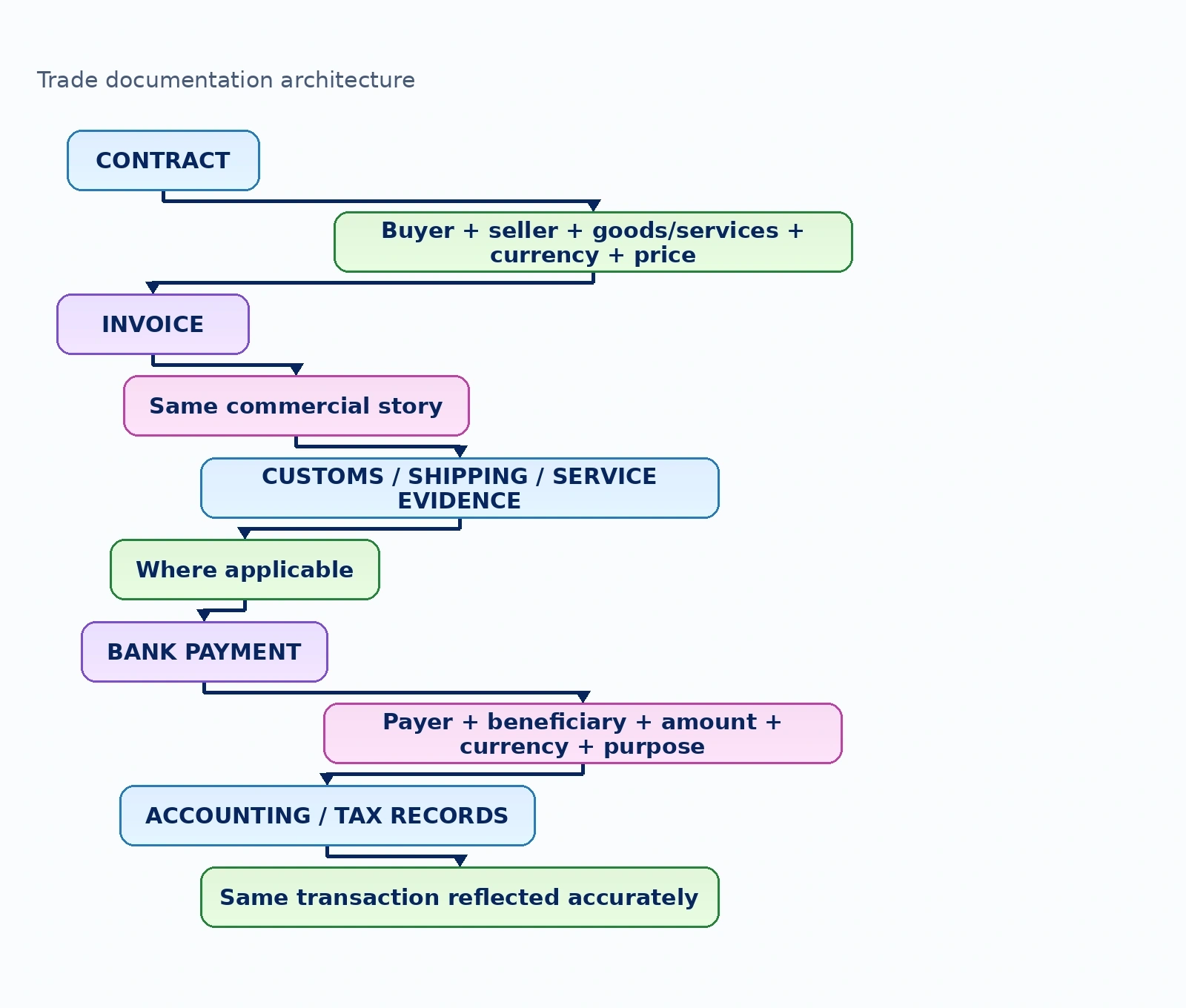
The more these layers contradict one another, the more difficult the payment becomes to defend.
Own-company payments versus customer payments
An importer paying its own invoice is making a company-to-company commercial payment. A platform that collects money from unrelated buyers and pays their suppliers is performing a different activity.
The second model can raise money-transmission, payment-services, safeguarding, AML and licensing questions in the jurisdictions where funds are collected, converted, held or paid. Calling every transfer a trade payment does not remove those obligations.
Before selecting a provider, state clearly whether the funds belong to the company making the payment or to customers whose money the company is handling.
Warning signs
A bank may reasonably scrutinize:
Unrelated third-party payer;
Unrelated third-party beneficiary;
Personal account used for a corporate trade;
Invoice amount inconsistent with payment;
Unusual split payments;
Rapid round-tripping;
Unexplained offshore intermediary;
Crypto-origin funds with poor provenance;
Transaction purpose inconsistent with company profile.
Keep a defensible audit file
Retain the corporate checks, ownership information, invoice, contract, shipping evidence, beneficiary verification, screening results, bank correspondence, internal approvals and explanation for any unusual feature. The file should show what was known when the payment was approved—not merely documents assembled after a bank raised questions.
Review the complete China trade-payment compliance checklist
Can RMB avoid FX controls?
No.
Using RMB can simplify legitimate RMB-denominated trade. It does not make the underlying transaction exempt from the regulatory framework.
Request a China Trade Payment Feasibility Review
Provide the flow of funds, whose funds they are, the invoice and contract, the currencies and the monthly volume.
Faisal Khan LLC can assess the flow, identify structural gaps, source potential regulated providers and coordinate introductions. Faisal Khan LLC does not take custody of or transmit client funds.
Related guides
Primary and authoritative sources
This primer was researched and updated for September 2026. Regulatory requirements can change, and transaction-level treatment depends on the parties, banks, purpose of payment, documentation, and jurisdictions involved.
State Administration of Foreign Exchange (SAFE), first-half 2026 foreign-exchange press conference
SAFE, reforms facilitating cross-border trade and investment
Hong Kong Monetary Authority (HKMA), Linked Exchange Rate System terminology
China State Council Information Office, September 2026 RMB internationalization policy
Library of Congress, May 2026 summary of China's February 2026 virtual-currency and stablecoin rules