
China does not have five different versions of money competing with one another. It has one Mainland sovereign currency, the renminbi, operating through an onshore market and an offshore market, while Hong Kong has its own separate currency, the Hong Kong dollar. International trade then adds the U.S. dollar, offshore RMB liquidity, correspondent banking, CIPS, foreign-exchange controls, and increasingly digital-dollar instruments such as USDC and USDT.
This primer is the detailed currency guide beneath our China Payments hub.
That is why the terminology becomes confusing.
A foreign buyer may receive a Chinese supplier invoice in USD. The supplier may ultimately keep CNY. A Hong Kong treasury company may hedge CNH. A bank may transmit an offshore RMB payment using the ISO currency code CNY. A group treasury center may maintain HKD, USD and RMB balances in Hong Kong. A crypto-native company may hold USDC offshore, but the final commercial payment into Mainland China may still need to arrive through a conventional banking channel backed by legitimate trade documents.
The purpose of this primer is to make that entire system understandable.
The shortest possible explanation:"
"RMB is the name of China’s currency. Yuan is its unit. CNY is the official ISO code for renminbi and is associated with the onshore Mainland market. CNH is the market convention used to distinguish offshore renminbi, particularly offshore FX trading. HKD is Hong Kong’s separate currency. USD remains a major international trade currency. USDC and USDT are private dollar stablecoins and are not legal tender in Mainland China.
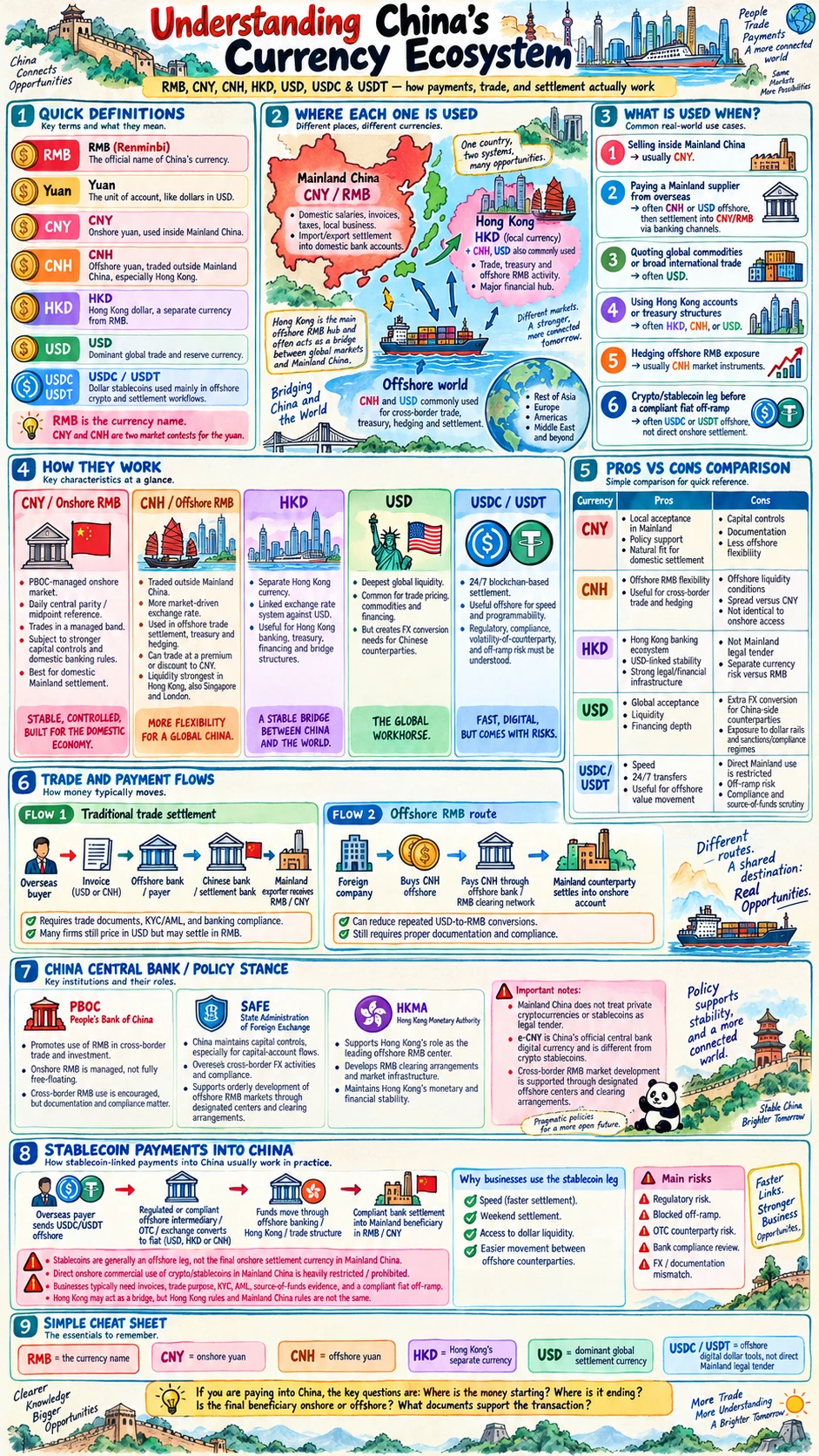
The seven ideas you need to understand first
Renminbi and yuan are not competing currencies. Renminbi is the currency name; yuan is the unit.
CNY and CNH are not two unrelated currencies. They represent the onshore and offshore market contexts for renminbi.
CNH is not a separate ISO 4217 currency code. Financial markets use CNH to distinguish offshore RMB pricing and liquidity, while payment messaging commonly still uses CNY.
Mainland China and Hong Kong operate different monetary systems. Hong Kong uses HKD and has its own banking, monetary and regulatory framework.
China wants more international use of RMB, but that does not mean unrestricted capital movement. Cross-border RMB is actively promoted while foreign-exchange and capital-account controls remain important.
CIPS and SWIFT are not the same thing. CIPS provides clearing and settlement infrastructure for cross-border and offshore RMB; SWIFT is primarily a global financial messaging network.
Stablecoin-funded commerce and a stablecoin payment into Mainland China are not the same thing. A business may begin with USDC or USDT offshore, but compliant Mainland settlement generally requires a fiat banking leg and a legitimate payment purpose.
1. RMB, Yuan, CNY and CNH: The terminology
RMB: Renminbi
Renminbi, abbreviated RMB, means people’s currency. It is the official name of the currency of the People’s Republic of China.
Think of renminbi as analogous to sterling in the United Kingdom.
Yuan
The yuan is the unit in which renminbi is counted.
If a product costs ¥100, the amount is 100 yuan.
A useful analogy is:
Concept | China | United Kingdom |
|---|---|---|
Currency name | Renminbi | Sterling |
Unit | Yuan | Pound |
Official currency code | CNY | GBP |
In ordinary business conversation, people often use yuan, RMB, and CNY loosely. The distinctions become important once FX trading, settlement, accounting, hedging or cross-border payment infrastructure is involved.
CNY: The official code and the onshore market
CNY is the official ISO currency code for renminbi.
In market terminology, CNY is also used to describe the onshore renminbi market inside Mainland China.
The onshore RMB exchange-rate regime is a managed floating regime, not a completely free float. The People’s Bank of China influences the market through the daily central parity rate and other policy tools. The USD/CNY interbank spot rate operates within a permitted band around the daily central parity.
CNY is therefore associated with:
Mainland bank accounts.
Domestic payments.
Salaries and taxes.
Domestic invoices.
Mainland FX conversion.
Import and export settlement through Mainland banks.
Capital controls and cross-border reporting requirements.
The domestic financial system supervised by Chinese authorities.
CNH: Offshore renminbi
CNH means offshore renminbi in financial-market usage.
The H historically reflects Hong Kong’s role in the offshore RMB market.
The crucial point is that CNH is not a second Chinese sovereign currency and is not an independently assigned ISO 4217 currency. It is a market convention used to distinguish offshore RMB from onshore RMB.
That distinction matters because the offshore market has different:
Liquidity.
Interest rates.
Market participants.
Supply and demand.
Hedging instruments.
Settlement mechanisms.
Access constraints.
As a result, USD/CNH and USD/CNY can trade at different rates.
Why can CNY and CNH differ if they are both renminbi?
Because money cannot always move frictionlessly between the onshore and offshore pools.
If arbitrage were completely unrestricted, traders could buy RMB wherever it was cheaper, move it instantly to the other market, sell it where it was more expensive, and eliminate the difference.
China’s cross-border capital framework limits that frictionless arbitrage. The result is two connected but not perfectly interchangeable RMB liquidity pools.
Read the dedicated explainer: RMB vs CNY vs CNH: What Is the Difference?
2. Hong Kong is not simply another Chinese CNY market
Hong Kong has its own currency: HKD the Hong Kong dollar.
The HKD operates under the Hong Kong Monetary Authority’s Linked Exchange Rate System, a currency-board framework centered around HK$7.80 per US$1, with convertibility undertakings at the strong and weak sides of the band.
That means Hong Kong can simultaneously have:
HKD current accounts.
USD accounts.
Offshore RMB balances.
CNH FX trading.
Offshore RMB lending.
RMB bond markets.
International banks.
Virtual-asset activity regulated under Hong Kong law.
Payment flows to and from Mainland China.
This makes Hong Kong a bridge between the Mainland Chinese monetary system and global capital markets.
In 2026 Hong Kong further expanded facilities designed to deepen offshore RMB liquidity and financing. The strategic direction is clear: Hong Kong is meant to remain a major global offshore RMB hub.
Read: HKD, CNH and Hong Kong’s Role in Offshore RMB
3. What currency is actually used in Chinese trade?
There is no single answer.
The currency used depends on:
Where the buyer is.
Where the seller is.
Whether the recipient account is in Mainland China or offshore.
The currency in which the contract is priced.
Who bears FX risk.
The banking relationships of both parties.
Whether trade finance is involved.
Whether the supplier needs CNY for domestic expenses.
Whether the buyer already holds RMB.
Availability of CNH liquidity.
Sanctions and correspondent-bank considerations.
Treasury policy.
The authenticity and documentation of the trade.
The most common structures can be simplified into several models.
Model A — Buyer pays USD; Chinese exporter receives USD
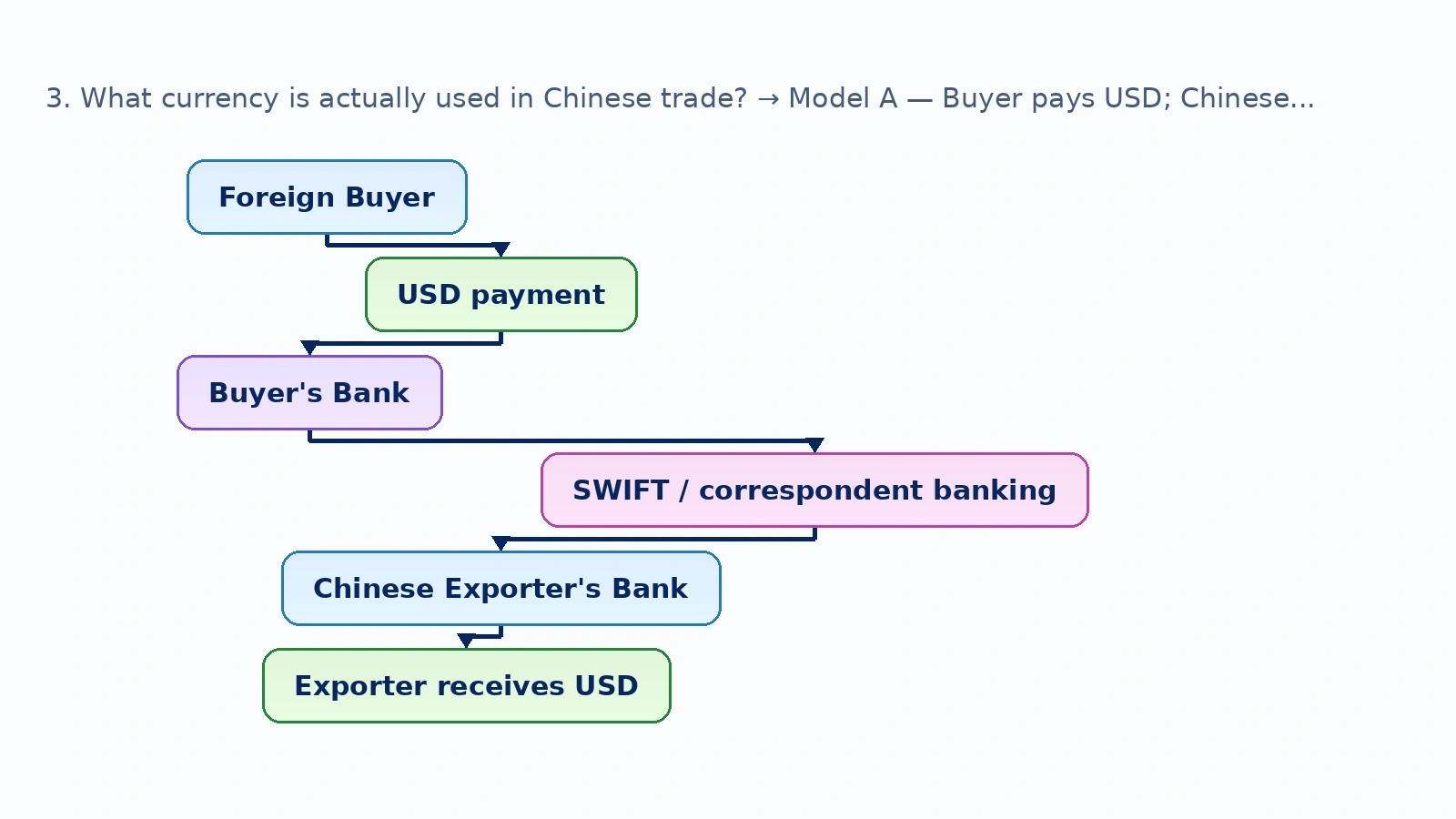
The Chinese exporter may keep permitted foreign currency balances or sell USD for CNY through its bank, depending on its requirements and applicable rules.
Why companies use it
USD is familiar globally.
Many commodities and trade contracts are priced in USD.
International buyers may already have USD liquidity.
Treasury systems and credit facilities may be USD-based.
Weakness
The Chinese exporter ultimately pays domestic salaries, taxes and suppliers in CNY. Someone must therefore bear the USD/CNY FX exposure and conversion cost.
Model B — Buyer pays offshore RMB; exporter receives RMB
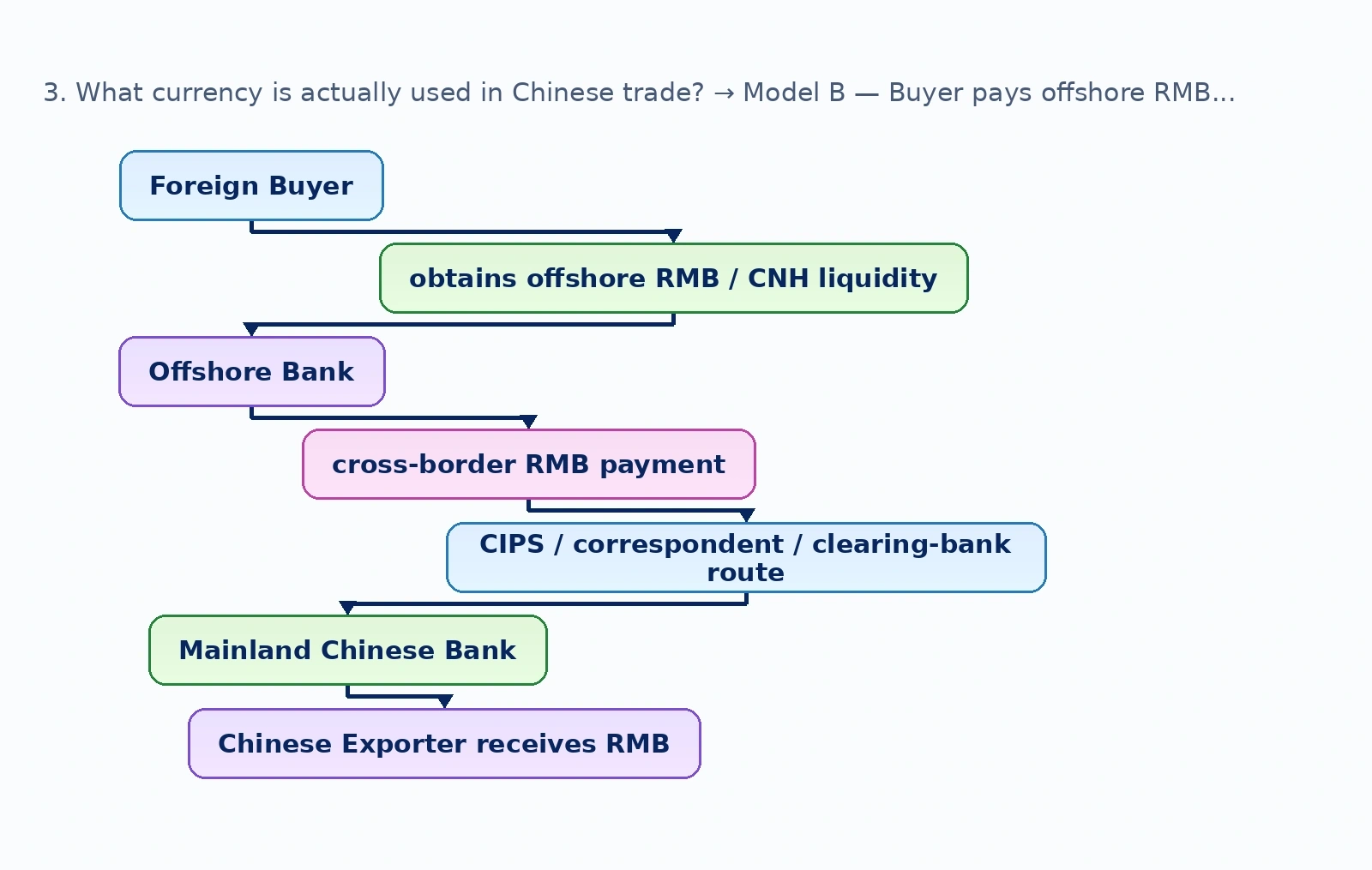
This can be economically attractive when:
The supplier wants RMB.
The buyer can source CNH competitively.
The contract is denominated in RMB;
Both parties want to reduce repeated USD conversion.
The supplier offers better pricing for RMB settlement.
Model C — Hong Kong intermediary or treasury structure
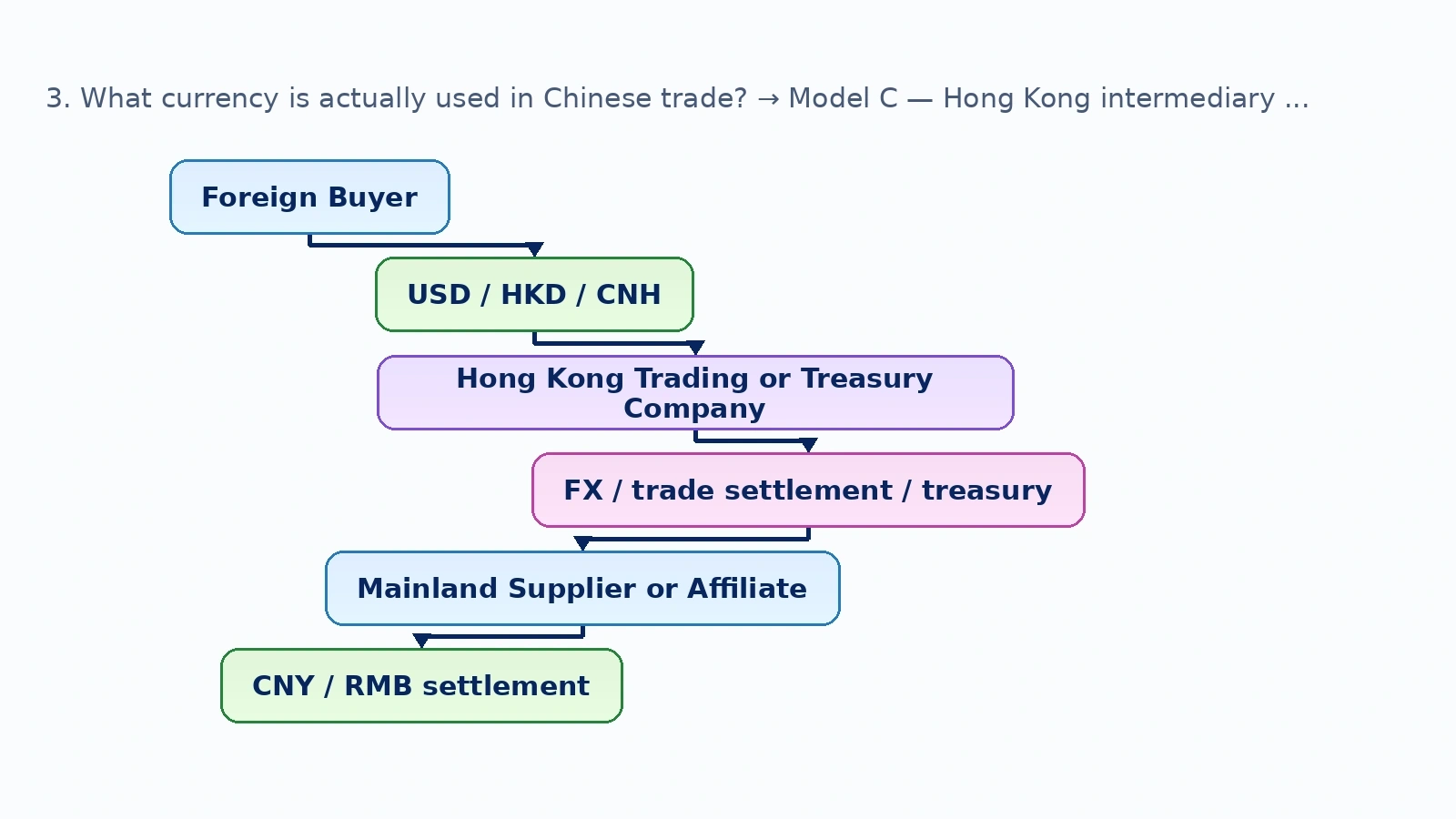
This can be legitimate and efficient, but the legal and economic substance matters. A Hong Kong company does not automatically remove Mainland documentation, transfer-pricing, tax, customs or foreign-exchange requirements.
4. CNY versus CNH in an actual US$100,000 supplier payment
Assume a U.S. importer owes a Shenzhen manufacturer the equivalent of US$100,000.
Option 1 invoice and pay in USD
The importer wires US$100,000.
The manufacturer or its bank ultimately converts all or part of that USD into onshore RMB.
FX risk: primarily sits with the Chinese exporter unless contract terms transfer it.
Option 2 invoice in RMB and buy CNH offshore
Suppose the invoice is RMB-denominated.
The U.S. importer asks its bank or FX provider for an offshore RMB quote. The provider sources CNH and sends the RMB payment through an available cross-border RMB route.
The Chinese exporter receives RMB.
FX risk: The U.S. buyer takes the RMB exposure because its dollar cost changes with the exchange rate.
Option 3 buyer maintains an RMB treasury balance
A multinational that repeatedly imports from China may maintain offshore RMB liquidity in Hong Kong or another financial center.
Instead of converting USD on every invoice, it can manage RMB centrally, hedge exposure, and make multiple RMB payments.
This is where CNH becomes more than a terminology question. It becomes a treasury-management instrument.
5. CNY and CNH exchange rates: Why the spread matters
You may see:
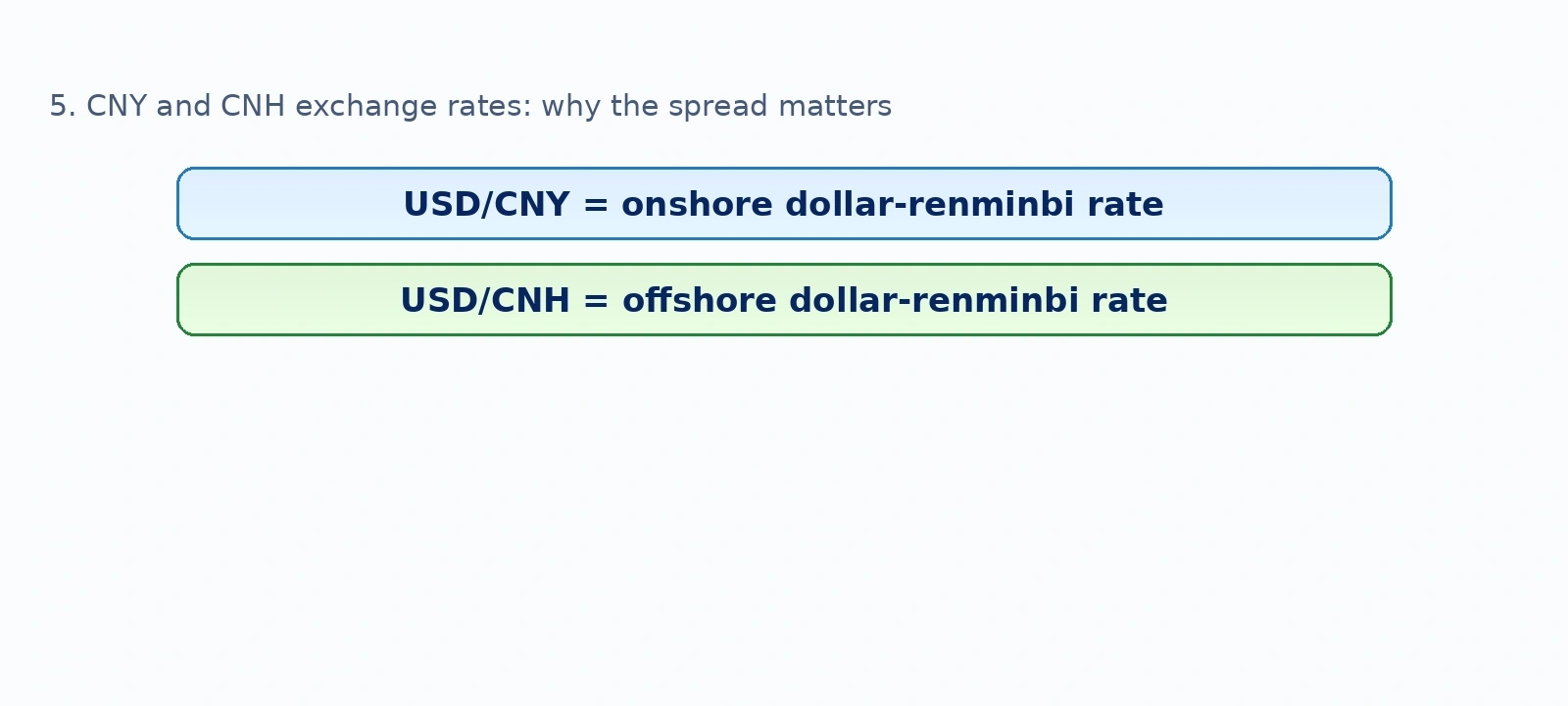
If USD/CNY and USD/CNH are different, that difference says something about:
Offshore RMB demand.
Offshore RMB liquidity.
Market expectations.
Funding conditions.
Hedging demand.
Policy expectations.
How easy or difficult it is to move liquidity between markets.
For a small invoice, the distinction may barely matter after bank spreads.
For a treasury operation moving tens or hundreds of millions of dollars, the distinction can be material.
Which rate should a business use?
Do not ask only, What is today’s RMB rate?
Ask:
Is the quote CNY or CNH?
Is it a spot, forward or fixing rate?
What is the bank/provider spread?
Are correspondent fees included?
Who pays intermediary charges?
What rate is used if the beneficiary bank converts currency?
When is the FX rate locked?
Does the invoice specify USD or RMB?
Does the beneficiary expect RMB or foreign currency?
Is the payment purpose permitted and documented?
6. CIPS: the infrastructure behind cross-border RMB
The Cross-Border Interbank Payment System (CIPS) is a financial-market infrastructure approved by the PBOC for cross-border and offshore RMB clearing and settlement.
Its 2026 business rules state that it provides clearing and settlement services for participants’:
Cross-border RMB payment transactions.
Offshore RMB payment transactions.
Financial-market activity.
Other approved business.
CIPS has direct participants and indirect participants.
A direct participant has an account in CIPS and handles transactions directly through the system. An indirect participant accesses CIPS through a direct participant.
CIPS is not simply China’s SWIFT
That comparison is too simplistic.
A useful conceptual distinction is:
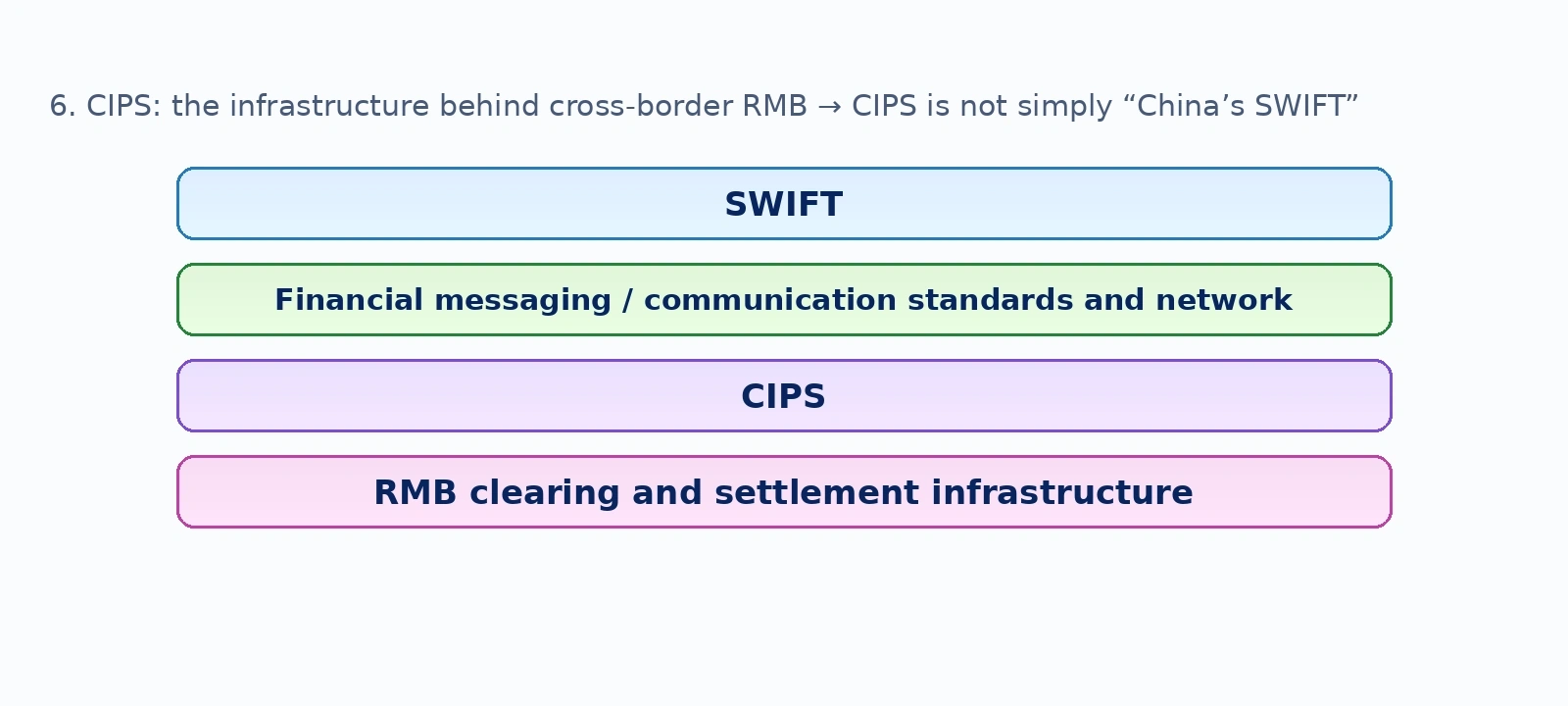
In real banking architecture, messaging, correspondent relationships, CIPS participation and settlement arrangements can interact.
A bank can therefore use standardized messaging while the actual RMB clearing and settlement takes place through CIPS or another permitted RMB clearing arrangement.
Read: CIPS Explained: How China’s Cross-Border RMB Payment System Works
7. The role of the PBOC: internationalize RMB without abandoning control
China’s policy can look contradictory until the objectives are separated.
China wants the RMB to be used more widely for:
International trade.
Cross-border payments.
Pricing.
Investment.
Financing.
Reserves.
Bilateral settlement.
Financial-market activity.
At the same time, China continues to manage:
The onshore exchange-rate framework.
Cross-border capital flows.
Foreign-exchange activity.
Banking channels.
Capital-account convertibility.
Virtual-currency activity.
These policies are not mutually exclusive.
The policy objective is better described as controlled internationalization rather than immediate, unrestricted convertibility.
In September 2026, PBOC officials again stated that China intends to improve cross-border yuan payments, support offshore RMB markets, expand local-currency settlement and make it easier for international institutions to hold and use RMB.
That direction is consistent with the expansion of offshore liquidity arrangements in Hong Kong.
8. SAFE: the institution businesses must understand
The State Administration of Foreign Exchange (SAFE) is central to China’s foreign-exchange and cross-border capital framework.
For businesses, the practical issue is that a payment is not evaluated merely as:
US$100,000 came into a Chinese bank account.
Banks look at the economic purpose of the payment.
That may include:
Goods trade
Services
Investment
Financing;
Dividends
Intercompany payments
Refunds
E-commerce receipts
Another permitted category
Banks can require information and documentation that demonstrates the authenticity and compliance of the underlying transaction.
For trade payments, that may involve:
Contract
Commercial invoice
Purchase order
Customs data
Shipping documentation
Identity of payer and beneficiary
Payment-purpose information
Source of funds
Relationship between contracting entities
Tax information where relevant
Explanation of discrepancies
China has progressively introduced trade-facilitation measures, but facilitation does not mean no controls.
In the first half of 2026, SAFE reported that RMB accounted for 52.9% of China’s cross-border settlements by non-bank sectors, illustrating how important RMB has become in China’s external payments.
Read: China FX Controls, SAFE and Cross-Border Trade Settlement
9. Current account versus capital account: a critical distinction
A business paying for imported machinery is not economically the same as an investor moving US$10 million into or out of a Chinese subsidiary.
The distinction between current-account and capital-account activity is therefore fundamental.
Current-account activity
Broadly includes commercial flows such as:
Goods trade
Services
Income
Ordinary business payments
China has made many current-account trade processes progressively more convenient, particularly for legitimate, well-documented activity.
Capital-account activity
Includes areas such as:
Foreign direct investment
Portfolio investment
Cross-border borrowing
Outbound investment
Securities
Certain shareholder transactions
Movement of investment capital
Capital-account transactions can involve more structured controls, registration, quotas, approvals or reporting depending on the activity.
This is one reason you cannot generalize from:
My company paid a factory invoice into China successfully
to:
Therefore I can move investment capital into or out of China the same way.
The payment purpose changes the regulatory treatment.
10. USD versus RMB in international trade
The U.S. dollar remains deeply embedded in international trade because of:
Global liquidity
Commodity pricing
Trade finance
Banking infrastructure
Dollar funding markets
Hedging markets
Historical network effects
RMB settlement can nevertheless be attractive.
Why a Chinese supplier may prefer RMB
A Mainland exporter typically has CNY expenses.
If it invoices in USD, it bears conversion and FX risk unless it hedges.
If it invoices in RMB:
Revenue matches more naturally with domestic expenses.
FX risk can shift to the overseas buyer.
Accounting can be simpler.
Treasury planning may improve.
Why a foreign buyer may prefer USD
The buyer may:
Earn USD
Borrow USD
Report in USD
Hedge USD more cheaply
Have no existing RMB treasury capability
There is no universal winner. The commercial question is who is best placed to manage the FX risk and liquidity.
11. HKD versus CNH versus USD in Hong Kong
A company operating through Hong Kong may encounter all three.
Currency | Typical Hong Kong use |
|---|---|
HKD | Local payroll, local expenses, domestic Hong Kong settlement |
USD | International trade, treasury, financing, global settlement |
CNH/offshore RMB | China-related trade, RMB liquidity, hedging, financing, investment |
HKD is not offshore CNY.
CNH is not Hong Kong’s currency.
USD is not legally required for Hong Kong international trade.
The three coexist because Hong Kong is both a local economy and a global financial center closely connected to Mainland China.
12. Stablecoins and China: where most explanations go wrong
This subject requires very precise language.
Mainland China’s February 2026 rules reaffirm that virtual-currency-related business activity is prohibited and expressly extend the regulatory framework to stablecoins and certain offshore activities.
Therefore, this is a poor way to describe a compliant commercial payment:
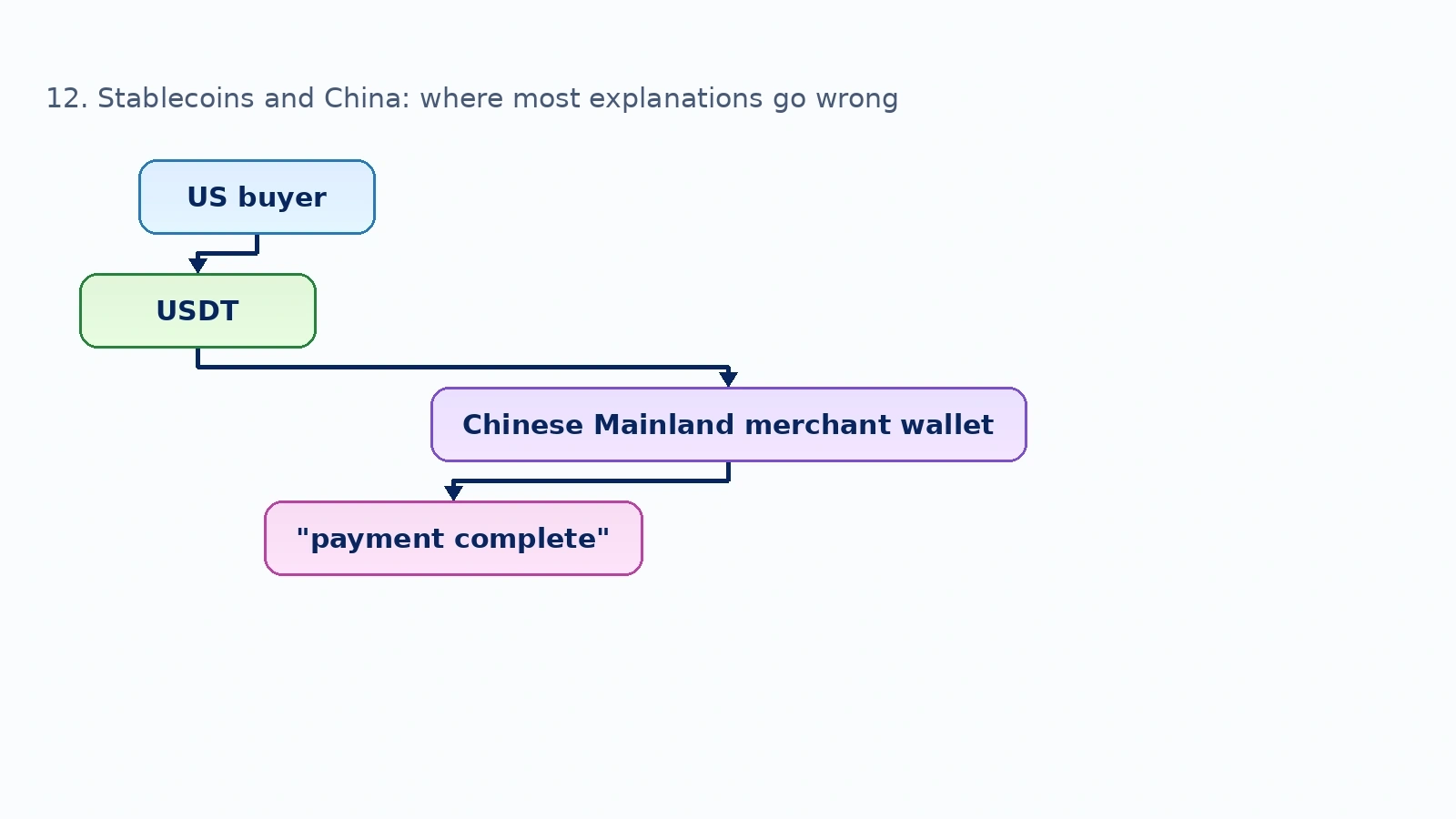
That diagram ignores the Mainland regulatory environment.
A more useful distinction is:
Stablecoin-funded offshore treasury
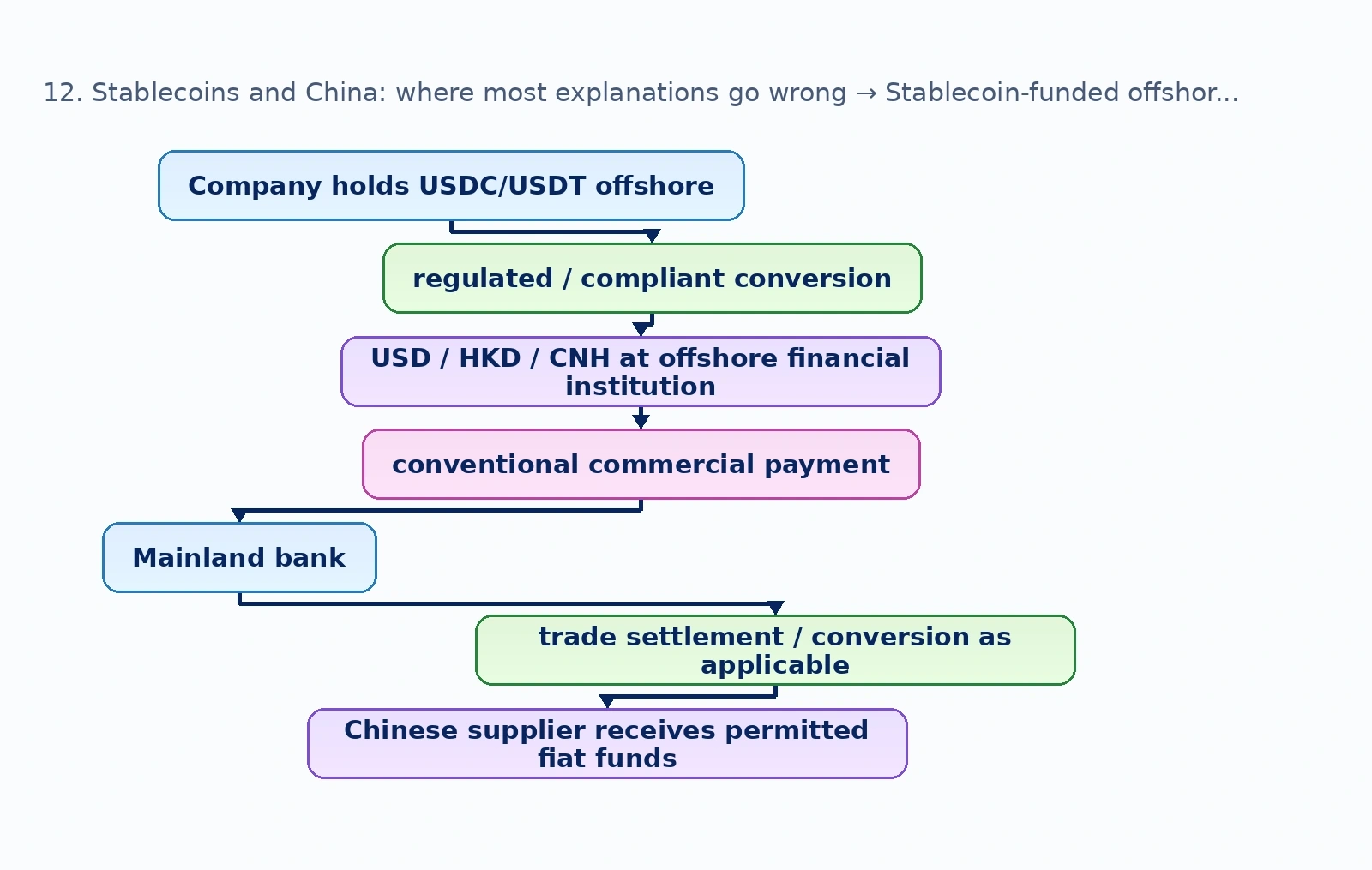
The stablecoin is used before the China payment, not necessarily as the China payment.
This can be relevant for companies that:
Receive digital assets internationally.
Maintain crypto-native treasury balances.
Need 24/7 movement between offshore counterparties.
Use regulated digital-asset infrastructure in a jurisdiction where it is permitted.
But by the time the transaction enters the Mainland banking perimeter, the critical questions become conventional banking questions:
Who is the payer?
Who is the beneficiary?
What is being purchased?
What currency is being sent?
Where was the fiat sourced?
Can the source of funds be demonstrated?
Do the invoice, contract and bank payment match?
Is the intermediary regulated?
Is the commercial purpose legitimate?
Does the receiving bank accept the structure?
Read the detailed guide: Stablecoin Payments to China: USDC, USDT, Hong Kong and the Fiat Off-Ramp
13. What about informal USDT/OTC settlement?
Informal OTC markets and personal-account settlement networks exist in many parts of the world.
Their existence does not make them compliant trade infrastructure.
A structure that effectively does this:
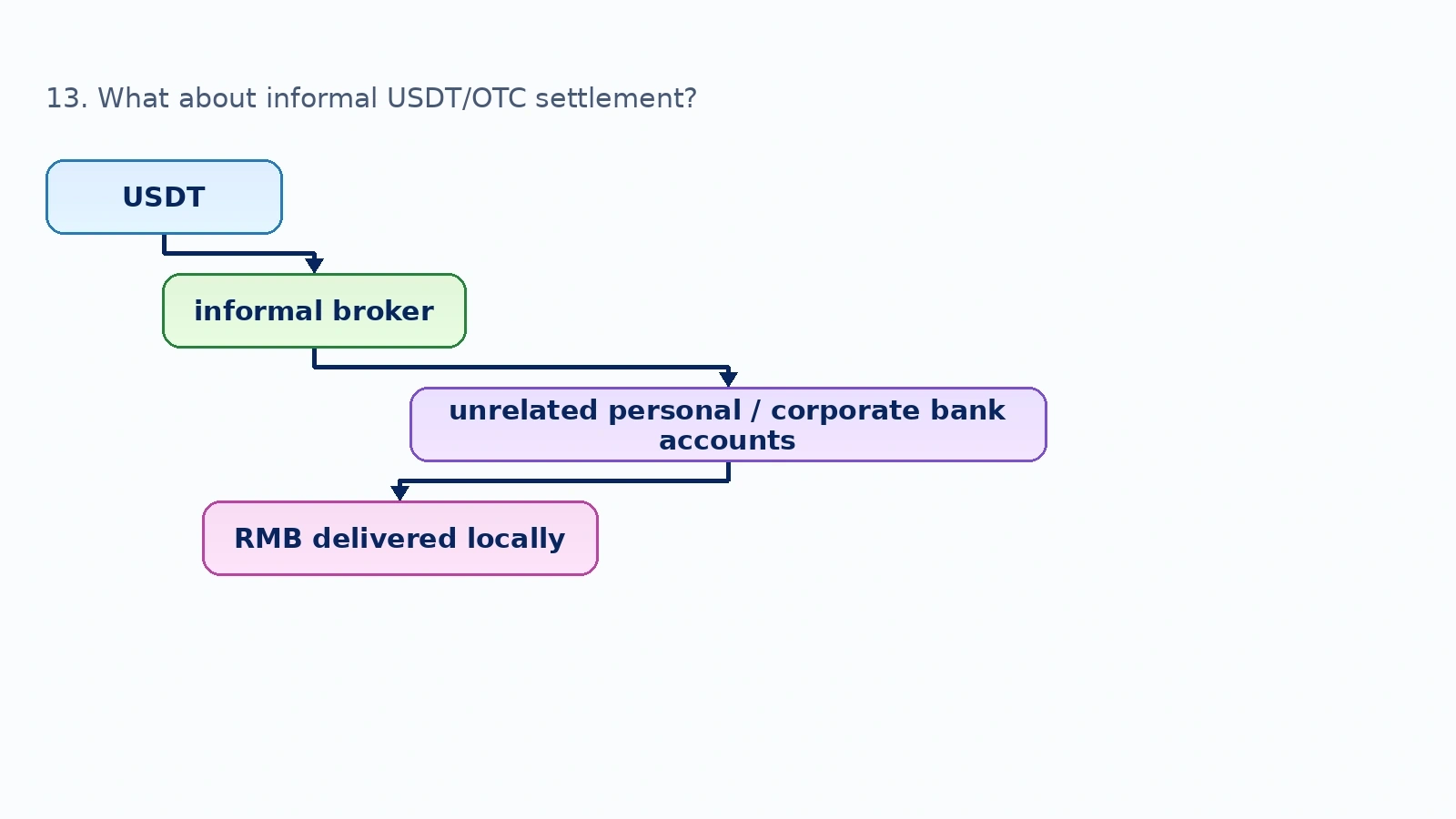
can create severe issues involving:
Unlicensed financial activity.
Source-of-funds opacity.
AML exposure.
Fraud.
Account freezing.
Tax mismatches.
False invoicing.
Capital-control evasion.
Third-party payment discrepancies.
Inability to demonstrate a clean audit trail.
For a legitimate importer, exporter, payment company or regulated financial institution, the relevant question is not:
Can someone deliver RMB?
It is:
"Can the entire transaction survive bank, auditor, regulator, tax and compliance scrutiny?"
That is a much higher standard.
14. e-CNY is not USDC, USDT or CNH
China’s e-CNY is a central bank digital currency issued within the official Chinese monetary framework.
It is fundamentally different from:
USDC
USDT
Bitcoin
Offshore CNH balances
A commercial-bank deposit token
A simplified comparison:
Feature | e-CNY | CNY bank deposit | CNH | USDC/USDT |
|---|---|---|---|---|
Issuer / monetary anchor | PBOC framework | Commercial bank liability denominated in RMB | Offshore RMB bank/market ecosystem | Private stablecoin issuer |
Currency | RMB | RMB | RMB | Usually USD-linked |
Mainland legal framework | Official | Official | Cross-border/offshore RMB framework | Virtual-currency restrictions apply |
Typical purpose | Digital sovereign money / payments | Banking | Offshore RMB trade/finance/FX | Blockchain-based offshore value transfer |
Read: e-CNY vs CNY, CNH, USDC and USDT
15. How to decide how to pay a Chinese supplier
Before choosing USD, RMB, CNH, HKD or any stablecoin-funded treasury route, obtain answers to these questions.
Beneficiary questions
Is the contracting company incorporated in Mainland China or Hong Kong?
Is the beneficiary account in Mainland China or offshore?
Does the bank account name exactly match the contracting entity?
What currency can that account receive?
Does the supplier want USD or RMB?
Is the supplier quoting an onshore CNY price or an offshore RMB price?
Is a third-party collection company involved?
Commercial questions
What does the contract state?
What currency is the invoice?
What are the Incoterms?
Who bears FX risk?
Is the amount fixed in USD or RMB?
Are partial payments allowed?
Is there a deposit and final payment?
Is trade finance involved?
Banking questions
Which bank receives the money?
Is there an intermediary bank?
Can the payer’s bank send RMB?
Can the beneficiary bank receive cross-border RMB?
Is CIPS available through the banking chain?
What payment-purpose code is required?
What documents are required?
Compliance questions
Is the payer the contracting buyer?
Is the beneficiary the contracting seller?
Is there any unrelated third party?
Is the source of funds explainable?
Are goods/services real and documented?
Does the payment amount reconcile with the invoice?
Is a crypto/stablecoin conversion somewhere in the source-of-funds chain?
If yes, can the bank accept and evidence that source?
For a step-by-step version, read How to Pay a Chinese Supplier: USD, CNY, CNH or HKD?
16. Decision table: which currency or rail fits which situation?
Situation | Typical candidate | Why |
|---|---|---|
Mainland domestic sale | CNY | Domestic currency and banking system |
Foreign buyer paying Mainland exporter in RMB | Offshore RMB / cross-border RMB | Supplier receives RMB; buyer sources offshore liquidity |
Foreign buyer paying invoice in USD | USD | Global liquidity and familiar correspondent banking |
Hong Kong local operating expense | HKD | Hong Kong’s local currency |
Hong Kong treasury funding China trade | CNH / USD / HKD depending structure | Multi-currency hub |
Offshore RMB hedging | CNH instruments | Offshore market pricing |
Cross-border RMB bank settlement | CIPS / RMB correspondent infrastructure | RMB clearing and settlement |
Crypto-native offshore treasury before fiat trade payment | USDC/USDT may be an upstream funding asset | Must be converted and banked compliantly before Mainland settlement |
Mainland sovereign digital-money use case | e-CNY | Official digital RMB framework |
17. Pros and cons
CNY / onshore RMB
Pros
Native Mainland settlement currency.
Natural match for domestic costs.
Eliminates supplier’s need to convert foreign currency when invoice is RMB-denominated.
Supported by China’s policy of expanding RMB use.
Cons
Onshore FX market is managed.
Cross-border movement is subject to controls and reporting.
Foreign buyers may have less direct access than to USD.
CNH / offshore RMB
Pros
Gives offshore companies access to RMB liquidity.
Useful for RMB trade settlement.
Supports offshore hedging and treasury.
Hong Kong offers deep RMB infrastructure.
Cons
Can trade differently from CNY.
Offshore funding conditions can change.
CNH liquidity is not the same as unrestricted access to the Mainland CNY market.
HKD
Pros
Highly developed Hong Kong banking ecosystem.
Linked to USD under Hong Kong’s currency-board system.
Useful for Hong Kong operations and treasury.
Cons
Not Mainland China’s domestic currency.
Adds another FX leg if final beneficiary needs RMB.
USD
Pros
Extremely liquid.
Familiar global trade currency.
Deep trade-finance and hedging markets.
Cons
Chinese beneficiary may need conversion into CNY.
Adds USD exposure and dependence on dollar correspondent rails.
USDC / USDT
Pros
24/7 blockchain transfer.
Useful in permitted offshore digital-asset markets.
Can be operationally fast between compatible counterparties.
Cons
Not legal tender in Mainland China.
Mainland virtual-currency restrictions are severe.
Fiat off-ramp and bank acceptance are critical.
Stablecoin, exchange, custodian and blockchain risks remain.
Source-of-funds scrutiny may be significant.
18. The strategic picture: what China is trying to achieve
It is useful to separate three policies.
Policy 1 More RMB in global trade and finance
China wants more companies, banks and governments to be able to price, pay, finance and invest in RMB.
Policy 2 Maintain monetary and financial control
China is not converting the Mainland system into an unrestricted free-capital-flow regime overnight.
Policy 3 Build controlled bridges
Those bridges include:
Hong Kong’s offshore RMB market
Offshore RMB clearing banks
Currency-swap arrangements
CIPS
Cross-border trade settlement;
Financial-market connect programs
Incremental facilitation measures.
This explains why the system can be simultaneously more international and still controlled.
19. A practical architecture for companies trading with China
A robust China payment setup usually has five layers.
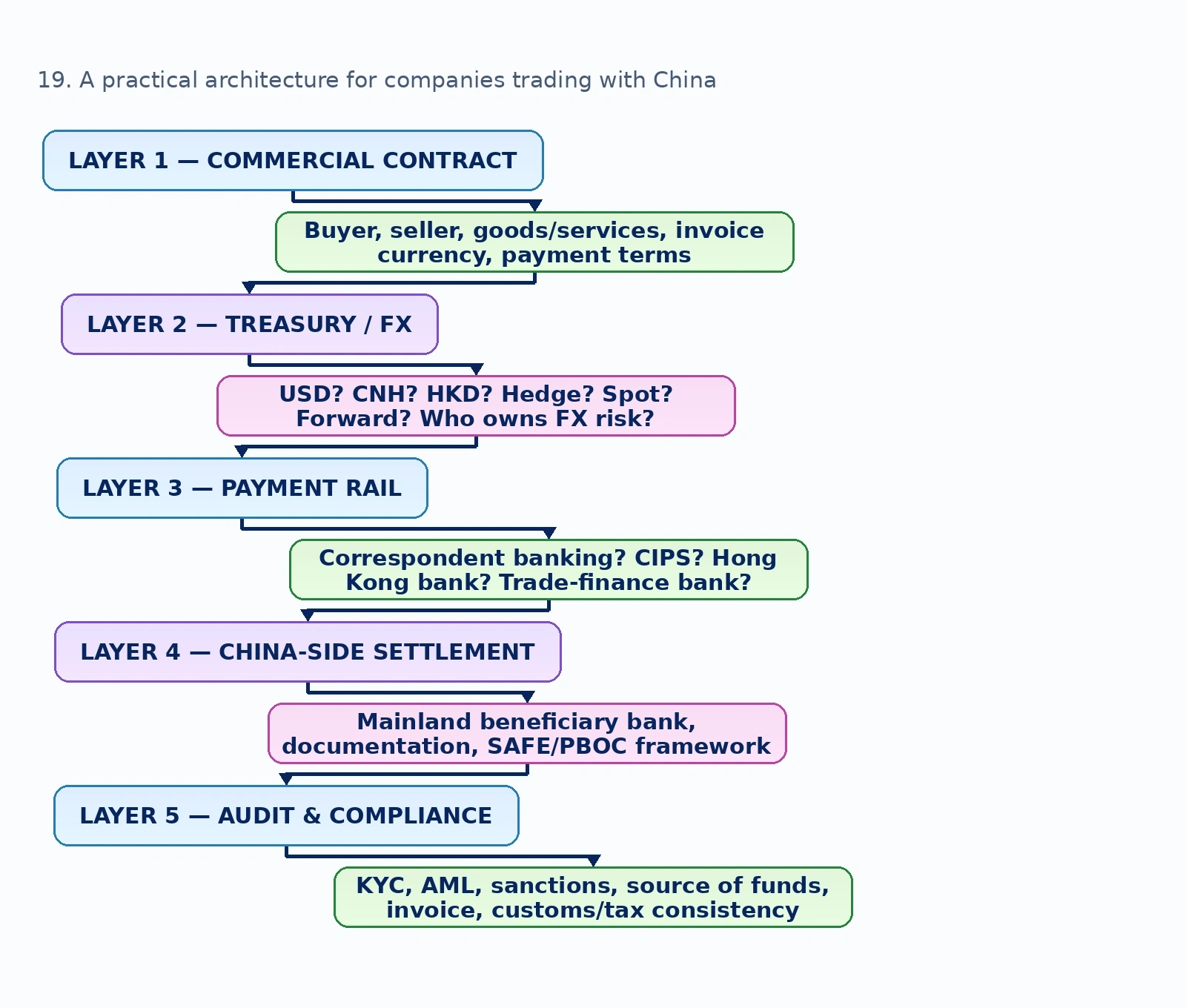
A fast payment is not necessarily a good payment.
The best payment is one where all five layers align.
20. Frequently asked questions
Is RMB the same as CNY?
RMB is the name/abbreviation for renminbi. CNY is the official ISO currency code. In market practice, CNY also refers to the onshore RMB market.
Is CNH a different currency from CNY?
No. CNH is the market designation for offshore renminbi. It can have a different market exchange rate and funding conditions because the offshore and onshore pools are not completely interchangeable.
Is CNH an official ISO currency code?
No. CNY is the official ISO 4217 code. CNH is widely used in FX and financial markets to identify offshore RMB.
Why does Hong Kong use HKD if it is part of China?
Hong Kong maintains a separate monetary and financial system. HKD is its local currency. Hong Kong also hosts a major offshore RMB market.
Can I wire RMB from the United States to China?
Potentially, yes, if your bank/payment provider supports cross-border RMB and the Chinese beneficiary bank can receive the payment. The commercial purpose and documentation still matter.
Can a Chinese supplier invoice me in CNH?
Commercial terminology may refer to offshore RMB/CNH, but operational payment instructions often use CNY as the currency code. Clarify the beneficiary bank’s required payment format rather than relying solely on invoice terminology.
Is CIPS replacing SWIFT?
That is an oversimplification. CIPS is an RMB clearing and settlement infrastructure. SWIFT is principally a financial messaging network. They can interact in the same payment architecture.
Can I pay a Mainland Chinese supplier in USDT?
Mainland China’s regulatory framework prohibits virtual-currency-related business activities. A compliant commercial structure should not be assumed to permit direct USDT settlement to a Mainland merchant. An offshore company may separately convert permitted digital assets into fiat through regulated channels and then make a conventional documented trade payment, subject to bank acceptance and applicable law.
Is Hong Kong a workaround for Mainland China’s crypto rules?
No. Hong Kong and Mainland China have different virtual-asset regulatory frameworks, but a Hong Kong leg does not erase Mainland rules governing the final Mainland transaction.
What is the biggest mistake foreign companies make?
Treating payment mechanics as separate from the underlying commercial transaction. In China, the contract, invoice, beneficiary, source of funds, payment purpose and bank documentation need to tell the same story.
Related China currency and payment primers
Start With the Flow of Funds
If your business needs to move money to, from or through China or Hong Kong, the correct structure depends on the flow of funds, beneficiary, payment purpose, licensing footprint, banking partners and settlement currencies.
Before selecting a provider, map:
payer → originating bank/provider → FX leg → settlement rail → intermediary → beneficiary bank → final beneficiary.
That flow usually reveals the regulatory and banking requirements far more quickly than starting with a product name.
Primary and authoritative sources
This primer was researched and updated for September 2026. Regulatory requirements can change, and transaction-level treatment depends on the parties, banks, purpose of payment, documentation, and jurisdictions involved.
State Administration of Foreign Exchange (SAFE), first-half 2026 foreign-exchange press conference
SAFE, reforms facilitating cross-border trade and investment
Hong Kong Monetary Authority (HKMA), Linked Exchange Rate System terminology
China State Council Information Office, September 2026 RMB internationalization policy
Library of Congress, May 2026 summary of China's February 2026 virtual-currency and stablecoin rules