
Hong Kong simultaneously operates with HKD, USD and offshore RMB.
It is one of the currency guides in our China Payments section.
That does not mean Hong Kong has three domestic currencies. It means Hong Kong is a local economy with its own currency and a global financial center with deep foreign-currency and RMB markets.
HKD is Hong Kong’s local currency
The Hong Kong dollar is a separate currency from renminbi.
The HKMA operates the Linked Exchange Rate System around HK$7.80 per US$1, with convertibility undertakings at HK$7.75 and HK$7.85.
That framework is fundamentally different from the Mainland CNY exchange-rate regime.
CNH is offshore RMB
Hong Kong is the leading offshore RMB hub.
Banks in Hong Kong can provide:
RMB deposits
Trade settlement
Offshore RMB lending
CNH FX
RMB bonds
Derivatives
RMB treasury services
Cross-border settlement
The offshore RMB ecosystem allows global businesses to use RMB without placing all offshore trading inside the Mainland financial system.
Why Hong Kong became the bridge
Hong Kong combines:
Close economic integration with Mainland China.
Its own monetary and banking system.
International banks.
Mature FX and capital markets.
A freely convertible local currency.
Global legal and financial infrastructure.
Direct cross-border financial links with the Mainland.
2026: Offshore RMB liquidity is being expanded
Hong Kong authorities and the PBOC have continued to deepen the offshore RMB market.
In July 2026, the HKMA announced measures including expanding its RMB Business Facility to RMB 500 billion, extending available tenors and exploring additional offshore RMB liquidity and market-development mechanisms.
The policy logic is straightforward:
More offshore RMB liquidity makes it easier for companies and financial institutions outside Mainland China to borrow, trade, hedge and settle in RMB.
How HKD, USD and CNH coexist
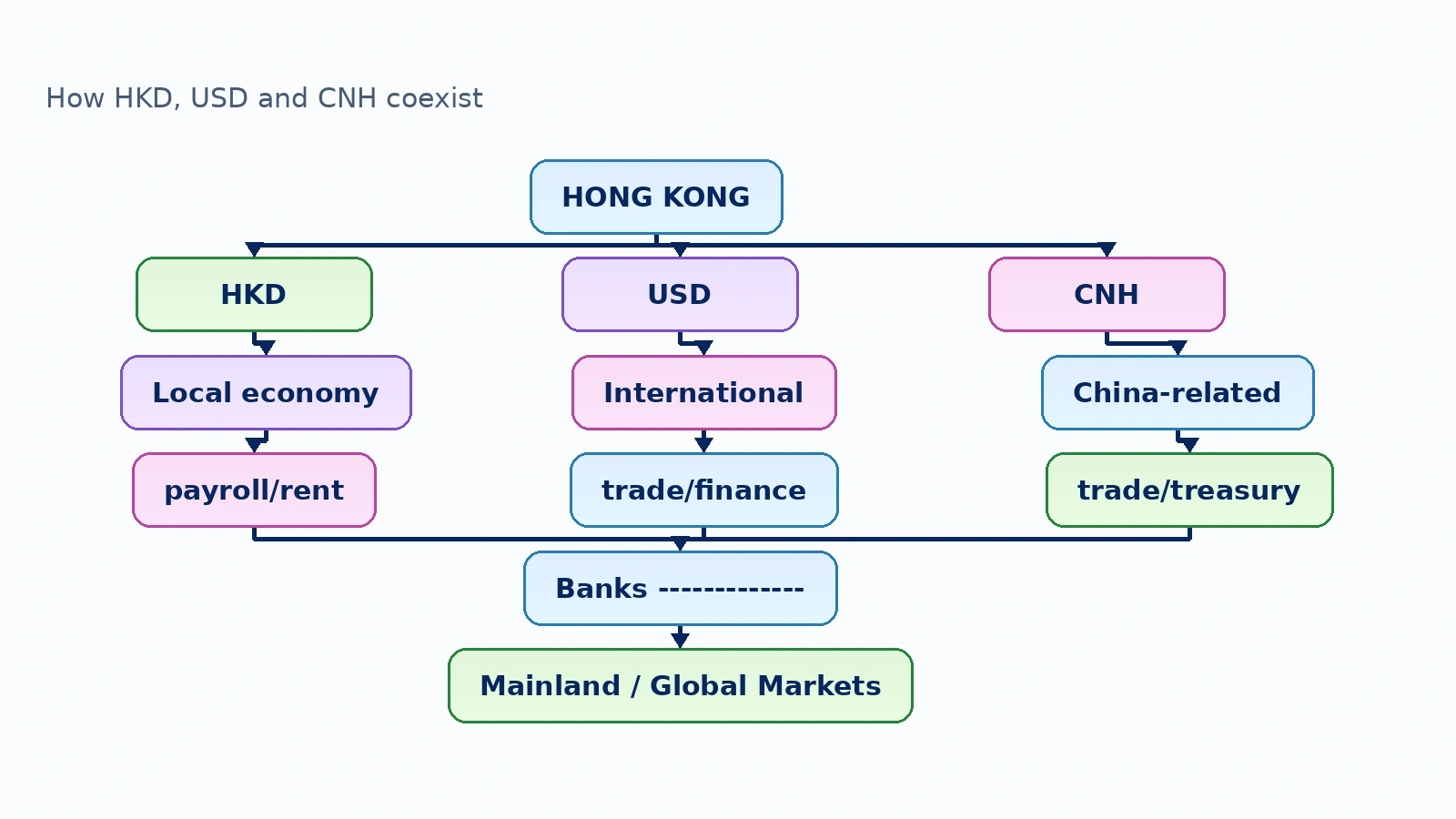
Example: Hong Kong trading company
A Hong Kong company buys goods from a Guangdong factory and resells them globally.
It could:
Invoice foreign customers in USD.
Maintain operating expenses in HKD.
Buy CNH to settle China payables.
Hedge future RMB exposure.
Borrow offshore RMB if economically attractive.
This is normal multi-currency treasury management.
HKD versus CNH
Feature | HKD | CNH |
|---|---|---|
What is it? | Hong Kong’s sovereign/local currency | Offshore-market designation for RMB |
Monetary authority | HKMA framework | Underlying RMB ultimately relates to PBOC monetary system |
Exchange-rate regime | Linked Exchange Rate System vs USD | Offshore market pricing |
Main use | Hong Kong domestic economy and finance | Offshore RMB trade, finance and hedging |
Relationship to Mainland CNY | Separate currency | Same underlying RMB, different market pool |
Is Hong Kong a way around Mainland controls?
No.
Hong Kong can provide a legitimate offshore financial layer, but a transaction that ultimately enters Mainland China still has to comply with applicable Mainland rules.
A Hong Kong account does not make a false invoice genuine or an impermissible payment purpose permissible.
Paying a Mainland-related supplier through Hong Kong
Using Hong Kong can be legitimate, but the Hong Kong entity must have a real and documented role.
Reasonable structures include:
- A Hong Kong company that issued the invoice and is the contractual seller
- A disclosed Hong Kong trading affiliate of the Mainland manufacturer
- A group treasury company authorized to collect payments
- A Hong Kong distributor purchasing from a Mainland factory and reselling internationally
- A documented collection or agency arrangement accepted by the relevant banks
Warning signs include:
- A personal beneficiary account
- An unexplained third-party company
- Bank instructions changed only by email
- A beneficiary whose business is inconsistent with the goods
- Split payments to multiple unrelated accounts
- Claims that Hong Kong removes the need for genuine invoices, customs consistency or regulatory review
Read the step-by-step supplier-payment guide
Hong Kong and stablecoins
Hong Kong has its own virtual-asset regulatory framework. That makes it potentially relevant as an offshore conversion or treasury jurisdiction.
But:
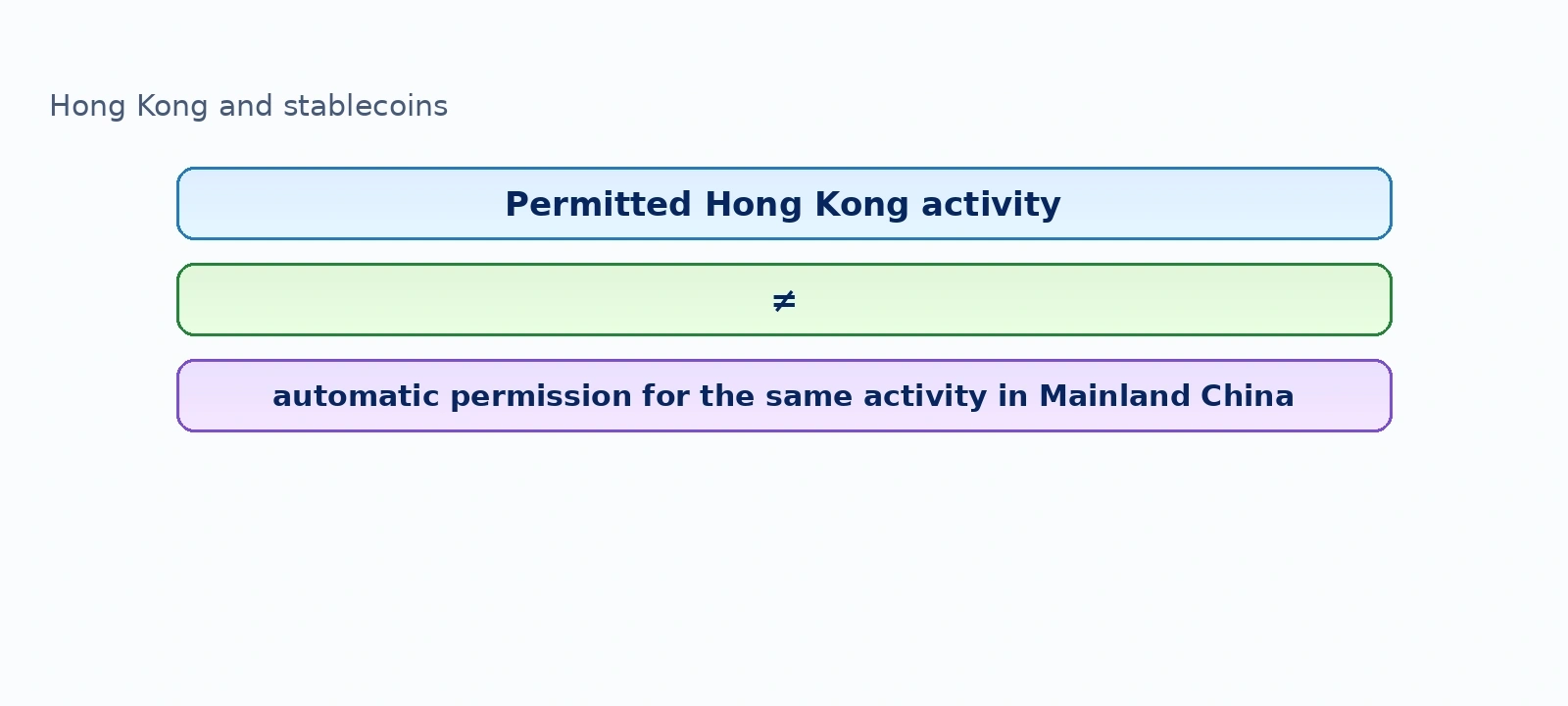
If a Hong Kong entity converts a permitted digital asset into HKD/USD/CNH and then pays a Mainland counterparty, the Mainland leg is still evaluated as a cross-border fiat transaction with its own regulatory and banking requirements.
Request a China Trade Payment Feasibility Review
Provide the supplier, the Hong Kong entity and its role, the invoice, the beneficiary instructions, the currency and the monthly volume.
Faisal Khan LLC can assess the flow, identify structural gaps, source potential regulated providers and coordinate introductions. Faisal Khan LLC does not take custody of or transmit client funds.
Related guides
Primary and authoritative sources
This primer was researched and updated for September 2026. Regulatory requirements can change, and transaction-level treatment depends on the parties, banks, purpose of payment, documentation, and jurisdictions involved.
State Administration of Foreign Exchange (SAFE), first-half 2026 foreign-exchange press conference
SAFE, reforms facilitating cross-border trade and investment
Hong Kong Monetary Authority (HKMA), Linked Exchange Rate System terminology
China State Council Information Office, September 2026 RMB internationalization policy
Library of Congress, May 2026 summary of China's February 2026 virtual-currency and stablecoin rules