
The phrase stablecoin payment to China hides several completely different transaction structures.
It sits within our China Payments section, which covers the bank-rail routes this page compares against.
Some are legitimate offshore treasury arrangements.
Some are legally uncertain.
Some are plainly inconsistent with Mainland China’s virtual-currency restrictions.
The first task is therefore to separate where the stablecoin leg occurs from where the commercial settlement occurs.
Mainland China’s 2026 position
On February 6, 2026, the PBOC and other Chinese authorities issued an updated virtual-currency framework.
The rules reaffirm that virtual currencies do not have the same legal status as fiat currency in China and that virtual-currency-related business transactions are prohibited as illegal financial activities.
The 2026 framework also addresses stablecoins more explicitly and restricts offshore entities from providing virtual-currency-related services to domestic Mainland entities.
This makes a direct commercial model such as:
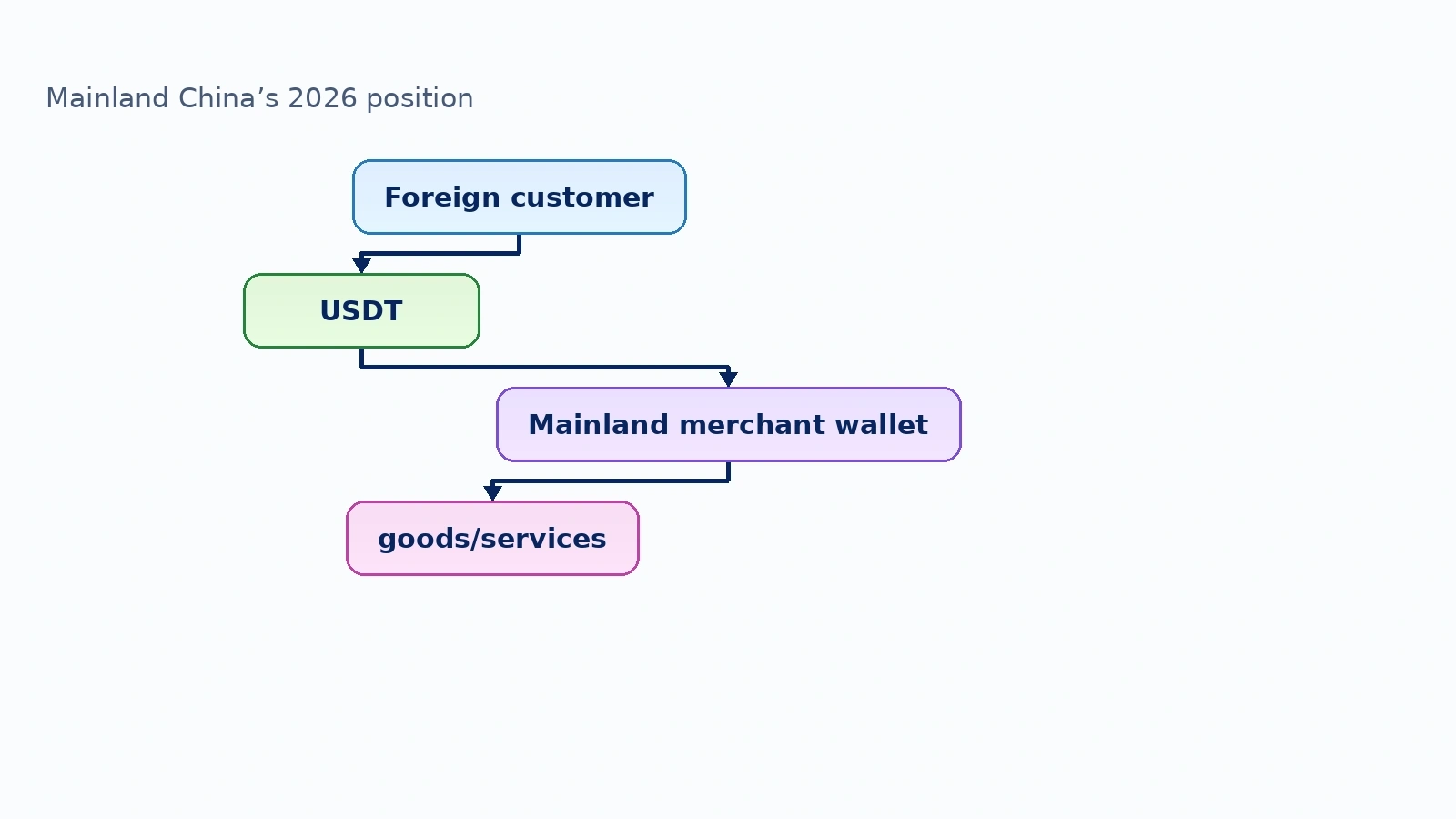
A fundamentally different regulatory proposition from an ordinary cross-border bank payment.
The key distinction: Stablecoin-funded versus stablecoin-settled
Stablecoin-settled
The merchant itself accepts the token as payment.
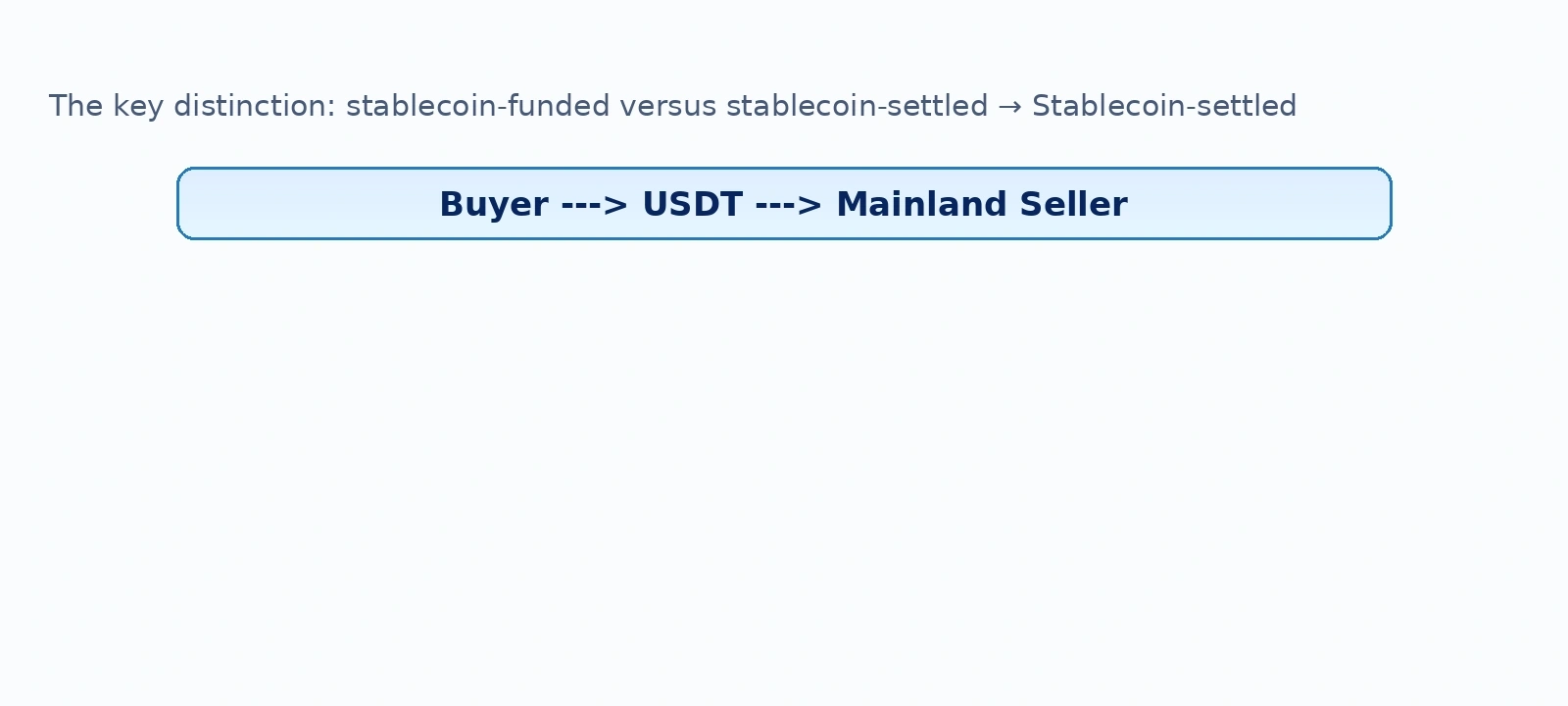
That directly engages Mainland virtual-currency restrictions.
Stablecoin-Funded
The buyer or an offshore treasury company begins with a stablecoin, converts it into conventional bank money outside Mainland China through a permitted/regulated route, and then makes an ordinary commercial bank payment.
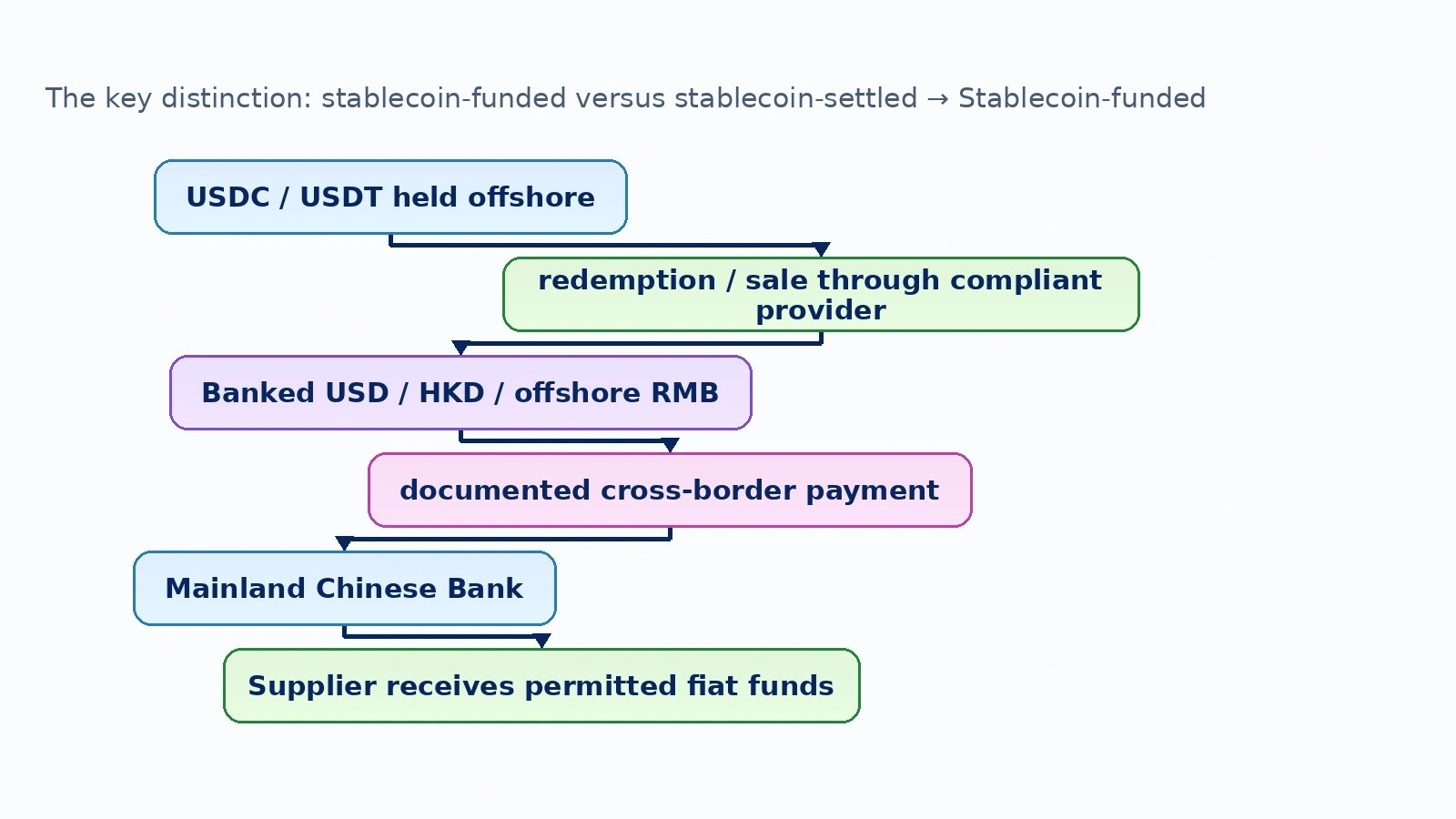
The final China-facing leg is fiat.
Example 1 offshore USDC treasury to USD trade payment
A U.S. digital business earns USDC.
It needs to pay a Chinese hardware manufacturer.
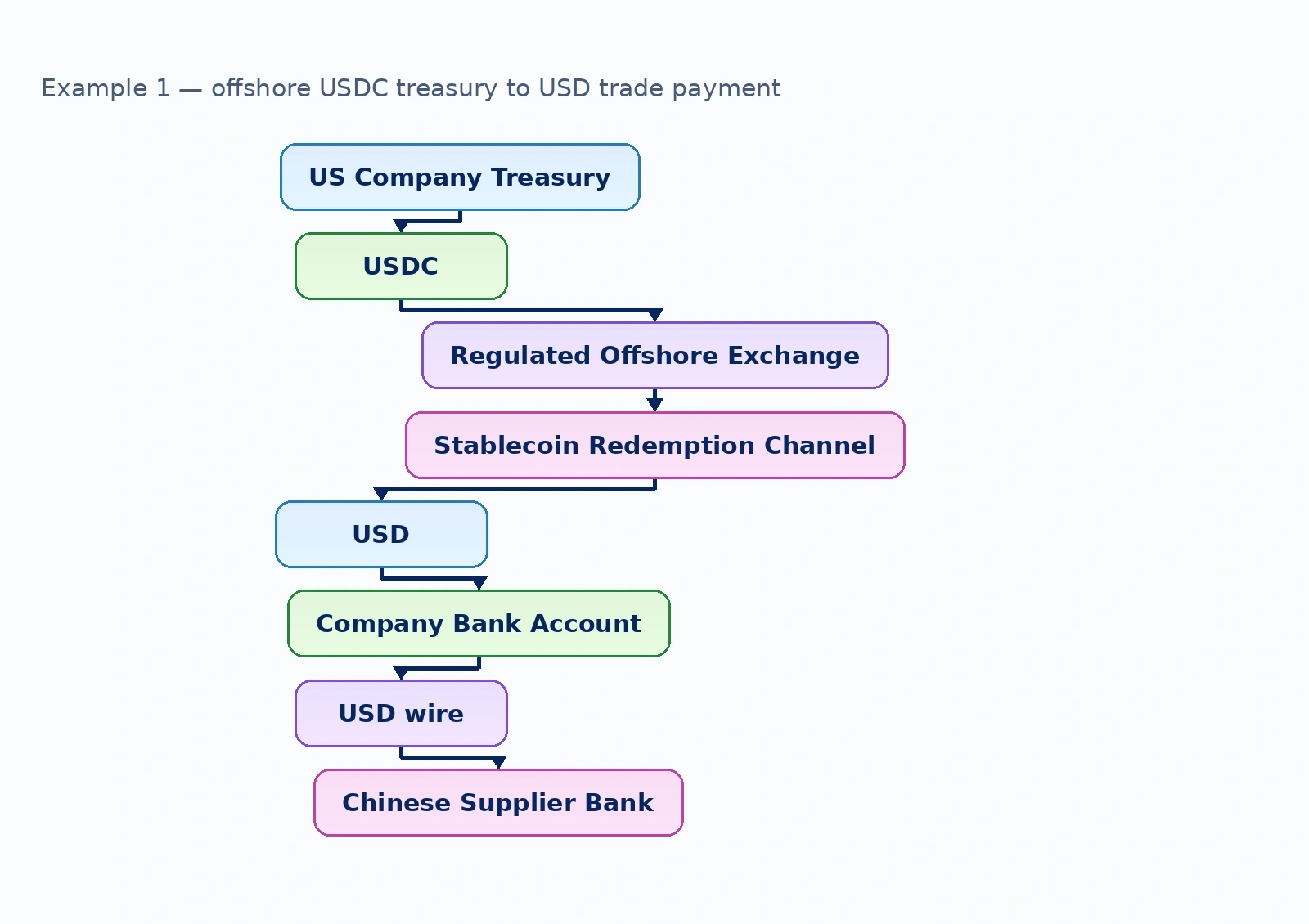
The supplier is paid in conventional bank money.
The payer must still be able to establish the source of funds and transaction purpose.
Example 2 — offshore stablecoin to CNH, then RMB payment
Conceptually:
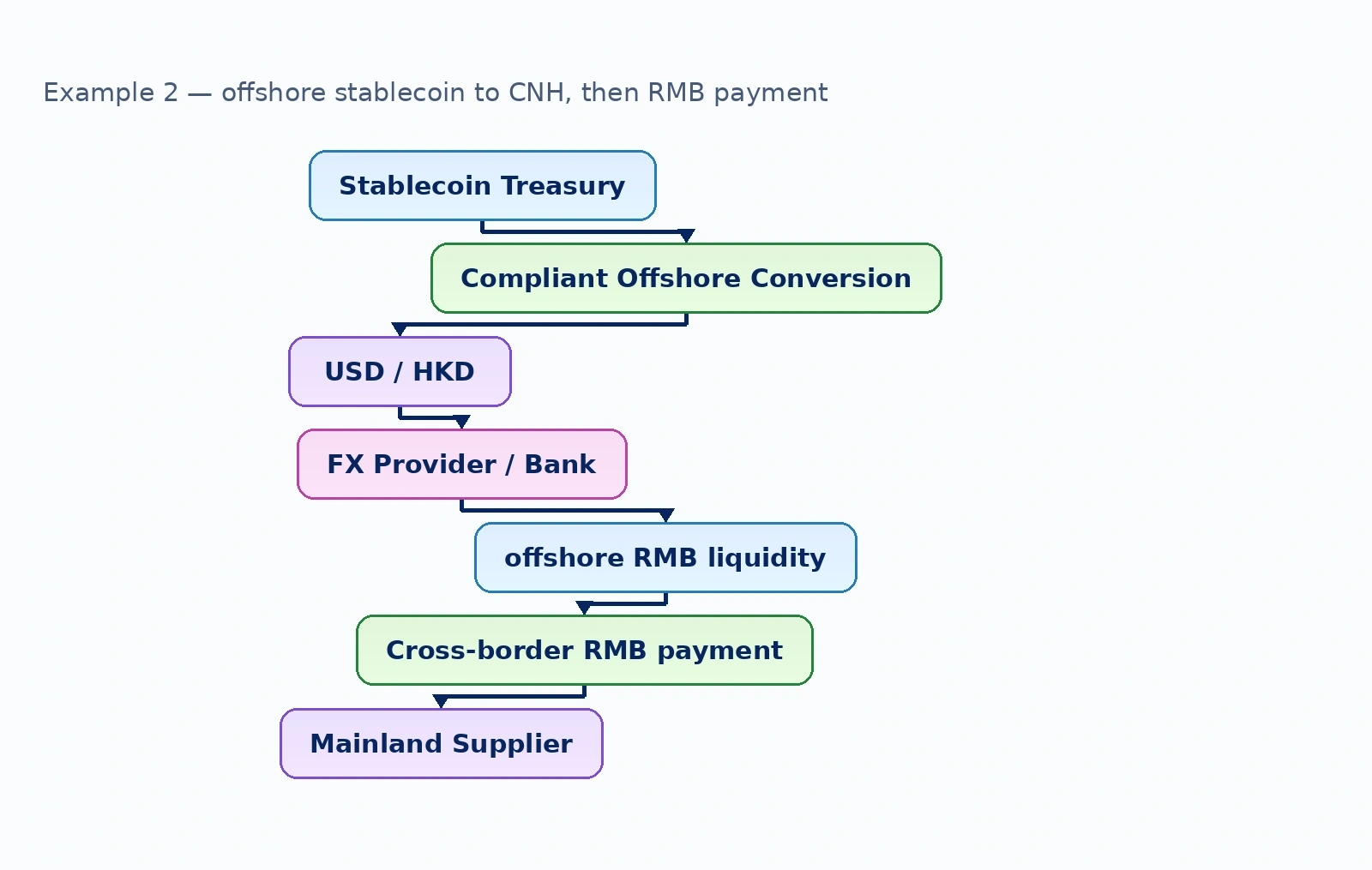
Whether any specific institution will support the flow depends on its licensing, banking partners, digital-asset policy, AML framework and source-of-funds requirements.
Why Hong Kong is discussed
Hong Kong is relevant because it has:
Deep USD and HKD banking;
The world’s leading offshore RMB market;
Regulated virtual-asset infrastructure under Hong Kong law;
Direct financial connectivity with Mainland China.
But the conceptual boundary must remain clear:
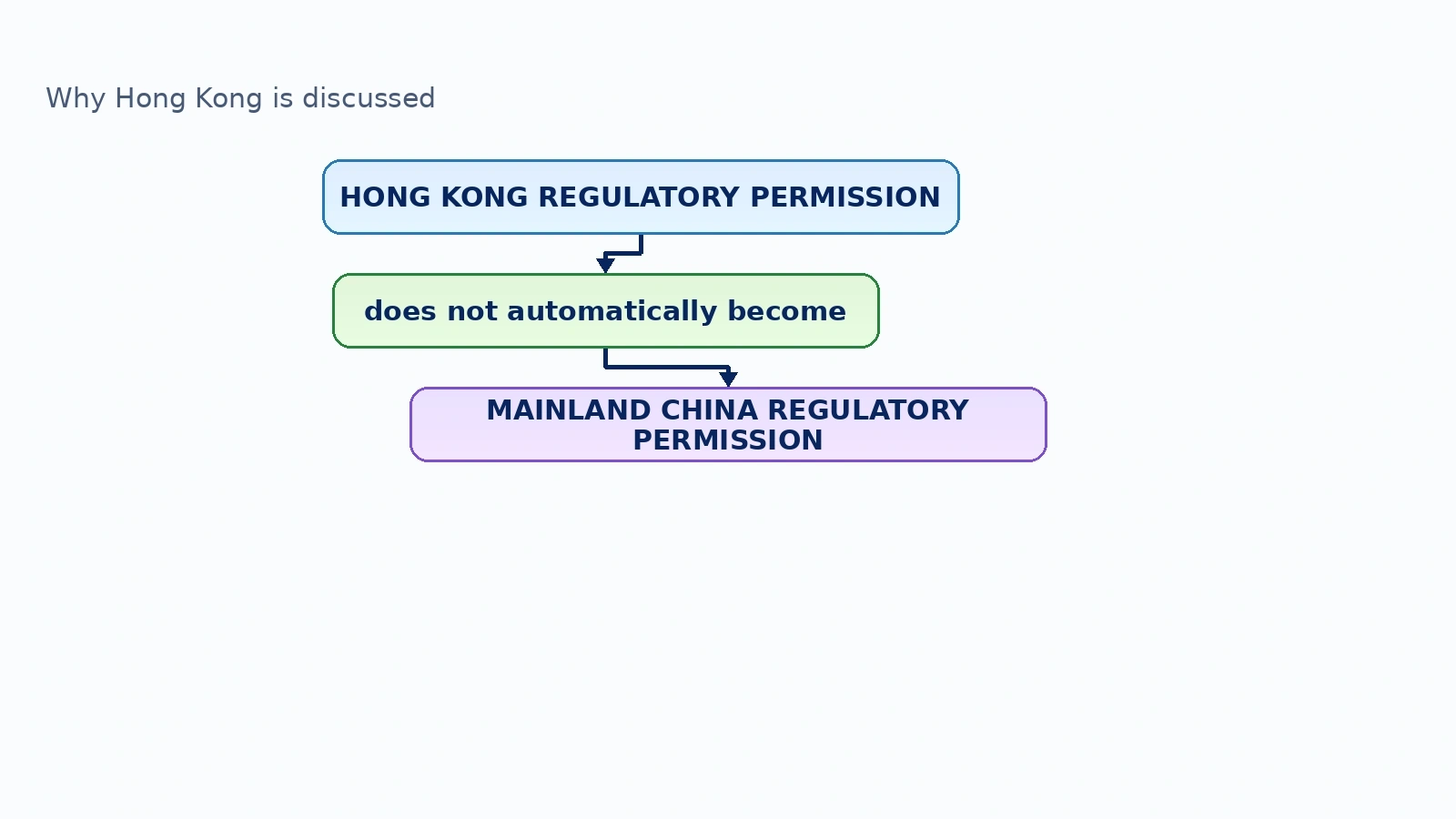
A Hong Kong conversion can potentially produce banked fiat. The subsequent payment into the Mainland remains a Mainland cross-border banking transaction.
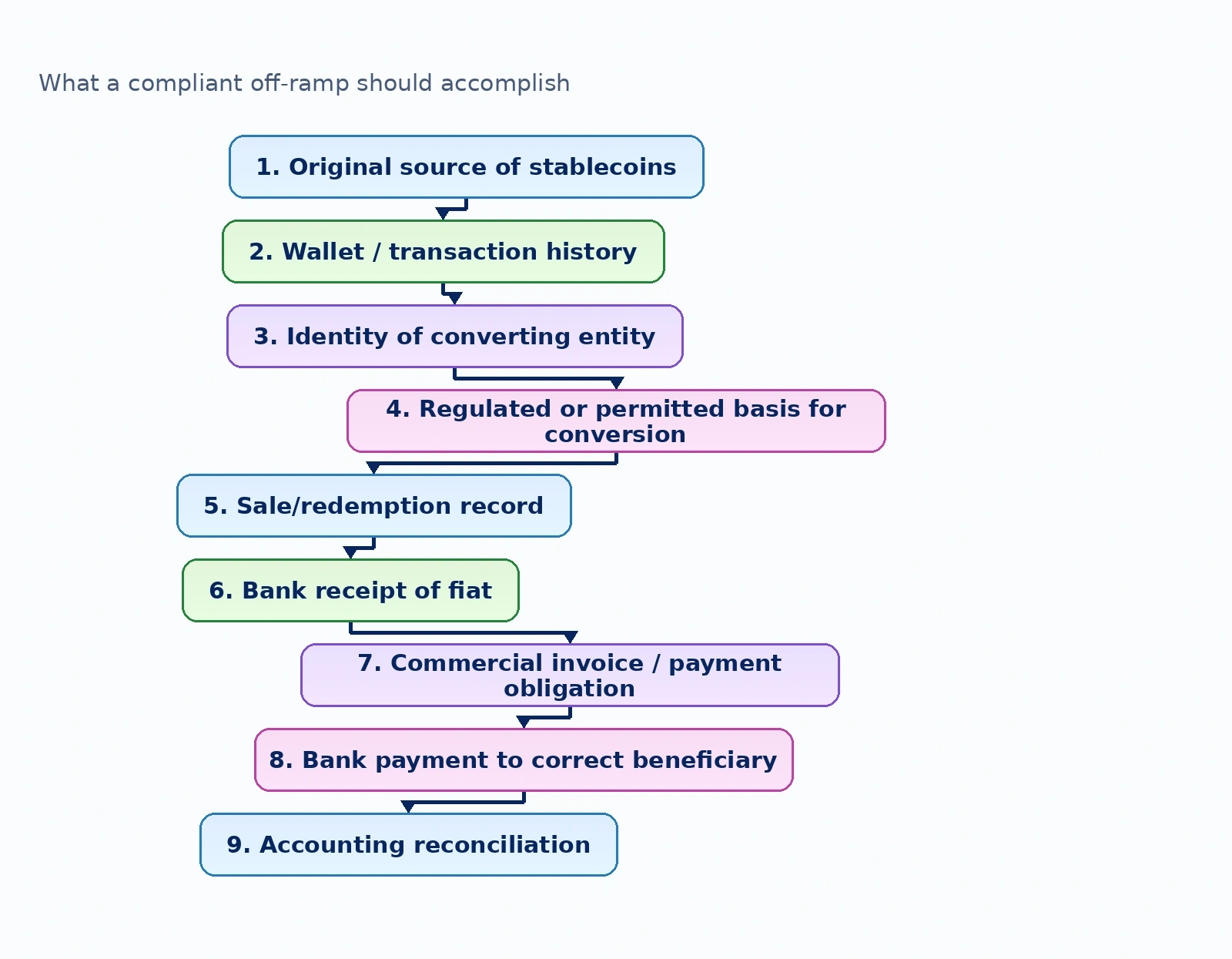
What a compliant off-ramp should accomplish
A strong off-ramp is not merely someone who gives you RMB.
It should produce a defensible chain showing:
Why informal OTC delivery is risky
An informal structure might look like:
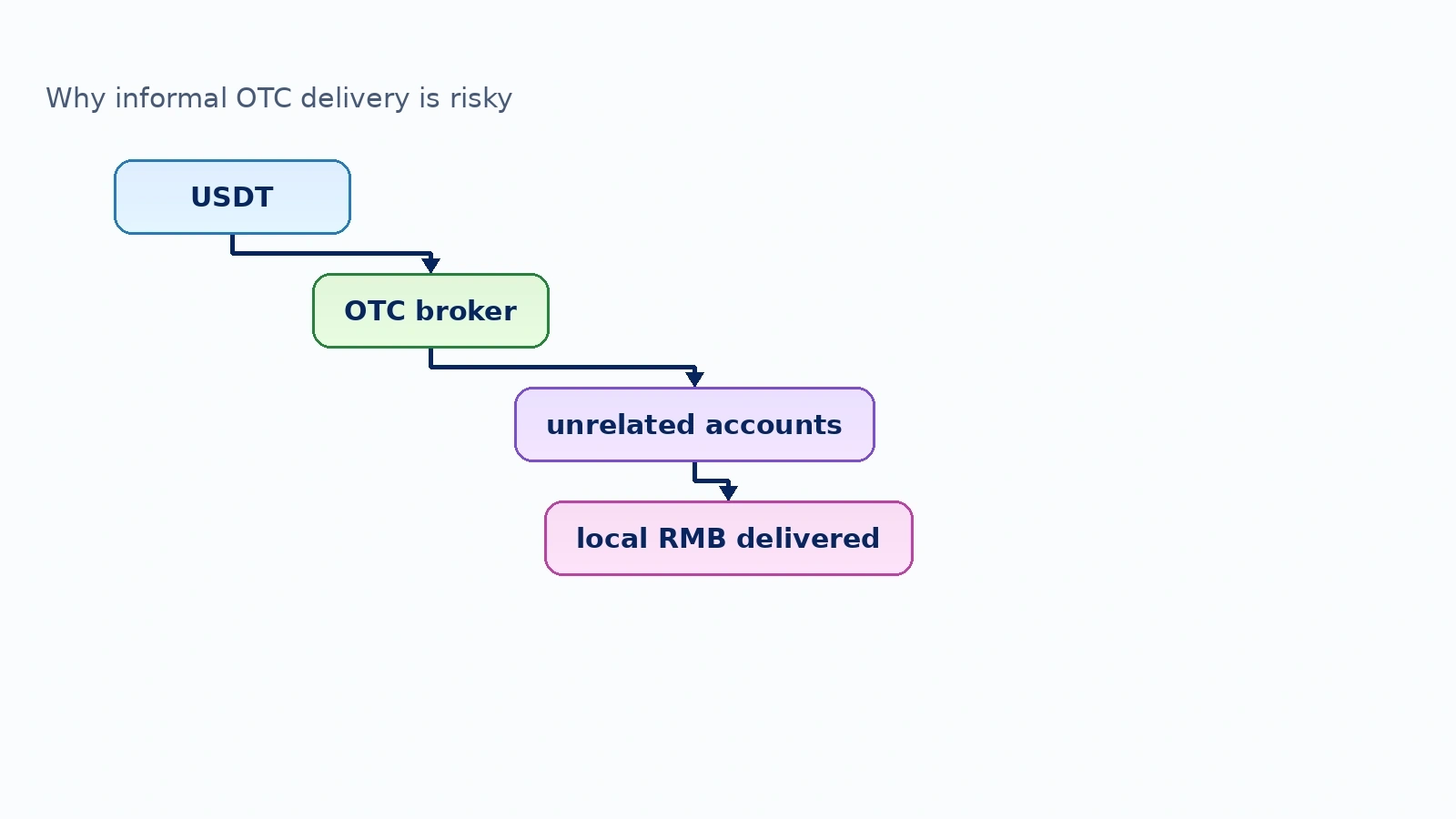
This can introduce:
Unknown counterparty risk;
Fraud;
Bank-account freezing;
Transaction laundering;
Third-party payment mismatches;
Money-transmission concerns;
AML exposure;
Source-of-funds failures;
False trade documentation;
Capital-control issues.
It may be fast. That is not the same as being bankable.
A useful due-diligence test
Ask whether the transaction can be explained in one sentence to:
The originating bank;
The Chinese beneficiary bank;
An auditor;
A regulator;
A tax authority.
If five different explanations are needed, the structure is weak.
Stablecoin choice: USDC versus USDT
For a China-related business flow, the most important distinction is usually not the token ticker.
More important questions are:
Where is the stablecoin legally held?
Which entity owns it?
Which provider converts it?
Is that provider regulated or permitted?
Which bank receives the fiat?
Will the bank accept crypto-origin funds?
What chain-analysis controls apply?
What documentation supports the source of funds?
What is the final settlement currency?
Who is the final beneficiary?
Do stablecoins eliminate FX?
No.
If the stablecoin is USD-linked and the supplier ultimately receives RMB, you still have an FX conversion:
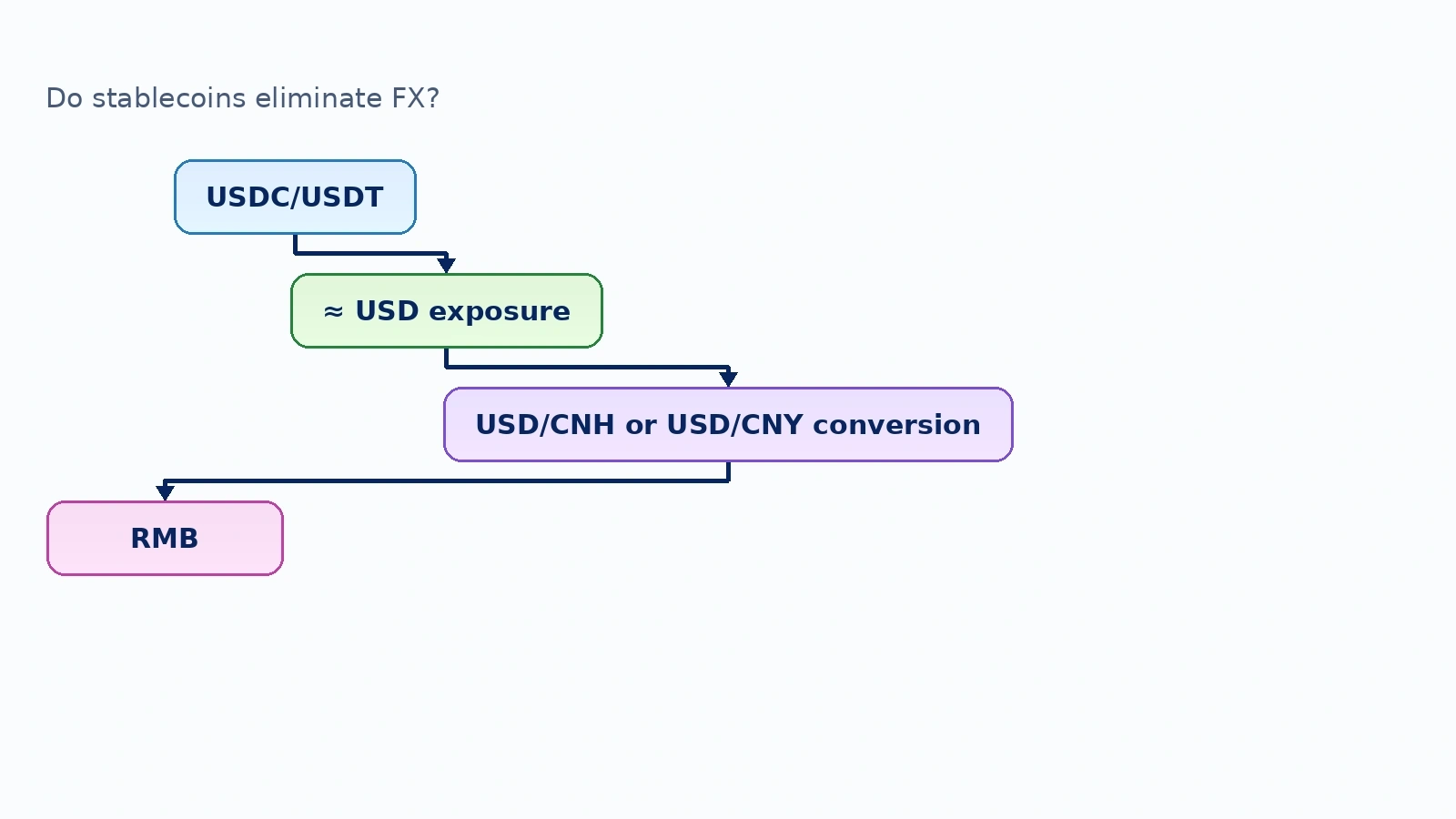
Stablecoins can change the movement and timing of value. They do not eliminate the underlying currency conversion.
Do stablecoins eliminate banks?
For Mainland trade settlement, generally no.
The moment the commercial beneficiary expects a conventional Mainland bank receipt, banking infrastructure remains part of the system.
Why businesses still consider a stablecoin leg
In permitted offshore contexts, stablecoins can offer:
24/7 transfer;
Rapid treasury repositioning;
Programmable settlement;
Access to digital-asset liquidity;
Potentially faster offshore movement between counterparties.
The benefit may exist before the China leg.
Compliance checklist
Stablecoin activity occurs in a jurisdiction and entity where it is permitted.
Conversion provider’s legal status verified.
Wallet ownership known.
Blockchain source-of-funds screening completed.
Stablecoin redemption/sale documented.
Fiat proceeds enter an account owned by the correct payer/treasury entity.
Payer-to-beneficiary relationship makes commercial sense.
Invoice and contract support the payment.
Receiving bank can accept the transaction.
No undisclosed unrelated personal accounts.
No false description of crypto-origin funds.
Tax/accounting treatment reconciles.
Request a China Trade Payment Feasibility Review
Provide the complete flow of funds, including who converts the stablecoin, where, and which entity pays the supplier in fiat.
Faisal Khan LLC can assess the flow, identify structural gaps, source potential regulated providers and coordinate introductions. Faisal Khan LLC does not take custody of or transmit client funds.
Related guides
Primary and authoritative sources
This primer was researched and updated for September 2026. Regulatory requirements can change, and transaction-level treatment depends on the parties, banks, purpose of payment, documentation, and jurisdictions involved.
State Administration of Foreign Exchange (SAFE), first-half 2026 foreign-exchange press conference
SAFE, reforms facilitating cross-border trade and investment
Hong Kong Monetary Authority (HKMA), Linked Exchange Rate System terminology
China State Council Information Office, September 2026 RMB internationalization policy
Library of Congress, May 2026 summary of China's February 2026 virtual-currency and stablecoin rules