
The correct way to pay a Chinese supplier is determined by the legal seller, beneficiary account, invoice currency, payment purpose, banking route and FX allocation.
This is the step-by-step guide in our China Payments section; the pages linked below go deeper on each step.
Do not begin with the question:
What is the cheapest payment app?
Begin with:
Who exactly am I paying, where is the beneficiary account, and what does the contract require?
Step 1 identify the legal seller
Your supplier may be:
A Mainland Chinese company.
A Hong Kong company.
A Mainland factory with a Hong Kong trading affiliate.
A foreign-owned Chinese company.
An export agent.
A marketplace.
A trading company that contracts separately from the manufacturer.
The payee should normally make commercial sense relative to the contract and invoice.
Step 2 identify the beneficiary account
Ask for:
Legal account name
Bank name;
Bank address
Account number
SWIFT/BIC
Supported currencies
Mainland or Hong Kong location
Payment-purpose requirements
Intermediary-bank instructions if relevant.
A request to pay an unrelated individual or unexplained third party is a compliance warning sign.
If the bank details suddenly change
A last-minute beneficiary change is not an ordinary administrative detail. It can result from a genuine treasury change, but it is also a common sign of business-email compromise and invoice-redirection fraud.
Verify changed instructions using a telephone number or contact channel established before the change request. Do not rely exclusively on the email containing the new account details. If the new beneficiary is a different legal entity, obtain a contractual explanation and confirm that the sending and receiving institutions accept the arrangement.
Step 3 decide the invoice currency
USD invoice
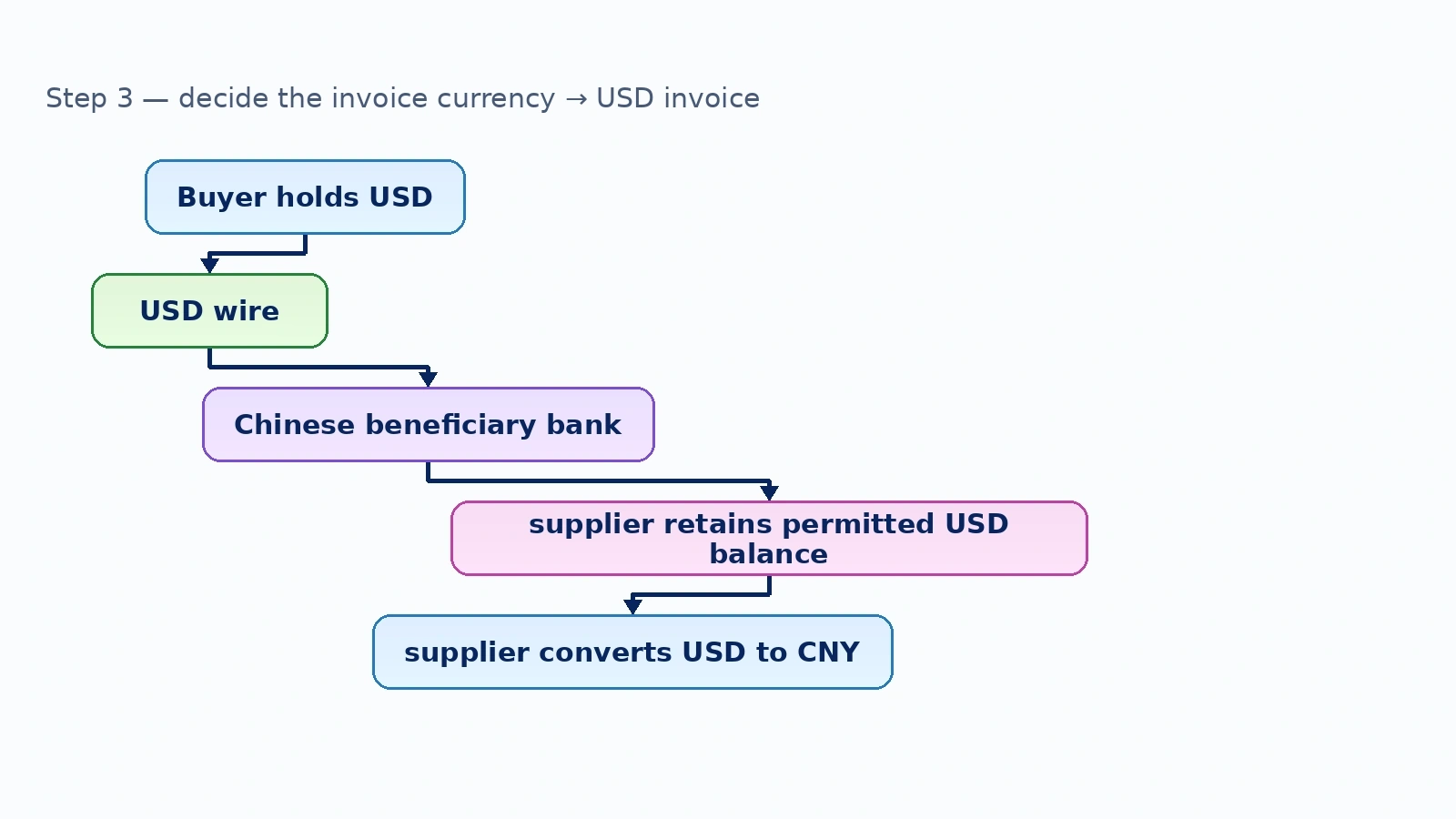
This is familiar to many international buyers.
RMB invoice
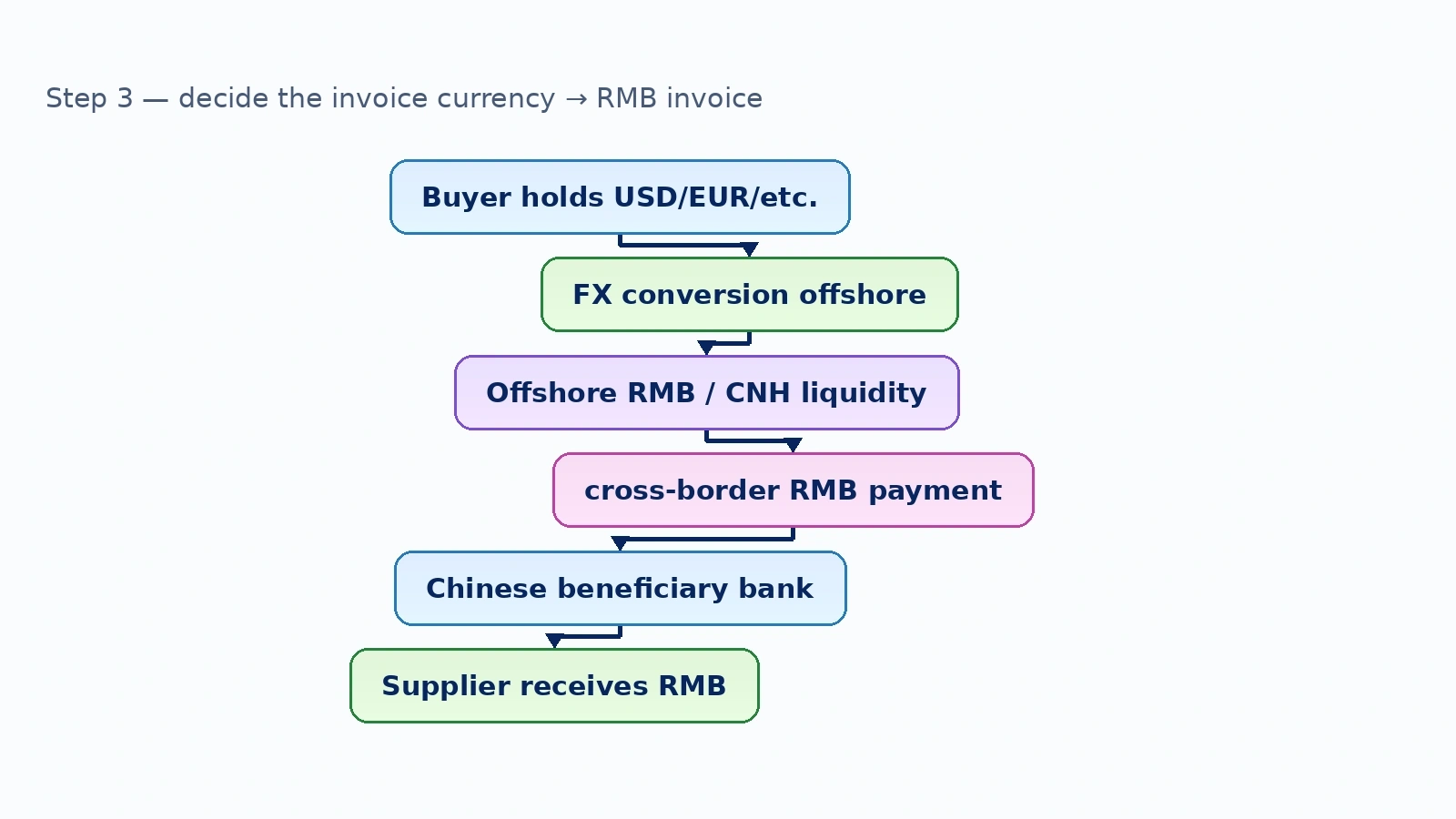
This can move FX risk from the Chinese supplier to the foreign buyer.
Step 4 compare the total FX cost
Do not compare only headline exchange rates.
Calculate:
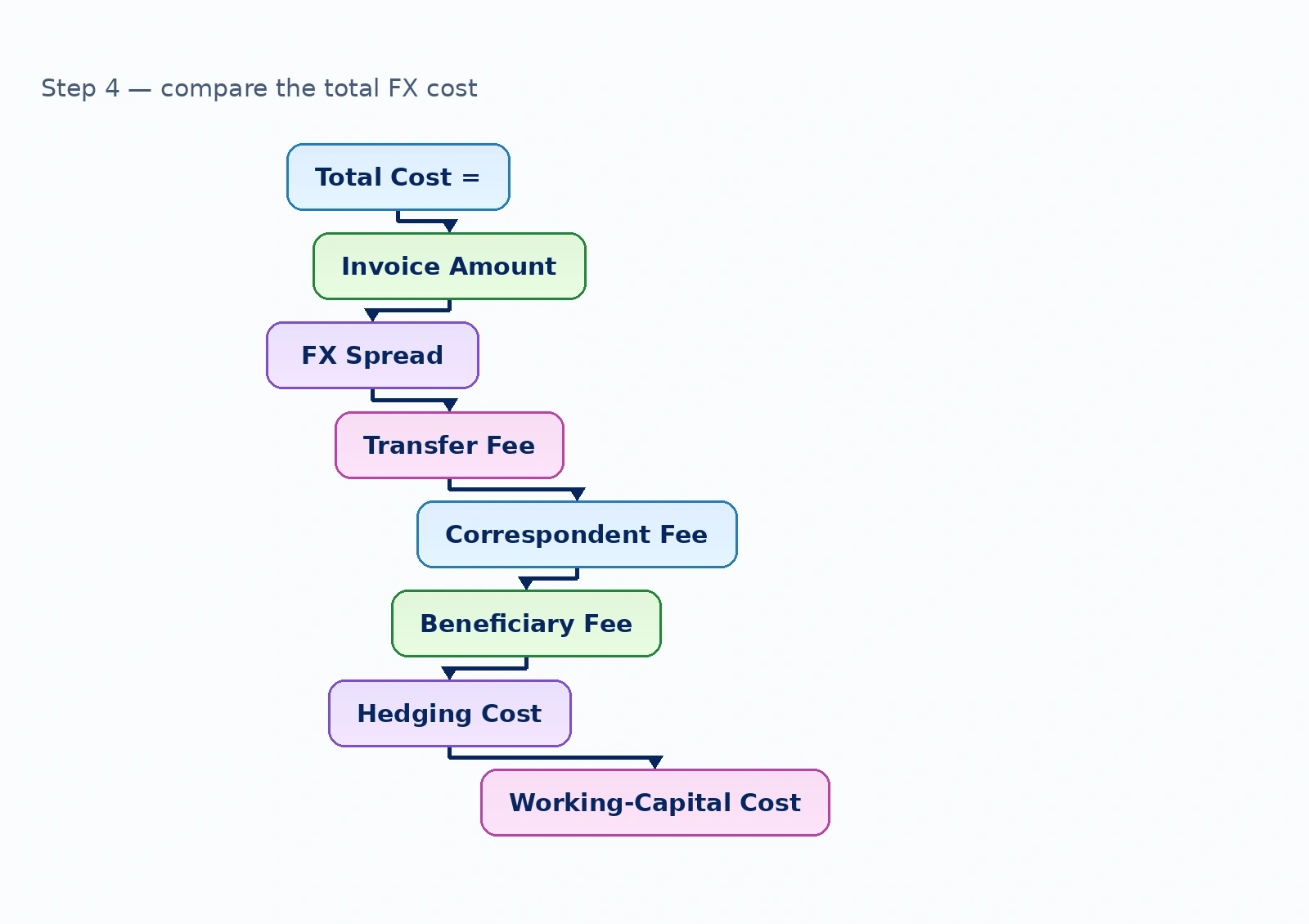
A zero-fee payment with a 100-basis-point FX spread can be more expensive than a bank transfer with a visible fee and a 15-basis-point spread.
The comparison should use the amount the supplier is expected to receive:
True delivered cost
= FX spread
+ sending fee
+ correspondent deductions
+ receiving-bank charges
+ supplier's embedded currency buffer
+ cost of delay, rejection or rework
A “zero-fee” transfer can be more expensive than a payment with a visible charge if the exchange-rate spread is materially wider.
See the complete FX-cost guide
Step 5 understand CNY versus CNH
If your provider says it can send CNH, what it generally means is that it can source and settle offshore RMB.
Operational payment messages may still use CNY because CNY is the ISO currency code.
Read: RMB vs CNY vs CNH
Step 6 determine the settlement rail
Potential bank-based routes include:
Cross-border RMB correspondent arrangements
Designated RMB clearing banks
CIPS direct or indirect participation through the banking chain.
The foreign buyer usually does not connect to CIPS directly. Its bank or payment institution uses its own clearing relationships.
Step 7 document the commercial purpose
The receiving bank may need the transaction to reconcile with:
Invoice
Contract
Goods description
Shipment
Customs information
Beneficiary identity
Payer identity
Payment purpose
Amount
A legitimate China payment is not merely an account number plus an amount.
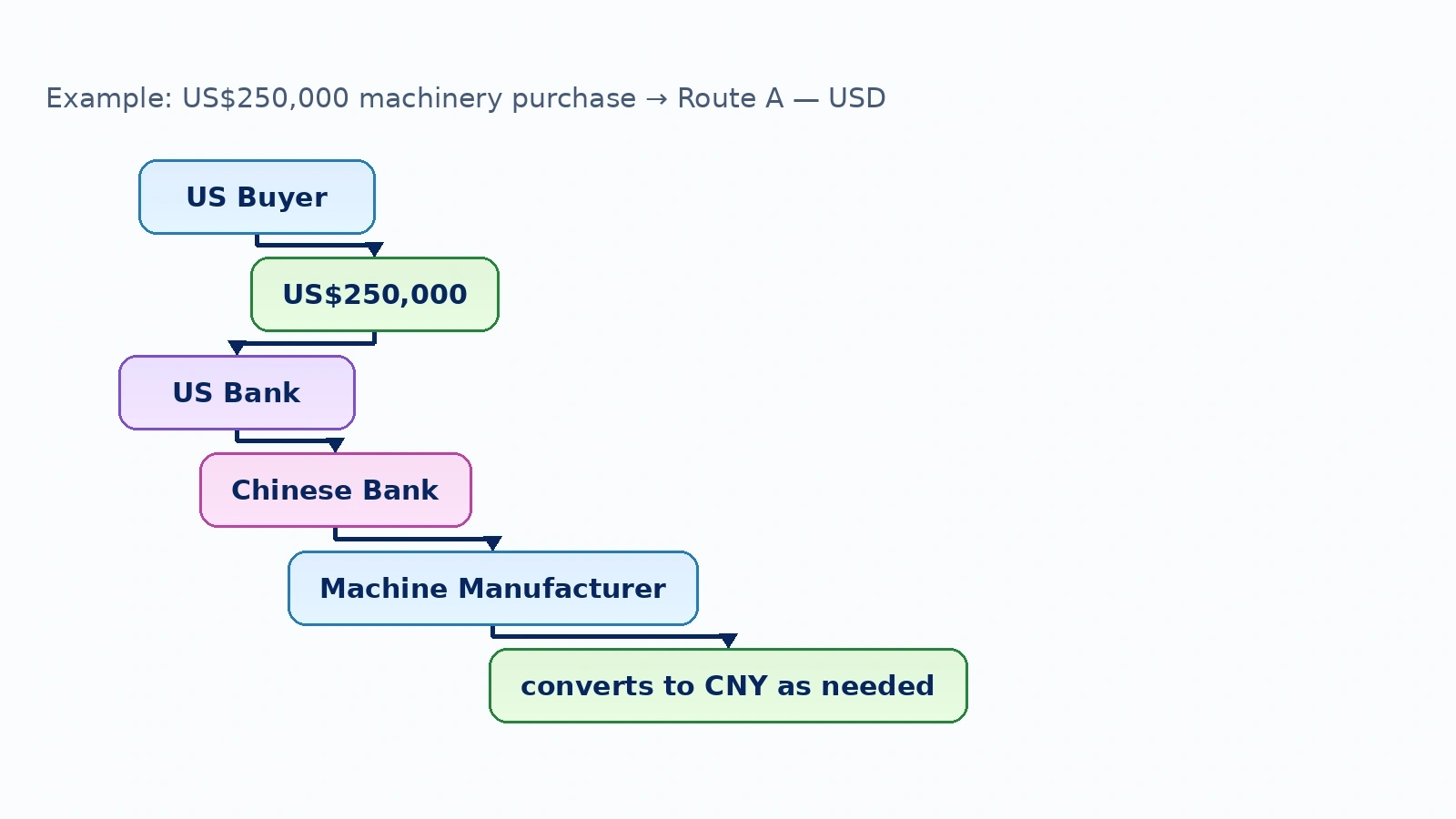
Example: US$250,000 machinery purchase
Route A USD
Route B — RMB
Assume the contract specifies RMB 1.7 million.
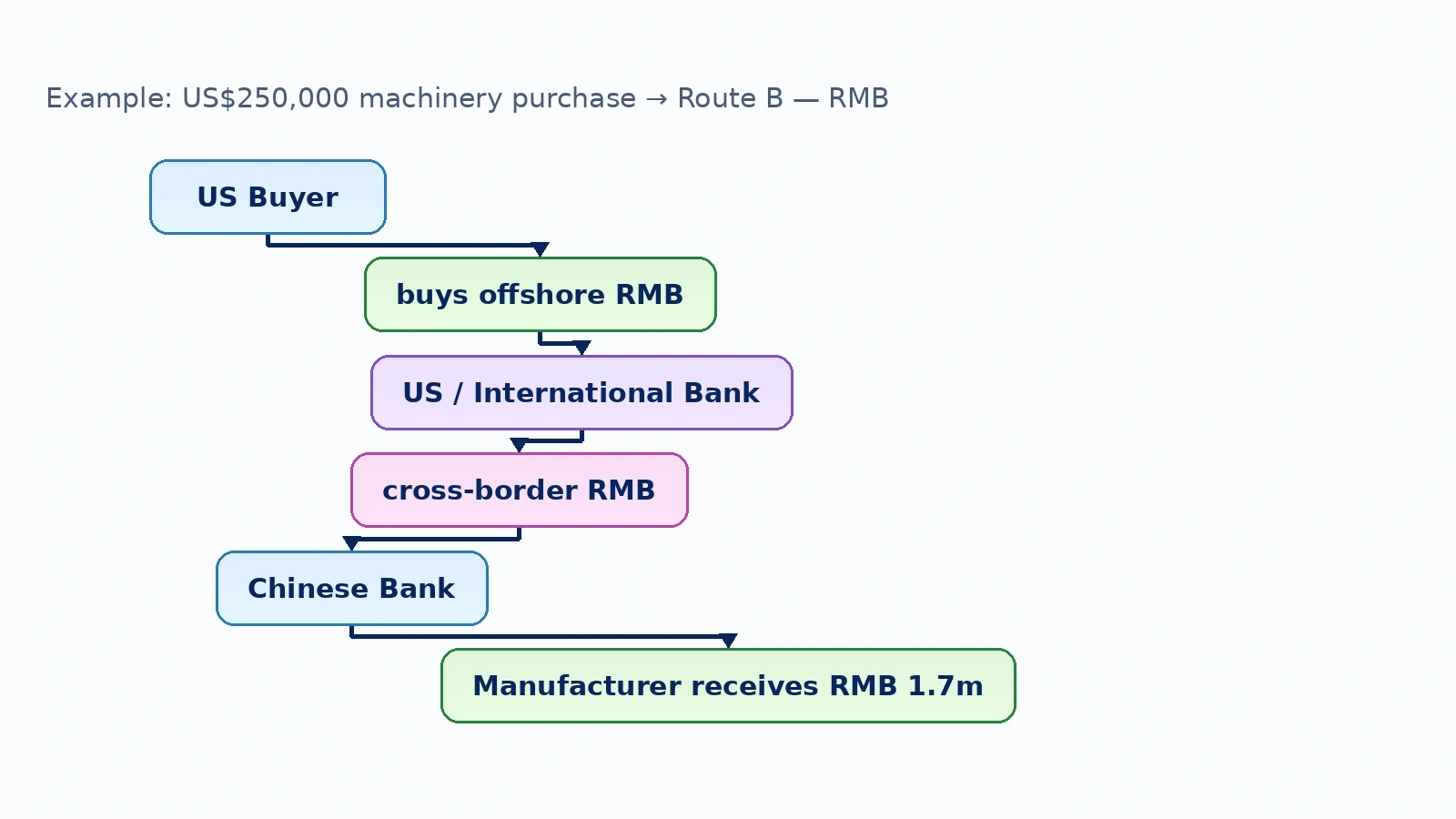
The commercial comparison should consider the buyer’s all-in dollar cost under each route.
When Hong Kong enters the flow
Some suppliers legitimately contract through Hong Kong.
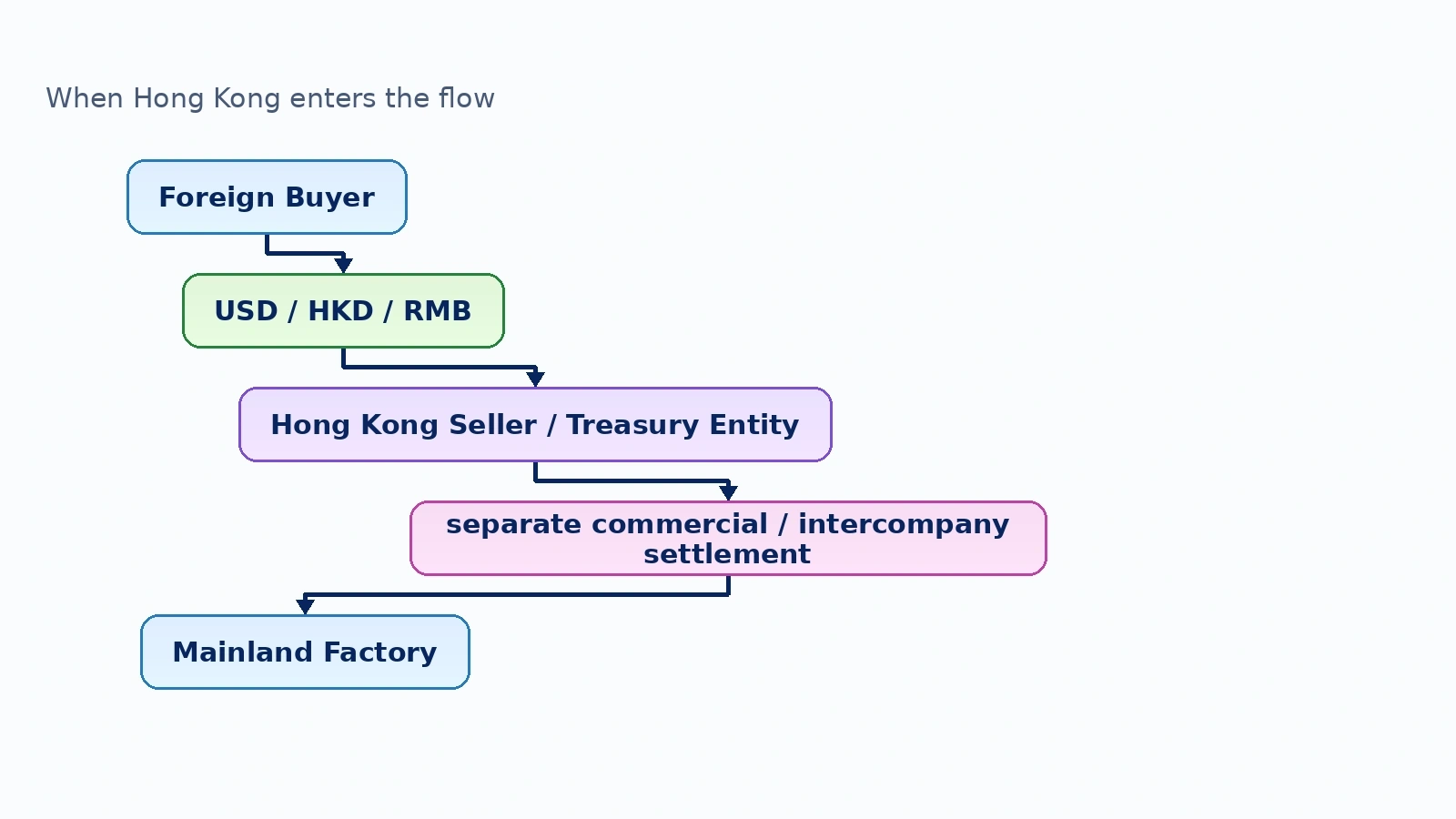
Do not assume this is automatically better or worse. Verify:
Who owns the goods.
Who issued the invoice.
Who bears warranty obligations.
Whether the Hong Kong company is genuinely the seller.
Tax and customs treatment.
How the Mainland factory is paid.
When a Hong Kong beneficiary is commercially coherent
A Hong Kong beneficiary may be reasonable when the Hong Kong company is the contracting seller, a disclosed trading affiliate, an authorized group treasury company, a distributor that purchases from the Mainland manufacturer, or a properly documented collection agent.
Pause and investigate when the Hong Kong account belongs to an unrelated company or person, the beneficiary changes without explanation, payments are divided among unrelated accounts, or the arrangement is promoted as a way to avoid Mainland controls, taxes, customs reporting or bank review.
The invoice, contract, beneficiary and commercial role of the Hong Kong entity should tell one consistent story.
Should you pay HKD?
HKD usually makes sense when the contractual beneficiary is in Hong Kong and prefers HKD.
It normally makes less sense for a Mainland beneficiary that ultimately needs CNY unless there is a specific treasury reason.
Can you pay with stablecoins?
For Mainland China, do not treat a USDT or USDC transfer as an ordinary substitute for a trade wire.
China’s 2026 rules continue to prohibit virtual-currency-related business activity in the Mainland.
A company that legitimately holds stablecoins offshore may sometimes:
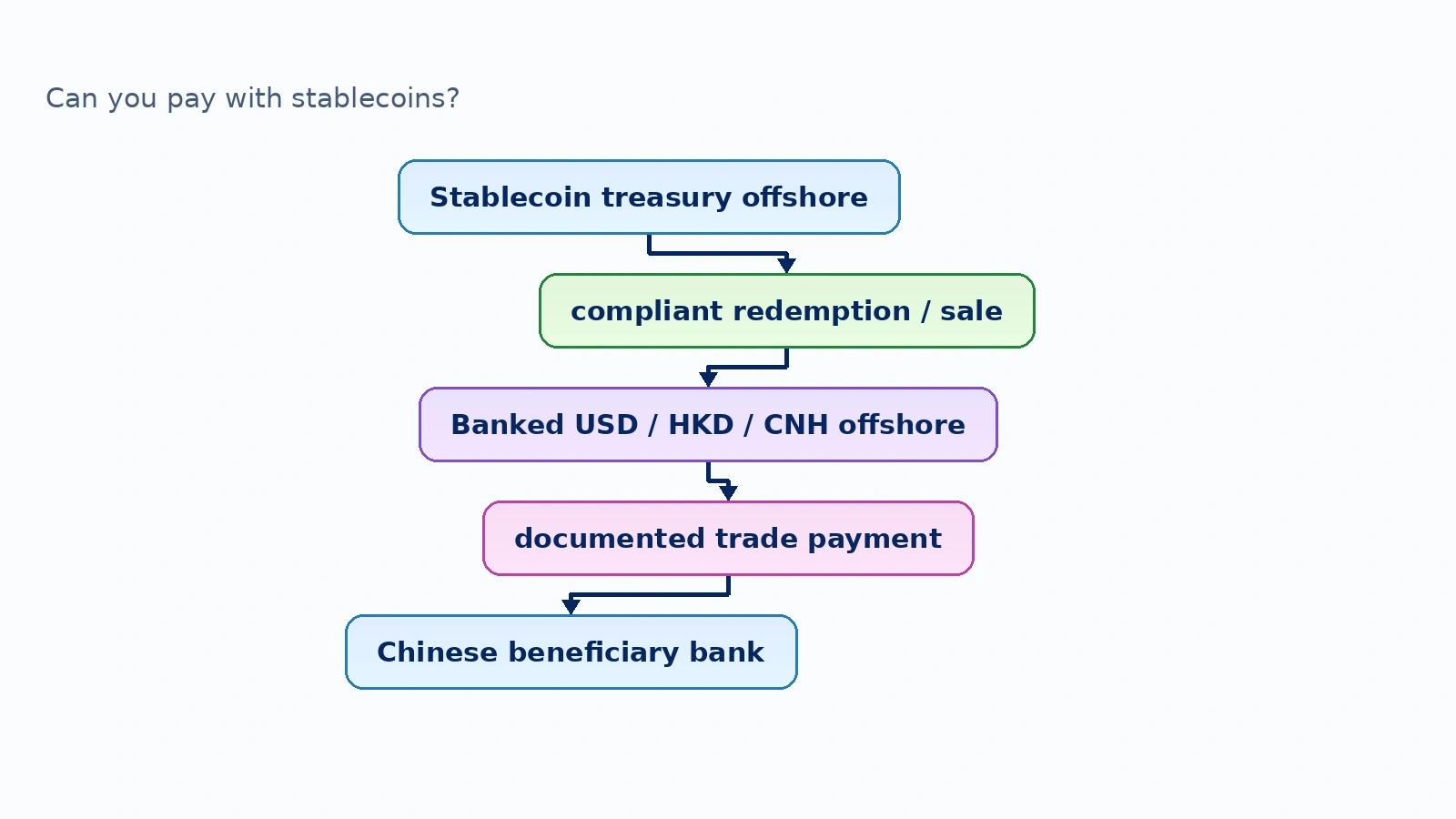
That is a fiat trade payment funded by an offshore asset conversion, not a direct stablecoin merchant payment into Mainland China.
Read: Stablecoin Payments to China
Supplier-payment checklist
Before sending:
Contracting seller confirmed.
Beneficiary account name matches expected legal entity.
Bank location confirmed.
Invoice currency confirmed.
Supplier has confirmed acceptable settlement currency.
FX quote states CNY/CNH methodology clearly.
Fees and intermediary charges known.
Payment purpose confirmed.
Supporting trade documents ready.
Source of funds can be evidenced.
No unexplained personal or third-party account.
Any crypto-origin funds have been disclosed where required and bank acceptance confirmed.
Sanctions/AML screening completed.
First payment preferably tested with controlled operational procedures.
Which option is usually best?
There is no universal answer.
Buyer situation | Candidate |
|---|---|
Buyer earns and borrows USD; supplier accepts USD | USD may be simplest |
Supplier gives better RMB price | RMB/CNH route may be cheaper |
Buyer has recurring China payables | Offshore RMB treasury may improve efficiency |
Contracting seller is Hong Kong entity | USD, HKD or offshore RMB may all be relevant |
Buyer receives stablecoins offshore | Convert compliantly to banked fiat, then use documented payment rail |
Request a China Trade Payment Feasibility Review
Provide the invoice, contract, beneficiary instructions, supplier jurisdiction, goods, amount, currency, monthly volume and current difficulty.
Faisal Khan LLC can assess the flow, identify structural gaps, source potential regulated providers and coordinate introductions. Faisal Khan LLC does not take custody of or transmit client funds.
Related guides
Primary and authoritative sources
This primer was researched and updated for September 2026. Regulatory requirements can change, and transaction-level treatment depends on the parties, banks, purpose of payment, documentation, and jurisdictions involved.
State Administration of Foreign Exchange (SAFE), first-half 2026 foreign-exchange press conference
SAFE, reforms facilitating cross-border trade and investment
Hong Kong Monetary Authority (HKMA), Linked Exchange Rate System terminology
China State Council Information Office, September 2026 RMB internationalization policy
Library of Congress, May 2026 summary of China's February 2026 virtual-currency and stablecoin rules