
The terms RMB, yuan, CNY and CNH are often treated as synonyms. They are related, but they do not mean exactly the same thing.
It is part of our China Payments section.
The cleanest framework is:
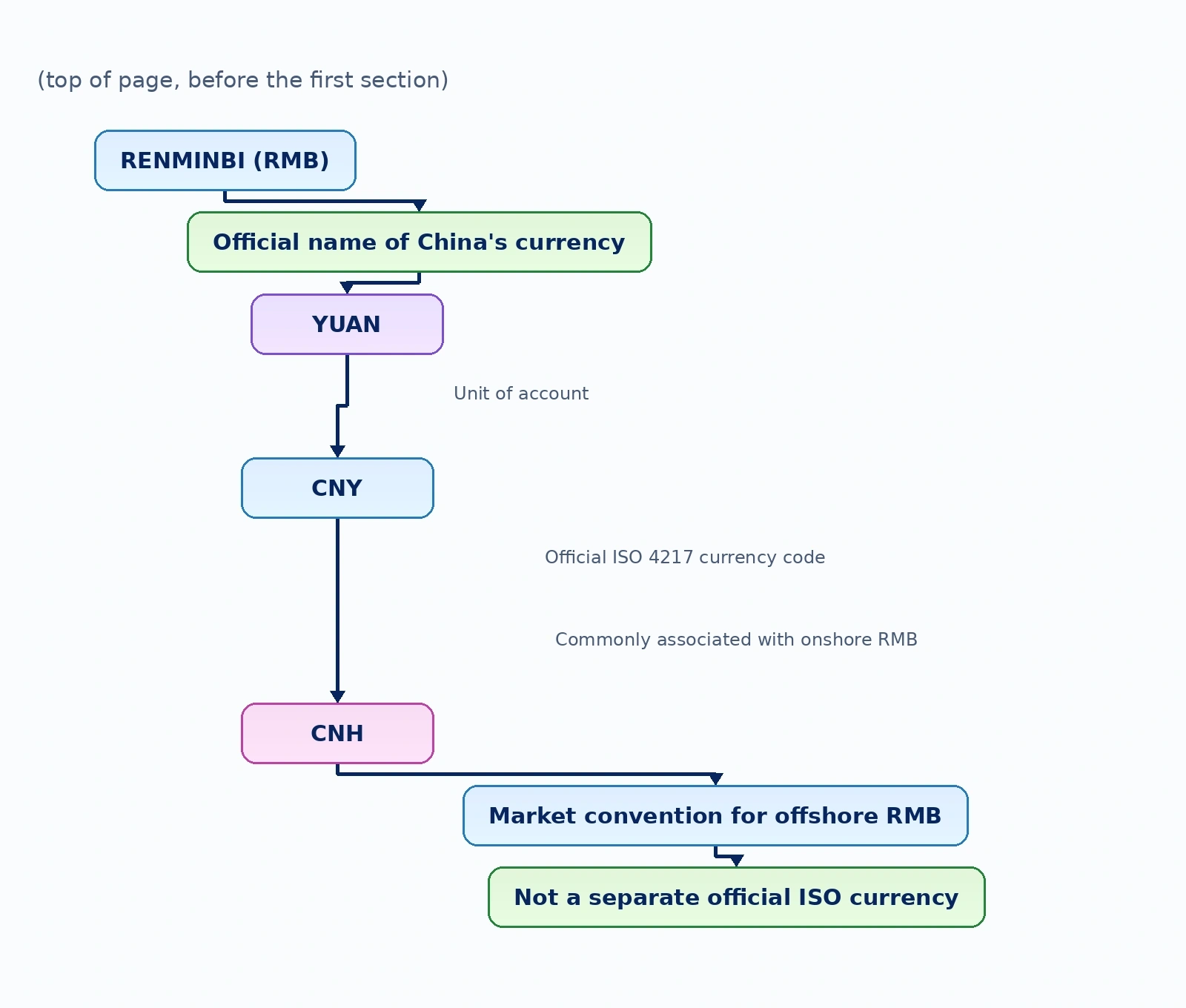
RMB
RMB is the abbreviation for renminbi, the official name of the Chinese currency.
Yuan
A yuan is one unit of renminbi.
The distinction is similar to sterling and pound.
CNY
CNY is the official ISO 4217 code for renminbi.
When traders distinguish between the domestic and offshore RMB markets, CNY normally means the onshore Mainland rate and liquidity pool.
Onshore RMB is subject to China’s managed exchange-rate system and cross-border capital framework.
CNH
CNH is the market label for offshore RMB.
It is heavily associated with Hong Kong, although offshore RMB markets also exist in other financial centers.
CNH is not an independent ISO 4217 currency. SWIFT messaging uses the official CNY currency code for offshore RMB transactions, even though dealers and treasury systems may refer to the economic exposure as CNH.
That distinction is extremely important for payment operations.
Why are there two exchange rates?
Because the onshore and offshore RMB markets are connected but not fully fungible.
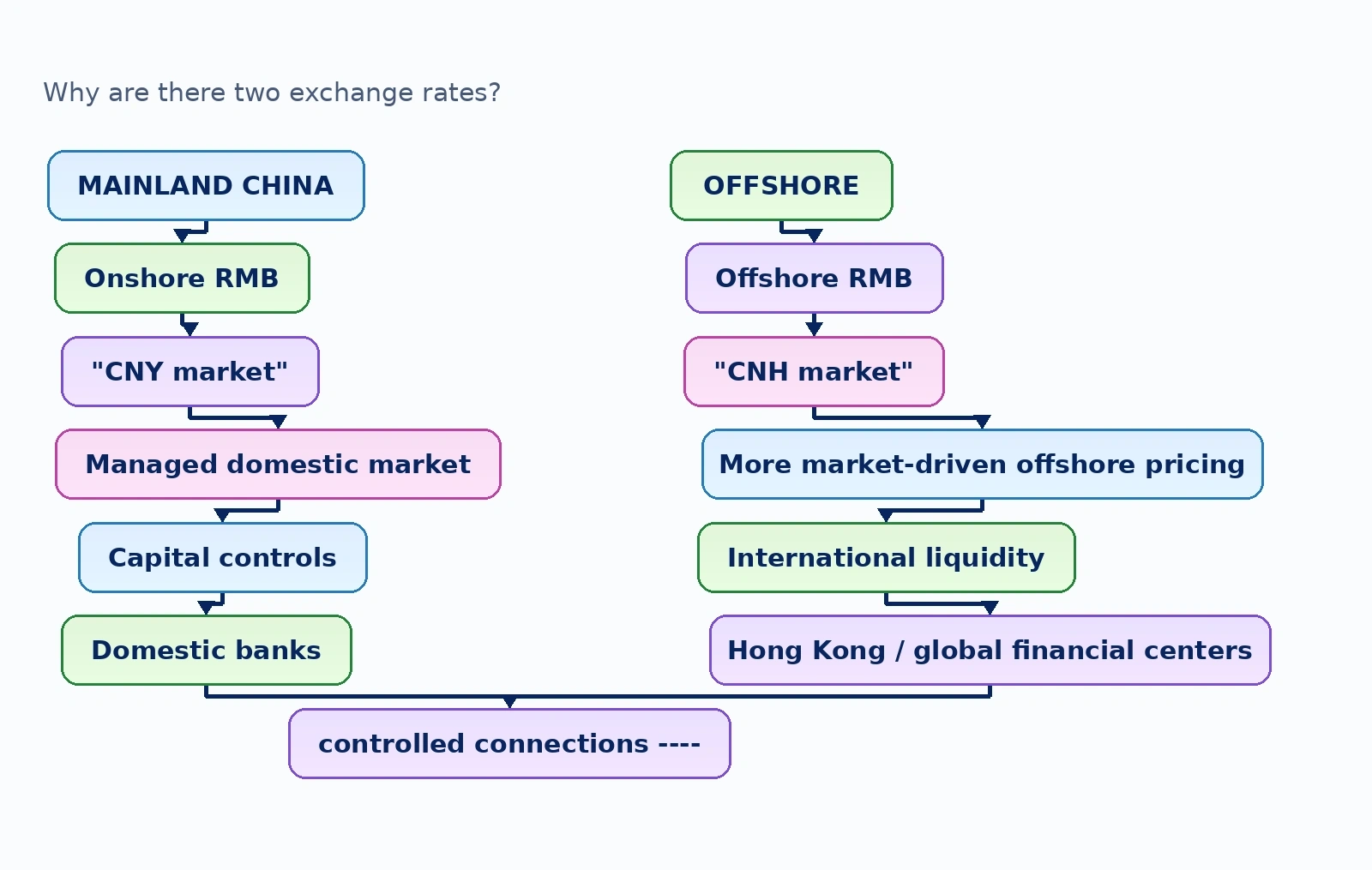
If liquidity could move without friction between the two pools, arbitrage would normally force the rates to converge almost perfectly.
Cross-border rules and liquidity constraints prevent completely frictionless arbitrage.
USD/CNY versus USD/CNH
USD/CNY is the dollar exchange rate against onshore RMB.
USD/CNH is the dollar exchange rate against offshore RMB.
They are usually close, but they can diverge.
The spread may reflect:
Offshore demand for RMB.
Offshore funding conditions.
Expectations about Chinese policy.
Hedging pressure.
Market stress.
Supply of offshore RMB.
Constraints on cross-border movement.
Is one real and the other synthetic?
No.
Both represent renminbi value in different market environments.
The better description is one currency with two connected market contexts.
Why does the PBOC allow an offshore RMB market?
The offshore market helps expand international use of RMB without requiring Mainland China to remove every domestic capital control.
It allows foreign companies and financial institutions to:
Hold RMB offshore.
Trade RMB.
Invoice in RMB.
Settle trade in RMB.
Issue RMB-denominated securities.
Hedge RMB exposure.
Finance RMB activity.
Hong Kong has become the most important offshore RMB center.
Can CNH become CNY?
Do not think of it as a retail conversion such as EUR → USD.
Economically, the underlying denomination is RMB. The issue is whether the funds can move from the offshore RMB pool into an onshore account under an allowed cross-border transaction.
A legitimate cross-border trade payment can provide that bridge.
Payment-message nuance
A common source of operational confusion is:
If I am paying CNH, should the SWIFT message say CNH?
Usually, no.
Because CNH is not the official ISO 4217 currency code, payment systems commonly use CNY as the currency code, with operational rules distinguishing offshore RMB processing where necessary.
Always follow the receiving bank’s instructions.
Example
A U.S. company owes a Chinese manufacturer RMB 7 million.
The U.S. company’s bank obtains offshore RMB liquidity.
The treasury desk may describe the FX leg as:
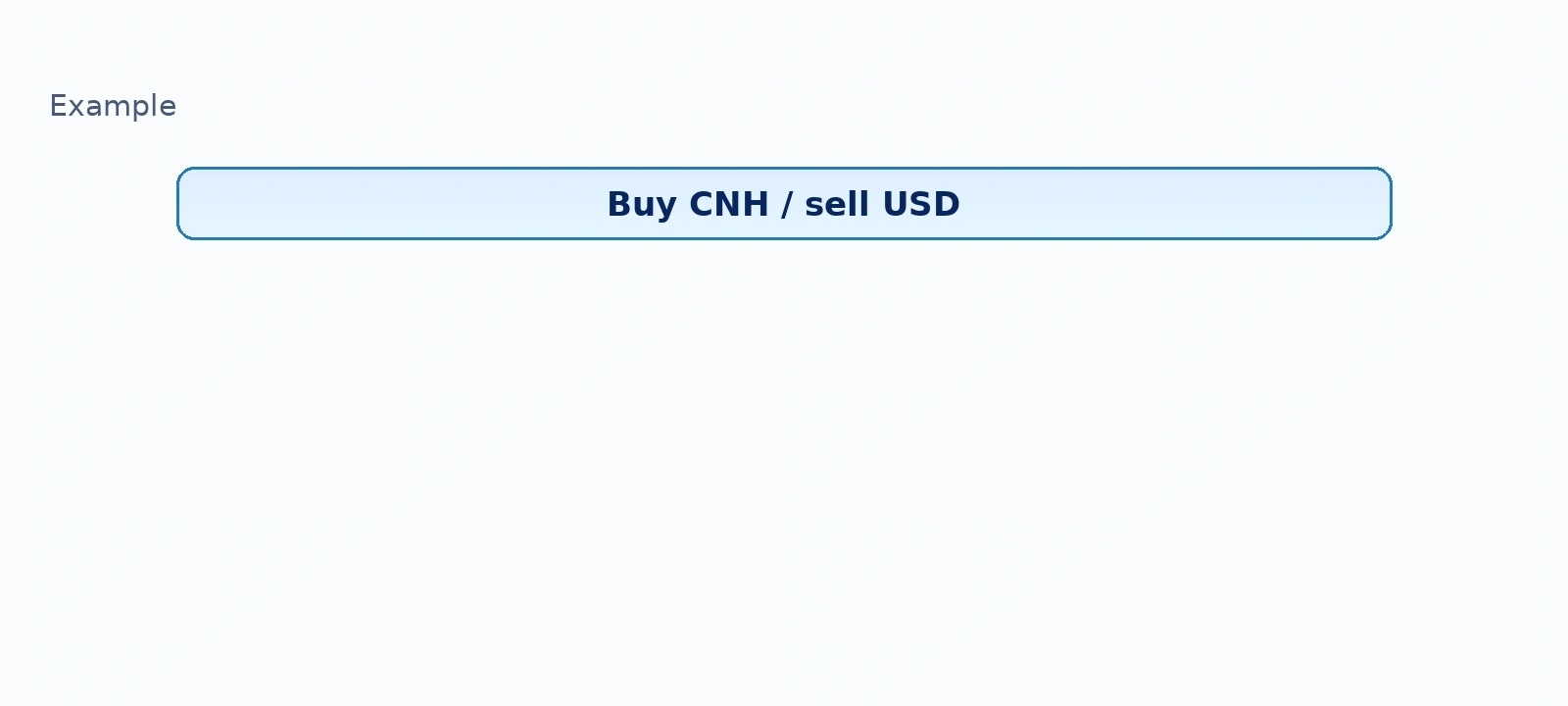
The payment instruction may still be transmitted as a CNY-denominated payment.
The Chinese manufacturer ultimately receives RMB in its Mainland account.
The transaction has therefore involved:
CNH pricing/liquidity offshore;
CNY-coded payment messaging; and
RMB settlement onshore.
There is no contradiction.
Comparison
Issue | CNY / Onshore RMB | CNH / Offshore RMB |
|---|---|---|
Underlying currency | Renminbi | Renminbi |
Official ISO code | CNY | No separate official ISO code |
Main market | Mainland China | Hong Kong and other offshore centers |
Exchange rate | Managed onshore market | More market-driven offshore market |
Liquidity | Mainland financial system | Offshore RMB pool |
Cross-border mobility | Controlled | More internationally accessible, but onshore entry remains regulated |
Common users | Mainland companies and banks | Global banks, funds, corporates, treasury desks |
Main uses | Domestic settlement, onshore FX | Trade, hedging, offshore financing, treasury |
When should a business care?
You need to care when:
Negotiating supplier pricing.
Comparing FX quotes.
Hedging RMB.
Paying a Mainland beneficiary.
Operating a Hong Kong treasury center.
Managing offshore RMB balances.
Reconciling invoice currency against payment instructions.
Request a China Trade Payment Feasibility Review
Provide the invoice currency, the currency you fund in, the supplier and beneficiary account, and the monthly volume.
Faisal Khan LLC can assess the flow, identify structural gaps, source potential regulated providers and coordinate introductions. Faisal Khan LLC does not take custody of or transmit client funds.
Related guides
FAQ
Is RMB a currency code?
RMB is a common abbreviation for renminbi, but CNY is the official ISO currency code.
Does CNH mean Hong Kong dollars?
No. CNH means offshore renminbi. HKD is the Hong Kong dollar.
Can USD/CNH differ from USD/CNY?
Yes. They are separate market rates connected by regulated channels rather than unrestricted arbitrage.
Is CNH legal tender in China?
The underlying currency is renminbi. CNH is a market designation, not a separate set of banknotes or a separate sovereign currency.
Primary and authoritative sources
This primer was researched and updated for September 2026. Regulatory requirements can change, and transaction-level treatment depends on the parties, banks, purpose of payment, documentation, and jurisdictions involved.
State Administration of Foreign Exchange (SAFE), first-half 2026 foreign-exchange press conference
SAFE, reforms facilitating cross-border trade and investment
Hong Kong Monetary Authority (HKMA), Linked Exchange Rate System terminology
China State Council Information Office, September 2026 RMB internationalization policy
Library of Congress, May 2026 summary of China's February 2026 virtual-currency and stablecoin rules