
AFAQ is the most important infrastructure to understand if you want to understand inter-GCC bank payments.
AFAQ stands for the Arabian Gulf System for Financial Automated Quick Payment Transfer.
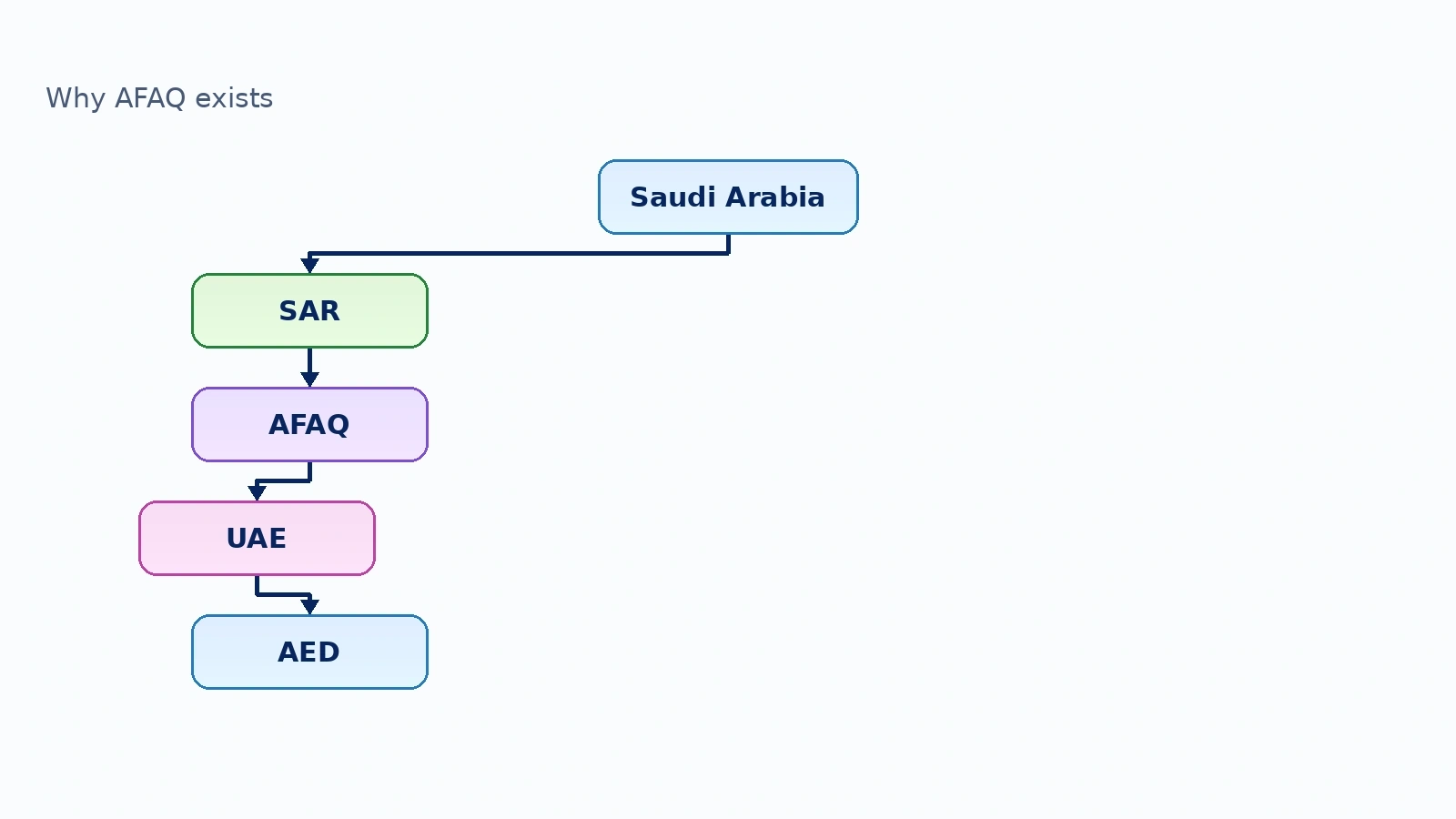
It is a regional real-time-gross-settlement infrastructure created for cross-border, cross-currency GCC payments.
It is operated by the Gulf Payments Company (GPC), which is owned by the six GCC central banks.
Why AFAQ exists
Historically, a payment between two neighboring GCC countries could still travel through international correspondent banking.
For example:
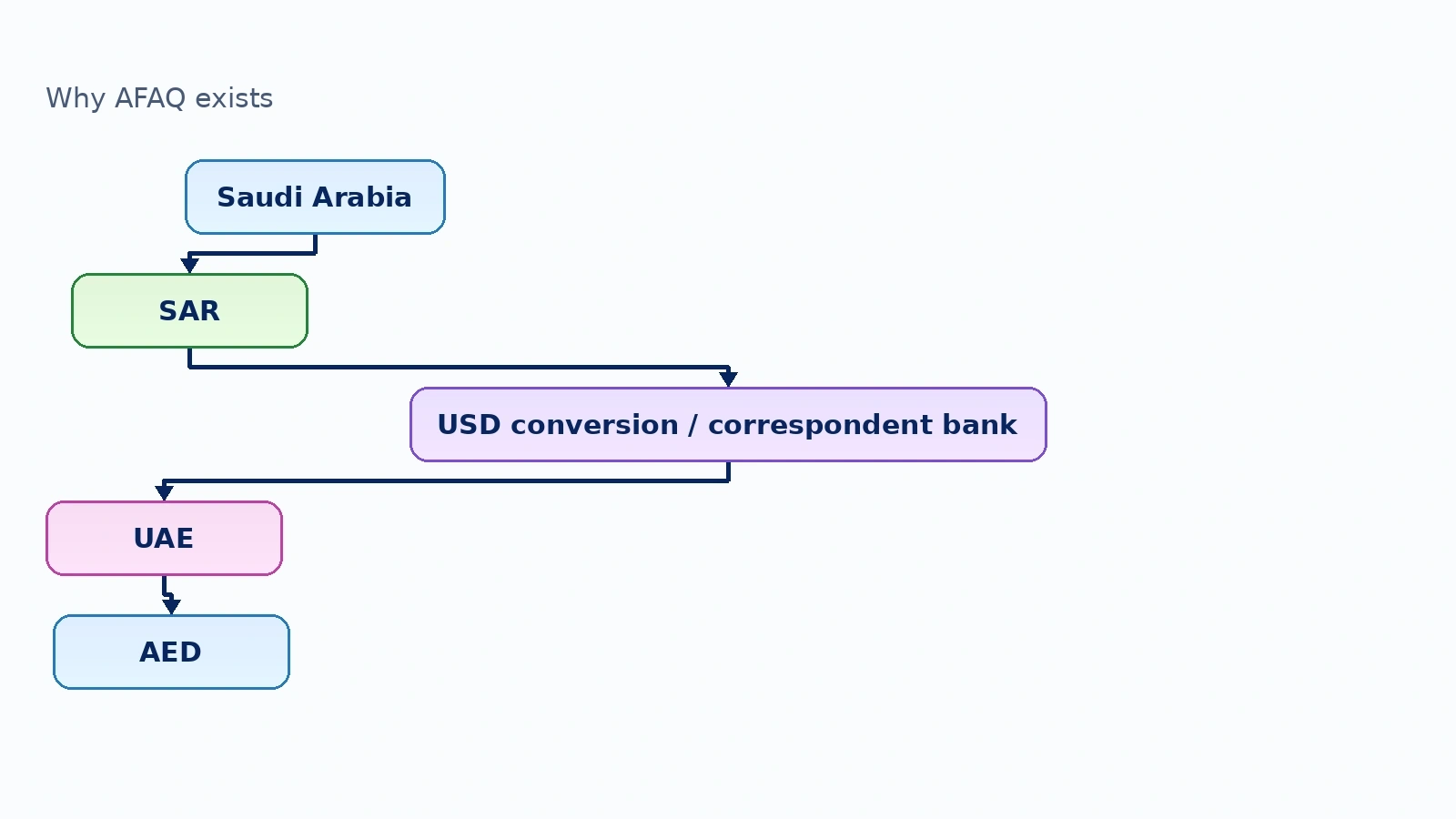
AFAQ is designed to make a regional payment more regional:
Who can participate?
The system is designed around:
GCC central banks;
Commercial banks;
Eligible financial institutions participating in their domestic systems.
A participant bank generally needs:
An account with its local central bank;
Membership in its domestic RTGS;
Technical and operational compliance with AFAQ requirements.
Who can benefit?
AFAQ's stated beneficiaries include:
Individuals;
Retail businesses;
Corporations;
Wholesale users.
In practice, customer access comes through participating banks/financial institutions.
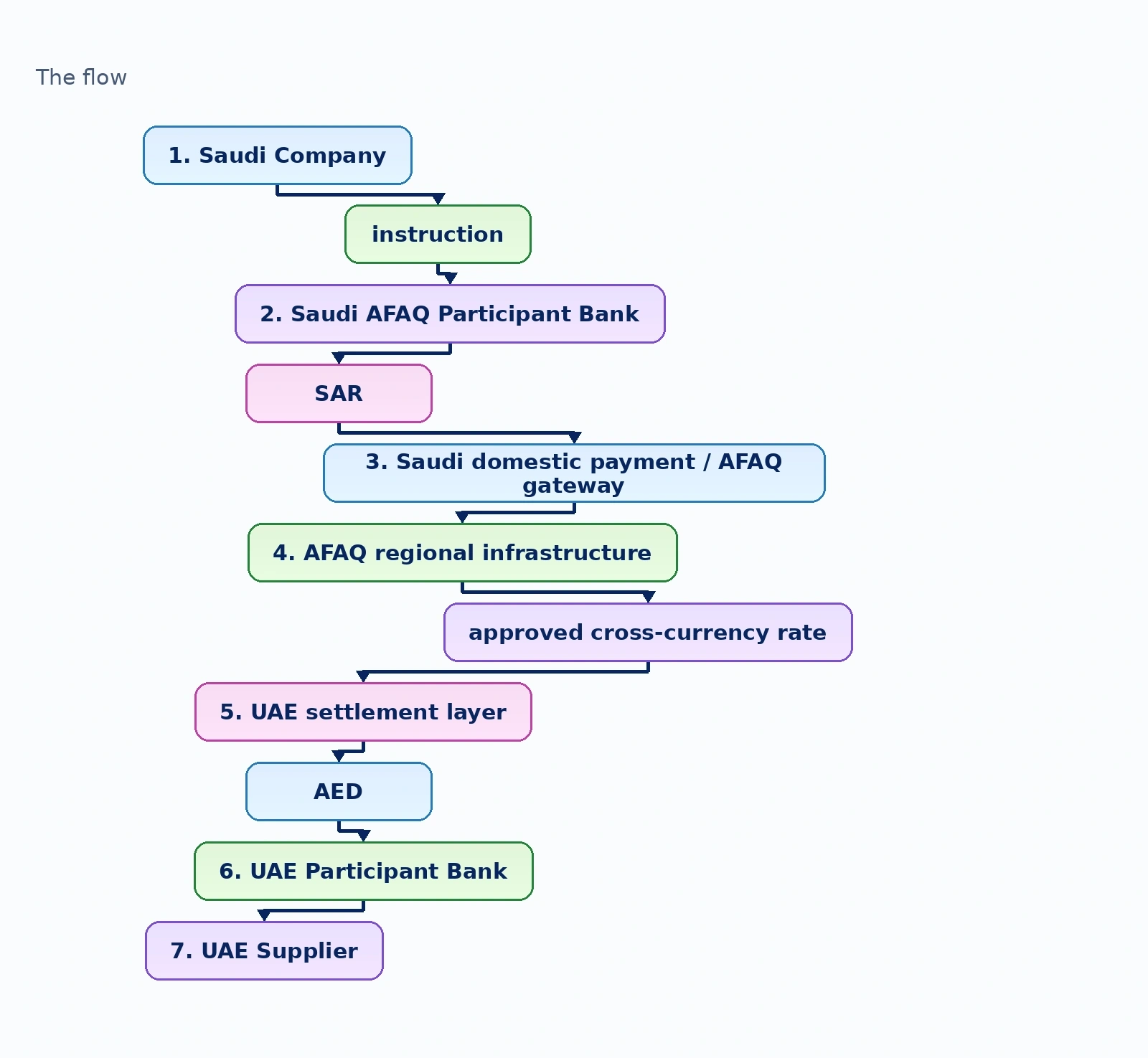
The flow
Example: Saudi company pays UAE supplier.
How FX works
Gulf Payments states that participating national central banks provide approved FX rates to AFAQ daily.
The rate used is fixed for the relevant business day.
This gives banks and customers greater predictability than a chain where multiple correspondents independently apply conversion.
Does AFAQ use USD?
AFAQ's key proposition is local-currency cross-currency settlement.
It therefore allows a payment to avoid using USD as the mechanical bridge currency in supported corridors.
That does not mean USD is irrelevant to the region. Five GCC currencies are directly anchored to USD, and USD remains important for international treasury and trade.
Does AFAQ use SWIFT?
GPC states that AFAQ uses a private network and does not use the SWIFT network for processing AFAQ financial payments.
AFAQ supports ISO 20022 messaging and straight-through processing.
Settlement speed
GPC describes AFAQ as supporting same-day execution/settlement and real-time payment-transfer capabilities.
Customer experience still depends on:
Participating bank;
Bank processing;
KYC/AML review;
Cut-off windows;
Purpose of payment;
Beneficiary information.
Qatar's 2026 onboarding
Qatar Central Bank joined AFAQ on September 7, 2026.
This is strategically important because it completes the six-country central-bank architecture.
Commercial-bank onboarding and corridor availability can nevertheless develop progressively, so current availability should be confirmed with the bank.
Why AFAQ matters
Lower dependence on external correspondent chains
Regional payments can stay closer to GCC financial infrastructure.
Local currency settlement
It supports the idea that a Saudi payer can originate local-currency value and a UAE beneficiary can receive local-currency value.
FX transparency
Central-bank-provided approved rates help standardize the conversion layer.
Regional integration
The system directly supports the GCC objective of deeper economic and financial integration.
What AFAQ does not do
AFAQ does not mean:
Every GCC bank is automatically connected;
Every payment is instant regardless of compliance review;
All customer fees disappear;
All currencies are always available through every bank;
Sanctions/KYC/AML disappear;
International payments outside the GCC route through AFAQ.
AFAQ versus a PSP
AFAQ is payment infrastructure.
A fintech/payment provider may still sit on top of it through:
Payment-service arrangements;
Correspondent relationships;
Domestic settlement accounts.
The fintech normally does not simply become a direct AFAQ participant without satisfying institutional eligibility requirements.
AFAQ and stablecoins
AFAQ settles regulated fiat currencies.
USDC/USDT are not AFAQ settlement currencies.
A stablecoin-funded transaction would require a separate conversion/off-ramp before conventional fiat settlement through AFAQ.
Related guides
Authoritative sources and update date
Research updated: September 16, 2026.
This content is designed as an explainer. Payment availability, participant-bank coverage, cut-off times, fees, FX spreads, stablecoin treatment, and licensing requirements can change. For an actual transaction, confirm the current position with the relevant central bank, payment-system operator, sending institution and receiving institution.