
The GCC does not have a single currency. Its six member states have six sovereign currencies.
What makes the region unusual is that five of the six are directly anchored to the U.S. dollar.
Country | Code | Currency | USD structure |
|---|---|---|---|
Saudi Arabia | SAR | Saudi riyal | 3.75 SAR = US$1 |
UAE | AED | UAE dirham | approximately 3.6725 AED = US$1 |
Bahrain | BHD | Bahraini dinar | approximately 0.376 BHD = US$1 |
Kuwait | KWD | Kuwaiti dinar | weighted currency basket |
Oman | OMR | Omani rial | OMR 1 = US$2.6008 |
Qatar | QAR | Qatari riyal | 3.64 QAR = US$1 |
Why the dollar pegs matter
A peg means local monetary and FX policy is designed to preserve a defined relationship to USD.
This provides:
exchange-rate predictability;
easier hydrocarbon and international trade pricing;
reduced FX uncertainty for USD contracts;
a stable nominal anchor.
The trade-off is that domestic monetary conditions become influenced by U.S. monetary policy.
Example: SAR and AED
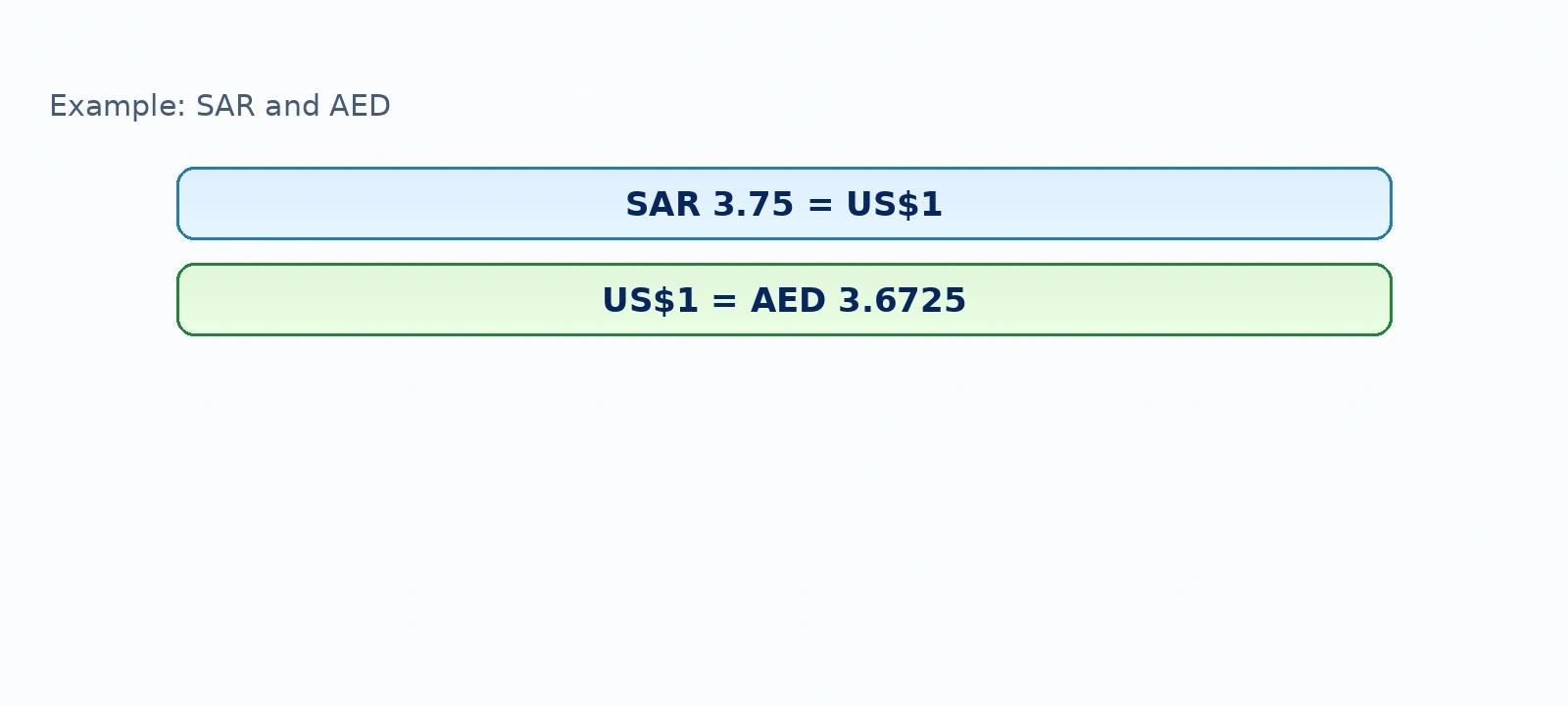
Because both SAR and AED are fixed to USD, the theoretical cross-rate is relatively stable.
Conceptually:
So:
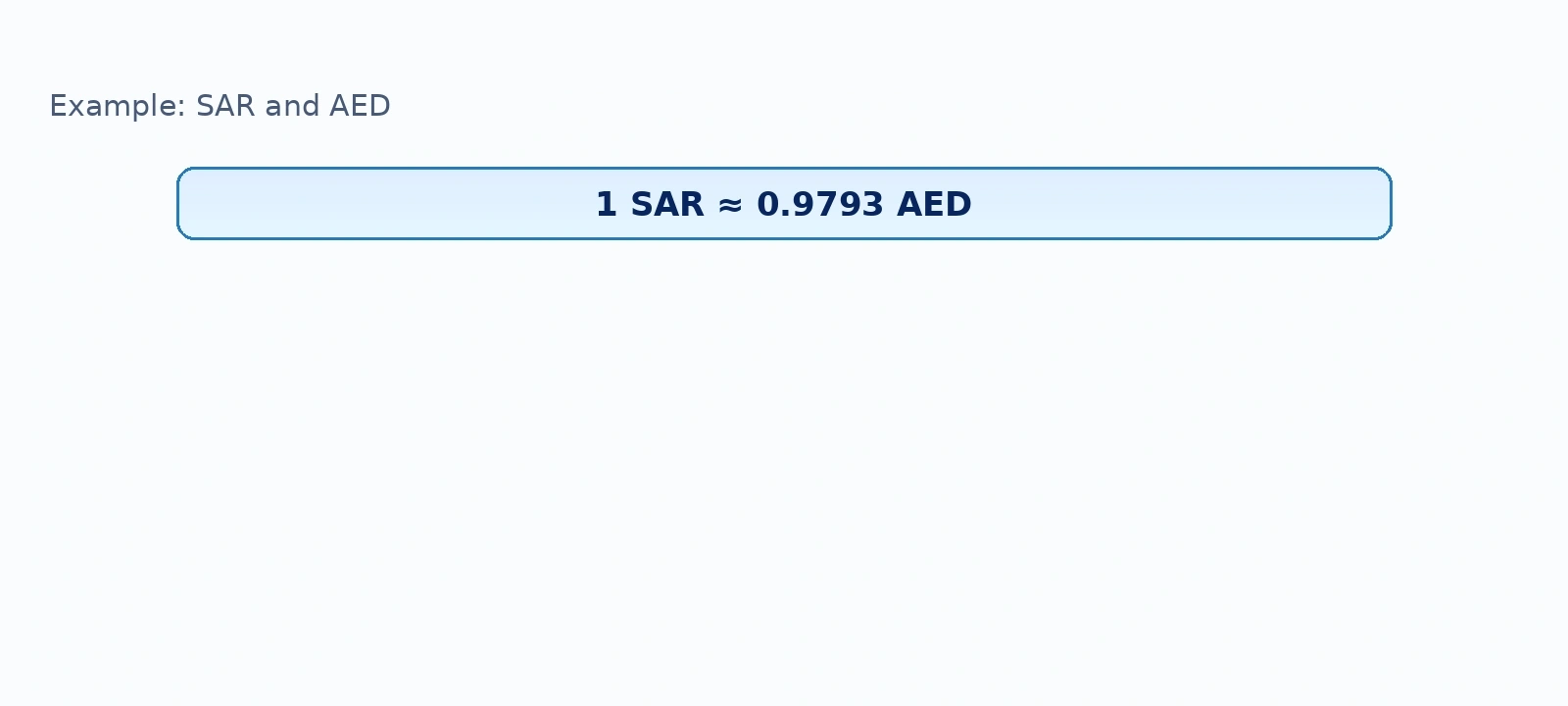
Actual bank/customer rates include spreads, fees and operational pricing.
Kuwait is the exception
Kuwait returned to a weighted basket of major currencies in 2007.
The exact basket composition and weights are not publicly disclosed.
Therefore KWD does not have a permanent fixed USD parity in the same way as SAR, AED, BHD, OMR or QAR.
Why KWD often looks "strong"
The numerical size of one unit does not measure economic strength.
One KWD may buy more than US$3, but that largely reflects the chosen denomination and exchange-rate framework.
You should not compare national economic strength by asking which currency unit buys the most dollars.
The GCC and USD liquidity
GCC banks have substantial need for USD because of:
trade finance;
imports;
energy;
global investments;
capital markets;
dollar borrowing and lending.
That is why USD remains an important treasury currency even when domestic payments are made in local currency.
Do dollar pegs make AFAQ unnecessary?
No.
A stable cross-rate does not solve:
messaging;
bank connectivity;
finality;
correspondent fees;
cross-border compliance;
operational cut-offs.
AFAQ addresses the payment infrastructure layer.
Do dollar pegs make stablecoins unnecessary?
Not necessarily.
A USD stablecoin may provide 24/7 movement of USD-linked value. But because many GCC currencies already track USD closely, its benefit is more about rail speed and digital treasury than about avoiding currency volatility.
Related guides
Authoritative sources and update date
Research updated: September 16, 2026.
This content is designed as an explainer. Payment availability, participant-bank coverage, cut-off times, fees, FX spreads, stablecoin treatment, and licensing requirements can change. For an actual transaction, confirm the current position with the relevant central bank, payment-system operator, sending institution and receiving institution.