
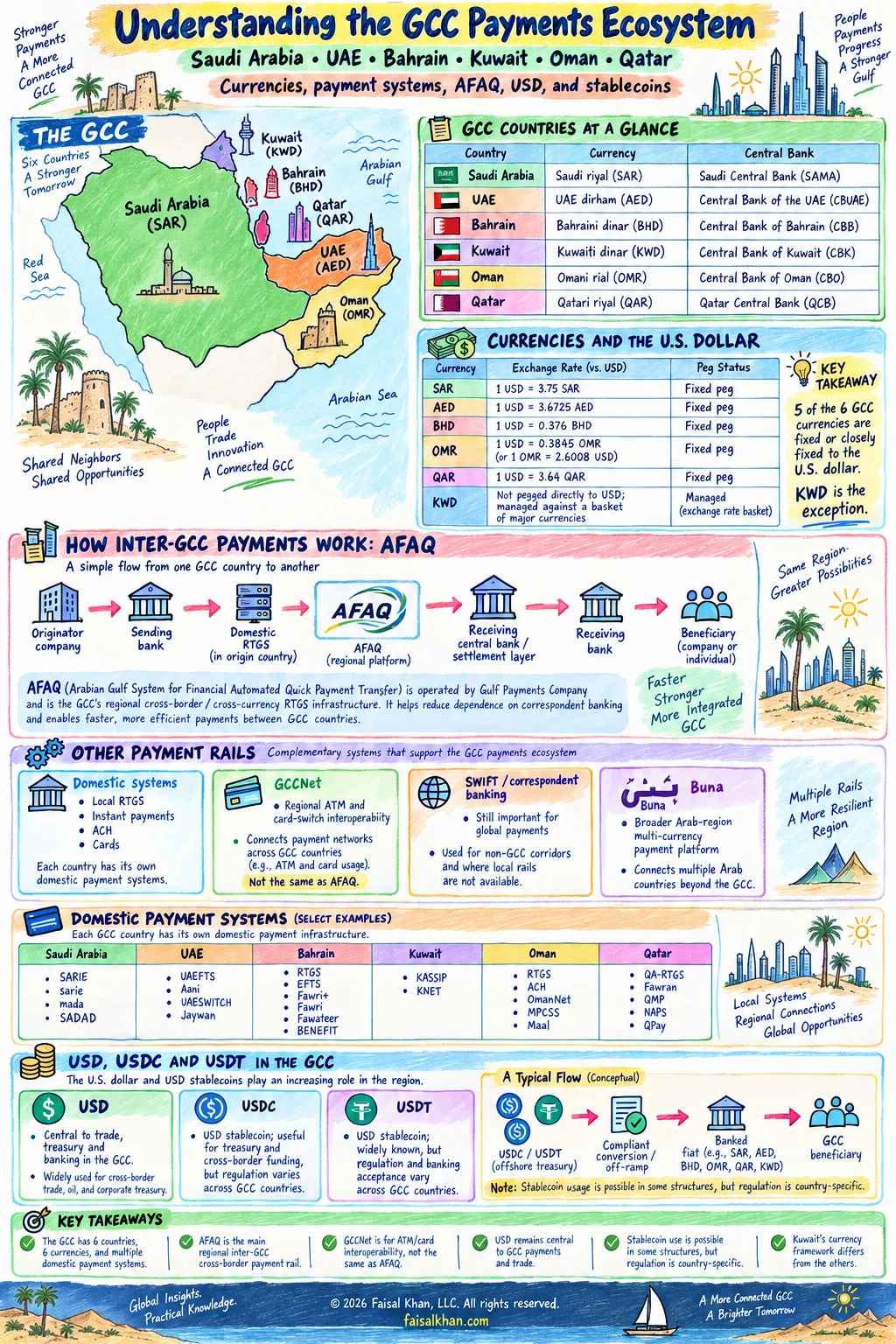
The Gulf Cooperation Council is one of the most interesting payment regions in the world because it combines six sovereign countries, six national currencies, six central banks, highly developed domestic banking systems, strong links to the U.S. dollar, large expatriate-remittance corridors, international trade, fast-growing instant-payment systems, and an increasingly integrated regional payment infrastructure.
The six GCC countries are:
Saudi Arabia
United Arab Emirates
Bahrain
Kuwait
Oman
Qatar
Each country has its own sovereign currency and domestic payment infrastructure. At the same time, the GCC has built regional rails that increasingly allow a payment to move from one member country to another without treating every transaction as a conventional USD correspondent-bank transfer.
The most important of those regional infrastructures is AFAQ — the Arabian Gulf System for Financial Automated Quick Payment Transfer.
The region also has GCCNet for regional ATM/card-switch interoperability, while Buna, operated at the wider Arab-region level, provides another multi-currency cross-border route.
Stablecoins such as USDC and USDT add another layer — but they do not have one uniform legal status across the six GCC countries.
This primer explains the entire structure from the perspective of a company, bank, fintech, payment service provider, treasury team, importer, exporter or remittance business that actually needs to understand how money moves.
1. The GCC payment system in one picture
Think of GCC payments as five layers:
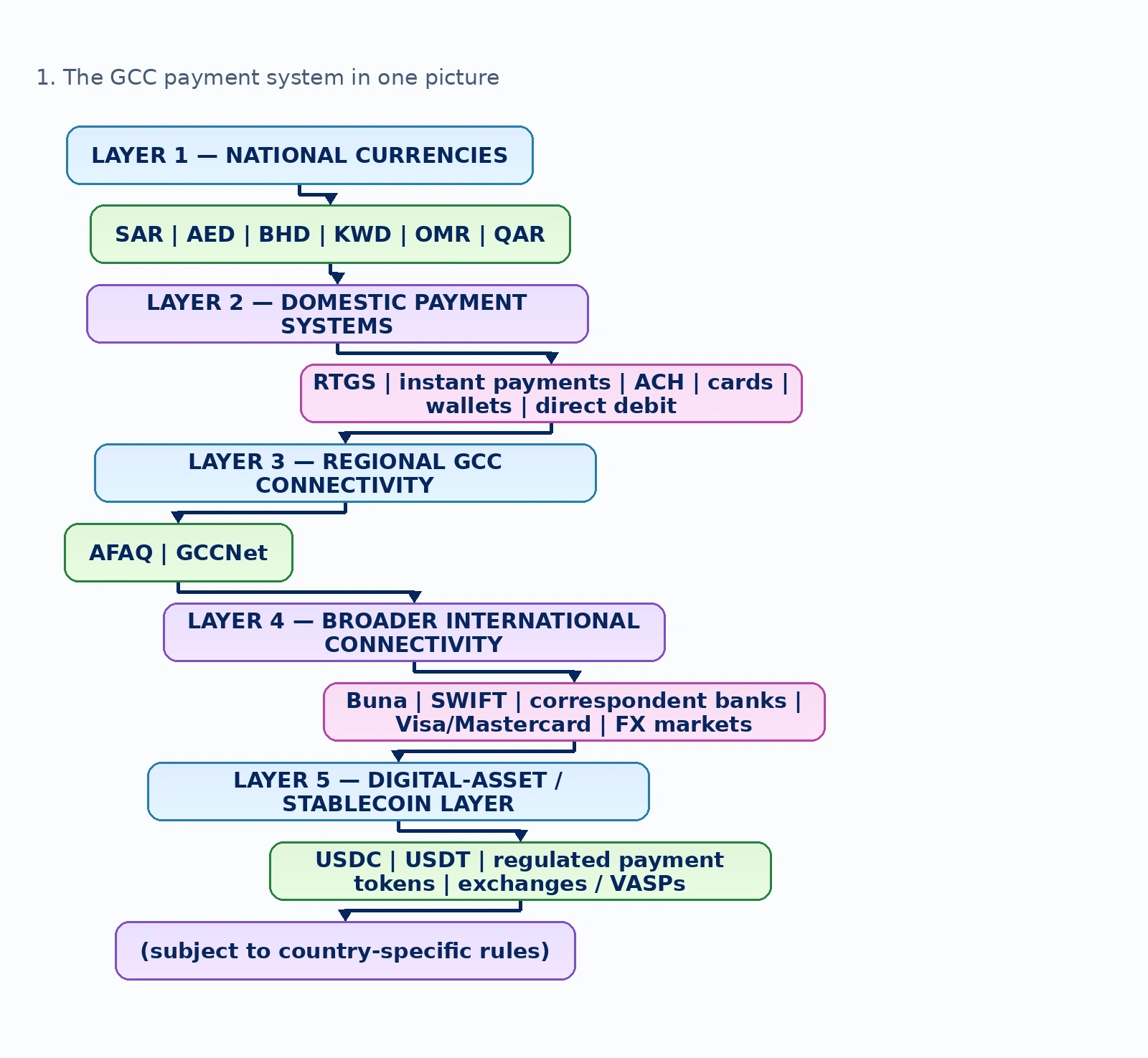
The mistake is to think the GCC has a single payments system.
It does not.
It has six domestic systems connected by regional and global infrastructure.
2. The six GCC currencies
Country | Currency | ISO code | Central bank | USD relationship |
|---|---|---|---|---|
Saudi Arabia | Saudi riyal | SAR | Saudi Central Bank (SAMA) | Fixed at SAR 3.75 per US$1 |
UAE | UAE dirham | AED | Central Bank of the UAE | Fixed around AED 3.6725 per US$1 |
Bahrain | Bahraini dinar | BHD | Central Bank of Bahrain | Fixed at about BHD 0.376 per US$1 |
Kuwait | Kuwaiti dinar | KWD | Central Bank of Kuwait | Managed against a weighted basket |
Oman | Omani rial | OMR | Central Bank of Oman | Fixed at US$2.6008 per OMR 1 |
Qatar | Qatari riyal | QAR | Qatar Central Bank | Fixed at QAR 3.64 per US$1 |
Five of the six currencies are directly anchored to the U.S. dollar.
Kuwait is the exception. The Kuwaiti dinar is managed against an undisclosed weighted basket of major currencies.
That distinction matters.
Read: GCC Currencies and the U.S. Dollar
3. Why the U.S. dollar is so important to GCC payments
The dollar matters for at least four reasons.
Currency policy
Five GCC currencies have a direct fixed relationship with USD.
Energy
A large share of hydrocarbon trade is historically denominated in dollars.
International trade
Many imports into the Gulf — machinery, electronics, commodities, technology and services — are priced in USD.
Global banking
GCC banks are deeply connected to the international USD correspondent-banking system.
This creates an unusual regional situation.
Even when two GCC companies trade with one another using SAR and AED, the economics of both currencies are already strongly connected to USD.
That is one reason local-currency inter-GCC settlement can be operationally attractive: it may avoid using USD as an unnecessary intermediary currency.
4. Domestic payments: each GCC country has its own infrastructure
Saudi Arabia
Important rails include:
SARIE RTGS for interbank settlement and high-value payments;
sarie instant payments for low-value transfers, available 24/7;
mada national card network;
SADAD bill payment.
Read: Saudi Arabia Payment System Explained
United Arab Emirates
Important rails include:
UAEFTS, the UAE RTGS;
Aani, the national instant-payment platform;
UAESWITCH;
UAE Direct Debit System;
UAE Payment Gateway System;
Jaywan domestic card scheme.
Read: UAE Payment System Explained
Bahrain
Important rails include:
CBB RTGS;
EFTS;
Fawri+ instant transfers;
Fawri deferred/batch transfers;
Fawateer bill payments;
BENEFIT infrastructure.
Read: Bahrain Payment System Explained
Kuwait
Important rails include:
KASSIP RTGS;
KNET retail/card infrastructure;
electronic cheque clearing;
regulated electronic payment providers.
Read: Kuwait Payment System Explained
Oman
Important rails include:
RTGS;
ACH;
OmanNet;
MPCSS / mobile payments;
electronic cheque clearing;
Maal national payment card.
Read: Oman Payment System Explained
Qatar
Important rails include:
QA-RTGS;
Fawran instant payments;
Qatar Mobile Payment (QMP);
NAPS;
QPay;
Tahweel.
Read: Qatar Payment System Explained
5. How an ordinary domestic GCC payment works
Suppose a Saudi company pays another Saudi company.
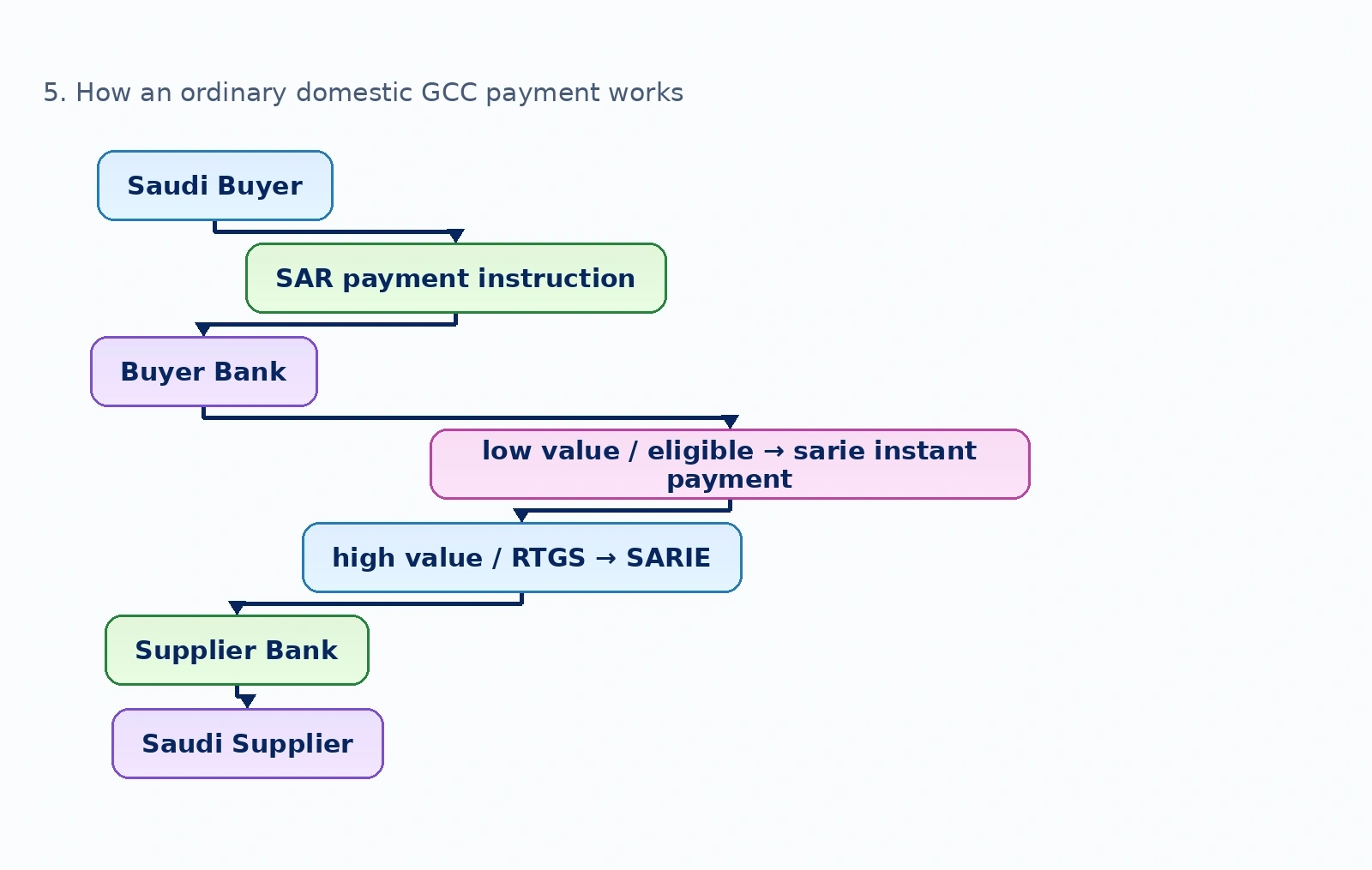
A UAE equivalent might use Aani for an eligible instant payment or UAEFTS for RTGS settlement.
The same concept exists across the GCC:
Domestic payment first enters the national payment infrastructure of that country.
6. How inter-GCC payments traditionally worked
Assume a Saudi company owes a UAE supplier.
One traditional structure is:
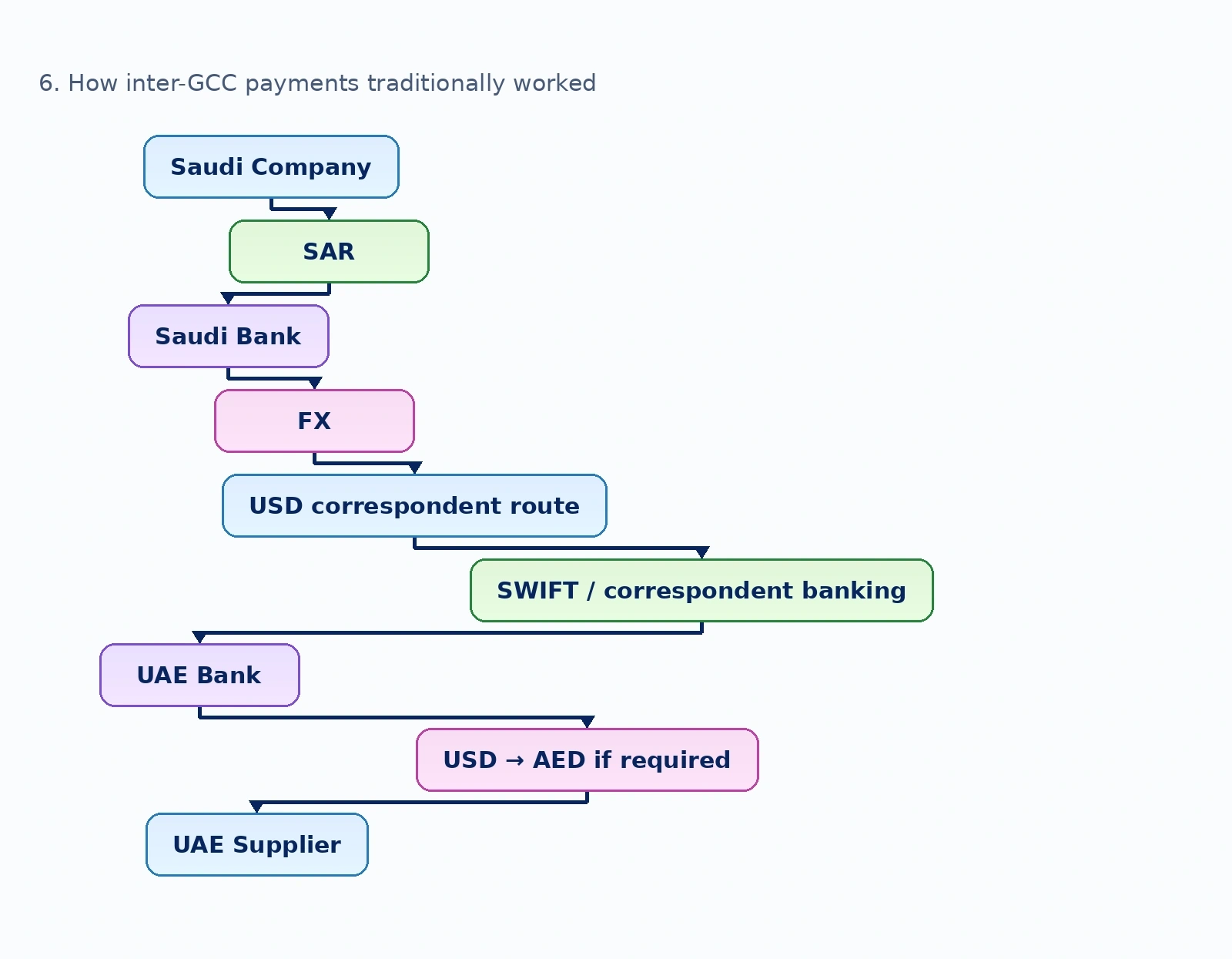
This works.
But it can introduce:
correspondent banks;
additional FX steps;
more fees;
longer chains;
cut-off times;
less pricing transparency.
The GCC therefore developed infrastructure specifically for regional payments.
7. AFAQ: the GCC's regional cross-border payment infrastructure
AFAQ stands for:
Arabian Gulf System for Financial Automated Quick Payment Transfer.
It is the GCC's regional cross-currency RTGS infrastructure.
It is operated by the Gulf Payments Company, which is owned by the GCC central banks.
AFAQ connects national payment infrastructure so participating banks can execute cross-border GCC payments in supported currencies.
The important idea is:
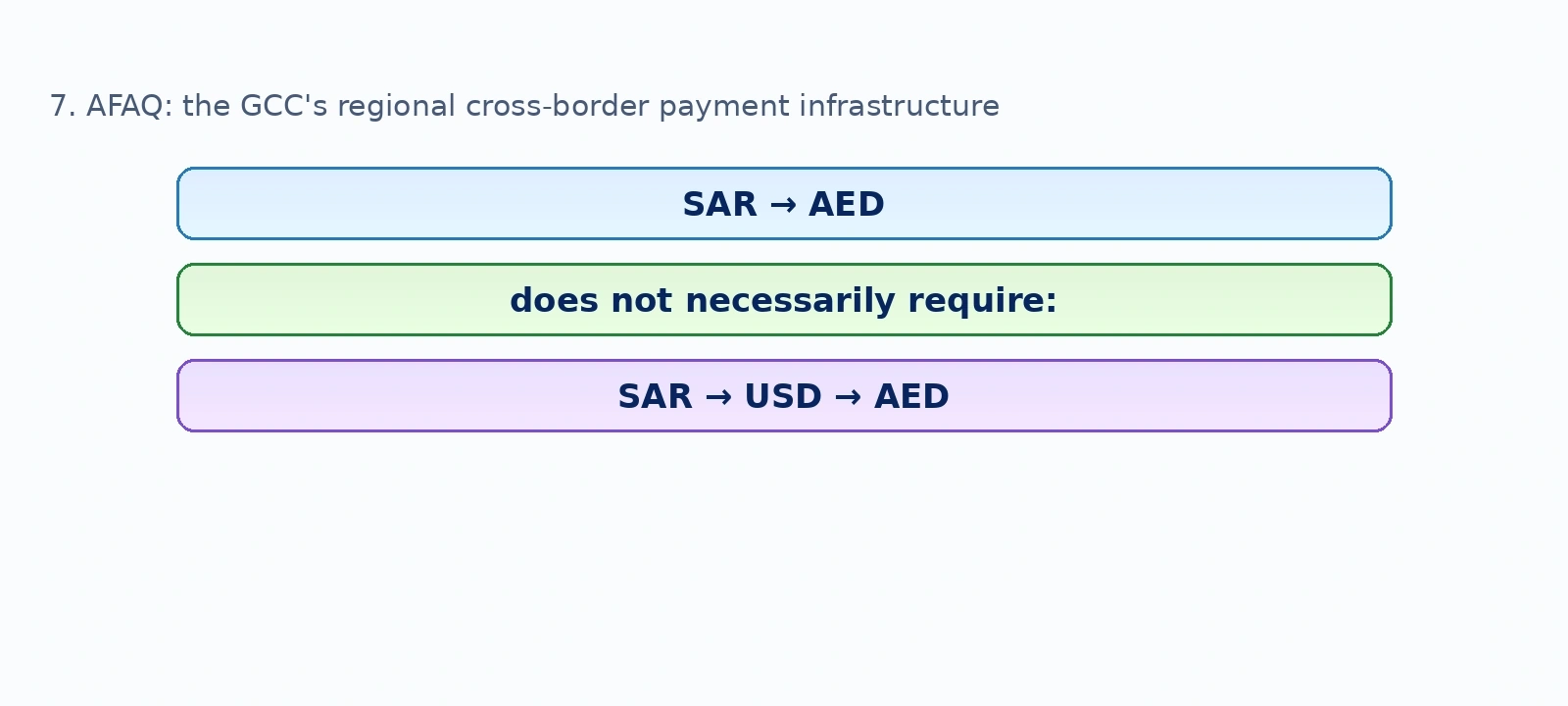
AFAQ can support a local-currency-to-local-currency structure.
Simplified Saudi → UAE AFAQ payment
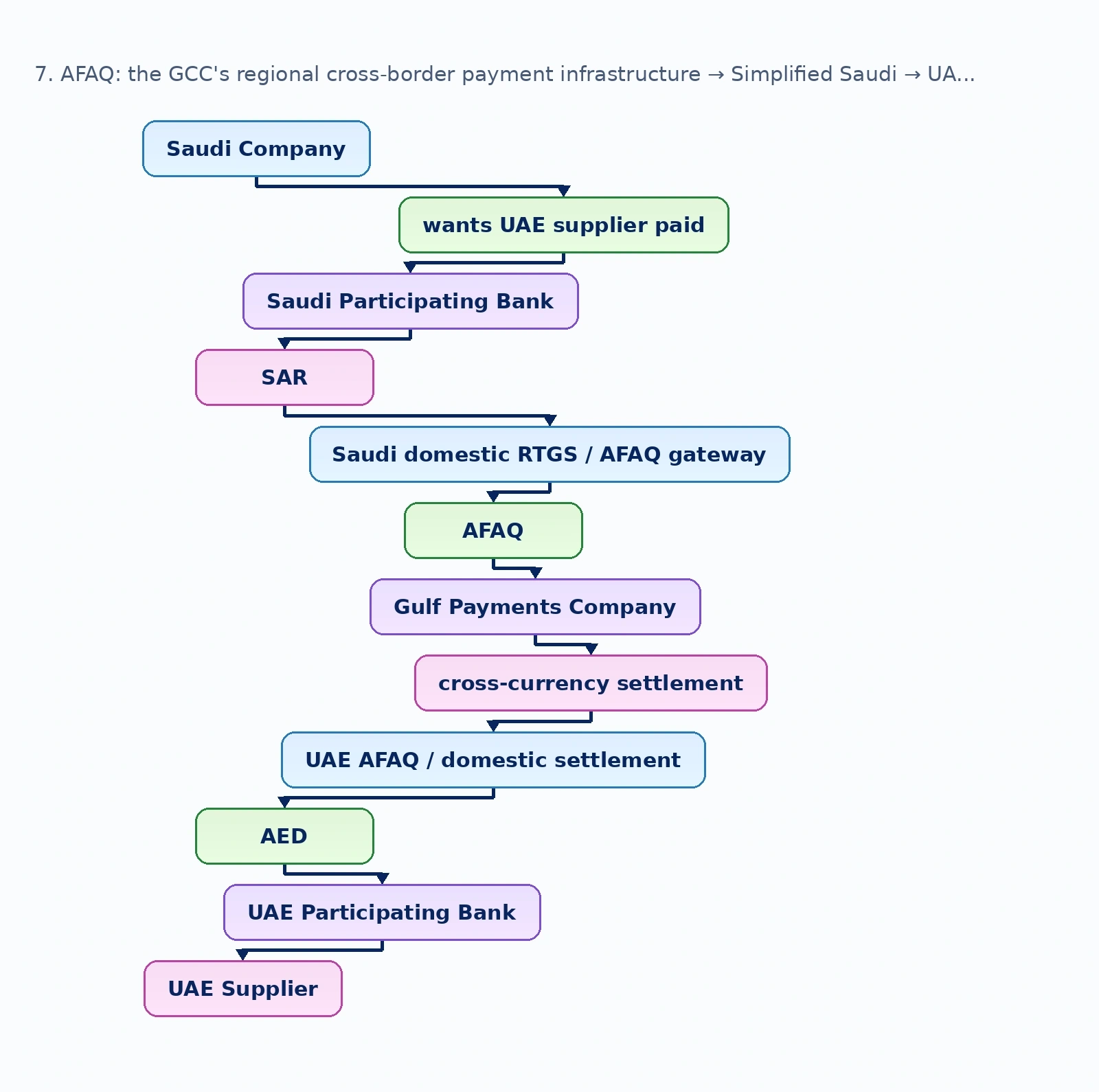
National central banks supply approved FX rates to AFAQ, and the system uses official daily rates for supported cross-currency transactions.
Read the full guide: AFAQ: How Inter-GCC Cross-Border Payments Work
8. Is AFAQ the same as SWIFT?
No.
This distinction is fundamental.
SWIFT is principally a global financial messaging network.
AFAQ is a regional GCC payment, clearing and settlement infrastructure.
AFAQ operates over its own private network and does not need SWIFT to process AFAQ payments.
A payment company or corporate should therefore not ask:
AFAQ or SWIFT — which messaging format is better?
The better question is:
Which settlement architecture will my bank use for this corridor?
Read: AFAQ vs Buna vs SWIFT
9. AFAQ versus Buna
Buna is the Arab Regional Payment System.
It is broader than the GCC.
Buna is designed as a multi-currency cross-border payment platform serving eligible financial institutions across the Arab region and beyond.
So:
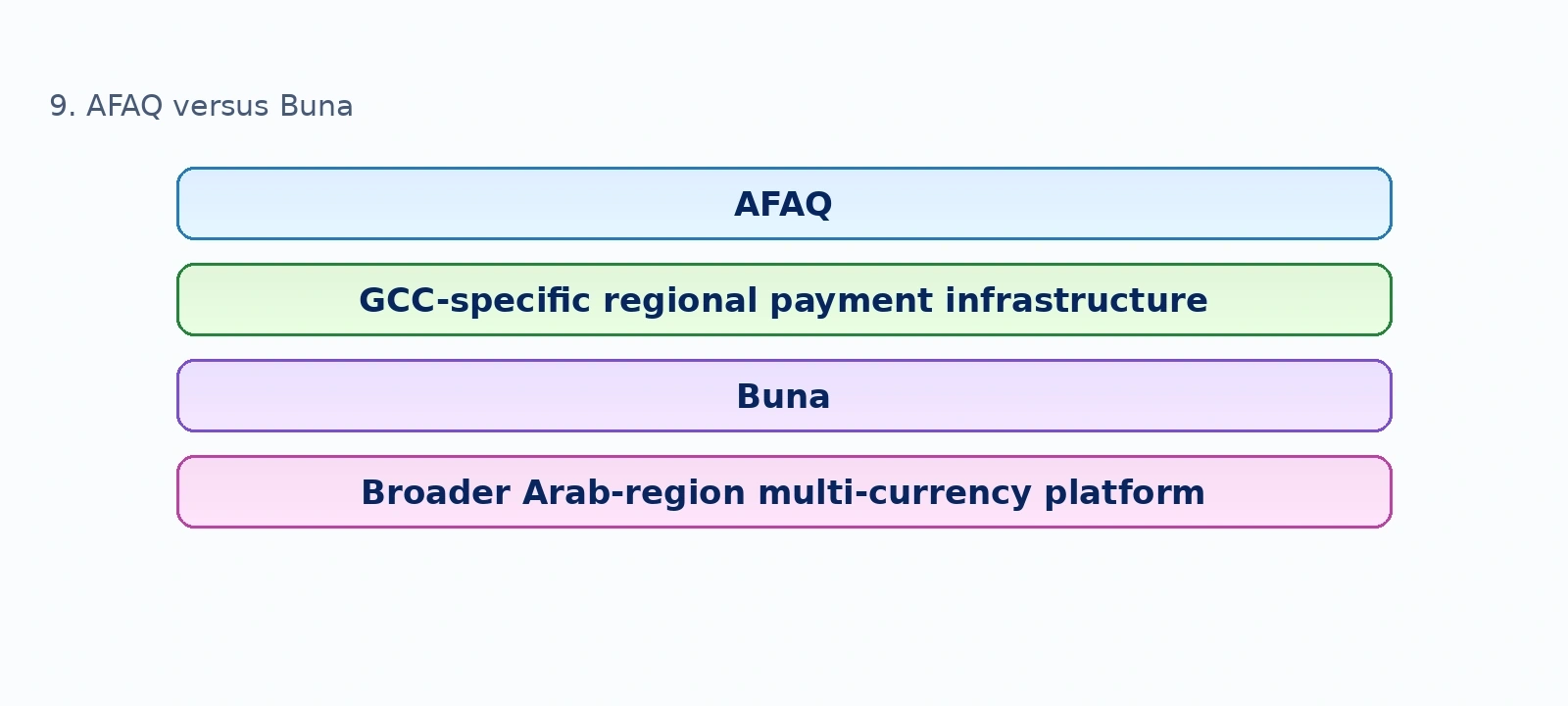
A GCC bank may potentially interact with more than one cross-border infrastructure depending on:
destination;
currency;
participant-bank coverage;
product;
commercial arrangements.
10. GCCNet: the retail/card layer
AFAQ is not the only regional GCC infrastructure.
GCCNet connects national ATM/card switches.
The national switches include systems such as:
mada in Saudi Arabia;
UAE Switch;
BENEFIT in Bahrain;
KNET in Kuwait;
OmanNet in Oman;
NAPS in Qatar.
Conceptually:
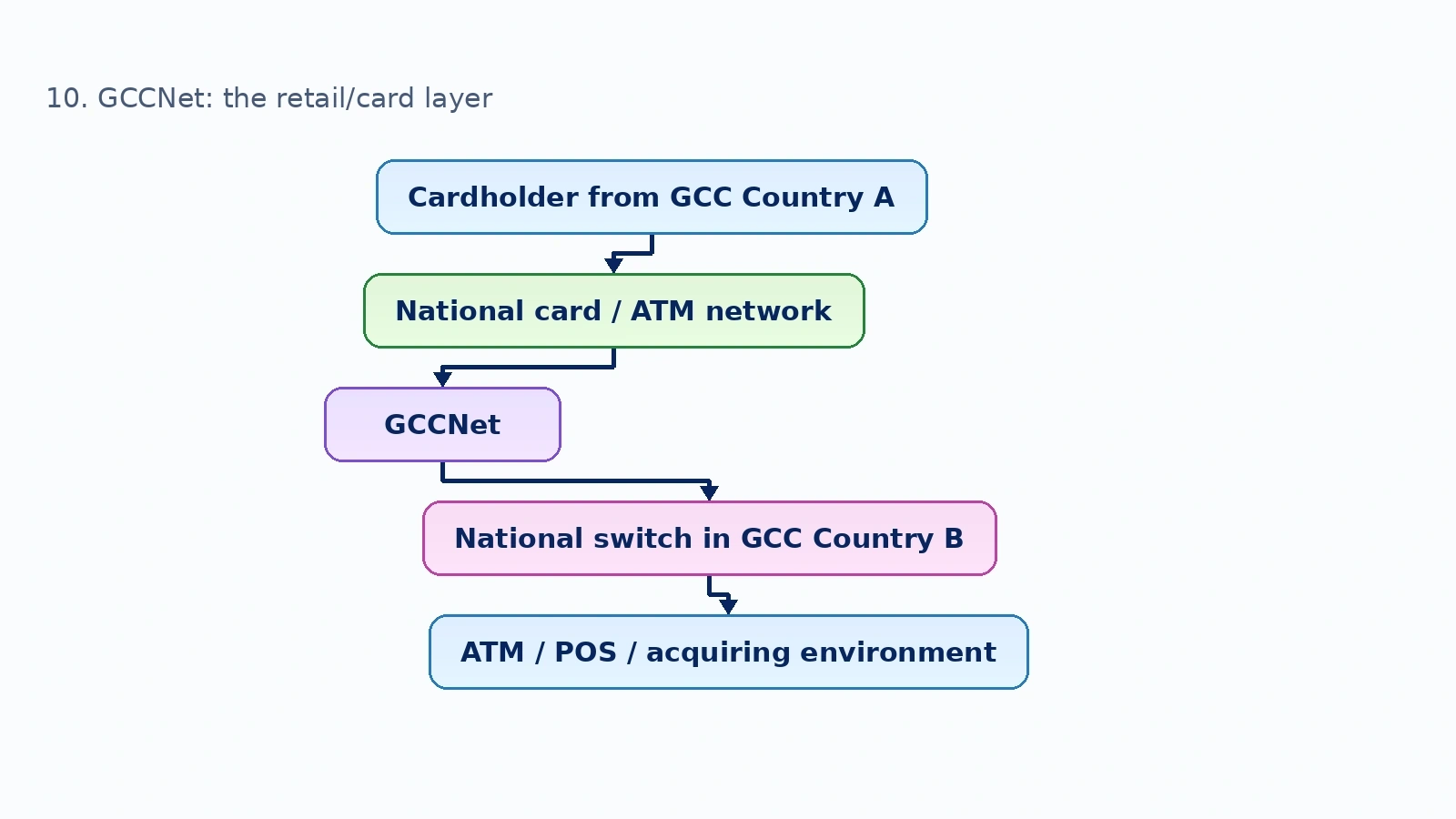
This is a retail-payment and card-interoperability layer.
It should not be confused with AFAQ's interbank cross-border RTGS role.
Read: GCCNet Explained
11. Stablecoins: USDC and USDT in GCC payment flows
Stablecoins introduce a completely different payment architecture.
A business can theoretically hold:
USDC;
USDT;
another USD-linked stablecoin;
and move value over blockchain rails.
But you cannot describe the GCC as having a single stablecoin payment regime.
It does not.
Conceptual stablecoin-funded payment
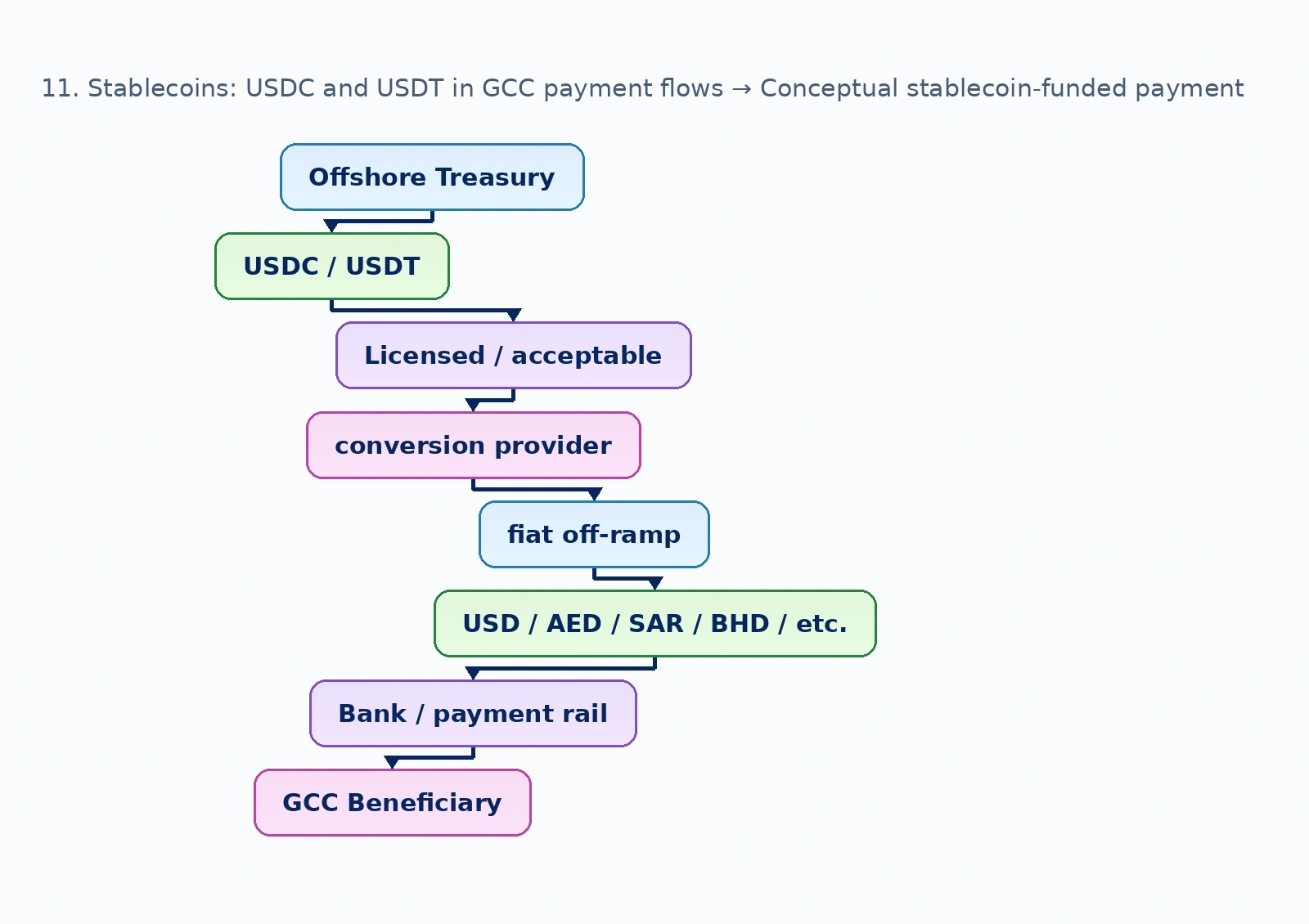
This is often the more defensible structure where stablecoins are used upstream for treasury, rather than automatically assuming a merchant can receive USDT directly as local payment.
12. Stablecoin regulation differs dramatically across the GCC
UAE
The UAE has an explicit Payment Token Services Regulation under the Central Bank.
The important nuance is that the onshore UAE framework distinguishes:
Dirham Payment Tokens; and
Foreign Payment Tokens.
Foreign payment tokens are subject to significant restrictions as a means of payment under the CBUAE framework.
This means:
USDC exists in the UAE crypto market
is not the same statement as:
Any UAE merchant can accept USDC for ordinary goods and services.
Those are legally different propositions.
Bahrain
Bahrain introduced an explicit stablecoin issuance framework in 2025.
Licensed issuers can issue fully backed single-currency stablecoins referencing:
BHD;
USD;
another fiat currency approved by the CBB.
This makes Bahrain one of the clearest GCC jurisdictions for regulated stablecoin issuance.
Kuwait
Kuwait takes a much more restrictive approach.
The CBK's 2023 circular prohibits the use of virtual assets as a payment instrument/means and prohibits licensed virtual-asset business under that framework.
Qatar
The QFC digital-asset framework explicitly treats cryptocurrencies and stablecoins used as substitutes for currency as Excluded Tokens. Earlier restrictions on those instruments remain relevant.
Qatar is separately experimenting with wholesale CBDC technology through the Qatar Central Bank.
Saudi Arabia
Saudi authorities have historically warned that virtual currencies are not recognized as legal currency and are outside the conventional local financial-institution framework.
A company should therefore not treat USDC/USDT as a standard SAR payment rail without specific regulatory and banking analysis.
Oman
Oman has established registration and AML/CFT requirements for virtual-asset service providers through its financial-sector authorities, while the broader virtual-asset regulatory framework has continued to develop.
Again, VASP regulation does not automatically mean that a stablecoin becomes ordinary legal tender for every commercial payment.
Read: Stablecoin Payments in the GCC: USDC, USDT and Regulation
13. Why stablecoins are commercially interesting in the GCC anyway
Even with the regulatory differences, stablecoins can be relevant for:
24/7 treasury movement;
digital-asset businesses;
offshore treasury;
settlement between regulated counterparties;
moving USD-linked value before fiat conversion;
cross-border corporate treasury;
trade settlement experiments;
tokenized deposits and CBDC-related infrastructure.
Their value proposition is generally strongest where the legal, banking and off-ramp architecture is designed first.
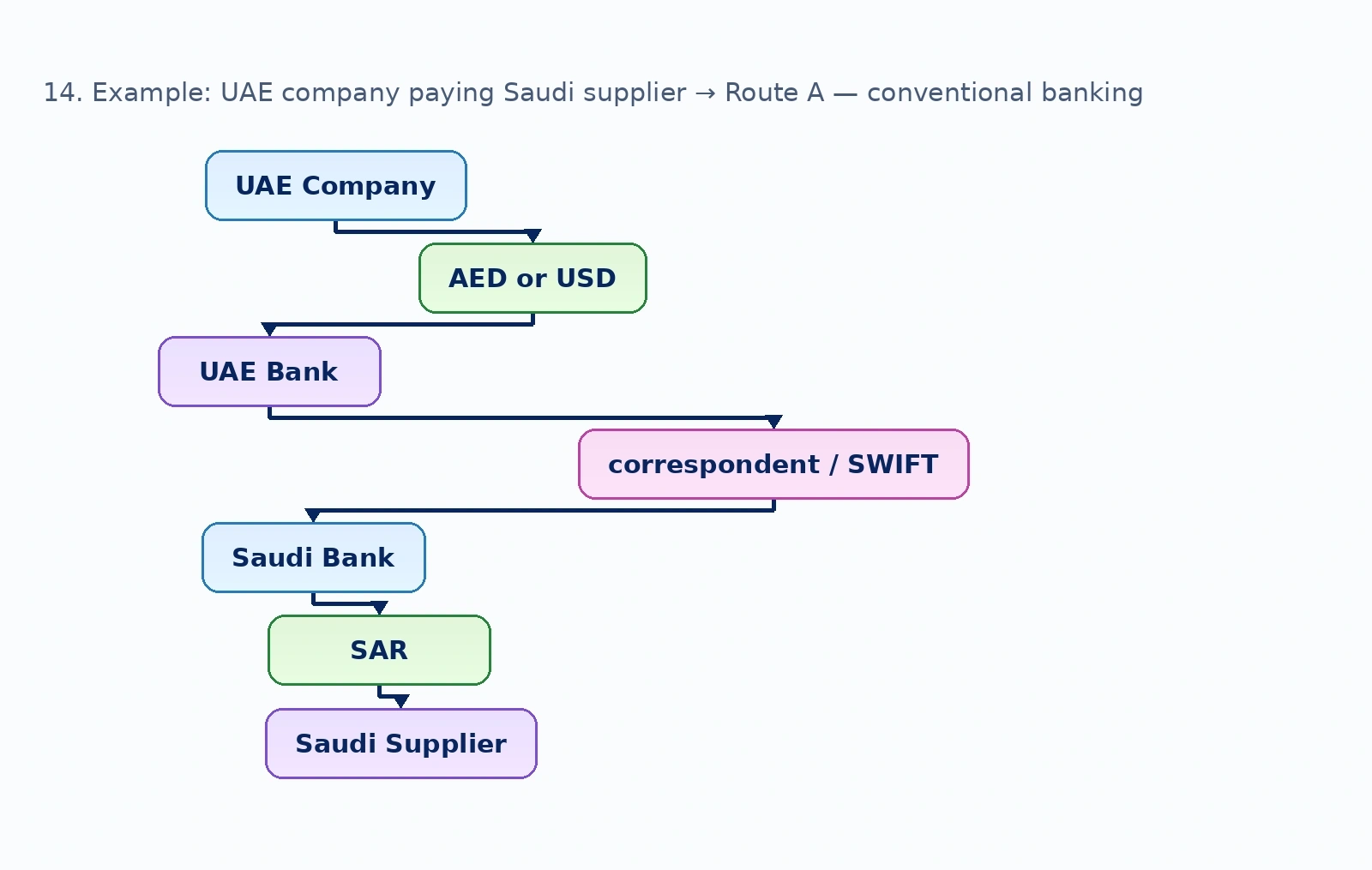
14. Example: UAE company paying Saudi supplier
Route A — conventional banking
Route B — AFAQ
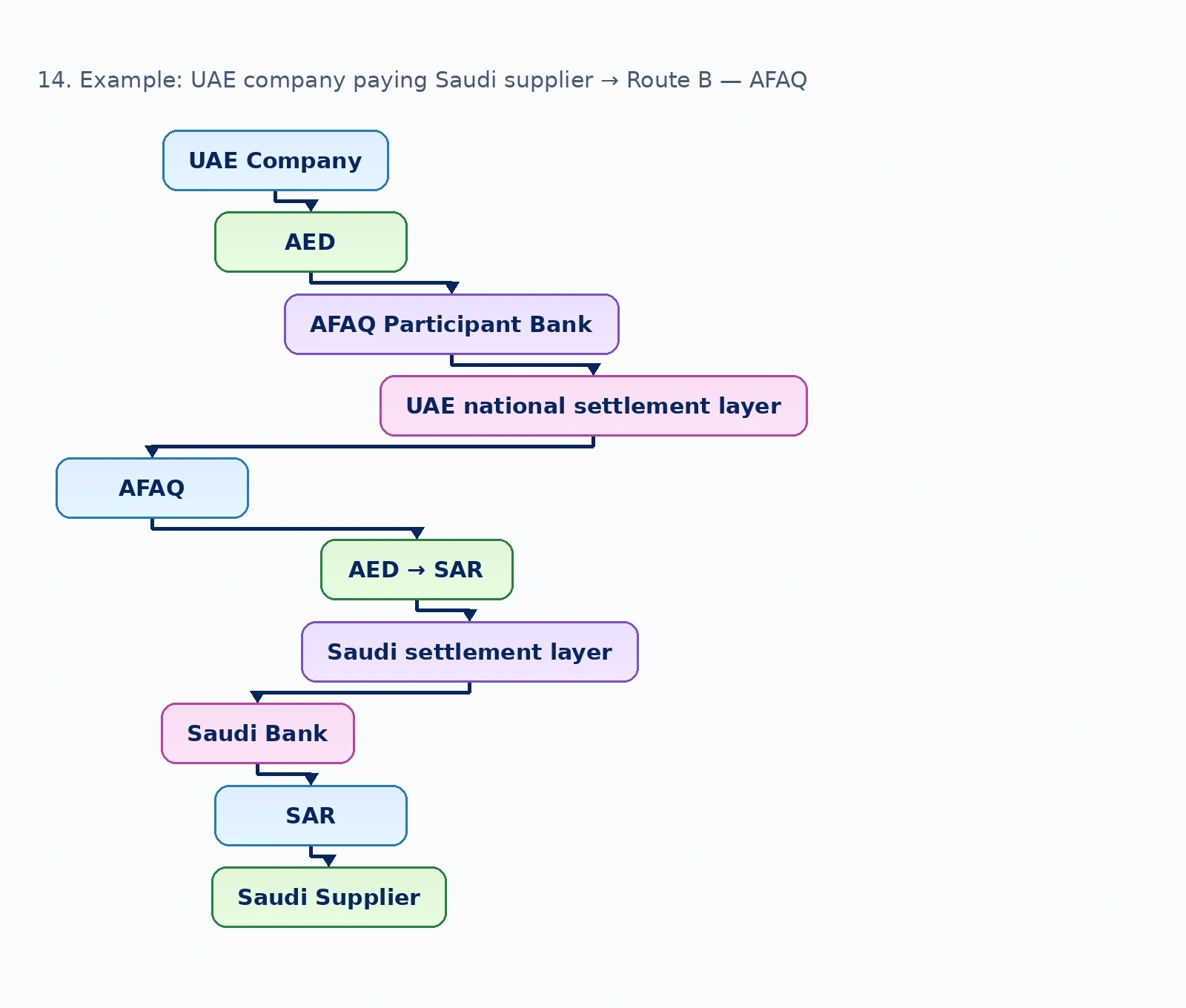
Route B can reduce reliance on an external intermediary currency.
Actual bank availability, fees and FX quotations still matter.
15. Example: stablecoin-funded UAE → Bahrain payment
A conceptual compliant structure might be:
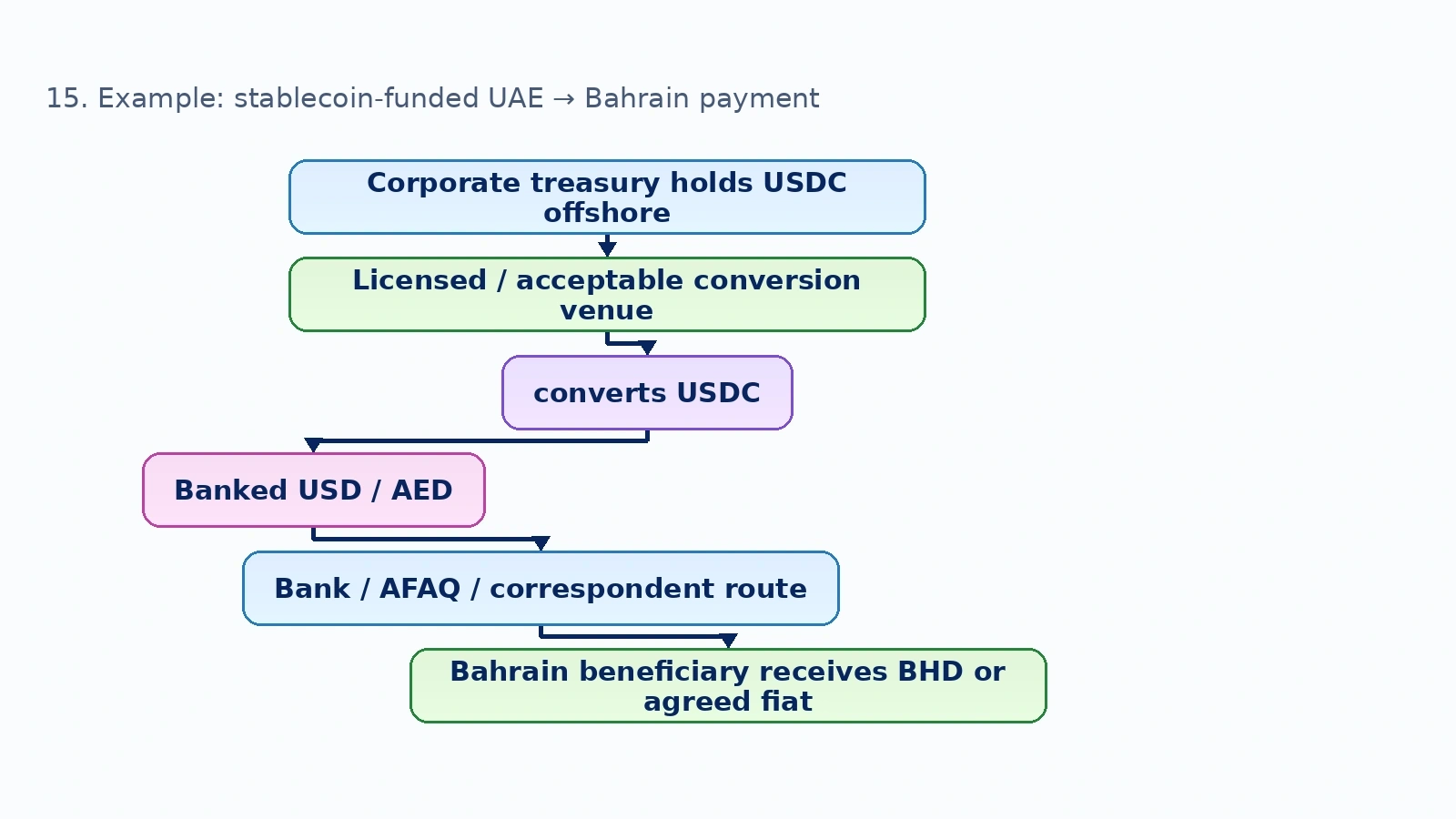
The important distinction is:
The stablecoin may fund the payment architecture without necessarily being the final merchant settlement asset.
16. What about remittances?
The GCC is one of the world's largest outbound remittance regions.
Retail remittances may use:
banks;
exchange houses;
licensed remittance providers;
digital wallets;
international MTOs;
correspondent-bank networks;
regional payment infrastructure where supported.
The optimal rail depends strongly on destination.
A GCC-to-GCC payment is structurally different from:
UAE → India;
Saudi Arabia → Pakistan;
Qatar → Philippines;
Kuwait → Egypt.
AFAQ is specifically designed around GCC regional connectivity.
17. What about business payments outside the GCC?
For GCC → Europe, Asia, Africa or the Americas, businesses typically continue to use:
SWIFT;
correspondent banking;
bank FX;
trade finance;
card networks;
payment institutions;
regulated cross-border PSPs;
potentially Buna for eligible routes/currencies;
stablecoin-funded structures where legally and operationally permissible.
There is no one universal GCC outbound rail.
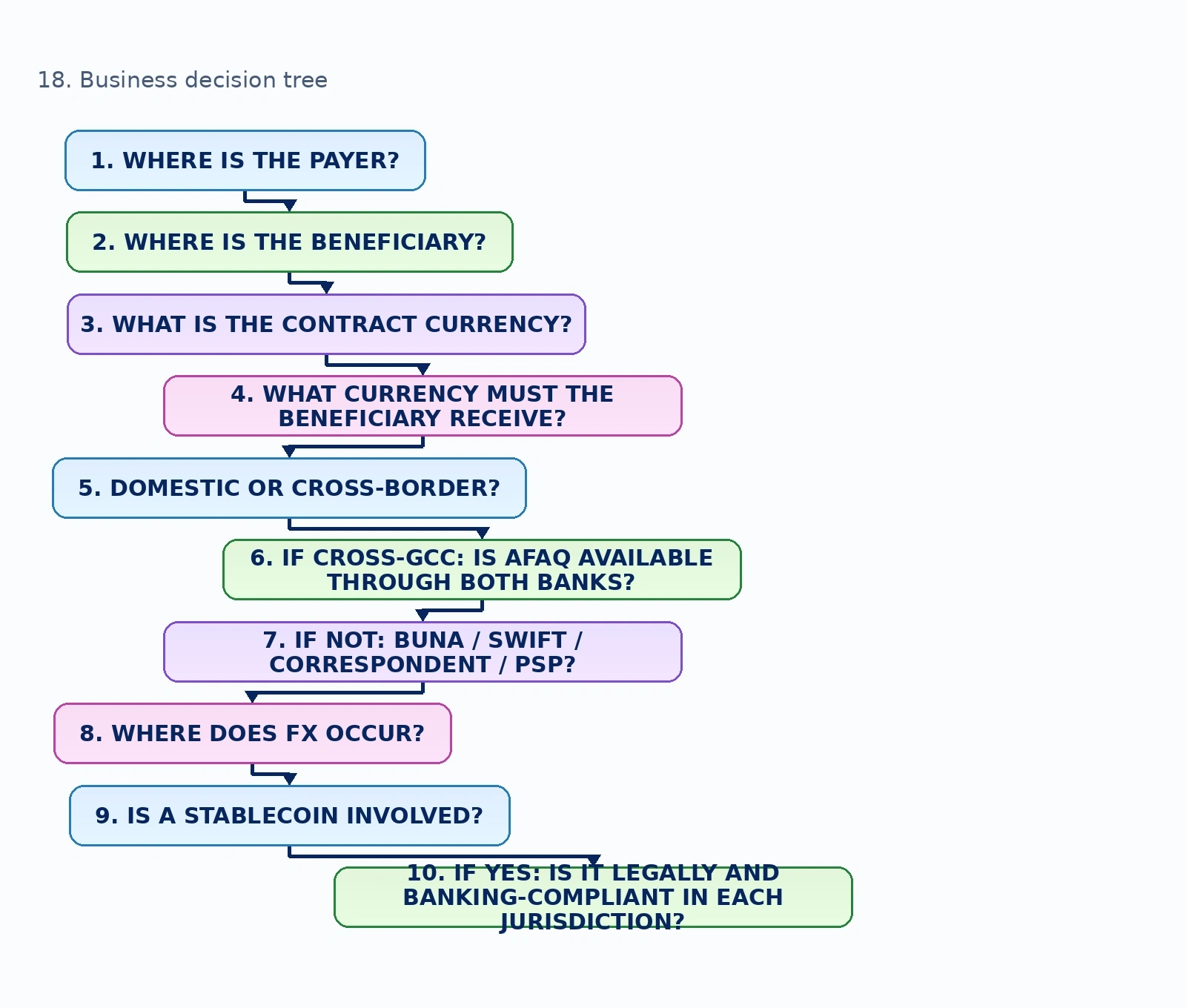
18. Business decision tree
If you need to move money involving a GCC country, ask these questions in order:
19. GCC payment-system comparison
Country | Currency | RTGS / wholesale | Instant / retail highlights | Regional layer |
|---|---|---|---|---|
Saudi Arabia | SAR | SARIE | sarie, mada, SADAD | AFAQ, GCCNet |
UAE | AED | UAEFTS | Aani, UAESWITCH, Jaywan | AFAQ, GCCNet, Buna |
Bahrain | BHD | CBB RTGS | Fawri+, Fawri, Fawateer, BENEFIT | AFAQ, GCCNet |
Kuwait | KWD | KASSIP | KNET and electronic payment rails | AFAQ, GCCNet |
Oman | OMR | RTGS | ACH, OmanNet, MPCSS, Maal | AFAQ, GCCNet |
Qatar | QAR | QA-RTGS | Fawran, QMP, NAPS, QPay | AFAQ, GCCNet |
20. What makes the GCC structurally unusual?
The GCC has a combination that very few regions share:
multiple sovereign states;
multiple sovereign currencies;
strong USD anchoring;
high bank penetration;
sophisticated national RTGS systems;
fast adoption of instant payments;
deep international banking connectivity;
regional ATM/card interoperability;
a purpose-built inter-GCC RTGS;
emerging regulated stablecoin frameworks in some member states.
This means the region is moving toward payment interoperability without requiring a single common currency.
That is the strategic point.
21. Frequently asked questions
Does the GCC have one currency?
No. Each member state has its own currency.
Is there a GCC euro-style common currency?
Not currently.
What is AFAQ?
AFAQ is the GCC's regional cross-currency RTGS infrastructure operated by Gulf Payments Company.
Can I send SAR and have the recipient receive AED?
Potentially, yes, through participating AFAQ banks and supported services.
Does AFAQ use SWIFT?
Gulf Payments Company states that AFAQ uses its own private network rather than SWIFT for AFAQ payment processing.
Is AFAQ available through every GCC bank?
No. Participant coverage must be checked. The system continues onboarding commercial banks and financial institutions.
Is QAR part of AFAQ?
Qatar Central Bank joined AFAQ on September 7, 2026. Because bank-level onboarding and service availability can lag central-bank participation, confirm current QAR corridor availability with the participating bank.
Are all GCC currencies pegged to USD?
Five have direct fixed or closely fixed USD links. Kuwait manages KWD against a weighted basket.
Can I pay any GCC merchant with USDC or USDT?
No. Stablecoin treatment is jurisdiction-specific and can be restrictive.
Are USDC and USDT legal tender?
No. They are privately issued USD-linked digital assets, not GCC sovereign legal tender.
Is a USD stablecoin economically useful when GCC currencies are already dollar-pegged?
Potentially. Its advantage is generally around 24/7 blockchain settlement and treasury movement, not eliminating FX risk against a currency already closely linked to USD.
Related GCC payment primers
Start With the Flow of Funds
For a GCC payment project, the fastest way to identify the right architecture is to draw the flow of funds:
payer → payer bank/PSP → originating currency → FX point → domestic/regional/international rail → receiving bank/PSP → beneficiary currency → beneficiary.
Once that diagram exists, questions around licensing, banking, AFAQ participation, FX, stablecoins, settlement and compliance become much easier to answer.
Authoritative sources and update date
Research updated: September 16, 2026.
This content is designed as an explainer. Payment availability, participant-bank coverage, cut-off times, fees, FX spreads, stablecoin treatment, and licensing requirements can change. For an actual transaction, confirm the current position with the relevant central bank, payment-system operator, sending institution and receiving institution.