
Part of our POBO & COBO Solutions guide.
The Problem
Cross-border POBO and COBO need more than a bank account. The payment message has to preserve enough information for banks, beneficiaries, compliance systems, and reconciliation processes to understand both the account owner and underlying economic party.
The correct design starts with the flow of funds: who owns the funds, who owes or is owed money, who owns the external bank account, what the relationship is between the parties, and whether the underlying parties are related group companies or external customers.
Typical Flow
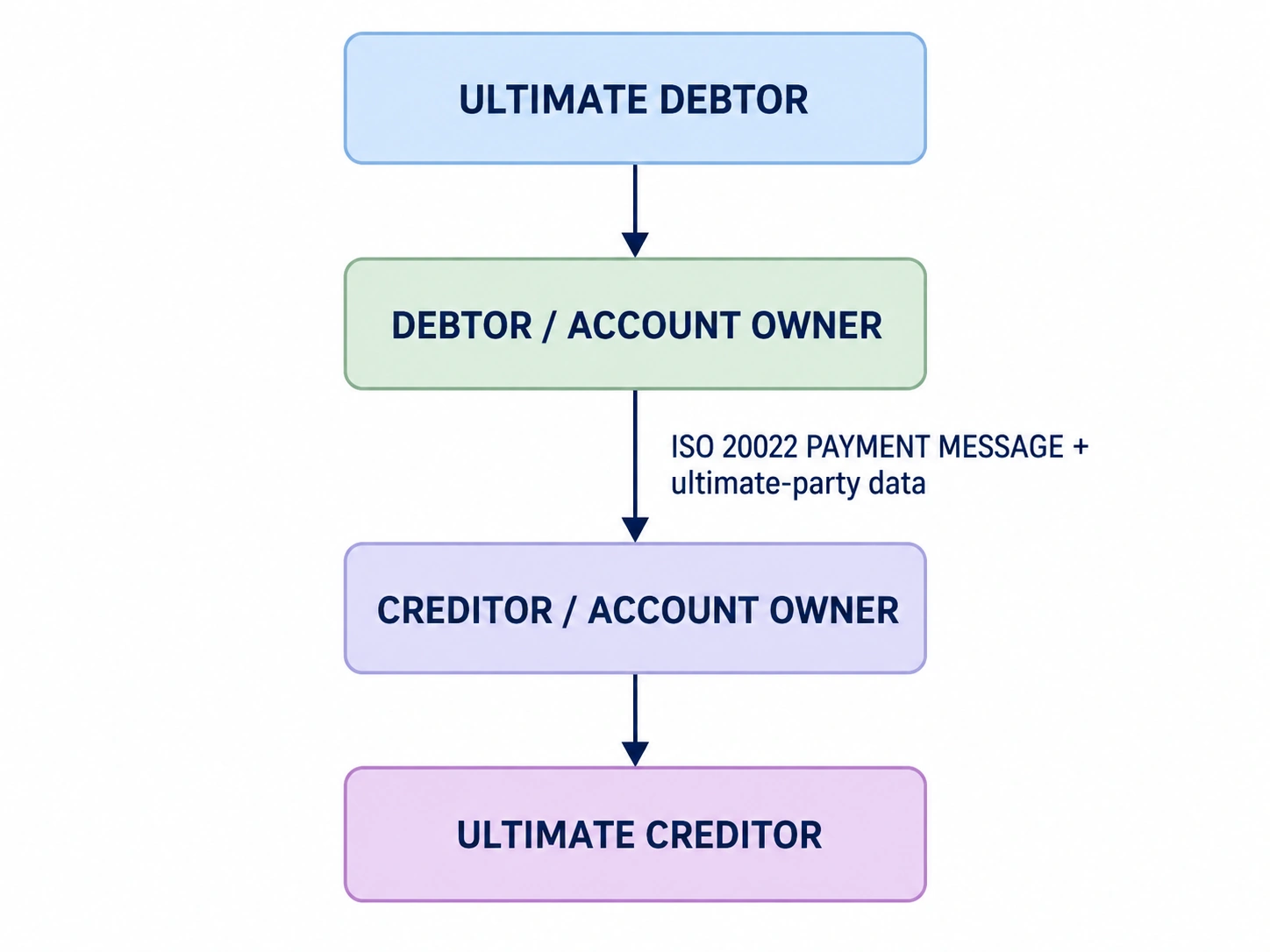
The diagram is intentionally generic. Actual implementation depends on the legal entities, jurisdictions, bank/provider rules, payment rails, currencies, licensing status, and reconciliation model.
ISO 20022 Ultimate Parties
Structured ultimate-debtor and ultimate-creditor data can represent the economic parties separately from the account owners.
SWIFT and Correspondent Banking
Cross-border payments may pass through intermediaries, so data quality and provider support matter.
Reconciliation
Structured remittance and party data can reduce manual investigation when the payer name differs from the entity on the underlying invoice.
Core Design Questions
- Who is the legal account owner?
- Who is the economic owner of the funds?
- Who is the debtor and who is the ultimate debtor?
- Who is the creditor and who is the ultimate creditor?
- Are the underlying parties related companies or external customers?
- Which countries and currencies are involved?
- Which rails are required?
- What monthly volume and transaction count are expected?
- Is a named, virtual, pooled, FBO, or safeguarded account required?
- Who performs KYC/KYB, sanctions screening, and transaction monitoring?
- How will the internal ledger and reconciliation work?
What We Can Help With
We can help map the transaction, identify the appropriate banking/payment architecture, determine what type of provider is required, prepare the provider-facing flow of funds, and source or introduce suitable banks, PSPs, MSBs, or program partners where there appears to be a fit.
Frequently Asked Questions
Does ISO 20022 automatically make POBO compliant?
No. It improves data representation; the legal, regulatory, and bank-approval questions remain.
Do beneficiaries always see the ultimate debtor?
Presentation depends on the payment chain and receiving institution.
Related POBO / COBO Pages
- POBO & COBO Solutions
- POBO & COBO Compliance: Ultimate Debtor, Ultimate Creditor, and Payment Transparency
- POBO for Corporate Treasury and Multinational Groups
- POBO & COBO Account Structures: Named, Virtual, FBO, and Pooled Accounts
- POBO & COBO Implementation Checklist
Related Services
Get Help Designing This Structure
Send us your entity chart and flow of funds. If you do not have a diagram, describe who pays, who receives, who owns each account, what the underlying obligation is, and where the money ultimately goes.