
Part of our POBO & COBO Solutions guide.
The Problem
POBO/COBO projects fail when teams choose a bank or technology provider before resolving entity relationships, account ownership, underlying-party data, legal authority, ledgering, reconciliation, and licensing.
The correct design starts with the flow of funds: who owns the funds, who owes or is owed money, who owns the external bank account, what the relationship is between the parties, and whether the underlying parties are related group companies or external customers.
Typical Flow
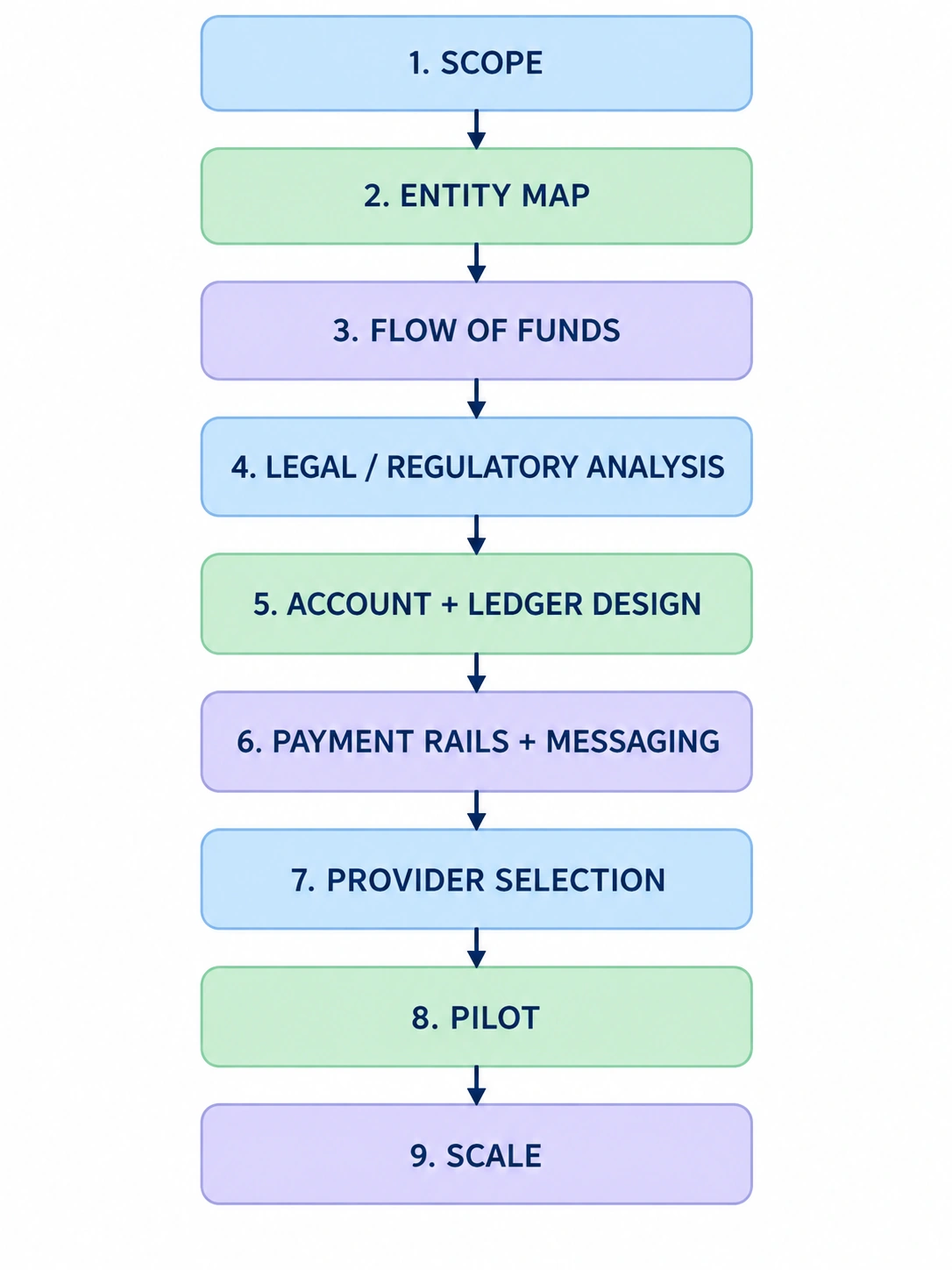
The diagram is intentionally generic. Actual implementation depends on the legal entities, jurisdictions, bank/provider rules, payment rails, currencies, licensing status, and reconciliation model.
Entity and Contract Checklist
List every legal entity, relationship, invoice owner, debtor, creditor, account owner, and authority to pay or collect.
Banking Checklist
Define currencies, countries, account ownership, named/virtual/FBO needs, rails, volumes, and transaction sizes.
Data and Reconciliation Checklist
Define ultimate-party fields, remittance data, virtual-account mapping, ledger entries, reconciliation frequency, exceptions, and audit trails.
Compliance Checklist
Define KYC/KYB responsibilities, sanctions screening, AML monitoring, licensing status, safeguarding, and provider oversight.
Core Design Questions
- Who is the legal account owner?
- Who is the economic owner of the funds?
- Who is the debtor and who is the ultimate debtor?
- Who is the creditor and who is the ultimate creditor?
- Are the underlying parties related companies or external customers?
- Which countries and currencies are involved?
- Which rails are required?
- What monthly volume and transaction count are expected?
- Is a named, virtual, pooled, FBO, or safeguarded account required?
- Who performs KYC/KYB, sanctions screening, and transaction monitoring?
- How will the internal ledger and reconciliation work?
What We Can Help With
We can help map the transaction, identify the appropriate banking/payment architecture, determine what type of provider is required, prepare the provider-facing flow of funds, and source or introduce suitable banks, PSPs, MSBs, or program partners where there appears to be a fit.
Frequently Asked Questions
What should be built first?
The entity map and flow of funds. Technology and provider selection should follow.
Should we pilot one country first?
Often yes. A controlled pilot can validate payment messaging, reconciliation, beneficiary acceptance, and operational controls before scaling.
Related POBO / COBO Pages
- POBO & COBO Solutions
- POBO vs. COBO: What Is the Difference?
- POBO & COBO Account Structures: Named, Virtual, FBO, and Pooled Accounts
- POBO & COBO Compliance: Ultimate Debtor, Ultimate Creditor, and Payment Transparency
- POBO & COBO With SWIFT and ISO 20022
Related Services
Get Help Designing This Structure
Send us your entity chart and flow of funds. If you do not have a diagram, describe who pays, who receives, who owns each account, what the underlying obligation is, and where the money ultimately goes.