
Part of our POBO & COBO Solutions guide.
The Problem
COBO exists when one entity receives funds that are economically due to another entity. In a corporate group, a treasury or shared-service entity may receive customer payments for subsidiaries. In a platform model, a PSP may collect money for merchants or clients.
The commercial convenience is similar. The legal and regulatory treatment may be very different.
The correct design starts with the flow of funds: who owns the funds, who owes or is owed money, who owns the external bank account, what the relationship is between the parties, and whether the underlying parties are related group companies or external customers.
Typical Flow
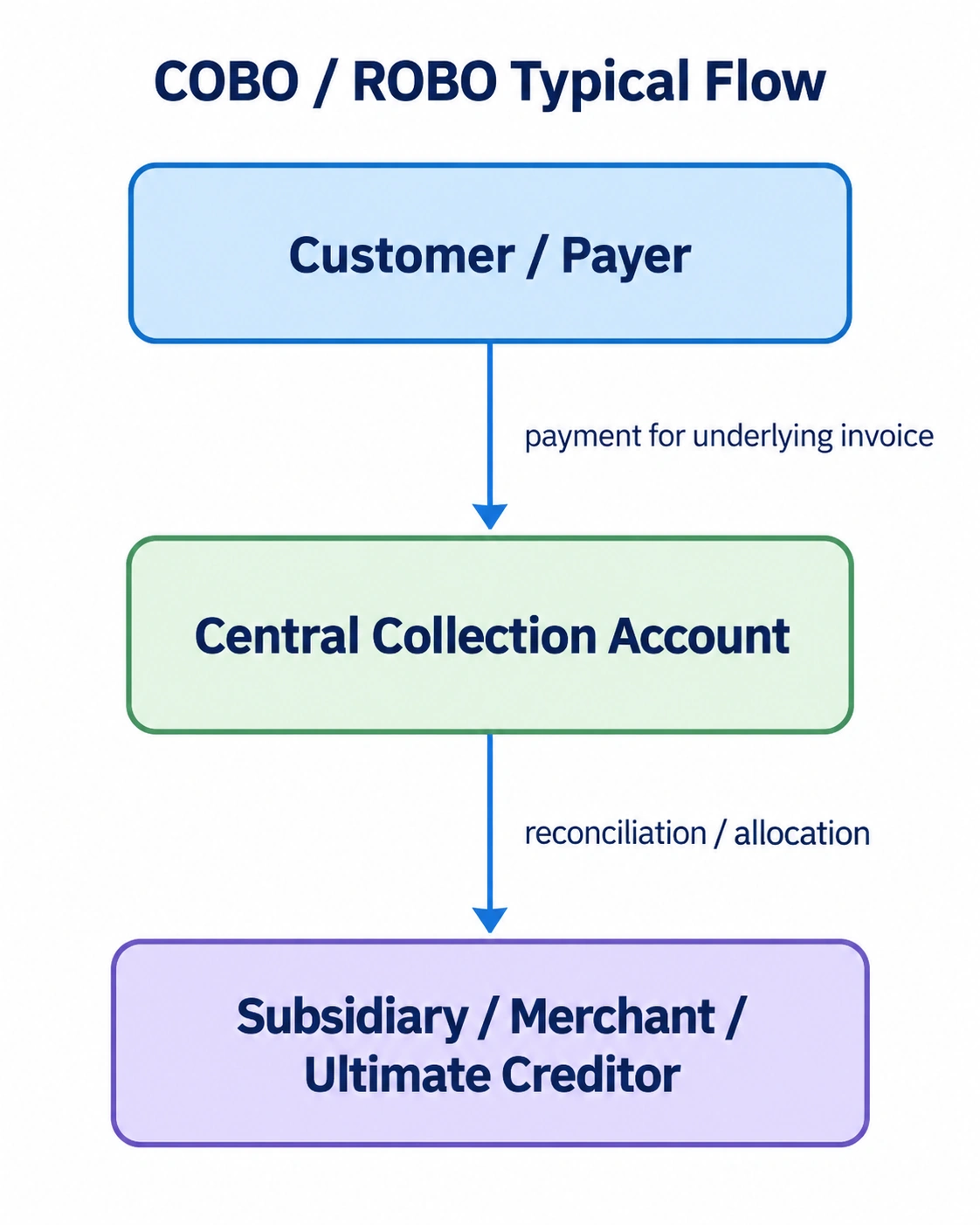
The diagram is intentionally generic. Actual implementation depends on the legal entities, jurisdictions, bank/provider rules, payment rails, currencies, licensing status, and reconciliation model.
COBO in Corporate Treasury
A central collection entity receives customer payments and allocates them internally to the subsidiary that owns the receivable.
COBO for Platforms
A platform collecting for unrelated merchants can enter payment-service, safeguarding, settlement, and licensing territory.
Virtual Accounts
Unique virtual accounts or references can identify the correct underlying entity while funds settle into a central physical account.
Core Design Questions
- Who is the legal account owner?
- Who is the economic owner of the funds?
- Who is the debtor and who is the ultimate debtor?
- Who is the creditor and who is the ultimate creditor?
- Are the underlying parties related companies or external customers?
- Which countries and currencies are involved?
- Which rails are required?
- What monthly volume and transaction count are expected?
- Is a named, virtual, pooled, FBO, or safeguarded account required?
- Who performs KYC/KYB, sanctions screening, and transaction monitoring?
- How will the internal ledger and reconciliation work?
What We Can Help With
We can help map the transaction, identify the appropriate banking/payment architecture, determine what type of provider is required, prepare the provider-facing flow of funds, and source or introduce suitable banks, PSPs, MSBs, or program partners where there appears to be a fit.
Frequently Asked Questions
Is COBO the same as ROBO?
The terms overlap. ROBO means Receivables On Behalf Of and is often used for centralized receivables structures.
Can COBO reduce bank accounts?
Yes, particularly in corporate treasury, where collections can be concentrated into fewer external accounts.
Does COBO create third-party-funds risk?
It can. The answer depends on who legally owns the receivable, who owns the account, and whether the underlying parties are related companies or external customers.
Related POBO / COBO Pages
- POBO & COBO Solutions
- POBO vs. COBO: What Is the Difference?
- COBO for Corporate Treasury and Multinational Groups
- COBO for PSPs, Marketplaces, and Payment Platforms
- POBO & COBO Account Structures: Named, Virtual, FBO, and Pooled Accounts
Related Services
Get Help Designing This Structure
Send us your entity chart and flow of funds. If you do not have a diagram, describe who pays, who receives, who owns each account, what the underlying obligation is, and where the money ultimately goes.